
How profitable is a Mallorca boat charter business?
Buying a sailing boat in Mallorca and financing it through charter income sounds appealing, but the advertised daily rate alone does not determine whether renting out a boat makes financial sense. What matters is how many days are actually booked, how much remains after the agent’s commission, and the costs you incur even when there are no guests. There is also a question you should not put off: whether your particular boat can be rented out, and under what conditions. This guide separates published charter prices from a reported individual example and shows you how to put together a simple revenue calculation. You will also learn why the costs of a privately used boat cannot simply be applied to a charter operation, which assumptions in a return calculation are especially prone to optimism, and what you should establish before deciding to buy. Advertised prices cannot tell you what return you will earn – but they can help you make a better-informed decision.

Is renting out a boat in Mallorca a good business?
A boat rental business involves making a boat available for individual days or longer trips in return for payment. In Mallorca’s listings, you will find sailing boats with and without a skipper. Owners can take on different roles: they can organise the operation themselves or leave the marketing to a charter company. You need to establish before buying which option is permitted and practical for the particular boat.

Chartering only makes financial sense if the revenue actually earned leaves enough margin after agency fees and ongoing costs. A booking at a high price is no substitute for a good occupancy rate; conversely, plenty of bookings at a low price will not necessarily cover upkeep. If you are still weighing up boat types and sizes, start with the right size of sailing boat – not the highest advertised charter price.
Which charter prices should you use in your calculations?
Published rental prices are a guide, not a promise of income to the owner. Even the figures below vary considerably. Only compare offers for the same rental period, and check whether a skipper is included or costs extra.
| Indicative prices quoted for sailing boats | Amount | What it represents |
|---|---|---|
| Click&Boat, daily charter | €250–500 per day | Without a skipper |
| Click&Boat, longer trip | €1,300–2,100 per week | Published range of advertised prices |
| Nautal, weekly charter | from €2,000 per week | Starting price, not an average |
Click&Boat cites factors including the season, boat type and age as influences on price. Nautal also lists length, year of construction, number of cabins and rental duration. You therefore cannot simply calculate a weekly rate by multiplying a daily rate by the number of charter days.
Note: These providers’ prices are examples, not a basis for forecasting income. Disclosure: mallorca.com, which publishes this guide, also offers Yacht charter in Mallorca.
How to calculate potential income
Start with a price you consider realistic for your boat and several scenarios for the number of booked days. Deduct the agreed agency commission before treating the remainder as money available to cover running costs and the purchase.
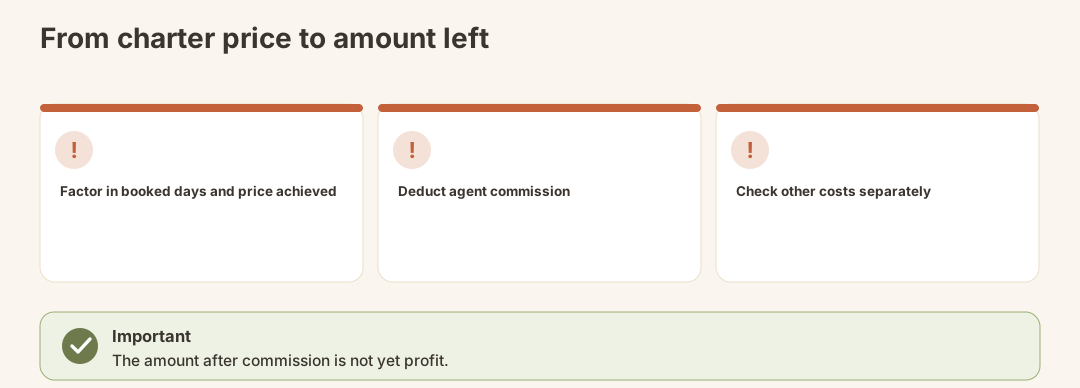
The following example does not use the sailing boat day rate mentioned above. It uses figures given by someone quoted in a Mallorca Zeitung report dated 2 August 2025 about a twelve-metre yacht: around €1,500 in revenue per rental day and a 30% commission, which he says low-cost charter operators charge. It illustrates only the effect of the number of bookings.
| Assumed rental days | Calculated charter revenue at €1,500 per day | 30% commission | Remaining before all other expenses |
|---|---|---|---|
| 5 | €7,500 | €2,250 | €5,250 |
| 10 | €15,000 | €4,500 | €10,500 |
| 20 | €30,000 | €9,000 | €21,000 |
This last column is not profit. It does not account for the boat purchase, insurance, technical requirements, repairs or taxes. Above all, none of these scenarios guarantees that you will achieve those rental days. So also allow for fewer bookings and a lower price than in your ideal scenario.
Which expenses are easy to underestimate?
For a charter boat, the running-cost estimate for a privately used sailing boat may not be enough. The person quoted in 2025 mentions stricter requirements for a boat offered for charter in his example and puts figures on individual costs:
| Items in the example described | Amount stated | What you need to clarify for your calculations |
|---|---|---|
| Technical inspection of the boat, ITB | €600 | Whether and when it is required for your boat |
| Third-party liability and comprehensive insurance | €5,000 | Cover and terms for chartering |
| Safety equipment | €5,000 | Existing equipment and any additions needed |
| Initial investment to meet various requirements | €10,000 | Extent of the modifications needed in your case |
Do not add these four figures together and treat the result as an annual budget. The report does not specify a consistent billing period for these items; the general initial investment figure may also overlap with individual items. For the twelve-metre yacht, it also describes a purchase price of generally €400,000 – not a general market price for sailing boats.
Instead, create separate lines for the purchase, necessary equipment, running costs and unexpected damage. To explore this further, look at the upkeep and eventual sale of a sailing boat. Only once you have specific quotes for your boat can you turn an example calculation into a more reliable budget.
What legal issues do you need to clarify before buying?
Being allowed to use a boat privately does not mean you are permitted to charter it commercially. Particular care is needed when chartering out private yachts: the report dated 2 August 2025 describes a model involving charter through a charter company for no more than three months, with no private use during that period. It also describes the Balearic Islands’ opposition to the liberalisation proposed by Madrid at the time.
Important: Do not read this description as a general permission to charter out a boat in Mallorca that is currently in force. Before paying a deposit, clarify which rules apply to the intended berth, registration and specific type of charter operation. Have the requirements for your particular boat and business model explained to you.
The distinction between private use and paid operations also matters for insurance and tax. You cannot derive specific tax rates from a charter price. General information – not legal, tax, financial or investment advice.
Where are the biggest financial risks?
Booking levels:A listing shows the price at which a boat is offered – not how often it is booked. Season and rental duration affect prices, so a calculation based on peak prices throughout is particularly unreliable.
Commission and services included:The individual example cited assumes a 30% commission. Only the specific offer will show whether your contract is similar and which tasks that commission covers.
Personal use:If you want to sail the boat yourself on days when demand is high, you cannot also rent it out on those days. In the private-boat model described in 2025, personal use during the rental period was expressly excluded.
Boat condition and equipment:The figures quoted for insurance, inspection and lifesaving equipment show why an ‘existing private boat’ and a ‘charter-ready boat’ can be very different financial starting points. Do not assume zero downtime or maintenance costs.
What order should you follow?
- Decide on an operating model:Will the boat be offered with or without a skipper, and who will handle marketing and handover?
- Check whether the boat can be rented out:Check the requirements for the specific boat, its berth and its intended use before committing to a purchase.
- Gather comparable prices:Separate daily and weekly charters, as well as offers with and without a skipper. For a customer’s perspective, the guide to boat rental costs in Mallorca provides further guidance.
- Calculate revenue scenarios:Use different booking numbers and achievable prices; deduct the actual commission.
- Get separate quotes for costs:Insurance, technical requirements and equipment in particular must be suitable for the intended charter use.
- Consider the purchase and your eventual exit:Do not assume that a well-booked summer will be enough to recoup the purchase price.
Most common mistakes in return calculations
| Mistake | Better approach |
|---|---|
| Treating the listed price as the owner’s income | Show the price actually achieved and the intermediary’s deduction separately |
| Mixing daily and weekly offers | Check the rental duration and services included in each offer |
| Treating a single example as the market standard | Use the €1,500 in daily revenue and 30% commission only as that source’s example |
| Applying private-boat costs to charter operations | Check insurance, inspection and equipment requirements for charter use separately |
| Investigating whether the boat can be chartered out only after buying it | Clarify the operating model and requirements before making a commitment |
The most consequential mistake is often not a calculation error but an unchecked assumption: that any suitable sailing boat can be chartered out at the advertised rates.
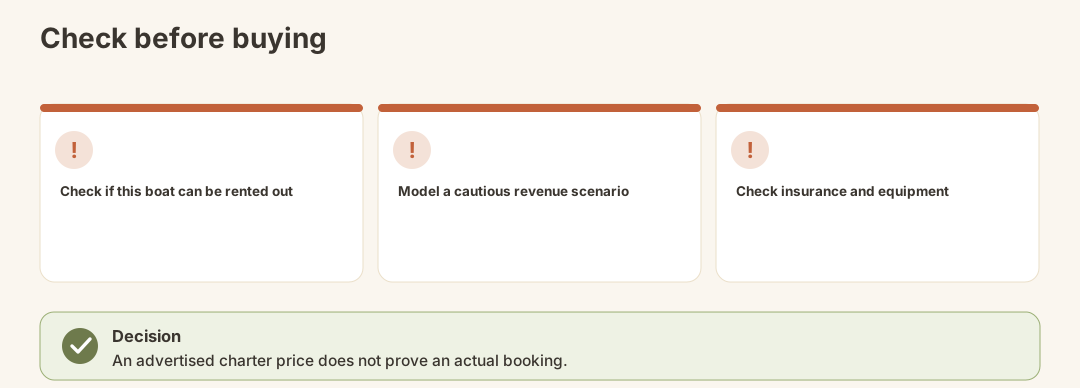
Checklist for your purchase decision
- Is it clear who operates and markets the boat?
- Has it been confirmed that this specific boat can be chartered out as planned?
- Are daily and weekly rates clearly distinguished?
- Are there revenue scenarios with fewer and with more bookings?
- Has any commission been deducted in the calculations?
- Have insurance, inspection and equipment requirements for charter use been checked?
- Do the figures still work without optimistic booking levels?
- Do you know how much personal use you want to combine with chartering?
What comes next?
Once you have confirmed that the boat can be chartered out and the figures still make sense under a cautious scenario, the next step is to assess individual boats and specific offers from operators. Compare not just the asking price, but also the boat’s condition, the equipment it needs and the terms of any potential arrangement with a charter company. When planning to use the boat at sea, you should also consider Weather and safety when sailing in Mallorca.
If the figures are marginal, chartering a boat as a customer is one way to get to know the type of boat and the sailing area without having to rely on the economics of owning one.
Conclusion
Buying a sailing boat to charter out in Mallorca can be a business opportunity – but high advertised daily rates do not, by themselves, make it a good investment. The figure that matters comes from realistic numbers of booked days and the rates actually achieved, less commission and all expenses. Before buying, check whether the specific boat can be chartered out and run the figures for a weak scenario too. If the plan only works with top rates and a full booking calendar, the calculations rest more on hope than on a financial buffer.
Official sources
- Official portal of the Balearic Islands – for checking the regional requirements that apply to a specific charter venture.
- Spain’s official legal publications – for checking national legal requirements.