
Padel Mallorca: Courts, Clubs and Getting Started
Padel Mallorca is no longer a niche topic – the sport has established itself on the island as one of the easiest ways to make connections outside of work and the neighbourhood. If you're new here as a German-speaking resident, you'll hear the word quickly: from the neighbour, at the gym, in the kids' school WhatsApp group. Unlike tennis, you don't need a fixed playing partner or a club membership to join in. This guide explains what sets padel apart from tennis, why getting started is noticeably easier, what equipment you really need, how to find a match without any contacts, and where to look for courts on Mallorca.
- Business directory: Padel & Tennis — search providers on Mallorca
What is padel – and why has it become so big in Spain?
Padel has developed into a mass sport, particularly in Spain, and has also seen a marked upswing on Mallorca in recent years. The island offers favourable conditions for this: plenty of open space for facilities, a climate that allows play virtually year-round, and a population that quickly finds sociability in a doubles format. Unlike tennis, padel was designed from the outset as a sport for two pairs, not for lone fighters – which explains why it's so well suited to an evening after work or a weekend with neighbours.
The sport is played on a much smaller, fully enclosed court than tennis. This fundamentally changes the dynamics of play: balls aren't simply hit out, but stay in play longer thanks to the walls. For beginners, this mainly means one thing: longer rallies, more moments of success, and less frustration in the first hour.
The court and the basic rules
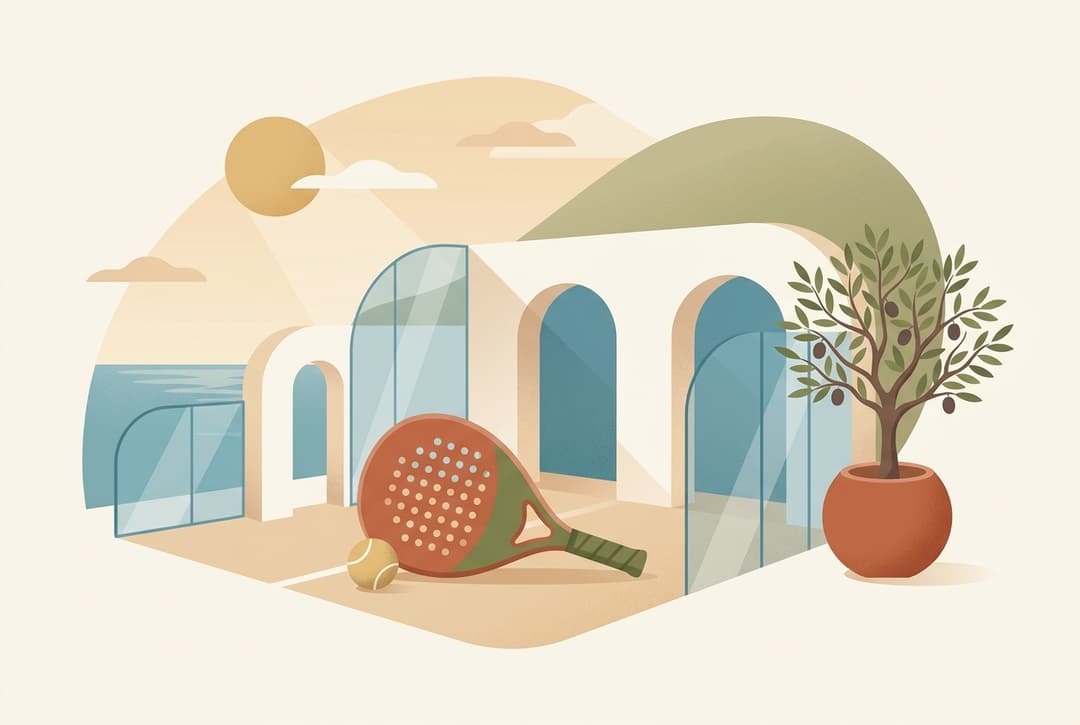
A padel court measures 20 by 10 metres and is completely enclosed – the end walls consist of glass or masonry sections with metal mesh above, while the side walls combine wall and mesh. A net divides the court in the middle, at roughly just below an adult's knee height.
| Feature | Padel | Tennis (for comparison) |
|---|---|---|
| Playing surface | 20 x 10 metres, completely enclosed | significantly larger, open |
| Walls usable | yes, the ball may be played back off the wall after bouncing | no |
| Serve | from below, after bouncing on the ground, below hip height | from above, no ground bounce |
| Format | almost always doubles | singles or doubles |
| Racket | perforated pala without strings | strung tennis racket |
Note: The net reaches roughly up to just below the knee height of an adult. You don't need to know the exact measurements – the finer details matter to court builders and referees, not to beginners.
Padel vs. Tennis: Why getting started is easier
The real beginner question is usually: Why can I already join in after an hour here, while in tennis I still can't manage a decent rally after a year? The answer lies in four practical differences in gameplay:
- The walls are part of the game. A ball that hits the wall after bouncing isn't lost – it can be brought back into play from there. This extends rallies and forgives mistakes that would immediately cost you the point in tennis.
- The serve doesn't decide the point. The serve is played from below, after a bounce on the ground and below hip height. There's no serve game like in tennis, where pure power makes the difference.
- The racket is more forgiving. The pala is a shorter, perforated surface without strings. This reduces the margin for error at the point of contact compared to a strung tennis racket.
- It's played in doubles. Three fellow players also cover the area – a single technical slip-up rarely decides the whole match.
The scoring system itself, however, you already know from tennis: 15, 30, 40, game, sets – nothing changes here.
Equipment: What you really need
The barrier to entry is deliberately kept low. Many facilities lend out rackets for your first attempts, so you don't need to invest straight away.
| Equipment | Needed to get started | Can be added later |
|---|---|---|
| Pala (padel racket) | yes – often available on loan at the facility | your own racket suited to your skill level |
| Sports shoes with a non-slip sole | yes | special padel shoes |
| Comfortable sportswear | yes | – |
| Padel balls | usually available on site | your own supply |
| Club membership | no | optional for regular play |
Note: Hold off on expensive purchases in the early days. Racket prices, court rental fees and membership charges vary so much between venues, time of day and season that a blanket price statement here would be misleading – it's better to compare directly with providers near you.
Finding connections without a fixed partner
This is the real added value of padel for newcomers to Mallorca: you need neither an established partner nor a club membership to play. Venues and booking platforms organise open matches where individual players team up into doubles – similar to a communal table at a restaurant.
Here's how you typically get to your first match:
- Choose a venue near you, for example via the industry directory.
- Ask whether open matches or beginner groups are offered.
- Honestly assess your approximate playing level – beginner, slightly advanced, experienced.
- Take part in an open match or a taster session.
- If you like it: arrange a regular slot with your new fellow players.
Where to find courts on Mallorca
There is no reliable, comprehensively counted figure for the number of padel courts across the whole of Mallorca – there is no official survey for this, and private specialist portals arrive at different figures depending on their data-gathering method. What you get instead is a curated starting point: the industry directory on mallorca.com currently lists 55 providers on the island under the category Padel & Tennis, with an average rating of 4.2 stars (as of 04.09.2026, own research).
| Source for finding venues | What you'll find there |
|---|---|
| Industry directory Padel & Tennis (mallorca.com) | curated provider list with ratings, usable in German |
| Venues' booking platforms | hourly court reservations, often with open matches |
| Recommendations from the neighbourhood/community | personal impression of occupancy and atmosphere |
For the specific choice of venue, rely on the Industry directory: Padel & Tennis rather than on individual recommendations – venues regularly change their opening hours, capacity and offerings, and a curated directory reflects this more up to date than an article written once.
Understanding playing level and open matches
Booking platforms and clubs work with playing-level indicators so that open matches remain roughly balanced. The principle behind it: you give a rough self-assessment, and the system tries to match you with fellow players of similar strength. However, the specific scales differ between platforms and sometimes between countries too – the first time, rely on an honest verbal assessment on site rather than on a number you read somewhere.
Note: If you're a complete beginner, say so openly. Most clubs have their own beginner formats or taster sessions before you join an open match with advanced players.
The right timing: season, heat, peak hours
Padel is played on Mallorca all year round, but it's not equally pleasant at every time of day. During the summer months, courts are noticeably more pleasant during the cooler off-peak times – early morning or late evening – than in the midday heat. During the classic after-work hours on weekdays, many clubs are also well booked, so it's worth reserving a bit ahead of time.
The most common mistakes when starting out
- Joining too strong a group too soon. Anyone who overestimates their own level ends up in matches that are neither fun nor helpful for learning.
- Buying expensive equipment straight away. You can usually borrow your first pala – hold off on investing until you know whether the sport suits you.
- Only wanting to play at peak times. Anyone flexible about the time of day finds it easier to get free courts and open matches.
- Equating padel with tennis. Anyone who carries their tennis technique over unchanged overlooks the crucial difference: the walls are part of the game.
What comes next? Tournaments, leagues, further development
For those seeking structure beyond open matches, Mallorca also offers organised competition – ranging from club leagues to larger tournament formats, with varying entries throughout the year. This isn't necessary when starting out; it's better to play regularly in open matches for about six months first and then decide whether a fixed framework with a ranking system fits your goals.
Checklist: your first month of padel on Mallorca
- Chosen a nearby club via the business directory
- Asked about open matches or beginner formats
- Comfortable sports shoes and clothing ready
- Booked your first match at a cooler time of day
- Realistically reassessed your own playing level after the first match
- Decided whether to get your own pala
Conclusion
Padel Mallorca is particularly appealing for German-speaking residents because getting started requires so little: no fixed partner, no club membership, no years of prior experience. The enclosed playing area, the underhand serve, and the doubles format mean you get into the game faster than with most other racket sports. Anyone looking for a club will get there fastest via a curated directory rather than individual recommendations – and anyone who plays regularly often finds connections on the island faster through open matches than through many other leisure activities.
Official sources
There is no official licensing or supervisory authority for padel as a recreational sport comparable to tax or traffic law. The sporting rulebook is maintained internationally by the Federación Internacional de Padel (FIP); an official information point of this institution usable by end customers is not available with a reliable URL for this guide and is therefore deliberately mentioned without a link. For finding clubs on Mallorca, our own business directory at /de/verzeichnis/padel-tennis the most reliable, continuously maintained source.