
Applying for a NIE Number in Mallorca: The Complete 2026 Guide
If you're buying a property on Mallorca, starting a job, opening a bank account, or dealing with an inheritance, there's no getting around a NIE number. The NIE (Número de Identidad de Extranjero) is your lifelong identification and tax number in Spain — not a residence permit, but the key that allows every Spanish authority, bank, and notary to properly identify you. This guide takes you step by step through the application process, required documents, costs, and the specific contact points on the island — including all official form numbers and fees as of 2026.

- Go to the guide: Relocating to Mallorca — the comprehensive guide to dealing with authorities and moving, within which the NIE fits.
Do I actually need a NIE?
The NIE isn't red tape for its own sake — it becomes necessary the moment you have an economic, professional, or social interest in Spain. That's exactly how the Policía Nacional puts it: a NIE is required for "foreigners who enter into a relationship with Spain for economic, professional, or social reasons".
Yes, you need a NIE if …
- you are buying or selling a property on Mallorca buying or selling (at the latest for the notarial deed, the escritura — and often earlier, for the deposit and banking processes).
- you are working on the island, becoming self-employed (autónomo) or setting up a company.
- you are opening a Spanish bank account or taking out a mortgage.
- you are inheriting or receiving a gift.
- you are buying, registering, or insuring a vehicle.
- you are submitting a tax return (e.g. in relation to the wealth tax on Balearic properties) or taking out insurance.
No, you don't (yet) need a NIE if …
- you are simply on a beach holiday and not entering into any contracts.
- you are a tourist briefly on Mallorca, without a bank account, property purchase or job.
Important: The NIE alone does not make you a resident. It is purely a number with no proof of residency. Anyone staying longer than three months also needs the Residencia (Certificado de Registro, "green NIE") — more on that below.
NIE vs. Certificado de Registro UE vs. TIE
Three terms, three different documents — and confusing them regularly costs people entire appointments on Mallorca. This table clears things up:
| Document | For whom | Purpose | Format | Form |
|---|---|---|---|---|
| NIE (Número de Identidad de Extranjero) | All foreigners (EU & non-EU) | Purely a tax/ID number for purchases, bank accounts, contracts, taxes | White A4 sheet with stamp | EX-15 |
| Certificado de Registro UE ("green NIE") | EU/EEA/Swiss citizens staying >3 months | Proof of legal residence; contains the NIE number | Green A4 sheet or green card without photo | EX-18 |
| TIE (Tarjeta de Identidad de Extranjero) | Non-EU citizens (e.g. UK, USA, CH third-country cases) with a residence permit | Biometric proof of residence and identity | Plastic card with photo & chip | EX-17 |
A useful rule of thumb for DACH expats: As a German, Austrian or Swiss national, you will receive not a TIE — you first receive the NIE (EX-15) and, if you stay permanently, the green certificate (EX-18). The TIE plastic card is reserved for non-EU citizens. If you are an EU citizen relocating with a partner from a third country (e.g. the USA), you receive the green document whilst your partner is required to obtain the TIE.not a TIE — you first receive the NIE (EX-15) and, if you stay permanently, the green certificate (EX-18). The TIE plastic card is reserved for non-EU citizens. If you are an EU citizen relocating with a partner from a third country (e.g. the USA), you receive the green document whilst your partner is required to obtain the TIE.
What is the structure of the NIE?
The NIE number follows a fixed pattern: one letter (X, Y or Z) — seven digits — one check letter, for example Y-1234567-A. The leading letter merely indicates the issuing generation (X for the oldest, then Y, currently Z), the seven digits are sequential, and the final letter is a check digit calculated using the same modulo-23 method as the Spanish DNI.
The number is valid for life and never changes — regardless of whether you later become a resident, move away again and return years later. You apply for it exactly once. If you lose the document, you do not apply for a new number but rather a duplicate of the same certificate (fee approx. 6 €).
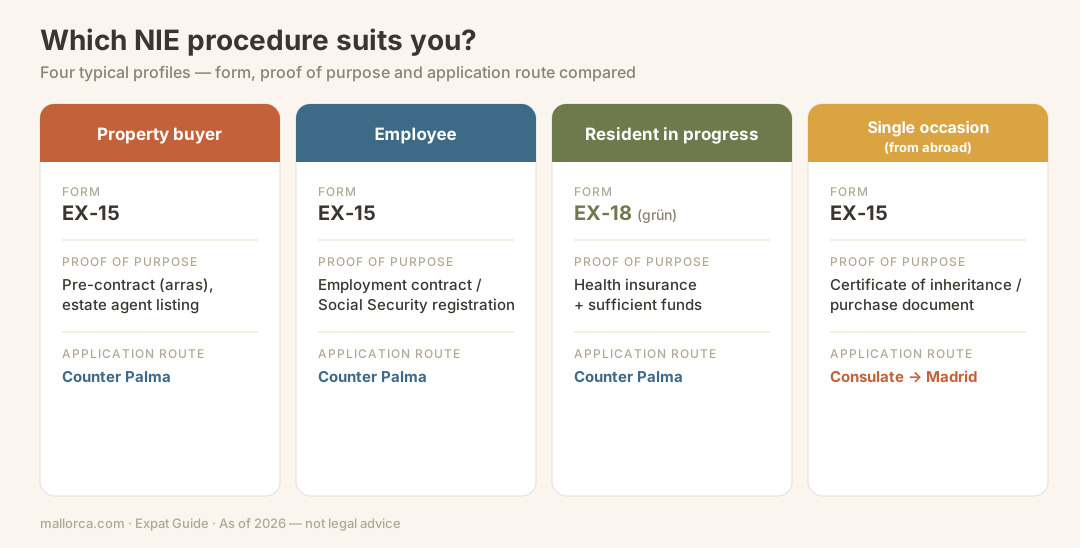
Four typical profiles — which procedure applies to you?
The route to the NIE depends on why you need it, as this determines your proof of reason (Motivo) and whether you should already be thinking about residencia at the same time.
The property buyer. You are purchasing a flat in Palma or a finca estate in the south-west. Procedure: straightforward NIE via EX-15. Proof of reason: reservation/preliminary contract (contrato de arras), estate agent's offer with property reference, or notary appointment confirmation. Tip: apply early — the NIE must be in place by the time of the escritura at the latest, and banks often require it as early as the deposit stage. Many buyers authorise a gestoría by notarised power of attorney (poder) so that the appointment does not fall through due to diary conflicts.
The employee. You are taking up a job on Mallorca. Procedure: NIE via EX-15. Proof of reason: signed employment contract or official letter of appointment/registration with the Seguridad Social. If you stay longer than three months, residencia follows directly (EX-18, category cuenta ajena).
The prospective resident. You are relocating your primary place of residence permanently to the island (retirees, persons of independent means, remote workers). Procedure: instead of the straightforward NIE, book directly via the portal for the "Certificado de registro de ciudadano de la UE" (EX-18) — the green certificate includes the NIE number, saving you one step. Supporting documents: health insurance (for non-employed persons, minimum cover of 30.000 €, with no excess) plus sufficient financial means (bank statements, pension notification).
The one-off matter from abroad. You are inheriting, purchasing a vehicle or entering into a one-off contract, but are still based in Germany, Austria or Switzerland. Procedure: NIE via the competent Spanish consulate (EX-15). Supporting documents: certificate of inheritance/will, purchase document or similar. The application is then processed via the central Comisaría General de Extranjería y Fronteras in Madrid — allow for a longer processing time.
What documents do I need?
Spanish authorities are strict about formalities: if a single document or copy is missing, you will be turned away at the counter and will have to rebook. This list covers the standard case of obtaining a NIE on Mallorca:
| Document | Details | Original / Copy |
|---|---|---|
| Form EX-15 | Solicitud de NIE y Certificados, completed in full in block capitals using a black pen and signed | Original + Copy |
| Passport (or EU national identity card) | Valid; copy all pages, not just the data page | Original + copy of all pages |
| Tasa 790-012, paid | Item "Asignación de NIE a instancia del interesado", paid at a bank, with bank stamp | Original receipt |
| Proof of purpose (Motivo) | Preliminary purchase contract, employment contract, certificate of inheritance, vehicle purchase contract or similar — specific, with reference | Original + Copy |
| Proof of residence (optional) | Rental agreement, hotel receipt or Empadronamiento (only required for stays of more than 3 months) | Copy |
| Notarised power of attorney (only when represented by a third party) | Poder; if the power of attorney was issued abroad, it must bear an Apostille and a certified translation into Spanish | Original + Copy |
| Appointment confirmation (cita previa) | Sent by email | Printout |
The EX-15 can be downloaded as an official PDF from the Ministry's website (inclusion.gob.es), the Tasa-790-012 form is generated online via the Sede of the Policía Nacional. With the Tasa form, selecting the correct item is crucial: choose "Asignación de Número de Identidad de Extranjero (NIE) a instancia del interesado" — the form will then automatically calculate 9,84 €. If you select the wrong item (e.g. a TIE or Certificado item), you will pay the incorrect amount and the receipt will be rejected.
Regarding the Motivo: it must be substantiated with concrete evidence. The Policía Nacional requires you to demonstrate the reasons for your application ("comunicar los motivos") — an unsubstantiated or missing Motivo will result in rejection (Denegación). "I want to live here" is not sufficient; a specific supporting document is required.
What does the NIE cost in 2026?
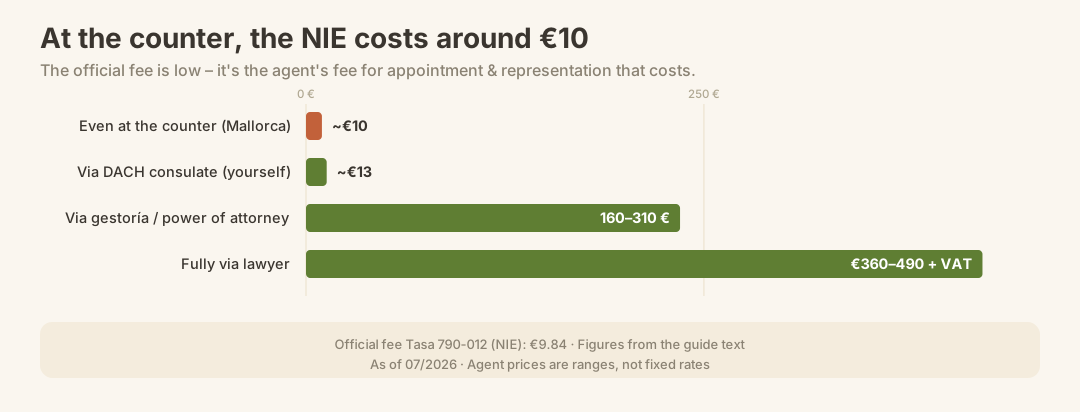
The official fee itself is low — the total cost depends on whether you go to the counter yourself or engage a gestoría. First, the official charges:
| Item | Cost 2026 | Note |
|---|---|---|
| Tasa 790-012 (NIE) | 9,84 € | Item "Asignación de NIE a instancia del interesado", payment at the bank |
| Consular fee (DACH consulate) | approx. 13,05 € | Different fee schedule abroad; consulate-specific, may vary slightly; card only, no cash |
| Duplicate NIE (loss) | approx. 6 € | Same appointment type, item "Duplicado" |
| Empadronamiento | usually free of charge | some municipalities approx. 3 € |
And now the realistic total cost scenarios including service providers:
| Scenario | Official fee | Gestoría / solicitor | Total (approx.) |
|---|---|---|---|
| Going to the counter yourself in Mallorca | 9,84 € | — | ~10 € |
| NIE via gestoría/power of attorney (Mallorca) | 9,84 € | 150–300 € | ~160–310 € |
| NIE via DACH consulate (self-managed) | ~13 € | — | ~13 € |
| NIE via solicitor – complete package (incl. purchase context) | 9,84 € | 300–400 € + VAT | ~360–490 € |
The gestoría and legal fees are not a surcharge on top of the authority's fees, but a separate service charge — primarily for securing appointments and acting as your representative by power of attorney, when you cannot or do not wish to be on the island yourself.
Step-by-step process
This is how the standard route on Mallorca runs from start to finish:
- Determine procedures.Pure NIE (EX-15), green Residencia (EX-18), or — for non-EU partners — TIE? In 90 % of DACH buyer cases, it's the pure NIE.
- Fill in and print out EX-15.Capital letters, black pen, name the motivo specifically (e.g. "compra de vivienda, ref. XXX"). OriginalandCopy.
- Fill in form 790-012.Online on the website of the Policía Nacional, select the option "Asignación de NIE" (€9.84), and print it out.
- Pay the fee at the bank.With the printed Tasa form, go to any bank — you don't need to have your own account there. Have theStampgiven; without it the receipt does not count.
- Book an appointment.Via the official portal, province "Illes Balears", then the relevant procedure. (Details in the next section.)
- Sorting documents.Passport + copy, proof of purpose + copy, stamped Tasa receipt, EX-15 in original + copy, appointment confirmation.
- Attend appointmentin Palma (or via an authorised Gestoría). At the counter, documents are checked, the Motivo is verified, and the allocation is recorded.
- Collect / receive notice.Often immediately, otherwise within the statutory resolution period of a maximum of 5 days. Keep the original sheet in a safe place — there is no plastic card.
Where exactly on Mallorca?
On Mallorca, NIE applications are processed through two offices — the Oficina de Extranjería and the Comisaría of the Policía Nacional. Both are located in Palma:
Oficina de Extranjería de Palma (Foreigners' Office) C/ Felicià Fuster 7, 07006 Palma de Mallorca Tel. 971 989 441 (Policía enquiries – foreign nationals documentation) · E-Mail: infoextra.illesbalears@correo.gob.es Responsible for, among other things, NIE assignment, Residencia and residence procedures.No processing without a cita previa.
Note on telephone numbers: Several official numbers are in circulation for the same address, Felicià Fuster 7. The 971 989 441 is the Policía enquiry line for foreign nationals documentation (from the official Policía Localizer). In addition, there is 971 989 000 (main switchboard) and 971 989 170 (information line of the Oficina de Extranjería of the Delegación del Gobierno). The cita previa via the online portal always takes precedence.
Policía Nacional — Documentación de Extranjeros (Comunitarios) C/ Felicià Fuster 7, 07006 Palma (same building, different counters) For EU-citizen procedures: mallorca.ouecomunitarios@policia.es
Jefatura Superior de Policía (UCRIF) C/ Simó Ballester 8, 07011 Palma — also a point of contact depending on the procedure.
Note for DACH expats: If you are not yet on the island, you can also apply for your NIE through the Spanish consulate in your home country (Embassy Berlin, consulates-general in Munich, Düsseldorf, Frankfurt, Hamburg, Stuttgart; Vienna; Bern/Geneva). The application is then processed via the central Comisaría General de Extranjería y Fronteras in Madrid and typically takes around 4–8 weeks in practice (consulates officially quote roughly two weeks, though in reality it is often longer). The consulate fee is currently approximately 13,05 €, payable by card only — cash is not accepted. If you submit the application through a representative, a notarised power of attorney with an apostille and a translation into Spanish is required.
How do I get a cita previa appointment?
In 2026, this is where the real bottleneck lies — not in the procedure itself, but in securing an appointment at all. Here is how to go about it:
- Open the official cita previa portal of the administration (sede.administracionespublicas.gob.es).
- Select the province "Illes Balears".
- Select your procedure — for a straightforward NIE, choose "POLICÍA – ASIGNACIÓN DE NIE"; for the green Residencia certificate, choose "Certificado de registro de ciudadano de la U.E.".
- Book an available slot and print the confirmation email.
Realistic waiting times in 2026 (based on experience): In urban centres and peak-season areas — and Palma certainly qualifies in summer — you should expect, based on experience, 1 to 4+ weeks for a free appointment slot, longer during peak periods. In addition, 2026 sees an extraordinary regularisation (Real Decreto 316/2026 of 14 April 2026, BOE-A-2026-8284), with applications running until 30 June 2026 (improrrogable, without extension). In our editorial assessment, this is likely to place additional strain on an already tight appointment availability nationwide — though this is not an official statement regarding appointment scarcity. Even after this deadline, demand is expected to remain high for some time, as processing will continue for months.
Practical tips against "No hay citas disponibles":
- Check at midnight (Spanish time) — new slots are often released at 00:00.
- Try multiple times a day and on different days of the week ; cancelled appointments come back on a rolling basis.
- If your deadline is tight (under 6 weeks): Instruct a gestoría with power of attorney — professionals have established channels and experience.
- Book as soon as your plans are confirmed — even if your dossier is not yet complete. The cita can be moved; your place in the queue is what counts.
Most common mistakes
- Wrong procedure booked. "Asignación de NIE" instead of "Certificado de registro UE" (or vice versa) → appointment fails. A resident? Then book EX-18 straight away.
- Tasa paid incorrectly. Wrong box ticked on the 790-012, wrong amount, or receipt without a bank stamp → rejection.
- Passport only partially copied. All pages must be copied, not just the data page.
- Motivo not evidenced. "I want to live here" is not enough — you need a concrete document (preliminary contract, employment contract, certificate of inheritance).
- Arrived without an appointment. In Mallorca there is no processing without a cita previa — turning up without an appointment is a waste of time.
- Confused NIE with Residencia. The NIE does not make you a resident and does not replace the Empadronamiento.
- Started too late. Anyone who only begins two weeks before the Escritura risks running into difficulties if appointment slots are tight.
What comes after the NIE?
The NIE is rarely the final goal — it is the first building block. Depending on your plans, the next steps are:
- Empadronamiento — registering your address with the local council (Ayuntamiento). A prerequisite for Residencia, a health card, and much more. Find out more in the Guide to Moving to Mallorca.
- Residencia (Certificado de Registro UE) — compulsory for EU citizens after three months of residency; the green certificate issued via the EX-18 form. This is the actual proof of residence.
- Completing a property purchase — with your NIE in hand, you can handle the deposit, financing, and Escritura smoothly. For guidance on prices and locations, see the current Mallorca market report and the property guide.
- Tax registration — as an owner or resident with the Agencia Tributaria.
Checklist before your appointment
Before the appointment (preparation):
- Procedure determined (NIE / EX-18 / TIE)
- EX-15 completed, signed, and copied
- Tasa 790-012 completed (item "Asignación de NIE" = 9,84 €)
- Fee paid at the bank, stamp on the receipt
- cita previa booked, confirmation email printed
- Proof of purpose (Motivo) obtained and copied
On the day of the appointment (bring with you):
- Passport or ID card in the original + copy of all pages
- EX-15 original + copy
- stamped Tasa receipt (original)
- proof of reason (original + copy)
- notarised power of attorney if applicable (when represented by a third party)
- appointment confirmation (printed)
After the appointment:
- NIE decision collected/received (often immediately, otherwise within the 5-day resolution period)
- original stored securely (no replacement — a duplicate application would be required)
- next step planned: Empadronamiento / Residencia / purchase
Conclusion
Three key insights for your NIE application in Mallorca:
- The process is straightforward — the appointment is the bottleneck. The official fee is only 9,84 €, and the only statutory deadline is the resolution period of a maximum of 5 days from receipt (Policía Nacional). The real time-consuming factor is the cita previa, whose availability in 2026 — partly due to the extraordinary regularisation process — is expected to be particularly limited.
- Form trumps everything. A complete EX-15, a stamped Tasa receipt in the correct position, copies of all passport pages, and documented Motivo — get these right and you'll be done in a single appointment.
- NIE is not Residencia. The NIE is simply a number. Anyone planning to stay permanently should also arrange Empadronamiento and the green certificate at the same time — ideally in one go via the EX-18.
Plan realistically with a typical timeframe of 2–6 weeks on the island or 4–8 weeks via a consulate — and get started as soon as your plans are confirmed. There are no guaranteed processing times beyond the 5-day resolution period; actual waiting times for appointments and processing vary considerably.
Official sources
- Policía Nacional — Asignación de NIE a instancia de interesado (procedure, 5-day deadline, procedure code 994354, EX-15, Tasa 790-012, fee 9,84 €): sede.policia.gob.es
- Policía Nacional — Certificado de Registro de ciudadano de la UE (EX-18, green certificate): sede.policia.gob.es
- Tasa 790-012 — online form of the Policía Nacional: sede.policia.gob.es/Tasa790_012
- Form EX-15 (official PDF, Ministerio de Inclusión): inclusion.gob.es
- Ministerio de Asuntos Exteriores — consulates & NIE abroad (consulate fee, power of attorney with apostille, processing time): exteriores.gob.es
- Cita previa — Sede Administraciones Públicas: sede.administracionespublicas.gob.es
- Delegación del Gobierno Illes Balears — Extranjería (Oficina Palma): mptmd.gob.es
- Legal basis: Ley Orgánica 4/2000 + Real Decreto 1155/2024 (BOE-A-2024-24099)
- Extraordinary Regularisation 2026: Real Decreto 316/2026 of 14 April 2026 (BOE-A-2026-8284)
As of: June 2026. This article is intended as a general guide and does not constitute legal or tax advice. Official fees, form fields, and appointment availability are subject to change at short notice; the official government websites are always the authoritative source. Figures for processing and waiting times beyond the statutory 5-day resolution period are based on experience and are not guaranteed deadlines. In cases of doubt — particularly regarding powers of attorney, inheritances, or tax matters — please consult a gestoría or a solicitor specialising in Spanish law.
Can I apply for an NIE entirely online?
No. You can book an appointment and prepare forms online, but you cannot complete the application simply by filling in a website. In Mallorca, you submit the documents at your booked appointment with the authorities. If you apply through a Spanish consulate, you or your authorised representative must attend there in person.
An online service that fills in forms or arranges appointments does not replace this official step. Being assigned an NIE is also not proof of residence; you can find further steps for moving in our guides. This overview is not legal or tax advice.