
Dentist in Mallorca: Costs, English-speaking Practices and What Your Insurance Covers
Anyone living in Mallorca or spending an extended period there will sooner or later encounter the question: how does the dentist actually work in Mallorca – and what will my insurance cover? The answer is not straightforward, because the Spanish system differs fundamentally from the German one. Public provision is essentially limited to emergencies, and there is no statutory fee schedule as exists in Germany. At the same time, the density of qualified private practices on the island is high – including several German-speaking practices that operate to German quality standards. This guide explains which practices are available, what treatments realistically cost, what your German statutory health insurance, your private health insurance, or a Spanish supplementary dental insurance will reimburse – and which mistakes you should absolutely avoid.
Not sure which health insurance in Mallorca is really right for you – and what it covers at the dentist?
- 📩 Submit a personal enquiry — We'll help you find the right solution for your situation
- Health insurance in Mallorca: the complete overview
The public dental system in Mallorca
Spain's statutory health system (Sistema Nacional de Salud) differs considerably from the German model when it comes to dental care. In Mallorca there are health centres (Centros de Salud) where dentists practise – but their remit is strictly limited: they generally only act in acute emergencies, that is, in cases of inflammation, injury, or severe pain. In such cases they prescribe pain-relief medication and may issue a prescription if necessary. For further treatment – dentures, implants, crowns, professional teeth cleaning – they refer patients to private practices.
Important: Anyone who is covered by statutory health insurance in Spain or protected via the S1 form is only entitled to this emergency provision within the public dental sector. Planned treatments must be paid for privately or covered through supplementary insurance.
Use of the public emergency service is free of charge with the Tarjeta Sanitaria (the Spanish health card). On the reverse of this card, EU citizens have the European Health Insurance Card (EHIC) integrated, which also enables tourists to access emergency care.
German-speaking and English-speaking dental practices in Mallorca
For Germans who prefer to communicate in their native language – particularly useful for complex treatments such as root canal procedures or implant work – there is a good range of established practices in Mallorca.
| Practice | Location | Languages | Telephone |
|---|---|---|---|
| Clinica Dental Vogelsang | Palma (outskirts) | German, Spanish, English | +34 971 23 43 77 |
| Clinica Dental Lutz M. Meyer | Cala Ratjada (North-East) | German | +34 971 588 164 |
| Zahnarztpraxis Schmieder | Cala Millor | German | +34 971 587 469 |
| Dental-Mallorca.com | Palma | German, Spanish, English | +34 971 71 71 72 |
| Platón Dental | Palma & Manacor | English, Spanish | +34 971 452 028 (Palma) / +34 971 554 964 (Manacor) |
According to a report by ZWP online (2023), Dr Philipp Vogelsang has been practising as a German dentist on Mallorca since 2014, specialising in prosthodontics and aesthetic dentistry. The Clinica Dental Vogelsang is located on the outskirts of Palma and is accessible by public transport as well as from the airport.
The Clinica Dental in Cala Ratjada explicitly emphasises its commitment to German quality standards whilst maintaining a warm, anxiety-free treatment environment.
Please note: German-speaking practices are generally slightly more expensive than their purely Spanish-speaking counterparts, as demand is high. Comparing prices across two or three practices is worthwhile — particularly for more extensive treatments.
Costs: What does a dentist on Mallorca really charge?
Spanish dental law does not have a statutory fee schedule comparable to the GOZ in Germany. Prices vary from practice to practice, but tend to be lower than in Germany, as both practice overheads and laboratory costs are cheaper on Mallorca. The following table is based on the published price list from dental-mallorca.com as well as supplementary information from research sources.
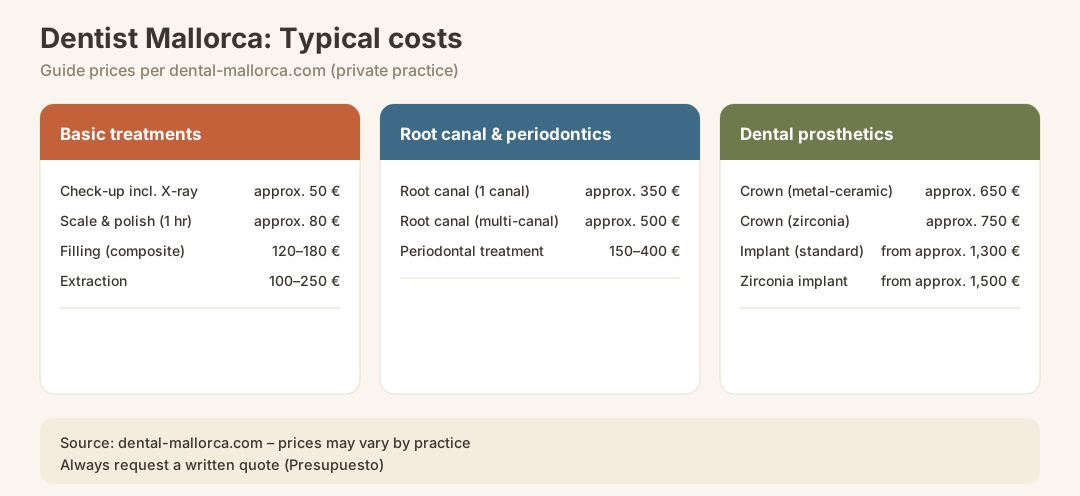
| Treatment | Price range (€) |
|---|---|
| Dental check-up (incl. X-ray) | ca. 50 |
| Dental X-ray (single image) | ca. 20 |
| Panoramic X-ray | ca. 50 |
| Professional teeth cleaning (1 hr) | approx. 80 |
| Filling (composite) | 120–180 |
| Temporary filling | 20–50 |
| Dental sealant | 25–50 |
| Root canal treatment (1 canal) | approx. 350 |
| Root canal treatment (multiple canals) | approx. 500 |
| Extraction | 100–250 |
| Dental crown (metal-ceramic) | approx. 650 |
| Dental crown (zirconia) | approx. 750 |
| Dental implant | from approx. 1,300 |
| Zirconia implant | from approx. 1,500 |
| Sinus lift | 300–900 |
| Bone grafting | approx. 400 |
| Maryland bridge | 600–1.250 |
| Dental prosthesis | 800–1.200 |
| Inlay / onlay | approx. 650 |
| Teeth whitening (bleaching) | 190–480 |
| Periodontal treatment | 150–400 |
| Splint (e.g. night guard for grinding) | 150–350 |
| General anaesthesia | 350–400 |
Please note: These figures are taken from a single price list and are intended as a guide only. Other practices — particularly German-speaking ones or specialist clinics — may differ. Always obtain a written cost estimate (Presupuesto) before undergoing any major treatment.
What does the German statutory health insurance (GKV) cover?
For Germans staying temporarily in Mallorca (holidays, short-term visits), the following applies: the GKV reimburses costs via the EHIC for treatments that the Spanish public system would also cover – which in the dental field essentially means emergency care.
For residents who have permanently relocated to Spain and deregistered from the German GKV, this entitlement generally no longer applies. Those who are still covered by German health insurance (e.g. through voluntary continued membership or as a cross-border commuter) have a limited entitlement.
When it comes to dental prosthetics, even within Germany the rule is: the GKV does not automatically and straightforwardly pay a fixed subsidy for treatments received in another EU country – there are considerable restrictions here. In individual cases, it is worth checking directly with your own insurer before undergoing treatment.
| Situation | GKV dental cover in Mallorca |
|---|---|
| Short stay / holiday (EHIC) | Emergency care in the public sector free of charge; private practices are not reimbursed |
| Resident with a Spanish health card | Public emergency care; planned treatments to be funded privately |
| Voluntarily GKV-insured (residence in Germany) | Reimbursement under German benefit regulations; cost estimate may need to be submitted |
| Private health insurance (PKV) | Depending on the tariff: often full reimbursement at private practices worldwide |
Spanish supplementary dental insurance: what do private providers offer?
Those who live permanently in Mallorca frequently take out private health insurance in Spain. This covers dental treatments in most cases only if a separate dental tariff ("seguro dental") is included. Statutory health insurance in Spain covers considerably less than its German equivalent – an aspect that newcomers often underestimate.
Several Spanish insurers (including Sanitas, Adeslas, Asisa) offer standalone dental insurance policies that, depending on the tariff, cover check-up examinations, dental hygiene appointments, fillings, and in some cases dental prosthetics as well. Implants are often excluded from more affordable tariffs or are only covered after a waiting period.
Please note: When taking out Spanish health insurance, never forget to check the dental tariff explicitly. Many low-cost basic policies do not include it.
You can find more general guidance on choosing health insurance in our guide to health insurance in Spain.
The S1 form: dental cover for EU pensioners and cross-border commuters
EU citizens who live in Spain but receive a pension from another EU country (e.g. Germany) or are socially insured there can be registered with the Spanish health system via the S1 form. In this case too, the same rule applies for dental care: entitlement is limited to public emergency treatment. Planned treatments remain privately funded.
Further details about the S1 process are explained in our guide to the S1 form in Spain.
Emergency dental care: what to do outside of surgery hours?
Acute toothache doesn't respect opening hours. In an emergency on Mallorca, you have several options:
- Centro de Salud (health centre): The nearest public facility is your first port of call for pain management, prescriptions for antibiotics or painkillers, and initial treatment of injuries.
- Hospital emergency department (Urgencias): For serious injuries (e.g. a tooth knocked out in an accident), the nearest Urgencias department is the appropriate place to go.
- Private emergency clinic: Some private practices offer emergency appointments or can be reached by email/WhatsApp outside of normal opening hours — for example, Clinica Dental Vogelsang states that it is also contactable by email at weekends.
- Out-of-hours GP service: The out-of-hours GP service can prescribe pain medication to tide you over until you can get a dental appointment.
Please note: Treatment costs at an emergency department or a private emergency clinic are only reimbursed by most insurers if you have checked the terms of your policy in advance. Keep all invoices (Facturas).
Payment terms: cash and payment in advance
One important difference from the German system: in Spanish dental practices, treatment costs are generally paid on the spot by card or in cash — regardless of which insurance you hold. The practice does not bill your insurer directly; you pay, receive an invoice (Factura), and then submit it to your insurer yourself.
This also applies to those with statutory insurance who visit a private practice. Anyone who relies solely on reimbursement without clarifying their cover in advance risks being left to foot the bill.
The reimbursement process (private practice):
- Receive your treatment
- Request a Factura (invoice including the practice's tax number) and, if applicable, a treatment report
- Send the documents to your insurer (often possible digitally)
- Wait for reimbursement — depending on the insurer, this can take several weeks
The most common mistakes when visiting the dentist on Mallorca
Many new residents and holidaymakers make avoidable mistakes that can prove costly:
- Not obtaining a cost estimate: Without a written Presupuesto, you have no basis for complaints or insurance submissions when it comes to more extensive treatment.
- Assuming statutory health insurance covers everything: At a private Spanish practice, German statutory health insurance typically pays nothing, or only a fraction of the costs — without prior clarification.
- Not keeping the Factura: Without a proper invoice (including the practitioner's tax number), there is no reimbursement from insurers.
- Dental insurance not checked: Many Spanish health insurance policies exclude dental services from the basic package.
- Waited too long: What would still have been a routine NHS-style treatment in Germany becomes an expensive private bill on Mallorca – a timely check-up and hygiene visit saves money.
- Fixated solely on German-speaking practices: Spanish practices with English-speaking staff are often cheaper and equally well equipped. There are no quality differences based on language choice alone.
What comes next? Dental treatment and taxes
Significant treatment costs can in some cases be tax-relevant – for example if you are a resident in Spain and submit your IRPF tax return. Dental treatments are generally not a directly deductible item, but in the context of overall healthcare expenditure and private insurance contributions it is worth taking a look at IRPF deductions in the Balearic Islands. Anyone wishing to plan their overall cost of living on Mallorca more effectively will find useful reference figures in our guide to cost of living on Mallorca.
Checklist: visiting the dentist on Mallorca
- Choose a practice and make an appointment (for more extensive treatments: obtain several quotes)
- Clarify your insurance cover before treatment (statutory health insurance, private health insurance, Spanish policy)
- For planned treatments: request a written Presupuesto (cost estimate)
- Have your payment method ready (card or cash – no direct billing to a health insurer)
- Keep the original invoice (Factura) with the practice's tax number
- If required: request treatment documentation for your insurer or GP in Germany
- In an emergency: go to the nearest Centro de Salud or Urgencias
Conclusion
When visiting the dentist on Mallorca you will find a well-developed private market with fair prices – often cheaper than in Germany, without any compromise on quality. Public provision is limited to emergencies; planned treatments are paid for privately or covered through supplementary insurance. German-speaking practices in Palma, Cala Ratjada, and Cala Millor remove the language barrier, though they tend to be slightly more expensive. The most important tip: sort out your insurance situation before you sit down in the treatment chair – and always get several quotes for any major work.
Official sources
- Servei de Salut (IB-Salut) – Baleares: Information on public healthcare provision in the Balearic Islands – https://www.ibsalut.es
- Consejo General de Dentistas de España: Professional association of Spanish dentists – https://www.consejodentistas.es
- Ministerio de Sanidad – Cartera de Servicios del SNS: Catalogue of services of the Spanish public health system – https://www.sanidad.gob.es
- German Liaison Office for Health Insurance Abroad (DVKA): Information on the EHIC and healthcare abroad – https://www.dvka.de
- GKV-Spitzenverband – Information sheet on treatment abroad: Basics on cost reimbursement within the EU – https://www.gkv-spitzenverband.de