
Avenc de Son Pou Cave Hike near Son Coll
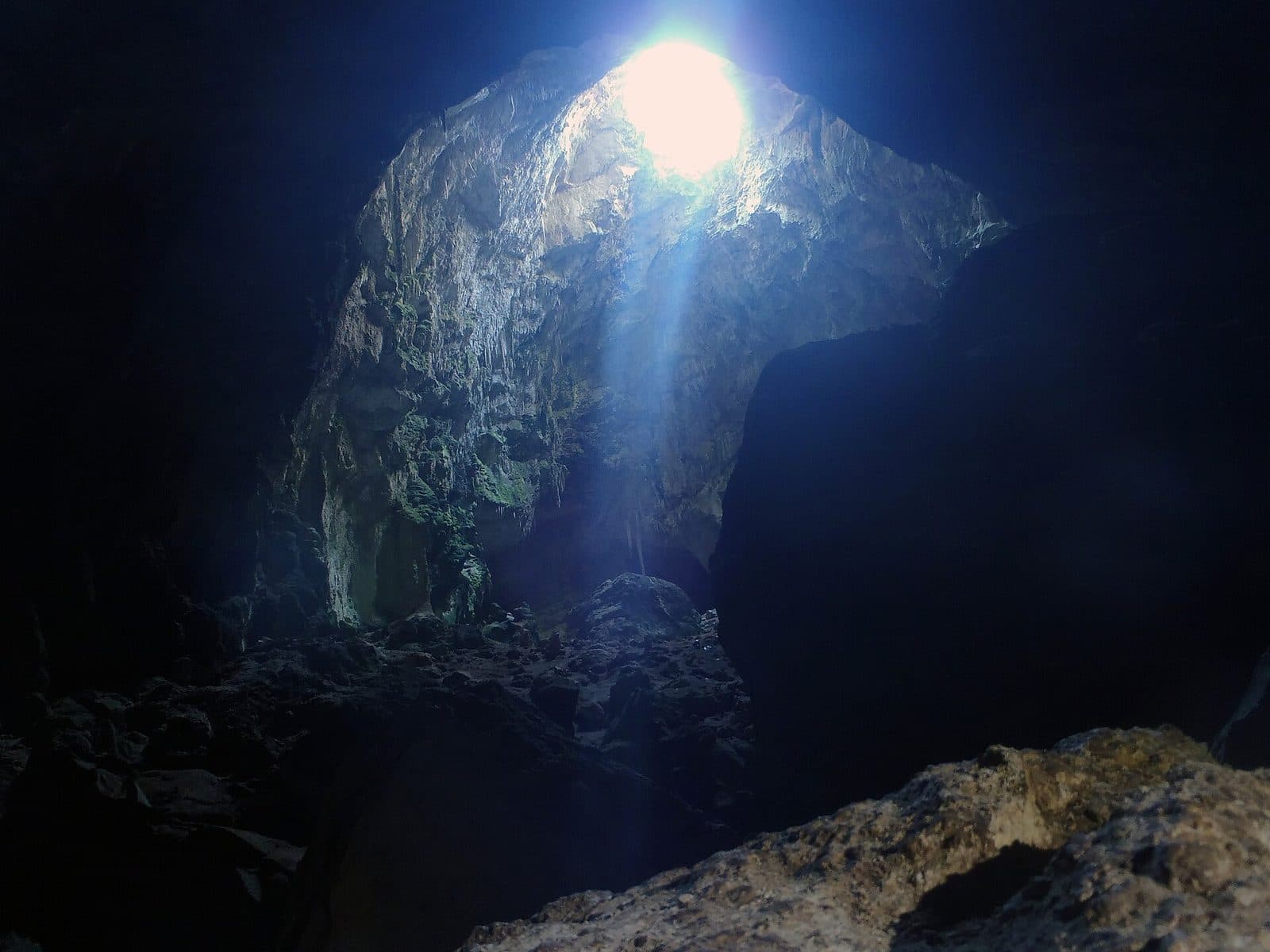

A bright circle high above the cave floor, with a vast chamber divided by flowstone formations below: Avenc de Son Pou near Son Coll is one of those places in Mallorca whose full impact only becomes apparent once you are inside. The natural opening lies in the ceiling of the karst cave. Sunlight enters through it into the large chamber, making the space feel more like an underground cathedral than a narrow rock fissure.
The route there is part of the experience. Avenc de Son Pou lies between the valley of Orient and the area around Santa Maria del Camí and is traditionally reached on foot. Anyone expecting a conventional show cave has come to the wrong place: this is a sensitive natural site in a hiking landscape, and access has at times been closed and made subject to a permit.
The cave is particularly rewarding for experienced hikers, visitors interested in natural history, and anyone seeking to understand Mallorca’s underground landscape away from the major show caves. The actual destination is not a succession of artificially staged halls, but a single main chamber with unusual proportions: from below, you can see the sky through the natural opening, while the historic tunnel enters the rock at the level of the cave floor.
The current access status should be checked before every trip. Old route descriptions and earlier visitor reports are not a reliable basis for planning: the cave was closed because of damage and sharply rising visitor numbers, and more recent information states that an official permit is required. Even when access is locked, the outing remains a hike through the Coanegra and Orient area – but entry into the cave must never be forced or attempted through the natural shaft opening.
History and significance
The natural shaft
Long before people could comfortably reach the cave floor on foot, Avenc de Son Pou was a predominantly vertical karst cavity. Its natural connection to the surface is the opening in the collapsed or exposed cave ceiling. The Mallorcan term “avenc” refers to a shaft or vertical cave formation and therefore describes precisely the feature that distinguishes this place from an ordinary grotto with a lateral entrance.
An early descent through the upper opening in the 19th century has been recorded. Such ventures had little in common with a modern cave visit: the natural entrance drops freely into the depths and requires caving equipment, experience, and safety techniques. Only a later intervention in the rock made it possible to reach the floor of the chamber without a vertical descent.
The tunnel and guano extraction
Toward the end of the 19th century, a horizontal tunnel was built at the level of the cave floor. Its purpose was not tourism: the artificial passage was intended to allow the bird guano accumulated in the cave to be extracted and transported out of the cavity. What is now perceived as an impressive entrance passage was therefore created out of commercial interest in a natural fertilizer.
The tunnel fundamentally changed the visitor experience. Instead of rappelling into the shaft from above, people could now walk through the mountain and enter the large chamber almost at floor level. This transition in particular explains part of the impact of Avenc de Son Pou: at first, the passage restricts the view to rock and darkness, before the high cave chamber reached by daylight suddenly opens up at the end. A solid gate at the tunnel entrance is now used to control and block access.
The treasure of Son Pou
The unusual cave also became part of Mallorca’s oral storytelling tradition. In a Rondalla collected by Josep Capó, Avenc de Son Pou conceals an enchanted palace with great halls, colored marble columns, living water, and a guarded treasure. Seven fairies are said to live there; during thunderstorms, they celebrate inside with music and dancing, while one of them always remains behind with the treasure.
The story does not provide a historical description of the cave, but it preserves an old way of viewing the place. A vast cavity accessible only through an opening in the mountain must have seemed like a world of its own. Flowstone formations could become the columns of a palace, and the light entering through the ceiling a sign of a hidden presence. In this way, the Rondalla combines real features of the Avenc with the characteristically Mallorcan belief that striking landscape formations were dwelling places of supernatural beings.
From hiking destination to protected site
As the cave became better known, visitor pressure increased sharply. Reports mentioned hiking groups with up to 300 participants, abandoned waste, and graffiti on the cave walls. In 2018, the Balearic regional government therefore announced the complete temporary closure of the cave, together with an investigation into its condition and the protective measures required. The owners of the estate and the municipality of Santa Maria del Camí were involved in this decision.
This development is now inseparable from the significance of the site. Avenc de Son Pou is not an adventure playground capable of withstanding unlimited use, but a sensitive natural environment on or adjacent to private land. The access restrictions protect flowstone formations and cave walls. Anyone wishing to visit the site must accept conservation rules, property boundaries, and a potentially required official permit process as part of planning the trip.
What to see
The cave cathedral
The first impression inside is shaped by a single vast volume. The floor lies far below the natural opening, while the walls rise on all sides and draw the eye upward. Because familiar points of scale are missing, the dimensions are initially difficult to grasp. Only a person at the opposite end of the space reveals how far the chamber actually extends.
This almost cathedral-like structure distinguishes Avenc de Son Pou from caves experienced as a succession of narrow passages and small chambers. Here, the eye does not stop at the next rocky projection, but travels from the floor across flowstone formations and irregular wall surfaces to the opening in the ceiling. The cave therefore feels less like an underground corridor than a great interior space carved out of the rock.
The natural ceiling opening
The defining feature lies above visitors. Daylight falls through the round opening in the cave ceiling and reaches the main chamber. The light changes with the weather and the position of the sun; it traces the contours of the opening and creates a visible connection between the cave floor and the outside world. Unlike in completely dark caves, there is no total separation from the landscape above the rock.
At the same time, the opening is the natural shaft entrance and a serious hazard. No hiking trail leads into the chamber from above. Descending from this side is a technical, vertical caving undertaking and belongs exclusively in the hands of properly equipped specialists. Only the artificial tunnel is intended for a regular visit – and even this may be entered only when access is expressly permitted and open.
The flowstone formations
Stalactites and stalagmites along the walls and floor give the large chamber additional structure. They do not form a museum-style illuminated backdrop; how they appear depends on the natural light and on a lamp brought by the visitor. The darker peripheral areas in particular show that although the light from the ceiling opening reaches far into the chamber, it does not illuminate every corner evenly.
The flowstone formations are not merely decoration. They form extremely slowly from mineral-rich seepage water and are sensitive to touch, contamination, and mechanical damage. Graffiti on the walls and rubbish left by previous visitors were therefore more than an aesthetic problem. In a cave like this, human interference remains visible for a long time and can permanently damage natural surfaces.
The artificial access tunnel
The historic tunnel cuts laterally through the rock and reaches the lower part of the chamber. It is straighter and lower than the cave space beyond, making the transition particularly striking. A headlamp or flashlight is already necessary in the passage; no one should rely solely on the daylight in the cathedral-like chamber.
A gate at the outer entrance can be used to close the tunnel. It is not an invitation to bypass, climb over, or force it open, but the visible boundary between the hiking trail and controlled cave access. Anyone who finds a closed gate there after a long hike must not assume that another entrance is permitted. The open shaft is not an alternative.
Light and scale
The strongest impression comes from the interplay of darkness and daylight. In the tunnel, the outside world initially disappears; in the chamber, it reappears as a bright opening far above. This almost automatically draws the eye toward the ceiling. At the same time, the light from the side emphasizes some rock surfaces more strongly than others, making the contours of the space appear different depending on where you stand. The documented large groups of the past also show how quickly the capacity of such a destination can be exceeded.
Visiting Avenc de Son Pou
A hike rather than a quick stop
Avenc de Son Pou is not a destination where you step out of the car directly in front of the entrance. Traditional routes approach either from Orient or via the Camí de Coanegra from the direction of Santa Maria del Camí. Depending on the starting point and route, roughly four to five hours are usually suggested for the outward and return journey. This time refers to the entire hike, not just the time spent in the cave.
From the Orient side, the route begins near the road between Bunyola and Orient. Among other directions, it follows signs toward Santa Maria and crosses stony terrain that is rougher in places. The route from Santa Maria follows the Camí de Coanegra and is longer. Access and parking regulations there have changed, so historical descriptions promising that most of the route can be covered by car should not be followed without verification.
Access only after checking current conditions
No fixed opening hours or reliable admission price have been recorded. Before setting out, you should therefore check whether the tunnel is currently accessible, whether a permit is required, and which rules apply to the land concerned. Older sources clearly contradict one another: some describe free access or access limited to certain days, while later reports mention a closure and the need for authorization.
For planning purposes, this means that the hike must not be based on the assumption that the gate at the end will be open. If access is closed, the cave visit ends there. Neither bypassing the barrier nor approaching the natural opening from above is an acceptable alternative. Anyone coming solely to see the interior should check the status especially carefully in advance.
Timing and daylight
Sufficient daylight should be allowed for the route. The stated four to five hours provide only a limited indication of breaks, navigation, and changing trail conditions; a tight schedule increases the risk of beginning the return journey at dusk. In winter, watercourses and the nearby Salt des Freu may provide additional interest.
It is not possible to name a universally best time of day for avoiding crowds when access is regulated. The first priority is having valid permission to enter. For the hike itself, an early start and a generous time reserve are more useful than hoping for a particular time window.
Time inside the cave
When access is officially permitted, the tunnel leads directly into the main chamber. For navigation, your lamp should already be within reach before entering the passage. In the cathedral-like chamber, it is worth not walking straight to the center, but consciously taking in the transition from the confined tunnel to the vast space. From different positions, the bright ceiling opening shifts in relation to the flowstone formations.
The visit should remain quiet and leave no trace. Flowstone formations must not be touched, walls must not be marked, and all waste must be taken away. Small numbers are especially appropriate for groups. The need for protection that led to the closure arose precisely from the cumulative effect of many supposedly minor actions and from visitor numbers for which the cave was not designed.
Getting there and parking
From Palma Airport to Son Coll
From Palma Airport, the drive follows the Ma-30, then the Ma-13 and the Ma-13A. Son Coll is 27 road kilometers away, and the journey takes around 50 minutes. These details expressly end in Son Coll, not at the entrance to Avenc de Son Pou. From there, the cave is not a conventional destination for direct access by car; the final section must be planned using a permitted hiking route.
Its location between the Orient valley and Santa Maria del Camí sometimes leads navigation services to suggest different approaches. However, what matters is not merely the shortest line on the map, but passable roads, current closures, and access across private land.
From central Palma to Son Coll
From central Palma, the route follows the Ma-13 and the Ma-13A. The journey to Son Coll covers 25 road kilometers and takes around 56 minutes. This time also applies only as far as Son Coll. Several additional hours must be allowed for the subsequent hike, depending on which permitted starting point is chosen.
The comparatively long driving time despite the moderate distance should not be underestimated when planning the day. The drive is followed not by a short visit, but by a hike with stony sections. The return drive, walking time, and sufficient daylight therefore all belong in the same schedule.
Parking at the trailhead
Older routes from the Orient side mention a pull-off on the road between Bunyola and Orient near Son Perot as a starting point. Other descriptions indicate that access and parking on the Camí de Coanegra were restricted and that vehicles had to be left farther away. A historical parking recommendation is therefore no guarantee of a legal or safe parking space today.
Parking is permitted only where there are no prohibitory signs and where property entrances, gates, and moving traffic are not obstructed. The particularly narrow roads in the Orient area are unsuitable for improvised roadside parking. Anyone preparing a route should check the permitted starting point just as carefully as access to the cave.
Public transport
No bus stop has been recorded in the immediate vicinity of Avenc de Son Pou. The outing therefore cannot be planned like a town attraction with a short walk from a bus stop. Larger vehicles are also problematic on the narrow roads; a documented school trip described even the bus journey through Orient as difficult and not worth repeating.
For travel without a private vehicle, the entire hiking itinerary must therefore be planned from a more distant location. Additional walking time, a reliable way to return, and the limited hours of daylight must all be considered. Taking a taxi to a starting point also does not automatically solve the question of how the return journey will be secured.
Nearby places
Son Coll
Son Coll is the reference point used in the driving information for the cave. The measured road routes from the airport and Palma end here; Avenc itself remains a hiking destination in the surrounding terrain. This distinction is important because an address containing a place name can easily create the impression that the cave entrance lies directly beside a driveable road.
The area marks a transition between the more accessible interior of the island and the more rugged landscapes on the edge of the Serra de Tramuntana. Anyone coming here should not plan the day as a sequence of several short sightseeing stops. The approach to the cave alone takes time and makes the landscape the true setting of the excursion.
Orient and the valley
Orient is the traditional reference point for one of the well-known hiking options. The small mountain village lies on the narrow road from Bunyola and is frequently associated with the path to Salt des Freu and onward toward Santa Maria. From this side, the route follows stony paths, passes through sections bordered by walls, and goes through gates or over stiles.
The valley offers an appealing landscape setting, especially outside dry periods. Nevertheless, Orient should not be treated merely as a parking area for the cave. The narrow roads and limited parking require consideration for residents, agriculture, and through traffic.
Camí de Coanegra and Santa Maria del Camí
From Santa Maria del Camí, a longer route approaches via the Camí de Coanegra. The path follows the valley northward and connects the cave with another side of the landscape. For hikers who prefer a longer approach, this route is an alternative to coming from Orient – provided that the paths and passages across properties are currently open.
Santa Maria del Camí is also suitable as the starting or finishing point for a day of hiking. However, the cave itself should not be confused with a visit to the town: a substantial walk separates the settlement, the end of the access road, and Avenc. Anyone starting the trip here should expect something closer to a half-day hike than a stroll.
Salt des Freu
Salt des Freu can be incorporated into routes from the Orient side. Its waterfall is particularly worth seeing after sufficient rainfall or in winter; during dry periods, significantly less water or none at all may be flowing. The detour should therefore not be mistaken for a waterfall guaranteed to be active throughout the year.
Salt des Freu works well as a combination because it lies within the same hiking area and complements the cave’s karst environment with a visible water feature. However, additional walking time and potentially wet ground must be taken into account. Combining both destinations definitively turns the outing into an extended trip.
The place it belongs to
Son Coll in the place guidePractical information for your visit
Footwear and trail conditions
Sturdy hiking boots are more important than special caving clothing. The described routes cross loose stones, rocky passages, and sections where carelessness may lead to slipping. Gates, narrow steps, or stiles may also form part of the route. Lightweight city shoes are unsuitable for both the approach and a potentially damp cave floor. The weather forecast should therefore be considered not only with regard to rain during the hike, but also to previous rainfall.
Light and navigation
A headlamp or reliable flashlight belongs in your pack even though daylight enters through the ceiling opening. The access tunnel and the peripheral areas of the chamber remain darker than the center of the cathedral-like space.
Depending on the direction, signs may point toward Orient or Santa Maria, but junctions and changes to property access can make old descriptions obsolete. The marked or permitted route must not be left: the area is riddled with caves.
Children and groups
The fact that school groups visited the cave in the past does not mean that every family hike is automatically suitable. Children need the stamina to walk for several hours, secure footing on stony terrain, and reliable supervision at gates and rougher passages. The natural shaft opening is a serious risk and not a viewpoint that should be approached.
Large groups are especially problematic. The documented damage and rubbish from previous visits were major reasons for the protective measures. Small, well-managed groups can remain quieter, keep the trail clear more easily, and better avoid the sensitive surfaces inside. Any official permit must include all participants.
Food, water, and responsible behavior
You should not expect reliable supplies along the actual hiking route. Water and necessary food must be carried from the starting point; packaging and organic waste must leave the area again in your backpack. Even supposedly compostable waste is a foreign object inside a cave.
Expectations of electric lighting or tourist staging should also be left at home. Avenc de Son Pou is not a developed visitor attraction. Its special character lies precisely in the natural space, the historic working tunnel, and the light entering through the open ceiling. Anyone who respects these conditions will also understand why a locked gate or required permit must be treated not as an annoying formality, but as a protective measure.
Local insider tips
Bring light for the tunnel
The ceiling opening illuminates the large chamber, but not the entire approach. A headlamp should be within reach before entering the historic tunnel; the peripheral areas of the cave cathedral remain especially dark.
Include Salt des Freu
Salt des Freu can be incorporated into the route from Orient. The waterfall is particularly interesting after sufficient rain or in winter; during dry periods, the water may stop flowing.
Find a sense of scale
The size of the cave cathedral is difficult to judge without a point of comparison. If access is officially permitted, looking toward people at the opposite edge reveals especially clearly how far the chamber extends.
Take the gate seriously
A locked tunnel must not be bypassed. The natural opening is not an alternative hiking entrance, but a deep shaft. Before the trip, you should therefore confirm whether a permit is required and whether entry is allowed.
Do not plan it as a quick stop
The well-known approaches are hikes lasting several hours. Depending on the starting point, approximately four to five hours are suggested for the outward and return route; driving time, breaks, and a possible combination with Salt des Freu must be added.