
creu de l'Ullastre in Andratx
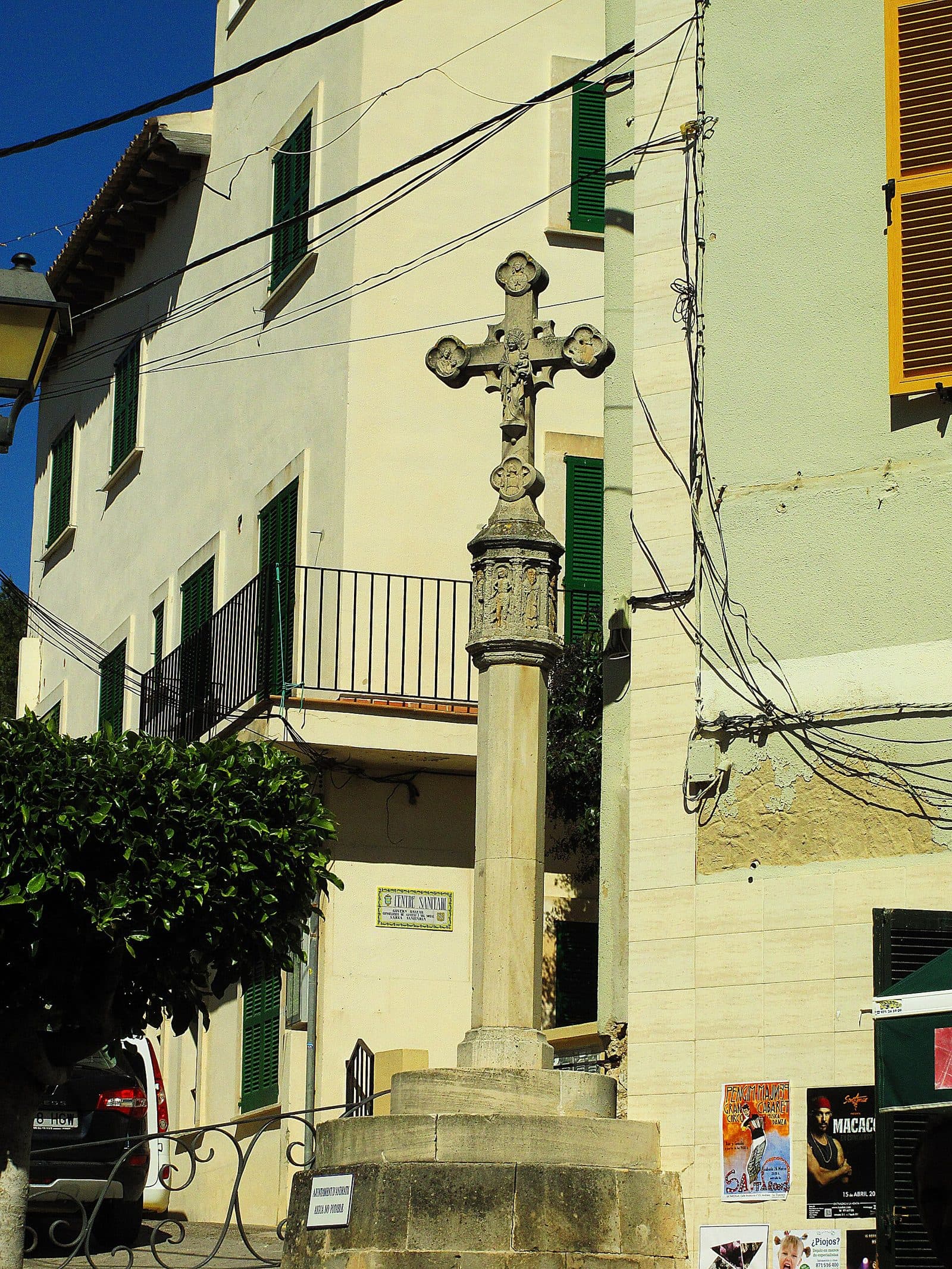
.jpg)
The creu de l'Ullastre is one of those small historical landmarks that are easily overlooked in the streetscape yet reveal a great deal about Mallorca's cultural landscape. The cross stands in Andratx in the southwest of the island and is listed as a creu de terme, meaning a wayside or boundary cross. It is not a major attraction with a visitor route, but a protected small monument whose impact comes from its form and location. That is precisely where its appeal lies: amid the everyday routes through Andratx, a historical monument appears as part of the townscape.
A visit is especially worthwhile for travelers who appreciate historical details beyond major churches and castles. The creu de l'Ullastre does not require a long stay, but instead rewards a close look at a historical monument in Andratx.
Clear identification is important: this is the protected cross in Andratx. Villas, property developments, and accommodations with the same name around Port d'Andratx are different places. Nor should it be confused with a cross near Vilafranca de Bonany described online.
History and significance
A creu de terme
The monument register lists the site as a creu de terme. The Catalan term refers to a historical type of cross. For the creu de l'Ullastre, this classification is more important than any spectacular construction history. In Andratx, the monument is recorded as a historical cross and protected cultural property. It stands within the built-up town and forms part of the present-day streetscape.
Protection as cultural heritage
The Creu dels Ullastres – the monument also appears under this plural form of the name in the Catalan register – is listed as a Bé d'Interès Cultural. Its registered protection dates from 25 September 1998, and the corresponding identifier is RI-51-0010249. This date refers to its legal recognition as a monument, not to the construction of the cross. It should therefore not be used to infer when the cross was built.
Its protected status draws attention to a type of monument that, because of its small size, is quickly overshadowed by larger structures. A wayside cross has neither monumental walls nor interior spaces, but it is directly visible in the townscape. Its value is made clear by its designation as cultural heritage.
Two traditional names
The name creu de l'Ullastre is common in German and tourist usage, while the Catalan cultural heritage entry refers to the Creu dels Ullastres. Both spellings are useful when preparing a visit: they lead to the monument in Andratx while helping to filter out the many other places with “Ullastre” in their names.
What to see
The cross
The clear shape of the cross is the focal point. Unlike a church visit, there is nothing to discover behind a façade: the monument itself and its silhouette make up the entire historical ensemble. Changing your viewing angle is therefore more important than looking for an entrance. From a short distance, the form stands out more strongly; from farther away, the shape of the cross can be seen in relation to the surrounding buildings.
The street corner in Andratx
A historical photograph or documentation shows the creu de terme on a corner in Andratx. The location is not a scenic hilltop viewpoint but part of the built-up town. This creates an appealing contrast: the historical cross does not stand in isolation against a museum-like backdrop but encounters passersby amid present-day life.
This context is essential when viewing it. Only by looking beyond the cross does it become clear why a small monument is protected here. Its position on the street corner also explains why the creu de l'Ullastre can easily go unnoticed during a quick drive through Andratx. It depends on proximity and attention, not on being visible across a broad landscape.
What is not part of the monument
Several search results for the name “Ullastre” lead to modern villas and estates on the La Mola peninsula near Port d'Andratx. Their sea views, gardens, terraces, and architecture have nothing to do with the historical creu de l'Ullastre. Nor is this the cross near Vilafranca de Bonany described as a hilltop destination. Descriptions of views in the island's interior must therefore not be applied to the location in Andratx.
Accordingly, visitors should not expect an accessible building, exhibition space, or viewpoint. The experience centers on the cross and its place in the streetscape. Those who accept this scale will discover a precise historical detail rather than a staged tourist attraction.
Visiting the cross
The cross can be appreciated through a few quiet observations. First, it is worth viewing it from some distance to take in its silhouette and position on the corner. Up close, its form then becomes clearer. Because there is no interior and no signposted visitor route, the length of the visit depends on personal interest: for some, it will be a brief stop during a walk through Andratx, while others will take time for photographs and comparisons with other historical traces around the town.
The street setting requires more attention than an enclosed museum site. When looking for a good viewing angle, the roadway, property boundaries, and possible driveways should be respected. Especially with children, the creu de l'Ullastre is better suited to a shared observation stop than to a place for exploring freely. The monument itself should, of course, not be climbed or used as a seat.
Opening hours and admission details have not been reliably documented. Before making a dedicated journey, it is therefore advisable to check current local information, especially if the visit is intended to include a guided tour or specific access. The outward appearance of a cross in a public street setting should not automatically be taken as confirmation that every adjacent area is open to the public.
A particular time of day for avoiding crowds is less important for this small monument than good visibility and careful awareness of traffic. It works best as a deliberately planned stop along a route through Andratx, not as a destination expected to offer an extensive sightseeing program.
Directions and parking
From Palma Airport
The stated distances and driving times lead to Andratx, not directly to the cross. Palma Airport is 39 kilometers away by road, and the drive takes around 35 minutes. The route initially follows the Ma-20 and then the Ma-1 into southwestern Mallorca. Only after arriving in Andratx does the local search for the creu de l'Ullastre begin.
For the final section, the Catalan register name “Creu dels Ullastres” is helpful as an additional search term. It reduces the risk of navigation leading to a villa, vacation home, or property development with a similar name. Andratx should be explicitly confirmed as the destination.
From central Palma
The road distance from central Palma to Andratx is 29 kilometers. The drive takes around 34 minutes and follows the Ma-1. These figures also end in Andratx; the exact onward journey to the monument must still be added. Because the cross is part of the local streetscape, a zoomed-in map view is recommended for final navigation rather than a simple name search across the entire island.
No confirmed parking area directly beside the cross has been documented. It is therefore advisable to park only in officially designated spaces in Andratx and complete the final section on foot, provided local conditions allow. A brief photo stop must not block driveways or traffic at the street corner.
By bus to Andratx
The stops Son Sampol, Supermercat, and Torrent are listed nearby. Which is most convenient for a particular connection and the subsequent walk depends on the route, direction of travel, and current timetable. Before departure, it is therefore advisable to compare not only the stop name but also the cross's exact location on the map. For the return journey, it is helpful to mark the appropriate stop upon arrival.
Local insider tips
Search using both names
In addition to creu de l'Ullastre, the Catalan monument register uses the name Creu dels Ullastres. The second spelling helps with navigation and distinguishes the cross from villas and vacation homes named Ullastre.
Step back before viewing the details
First view the shape of the cross together with the street corner, then move closer to the stone. This reveals both its former function as a wayside marker and the quality of its craftsmanship.
Interpret the protection date correctly
25 September 1998 refers to its registered recognition as cultural heritage, not the year it was built. Knowing this detail prevents a common misinterpretation of the monument register.
Bus lines to creu de l'Ullastre at a glance
| Line | Route | Departures/day | First | Last |
|---|---|---|---|---|
| 121 | Sant Elm - Andratx | 71 | 07:35 | 21:57 |
| 122 | Port d'Andratx - Santa Ponça | 70 | 06:28 | 23:45 |
| 101 | Port d'Andratx - Palma | 33 | 06:18 | 23:45 |
| 131 | Santa Ponça - Banyalbufar | 4 | 10:40 | 17:00 |
From the official GTFS feeds (TIB/SFM), no real-time data. The figures cover all stops in the town; weekend and holiday services differ — check with the operator before travelling.
Getting there by bus
Son Sampol (5035) · 0.5 km as the crow flies
- 121Sant Elm - Andratx · Daily
Supermercat (5030) · 0.7 km as the crow flies
- 101Port d'Andratx - Palma · Daily
- 121Sant Elm - Andratx · Daily
- 122Port d'Andratx - Santa Ponça · Daily
- 131Santa Ponça - Banyalbufar · Daily
Torrent (5031) · 0.7 km as the crow flies
- 101Port d'Andratx - Palma · Daily
- 121Sant Elm - Andratx · Daily
- 122Port d'Andratx - Santa Ponça · Daily
- 131Santa Ponça - Banyalbufar · Daily
Timetable data: official GTFS feeds (TIB/EMT), no real-time — check with the operator before travelling.