
Fosa Séptica in Mallorca: Operating a Septic Tank Legally
Anyone who owns a finca without a mains sewer connection and instead uses a fosa séptica often assumes this means being "outside the system" – no sewer charge, no wastewater levy. That's a misconception with tax consequences. The Balearic tax authority ATIB levies the canon de saneamiento de aguas regardless of whether the wastewater is disposed of via a public network or directly via one's own septic tank. This guide explains why having a fosa séptica in Mallorca does not exempt you from the wastewater levy, who must register within which deadline, what happens if you fail to do so, when the annual declaration is due – and where the water-law aspects of your septic tank are regulated.
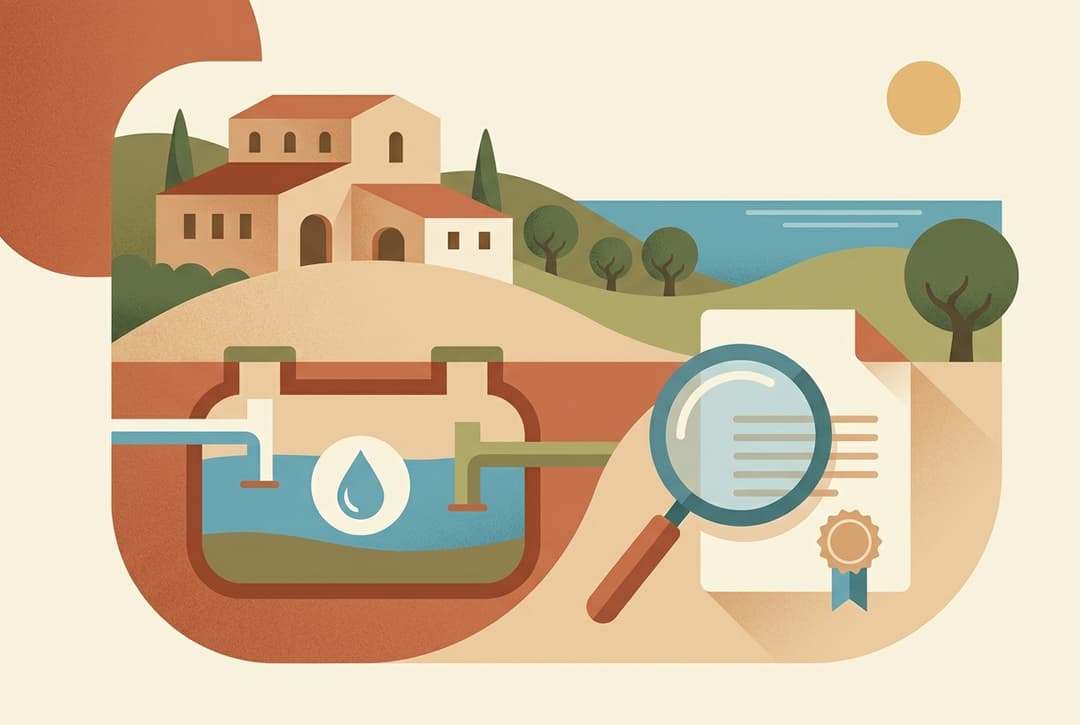
The misconception: no sewer connection, no wastewater levy?
The misunderstanding is understandable, because intuitively it sounds logical: without a connection to the public sewer network, surely there's nothing to pay for. However, in its definition of the taxable event (hecho imponible), ATIB makes clear that the canon de saneamiento is linked to the discharge of wastewater – measured by water consumption, regardless of its origin. This applies explicitly both to discharges into public or private sewer networks and to those made directly into the natural receiving medium. That is exactly what a fosa séptica does: it discharges pre-treated wastewater into the ground – i.e. directly into nature, not into a pipe system. For tax purposes, this makes no difference.
Having your own well doesn't protect you from the levy either. The taxable event is linked to water consumption "de cualquier procedencia" – that is, regardless of whether the water comes from the public network, a private well, or another source. The only explicit exception concerns rainwater collected in cisterns or aljibes.
| Case | Subject to canon? |
|---|---|
| Wastewater discharged via public sewer network | Yes |
| Wastewater discharged via fosa séptica directly into the ground | Yes |
| Water consumption from own well (aprovechamiento privativo) | Yes |
| Rainwater from cistern (aljibe/cisterna) | No, explicitly exempted |
Note: The canon de saneamiento is purely a tax matter handled by ATIB. Whether your septic tank is technically and legally operated in compliance with water regulations is a separate issue, independent of this – more on that below.
Legal basis: where the canon de saneamiento comes from
The basis for the levy is the Texto refundido de la Ley 9/1991, de 27 de noviembre, reguladora del canon de saneamiento de aguas, consolidated by the Decreto Legislativo 1/2016, de 6 de mayo. This version is currently in force. A later amendment, the Disposición final vigésima quinta of Ley 4/2026, de 11 de junio, concerns, according to its content, the compensation of municipalities and public bodies for the operation and maintenance of treatment plants – not the tax liability of the individual owner.
| Norm | Regulatory content | What it means for you |
|---|---|---|
| Ley 9/1991 (Texto refundido) | Basic law on the canon de saneamiento de aguas | Establishes the levy as such |
| Decreto Legislativo 1/2016, de 6 de mayo | Consolidated, current version of the law | Current legal basis |
| Ley 4/2026, de 11 de junio (Disp. final 25ª) | Regulation on reimbursement of costs to municipalities for treatment plants | Does not change your obligation to register and pay |
Who must register – and within what deadline
The ATIB names two groups of people who must submit a declaración de alta: owners of urban, IBI-liable properties that are not connected to the public water supply network, as well as holders of private usage rights to public waters (aprovechamientos privativos de aguas públicas) – typically, therefore, well owners. This applies exactly to the classic finca with its own well and fosa séptica.
The deadline for this initial registration is six months from the point at which the tax liability begins.
| Group | Requirement | Registration deadline |
|---|---|---|
| Owners of urban properties (IBI-liable) | No connection to the public water network | 6 months from the start of the tax liability |
| Holders of private water usage rights | Aprovechamiento privativo de aguas públicas (e.g. own well) | 6 months from the start of the tax liability |
- Check whether your own property is IBI-liable and not connected to the public network.
- Check whether a private water usage right exists (e.g. a registered well).
- Submit the declaración de alta to the ATIB within the six-month deadline.
- Report any changes to the declared data in subsequent years within the deadline (see below).
What happens if the registration is missed
The ATIB does not leave it to chance whether unconnected properties are recorded. According to its own statements, the tax administration departments of the canon de saneamiento formalise the registration in the Contribuyentenregister ex officio for everyone who is not connected to the water supply network and has not fulfilled their declaration obligation. This is followed by a tax assessment for all periods that are not yet time-barred – i.e. retroactively.
Attention: Failing to register does not mean that no liability arises. It means that the ATIB carries out the registration itself and assesses retroactively for all periods that are not yet time-barred. The ATIB source does not specify a concrete number of years for the limitation period – that is a matter for individual tax advice.
Anyone unsure whether their own finca is already registered should clarify this proactively rather than waiting for a letter from the authorities.
The annual declaration: only in case of changes, but with a fixed deadline
Since 1 January 2023, taxpayers have been obliged to submit a tax declaration for the previous financial year, i.e. as at 31 December of the preceding year – but only if previously declared elements have changed. This declaration must contain all the information necessary for assessing the canon and must be submitted before 28 February of each year.
| Event | Deadline / date |
|---|---|
| Initial registration (declaración de alta) | Within 6 months of the start of the tax liability |
| Annual declaration in case of changed information | Before 28 February of each year |
| Start of the annual declaration obligation | Since 1 January 2023 |
Note: Without any change to the declared elements, no renewed declaration obligation arises for the respective year. So anyone who continues to use the same property unchanged does not automatically have to submit a new declaration every year – but must do so as soon as something changes, such as a new well, a change of use, or a change of ownership.
Exemptions: agriculture yes, finca romanticism no
The ATIB names a clearly defined exemption: exempt from the levy is the discharge of wastewater by agricultural, livestock, forestry or mixed operations (agricultural, livestock, forestry or mixed holdings) as well as water intended for public fire-fighting services.
The precise reading matters here: the exemption is tied to the holding (explotación) – not merely to the location in a rural area. A finca that is mainly used as a residence or holiday property is not automatically exempt from the levy just because it is located on suelo rústico. Whether a specific finca qualifies as an agricultural holding within the meaning of this rule is a matter for tax advice and should be assessed individually.
| Situation | Exempt from the canon? |
|---|---|
| Active agricultural, livestock or forestry holding | Yes, explicitly exempt according to ATIB |
| Finca on suelo rústico without an active agricultural operation, privately inhabited | No, no automatic exemption |
| Water for public fire-fighting services | Yes, explicitly exempt |
The second issue: water law at the Dirección General de Recursos Hídricos
The canon de saneamiento is a tax matter. Whether your fosa séptica itself is operated correctly under water law – i.e. whether and how the discharge must be authorised, what technical requirements apply, or what documents an authorisation procedure requires – is a separate, distinct question. Responsibility for this lies with the Dirección General de Recursos Hídricos of the Govern de les Illes Balears, based within the Consejería del Mar y del Ciclo del Agua. According to its own description of responsibilities, it is in charge of water planning, the dominio público hidráulico and water law regulation, water supply and wastewater treatment, as well as initiating and deciding on sanction proceedings within its remit.
Note: This guide deliberately does not cover the authorisation procedure for discharge (autorización de vertido), the minimum technical requirements for the installation, or the distances required from wells and property boundaries. No verified official information is available on this that could be reliably reproduced here. Anyone needing clarity on this should contact the Dirección General de Recursos Hídricos directly or consult a specialised local expert.
The connection between the fosa séptica and a possible holiday rental licence or the cédula de habitabilidad has also not been reviewed here and is therefore deliberately not covered.
The most common mistakes regarding the fosa séptica
The following misconceptions come up again and again in practice:
| Misconception | Why it is wrong |
|---|---|
| "Without a mains sewer connection, I don't pay the canon de saneamiento" | The taxable matter is the discharge of wastewater, regardless of the mains sewer connection |
| "My own well makes me exempt from the levy" | Consumption "de cualquier procedencia" (from any source) is decisive, the well counts too |
| "My finca is out in the countryside, so I'm a farmer within the meaning of the exemption" | The exemption is linked to actual operation (explotación), not to location |
| "If nobody asks, it goes unnoticed" | The ATIB registers unconnected properties ex officio and assesses them retroactively |
| "Tax authorisation and water-law authorisation are the same procedure" | The canon runs through the ATIB, while the discharge permit runs through the Dirección General de Recursos Hídricos |
What comes next?
After the initial registration with the ATIB, the matter doesn't end automatically. Two points remain ongoing: first, the annual monitoring obligation – as soon as something changes on your property (new well, changed use, change of owner), this must be declared before 28 February of the following year. Second, the water-law side, which must be resolved independently of the tax question with the Dirección General de Recursos Hídricos, particularly if you plan structural changes to your finca's water supply or wastewater disposal.
Anyone reorganising their finca's water supply anyway, for example through well construction or cistern expansion, should use this opportunity to check both sides – tax and water law – together.
Checklist: Operating a fosa séptica legally in Mallorca
- Check whether the property is subject to IBI and not connected to the public water network.
- Check whether a private water usage right (well) exists.
- Submit the declaración de alta to the ATIB within six months of the start of tax liability.
- Check annually whether declared elements have changed – if so, submit the declaration before 28 February.
- Check whether your own finca actually qualifies as an agricultural, livestock or forestry operation within the meaning of the exemption, rather than simply assuming so.
- Resolve the water-law side (discharge permit, technical requirements) separately with the Dirección General de Recursos Hídricos.
- If in doubt, involve a German-speaking tax adviser or gestoría as well as a specialist company for water and wastewater technology.
Conclusion
The fosa séptica is the reality on many Mallorcan fincas, not the exception – but it is not exempt from the canon de saneamiento. The levy is linked to water consumption, regardless of its source, and therefore also affects owners with their own well and their own septic tank. Anyone who registers on time avoids the retroactive ex officio assessment. Anyone who additionally clarifies the water-law side with the responsible authority has their finca properly set up on both fronts – for tax purposes with the ATIB, and for water-law purposes with the Dirección General de Recursos Hídricos.
Official sources
- Agencia Tributaria de les Illes Balears (ATIB), information page on the canon de saneamiento de aguas: https://www.atib.es/TA/contenido.aspx?Id=9858&lang=es
- Govern de les Illes Balears, Dirección General de Recursos Hídricos: https://www.caib.es/webgoib/es/w/direccion-general-recursos-hidricos