
Declaración de Interés General (DIG) for suelo rústico in Mallorca
Anyone who owns a plot of land in suelo rústico on Mallorca and wishes to use it for something other than conventional agriculture or a single-family home will quickly come up against a wall of planning law, environmental protection, and jurisdictional questions. The Declaración de Interés General Mallorca — DIG for short — is the official route for legally navigating that wall. Under certain conditions, it permits uses on rural land that are neither prohibited nor automatically authorised: from agritourism and renewable energy to educational facilities or artisan businesses. In this guide you will learn about the legal basis behind it, which activities are eligible in the first place, how the procedure at the Consell de Mallorca works, which documents you need — and where the most common mistakes occur.

What is the Declaración de Interés General — and why does it exist?
A considerable proportion of Mallorca's land area consists of suelo rústico. Under the law, this land is protected from urban development — it is intended to preserve agricultural, ecological, and cultural values. Spanish and Balearic law distinguish, with regard to rural land, between permitted uses (e.g. agriculture, a single-family home on a minimum-sized plot), prohibited uses and a third category: uses that are neither expressly permitted nor prohibited, but can only be authorised if a public interest is demonstrated.
It is precisely for this third category that Article 26 of the Ley del Suelo Rústico de las Islas Baleares (LSRIB, Ley 6/1997) creates the DIG. The procedure ensures that such activities are subject to an individual assessment by the authorities before planning permissions or changes of use can be granted.
Please note: The DIG is not a blank cheque. It is a prerequisite — not a guarantee. Only after a positive declaration can the actual planning permission be applied for at the competent municipal planning office.
Legal basis: what the law actually says
The key provision is Article 26 of the LSRIB (Ley 6/1997). The most important points at a glance:
| Aspect | Provision under Art. 26 LSRIB |
|---|---|
| Scope of application | Uses that are not prohibited but are also not automatically authorised — and do not constitute residential use |
| Jurisdiction | Consell de Mallorca (Urbanismo department) as the standard case; Govern Balear in the cases referred to in Art. 3.4 Ley 9/1990 |
| Substantive requirement | Contribution to rural planning or development (ordenación o desarrollo rurales), compatibility with the level of protection applicable to the zone |
| Preferred cases | Preservation of buildings with ethnological or architectural value; new activities in derelict buildings not yet declared out of use |
| Structural/building technical obligation | Same conditions as for a detached house (Titles III and IV LSRIB), except where the DIG declaration expressly permits exemptions |
The term "rural order or development" is specifically defined in the law: it refers to public policies that preserve and expand the economic base of rural areas — through competitive, multifunctional activities and a diversification of the economy with new, sustainably compatible uses. The Consell de Mallorca may give the term specific shape for Mallorca.
Who is responsible? Consell de Mallorca vs. Govern Balear
For Mallorca, the following applies: The competent authority is in most cases the Consell de Mallorca, Department of Urbanisme. According to its own documentation, this department expressly handles Expedientes de Declaración de Interés General for activities on suelo rústico.
In certain special cases — specifically where Article 3.4 of Ley 9/1990 applies, which assigns the Consejos Insulares competences in urban planning and habitability — responsibility lies with the Govern de les Illes Balears. In practice, this primarily concerns projects with spatial planning relevance beyond Mallorca or certain strategic undertakings.
| Case type | Competent authority | Contact/submission |
|---|---|---|
| Standard DIG on Mallorca | Consell de Mallorca, Dept. Urbanisme | Sede Electrónica: seu.conselldemallorca.net |
| Strategic projects / Art. 3.4 Ley 9/1990 | Govern de les Illes Balears | caib.es |
| Energy projects on suelo rústico | Conselleria d'Empresa / Direcció General d'Energia | caib.es/sites/energiaicanviclimatic |
Please note: The application is submitted via the electronic administration portal. The Sede Electrónica of the Consell de Mallorca (seu.conselldemallorca.net) lists the procedure under the heading "Declaración de Interés General" together with the relevant forms.
Which activities are eligible for a DIG?
Art. 26 LSRIB does not provide an exhaustive list — instead it sets out criteria. Typical categories can be identified from practice and the text of the law:
| Activity category | DIG generally possible? | Special conditions |
|---|---|---|
| Agrotourism / Agroturismo | Yes | Must promote rural development |
| Educational and research institutions with a rural focus | Yes | Proof of rural connection required |
| Artisan businesses (Artesanía) | Yes | Compatibility with the protection level of the zone |
| Renewable energy installations (e.g. photovoltaic) | Partly special procedures | Energy projects often via DG Energía |
| Cultural facilities / Ethnological use | Yes, preferred | Preservation of buildings with ethnological value |
| New activity in derelict buildings | Yes, expressly preferred | Building must not have been declared out of use |
| Holiday letting (ETV) | No / Special regime | Own licensing system, currently largely restricted |
| Pure residential use | No | Own regime (Vivienda unifamiliar) |
| Prohibited uses under protected area law | No | Even a DIG cannot remedy a prohibited use |
Please note: Whether a specific activity in a particular protected zone (e.g. ANEI, ARIP) can be approved via a DIG at all depends on the respective level of protection. In ANEI areas the scope is very limited — even a DIG cannot permit a use that protected area law categorically excludes. More on this in the guide ANEI & Nature Conservation on Mallorca.
Suelo Rústico on Mallorca: Categories and Their Relevance for the DIG
Not all suelo rústico is the same. The LSRIB and Balearic spatial planning regulations distinguish several protection categories that determine what is possible in the first place:
| Category | Characteristic | DIG Scope |
|---|---|---|
| Suelo rústico común / general | Agriculture without special protected designation | Relatively broad |
| ANEI (Área Natural de Especial Interés) | Highest level of nature protection (Ley 1/1991) | Very narrow; many uses categorically excluded |
| ARIP (Área Rural de Interés Paisajístico) | Landscape protection | Moderate; assessed on a case-by-case basis |
| APR (Área de Prevención de Riesgos) | Risk zone (fire, flooding) | Restricted |
| Suelo rústico protegido (agricultural, forestry) | Specialist protected designation | Dependent on the specific instrument |
Before submitting any DIG application, it is therefore advisable to carry out a thorough review of the classification of the plot in the Land Registry and the municipal cadastre, as well as in the Plan Territorial de Mallorca.
The DIG Process: Step by Step
The process is multi-stage and can — depending on the complexity of the project and the workload of the authorities — take considerable time. Realistic planning should allow for a minimum of 12 to 24 months.
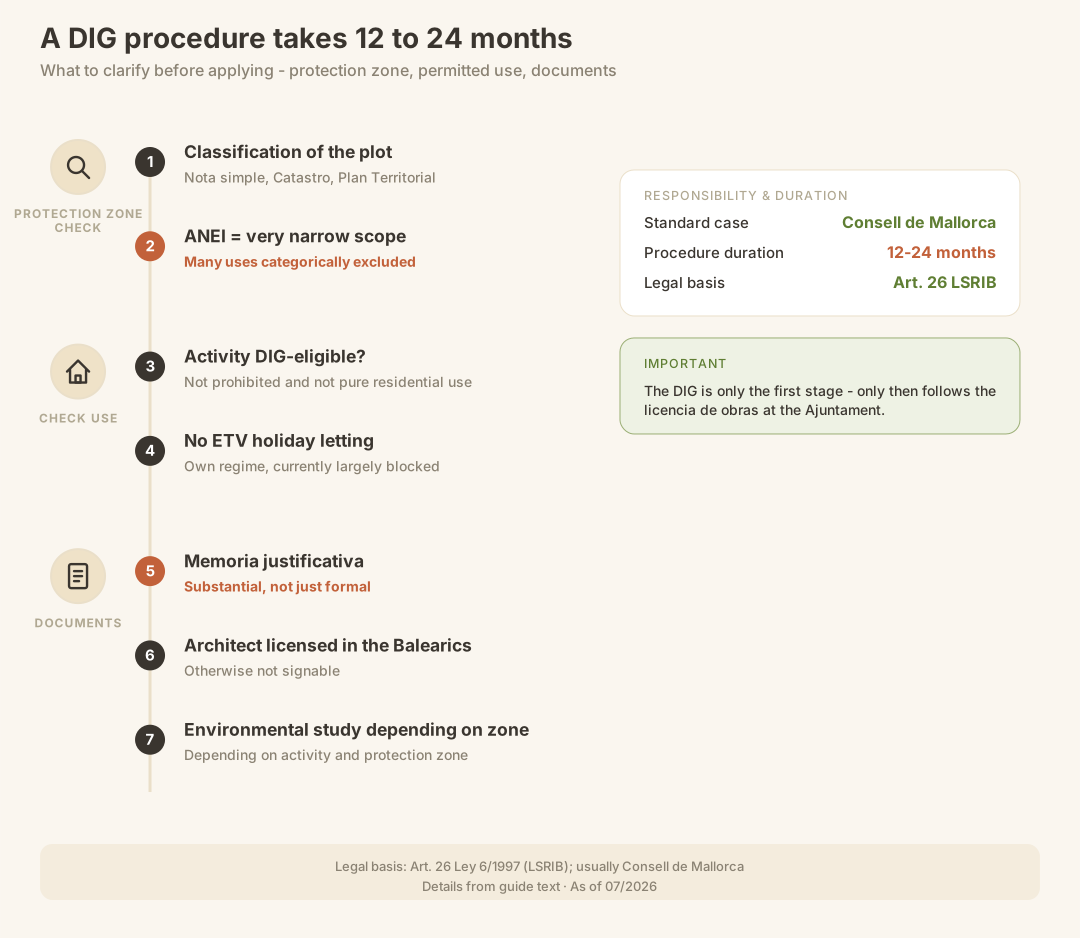
Preliminary Review and Classification of the Plot Determination of the precise category of suelo rústico, the applicable protection instruments, and the fundamental permissibility of the planned activity.
Pre-Application Consultation (consulta previa) Informal discussion with the Dept. Urbanisme of the Consell de Mallorca. Not strictly required, but in practice extremely valuable for clarifying basic feasibility and the documents needed.
Preparation of the Project Documentation An authorised architect or technician prepares the required plans and project documentation. The building conditions for single-family dwellings on suelo rústico (Titles III and IV LSRIB) must generally be observed, unless the DIG provides for an exemption.
Submission via the Sede Electrónica Filing through the electronic register of the Consell de Mallorca (seu.conselldemallorca.net). Complete documentation is a prerequisite for acceptance.
Completeness Check The administration checks whether the application is formally complete. If there are deficiencies, a request for remediation will be issued.
Technical assessment and, where applicable, environmental review Depending on the nature of the activity, an environmental impact assessment must be obtained. External specialist bodies will be involved.
Public participation (información pública) The project is made available for public inspection. Third parties may raise objections.
Resolution by the Consell de Mallorca Grant or refusal of the DIG. The declaration may include conditions and requirements.
Planning permission from the municipal planning authority Only after a positive DIG can the actual planning permission (licencia de obras) be applied for at the relevant municipal planning authority (Ajuntament).
Registration in the Land Registry Once all works have been completed and all permits obtained, the change can be registered in the Land Registry.
Typical documents required for the DIG application
The following overview is based on the general requirements of Balearic administrative law and Art. 26 LSRIB. The Sede Electrónica of the Consell de Mallorca sets out the currently applicable form requirements in a binding manner.
| Document | Purpose |
|---|---|
| Instancia/Application (Consell form) | Formal submission of application |
| DNI/NIE/CIF of the applicant | Identification |
| Land registry and cadastral extract (Nota simple, Catastro) | Proof of ownership and classification |
| Technical project (architect/technician) | Description of the project, plans, calculations |
| Memoria justificativa | Justification of the general interest within the meaning of Art. 26 LSRIB |
| Environmental study (estudio ambiental) | Depending on the activity and protected zone |
| Evidence of any existing permits | Existing rights situation of existing buildings |
| Power of attorney (if not submitting in person) | Authorised Representative |
Note: Anyone wishing to issue a power of attorney for the procedure will find further information in the guide Power of Attorney Spain Notary.
DIG and the Legalisation of Existing Buildings: What the Decreto Ley 3/2024 Changes
Since the Decreto Ley 3/2024, de 24 de mayo, the Balearic Islands have had an extraordinary legalisation procedure for buildings and uses on suelo rústico where the administration's right to reinstatement has already become time-barred. This so-called "amnistía urbanística" is conceptually distinct from the classic DIG, but in practice is closely linked to it:
- The legalisation procedure applies to buildings and uses that have been placed outside the planning framework (fuera de ordenación) and for which the limitation period has expired.
- It requires an assessment of whether the specific circumstances of the development's origin permit its application.
- There are express grounds for exclusion — for example, buildings in protected zones to which special provisions of the Ley 1/1991 apply.
- An express condition: legalised residential buildings may not be marketed as tourist holiday lets (plazas turísticas). This exclusion is recorded in the legalisation project and entered in the Land Registry.
The procedure under Decreto Ley 3/2024 is time-limited — three years from the date of entry into force. It does not replace the DIG, but in cases involving existing buildings it can serve as a route into a regular planning permit. More on this in the guide Legalising Unauthorised Buildings Mallorca.
Strategic Projects: Decreto-Ley 8/2025 and Its Significance for suelo rústico
The Decreto-Ley 8/2025, de 5 de diciembre (published in the BOE Nr. 8 of 9 January 2026) introduces measures to accelerate strategic projects intended to contribute to the economic transformation of the Balearic Islands. The context: according to forecasts by the Dirección General de Economía y Estadística, growth in gross value added for the Balearic economy is expected to be around 2,7 % in 2025 — following a record year in 2024 with growth of 4,0 %.
Of relevance to suelo rústico is the fact that the decree-law is intended to simplify and accelerate procedures for so-called "proyectos estratégicos". Anyone planning a project that could be classified as a strategic project should examine whether this instrument represents a viable alternative or complement to the classic DIG. As a rule, such a project is handled via the Conselleria d'Empresa, not through the Consell de Mallorca.
The Most Common Mistakes in the DIG Procedure
These are the mistakes that experienced lawyers and architects encounter time and again in practice:
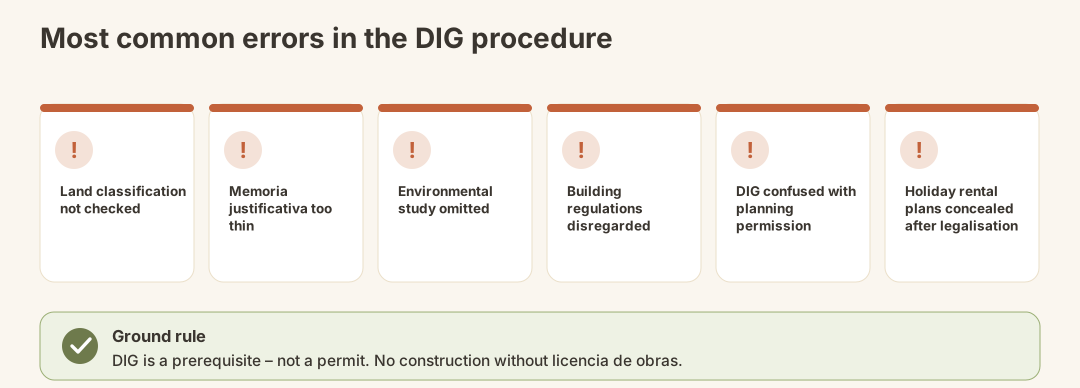
Failure to verify land classification in advance: Many applicants are unaware that their plot lies within, for example, an ANEI — where certain activities are categorically excluded. The first essential step: Nota simple + municipal development plan + Plan Territorial.
Memoria justificativa too thin: The authority must be able to understand why the project serves the "Interés General" and contributes to rural development. A formal statement is not enough — substantive argumentation is required.
Environmental study omitted or underestimated: Particularly near protected zones, an incomplete environmental impact assessment can bring the entire process to a halt.
Technical building standards for suelo rústico disregarded: Art. 26 LSRIB generally binds DIG projects to the same technical conditions as single-family homes in suelo rústico. Exceptions must be actively applied for and justified.
DIG confused with planning permission: The DIG is only the first stage. Construction may not begin without a subsequent licencia de obras from the local planning authority.
Holiday rental plans concealed after legalisation: Anyone who legalises an existing building under Decreto Ley 3/2024 and then converts it to tourist rental use is in breach of a restriction registered in the land registry — with significant consequences.
Process started without a lawyer or architect holding Balearic accreditation: The process is complex and strictly form-bound. An architect without accreditation for the Balearen cannot sign the required project documentation.
What comes after the DIG?
A positive DIG is the starting point, not the finish line. Several further steps follow the declaration:
- Building permit (licencia de obras) from the competent Ajuntament — the municipality in which the plot is located.
- Cédula de Habitabilidad, if residential use is planned or already in place. More on this: Cédula de Habitabilidad Mallorca.
- IBI adjustment: Following a change of use, the cadastral valuation — and therefore the IBI tax — will generally change as well. Guide: IBI Tax in Spain.
- Land registry entry of the new use or the structures erected.
- For renewable energy: registration with the Direcció General d'Energia, and where applicable a separate approval procedure. Guide: registering solar panels in Mallorca.
Checklist: Before submitting the DIG application
Before submitting a DIG application to the Consell de Mallorca, you should be able to tick all of the following boxes:
- Plot classification fully verified (Nota simple, Catastro, municipal development plan, Plan Territorial de Mallorca)
- Protected zone status confirmed (ANEI, ARIP, APR, others)
- Planned activity not listed in the prohibited-use catalogue
- Architect or technical professional with Balearic accreditation engaged
- Memoria justificativa prepared with substantive proof of Interés General
- Environmental study commissioned or relevance assessed
- Solicitor specialising in Balearic property/planning law involved
- Realistic timeline in place (minimum 12–24 months)
- Financing plan and tax situation reviewed
- Subsequent permits (building permit, Cédula) incorporated into planning
Conclusion: DIG is achievable — but not something to tackle casually
The Declaración de Interés General is a well-conceived, legally sound instrument that can unlock considerable economic and cultural potential on Mallorca — from the revitalisation of old fincas to sustainable agrotourism. At the same time, it is not a straightforward process: it demands careful preparation, professional support, and patience.
Those who understand the ground rules — the correct authority, a substantiated demonstration of public interest, complete documentation, and sound construction practice — stand a good chance of success. Those who start without adequate preparation risk lengthy delays or a refusal that is difficult to overturn.
For further questions on buying, building, and legal matters on Mallorca: Building & Renovation Overview and Taxes & Legal Overview.
Official Sources
- Ley 6/1997, de 8 de julio, del Suelo Rústico de las Illes Balears (LSRIB) — consolidated version: boe.es/buscar/act.php?id=BOE-A-1997-18197
- Artículo 26 LSRIB — Actividades declaradas de interés general: infraccionesurbanisticasmallorca.es/lsrib/articulo-26
- Consell de Mallorca — Área de Urbanisme: conselldemallorca.es/es/urbanismo
- Sede Electrónica Consell de Mallorca — DIG procedure: seu.conselldemallorca.net/es/fitxa?key=13944
- Decreto Ley 3/2024, de 24 de mayo (extraordinary legalisation of suelo rústico) — Govern de les Illes Balears
- Decreto-Ley 8/2025, de 5 de diciembre (strategic projects): boe.es/boe/dias/2026/01/09/pdfs/BOE-A-2026-487.pdf
- Agència de Defensa del Territori de Mallorca (ADTM): adtmallorca.net
- Ley 1/1991, de 30 de enero, de espacios naturales de las Illes Balears (ANEI protection zones): boe.es
- Ley 9/1990, de 20 de junio (distribution of responsibilities between Consejos Insulares / urban planning): Govern de les Illes Balears