
Sailing safety off Mallorca: Weather and trip planning
When sailing off Mallorca, safety and weather go hand in hand – but a sunny forecast for the island tells you little about the conditions on your particular route. Wind direction and strength can vary considerably across the large bays; along the north-west coast, the distances between suitable places to stop are longer. Choosing between a monohull and a catamaran does not remove the need to decide on your route and weather window, either. This guide explains which wind conditions call for particular attention, how to prepare for a lull and for motoring, and why there is no useful rule of thumb about right of way between sailing boats and motorboats that applies to every encounter. You will also learn what matters more than an ambitious sailing plan when a thunderstorm or strong winds are approaching: being able to turn back in good time, knowing a reachable alternative harbour and checking the boat thoroughly before setting off.

Sailing off Mallorca: What weather can you safely plan for?
The ADAC’s cruising guide reports that winds are often 2–3 Beaufort in the morning and often 4 Beaufort after midday. That is a pattern to plan around, not a guarantee for your day’s sailing. In March, April and October in particular, winds of 6 Beaufort are also reported to be common. So check the latest forecast for the area where you will be sailing and for the time of your return – not just the weather when you set off.

| Weather and wind conditions | Conditions reported in the cruising guide | What it means for planning |
|---|---|---|
| Morning | often 2–3 Beaufort | Assess the wind for the outward and return legs separately |
| After midday | often 4 Beaufort | Do not judge conditions for the return trip by those when you set off |
| March, April and October | often 6 Beaufort too | Take particular care to match your sailing plans to the crew and weather window |
| Levante from the east | up to 5 Beaufort | Check which stretches of coast and bays are affected |
| Mistral from the north or north-west | up to 50 knots possible | Keep a day in harbour as a genuine option |
Note: An average is no help if conditions along your stretch of coast are different. The Spanish weather service AEMET provides the latest wind and weather forecast for the Balearic Islands.
Where do wind and waves vary most?
Mallorca's large bays have their own thermal conditions. The cruising information from Blauwasser describes sometimes strong southerly and south-westerly winds in the Bay of Palma from midday onwards; in the bays of Alcúdia and Pollença, thermal winds can instead come from the north-east. It even describes cases where the Bay of Palma has winds of 7 Beaufort while the Bay of Pollença is calm – or vice versa.
| Area | Notable condition | What it means for your trip |
|---|---|---|
| Bay of Palma | Thermal winds sometimes from the south to south-west | Factor in afternoon conditions at your planned berth or anchorage |
| Bays of Alcúdia and Pollença | Thermal winds sometimes from the north-east | Do not assume the forecast for Palma applies here |
| Mallorca's north-west coast | Longer passages and greater distances between harbours and bays | Decide on a turn-back point and a reachable alternative harbour in advance |
The ADAC expressly recommends having a plan B for a trip around the island. A circumnavigation can be completed in six days in settled weather; if the Mistral sets in, however, that could mean 2–3 days in harbour instead. How far your sailing boat can travel cannot be determined from this: the weather, route, boat and time available all need to align. If you are taking over a boat for the trip, clarify these points with your yacht charter in Mallorca.
Which sailing boat is the most stable – and is a catamaran safer?
There is no credible way to name a single ‘most stable sailing boat’ for Mallorca. Before choosing one, consider the questions that matter more for your trip: How does the boat handle the expected conditions? Does the crew know the boat? What route and alternatives are planned?
A catamaran may feel calmer to passengers; it is sometimes recommended for people sensitive to a boat's movement. Perceived as calmer does not, however, mean it is safer in all circumstances. Neither a catamaran nor a monohull makes thunderstorms, strong winds or an unsuitable route harmless. When you take over the boat, ask to be shown how to handle the specific boat you intend to take out.
What should you do in a thunderstorm or storm?
A thunderstorm is no time to test your boat’s weather limits. An operator of guided sailing trips off Mallorca says it does not sail in rain or strong winds. For your own trip, the crucial question needs to be asked even earlier: If conditions deteriorate, can you turn back or reach a suitable harbour?
- Before setting off: Check the latest forecast for the area where you plan to sail. If thunderstorms or strong winds affect your planned route, postpone the trip or change your plans.
- While under way: Keep comparing the actual conditions with what you planned for. Do not stick to your destination simply because it has already been agreed.
- If conditions deteriorate: Turn back at the point you identified in advance, or head for your designated alternative harbour, while it is still within reach.
In a thunderstorm, any plan that depends on the weather staying the same quickly falls apart. Equally, a sailing boat in a storm is neither automatically safe nor inevitably lost: the outcome depends on the specific weather, boat, sailing area and crew. The prudent approach is to avoid having to assess such conditions for the first time at sea wherever possible.
What if there is no wind – can a sailing boat travel on its engine alone?
If a sailing yacht has an engine, it can travel under engine power without using its sails. But trip preparation should not treat this as a substitute for planning around the weather and your route. Before setting off, check that the engine runs properly and that there is enough fuel on board. According to a safety guide for sailing trips off Mallorca, technical checks should also cover oil and water levels and any leaks.
How much fuel does the engine use, and how far can the boat travel? A general figure in litres or a standard range would be misleading. Find out how much fuel the specific boat carries and how much it is expected to use before planning to cover a distance under engine power. If there is no wind on the outward journey, you must also plan for the return trip.
Who must give way: a sailing boat or a motorboat?
For encounters at sea, the question ‘Who has right of way?’ cannot be answered with ‘always the sailing boat’. To make a safe decision, you need to assess the specific situation and the applicable rules for giving way. In particular, do not assume that another vessel will give way simply because you are under sail.
If you are not confident you know the rules for encounters at sea, clarify them as part of your nautical training before the trip. Keep a proper lookout for other vessels while under way, and do not leave manoeuvres until the last moment.
Note: This section is not a substitute for nautical training. Not legal or tax advice. For an overview of training and qualifications, see Recreational boating licences in Spain.
How to plan a sailing trip with alternative options
A good sailing plan includes more than a destination port. For Mallorca, the ADAC expressly recommends setting points at which to turn back, alternative destinations and allowing for possible days in port – particularly in view of the Mistral and longer passages along the north-west coast.
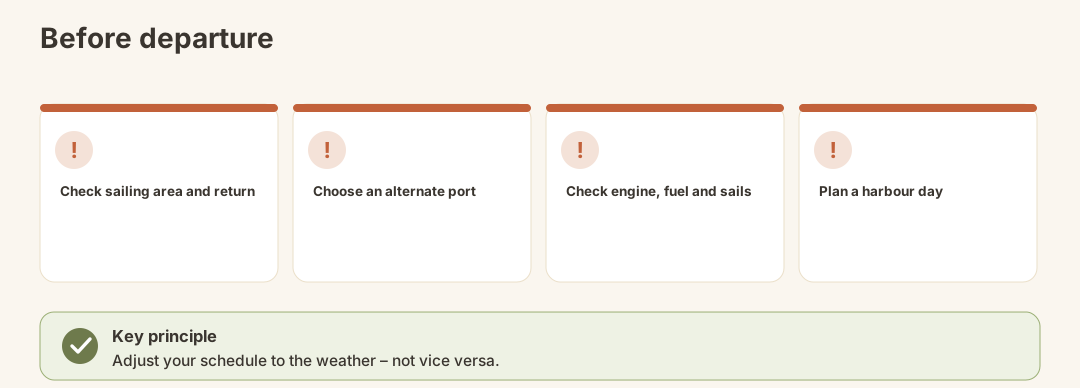
- Define your sailing area: Look at the coast where you will actually be sailing, rather than relying solely on an island-wide forecast.
- Check the outward and return routes: Bear in mind that the wind is often stronger in the afternoon than in the morning.
- Mark an alternative destination: Before setting off, choose a port you can reach and a point by which you must decide whether to turn back.
- Check the boat: Check the engine, fuel, oil and water levels, watertightness, sails and lines.
- Allow for a day in port: Adapt your schedule to the weather – not the other way round.
Most common mistakes
- Using Palma as a benchmark for the whole island. Thermal winds can vary between Palma, Alcúdia and Pollença.
- Considering only the wind when setting off. It often picks up after midday.
- Starting a trip around the island without a plan B. The Mistral can mean spending several days in port.
- Treating the engine as an unlimited fallback. Check the engine’s condition and fuel supply before departure.
- Assuming a catamaran is inherently safe. How the boat feels is no substitute for assessing the weather conditions.
- Relying on an assumed right of way. A specific encounter calls for a specific assessment.
What comes next?
Once you have settled on a sailing area and weather window, check the chosen boat and discuss the trip with your crew: Who will monitor changes in the weather? When will you decide to turn back? Which harbour is the alternative? These questions are especially important if the crew does not yet know the boat.
If you are planning a guided trip instead of sailing independently, compare more than just the route and type of boat: ask how decisions are made in bad weather. For an initial overview of the different options, see the guide to boat trips on Mallorca.
Checklist for safe sailing off Mallorca
- Current forecast for the specific sailing area checked
- Conditions for the outbound and return journeys considered
- Potential local thermal winds in the planned bays taken into account
- Turning point and alternative harbour agreed
- Time for a day in port allowed for in the sailing plan
- Engine, fuel, oil and water levels, and watertightness checked
- Sails and lines checked
- Rules for giving way when encountering other vessels at sea clearly understood
Conclusion
Off Mallorca, safety does not come from the name of a boat type or an average wind speed. What matters is the current conditions along your route, a boat that has been checked, and a plan you can change without hesitation if the weather changes. A crew that knows its return route, turning point and alternative harbour before setting off is better prepared than one with the most appealing but inflexible itinerary.
Official sources
- AEMET – Spanish weather service for current weather forecasts