
Bringing Your Dog to Spain: The Complete 2026 Guide
Taking your dog to Spain from another EU country is not particularly complicated – as long as you know that the real work happens at your German vet's practice, not at Palma Airport. The most common mistake: getting the microchip and vaccination in the wrong order, or a date in the EU Pet Passport that doesn't add up. Either way, your travel plans fall apart before you've even boarded the plane. In this guide you'll learn which three documents and measures you need, exactly how the 21-day rule works, what Spanish animal welfare legislation requires of you after arrival, and which rules apply specifically on Mallorca – from registration to third-party liability insurance for dogs.
Are you planning your move to Mallorca with your dog and want to make sure all the deadlines are in order?
- 📩 Submit a personal enquiry — We'll help you make your four-legged friend's checklist watertight
- All official matters at a glance
The three mandatory requirements at a glance
Before we get into the details, here's the most important information in brief: to enter Spain from another EU country, your dog needs exactly three things. Everything else – Spanish forms, customs declarations, queues at the airport – simply does not exist for private entry from within the EU.
| Requirement | Details | Who issues / administers |
|---|---|---|
| ISO microchip (or tattoo applied before 03.07.2011) | ISO-compliant chip, must be readable; tattoo only valid if verifiably applied before the cut-off date | Vet in Germany |
| Valid rabies vaccination | Vaccine must be valid at the time of travel; 21-day waiting period after initial vaccination | Authorised veterinarian |
| EU Pet Passport | The only recognised travel document for travel between EU countries | Authorised veterinarians only |
Please note: The microchip must be implanted before the rabies vaccination and documented in the EU Pet Passport. If the vaccination is administered first, it is deemed invalid – the entire schedule is pushed back by at least 21 days, plus a repeat vaccination.
The EU Pet Passport: the only document that counts
The EU Pet Passport is a standardised document valid across Europe and is mandatory for travel between EU member states. It replaces all national certificates and contains:
- Description and identification details of the animal (microchip or tattoo number)
- Proof of rabies vaccination with exact dates
- Contact details of the issuing vet and the owner
- Sections for additional vaccinations and treatments
An EU Pet Passport may only be issued by an authorised veterinarian – that is, one who has been expressly approved by the relevant authority. Not every veterinary practice holds this authorisation. Ask before booking your appointment.
The passport is valid for life, provided the health data it contains remains current. In practice, this means you must have the rabies vaccination regularly renewed and recorded in the passport before it expires.
Please note: Other documents such as national vaccination booklets, veterinary certificates on headed paper, or photocopies do not replace the EU Pet Passport when entering Spain.
The 21-day rule and minimum age: calculated precisely
The most common pitfall when it comes to taking your dog to Spain is calculating the waiting period correctly. Here is an overview of the key rules:
| Situation | Regulation |
|---|---|
| First rabies vaccination | Minimum waiting period of 21 days before crossing the border |
| Booster vaccination (administered on time, continuous vaccine protection) | No new waiting period, fit to travel immediately |
| Minimum age for rabies vaccination | 12 weeks |
| Minimum age at entry | 15 weeks (12 weeks vaccination age + 21 days waiting period) |
| Dogs under 15 weeks | Entry into Spain is not permitted, no exceptions |
In practical terms: if you have your dog vaccinated for the first time on 1 June, the earliest possible entry date is 22 June. Not the 21st, not the 20th – 22 June.
Please note: The Spanish Consulate General in Stuttgart expressly confirms that for dogs under 15 weeks no special permits are issued and entry will be refused.
Travelling to Mallorca: plane or ferry?
As Mallorca is an island, you essentially have two options. Both have specific requirements that go beyond the general entry documents.
By plane
Taking dogs on a flight depends heavily on the airline. A few points that apply regardless of the carrier:
- Small dogs below a certain weight limit (dog plus carrier combined) are often permitted to travel in the cabin
- Larger dogs travel in the climate-controlled hold
- Each airline has its own rules regarding carrier dimensions, weight limits and booking deadlines – these must be checked directly with the airline as they are subject to change
- The veterinary entry documents remain the same regardless of whether the animal travels in the cabin or in the hold
By ferry
The ferry to Mallorca (typically from Barcelona or Valencia) is the less stressful option for many dog owners. Dogs are generally not permitted in cabins and are instead accommodated in dedicated animal areas on board. The booking rules of the respective ferry operator apply here too – reserve early.
Please note: For both modes of transport: the documents must be complete and correct. Checks do take place, even if they are not always thorough.
What counts as private entry – and when does it get complicated?
The straightforward rules for EU citizens apply only to the non-commercial movement of pets. In practical terms, this means:
| Criterion | Private entry | Commercial movement |
|---|---|---|
| Number of animals | Maximum 5 dogs per person | More than 5 animals |
| Purpose | No sale, no change of ownership | Trade, breeding, sale |
| Accompanied | Animal travels with owner or authorised person | Different regulations |
| Time window for unaccompanied transport | Up to 5 days before/after the owner's travel is permitted | Other regulations |
So if you are bringing more than 5 dogs or puppies to Spain for sale, different – significantly stricter – rules apply. This is not relevant for most expats, but worth knowing.
After arriving in Mallorca: registration and enrolment
This is where things get underestimated by many people: entry alone is not enough. Anyone living permanently in Mallorca with a dog must take further steps.
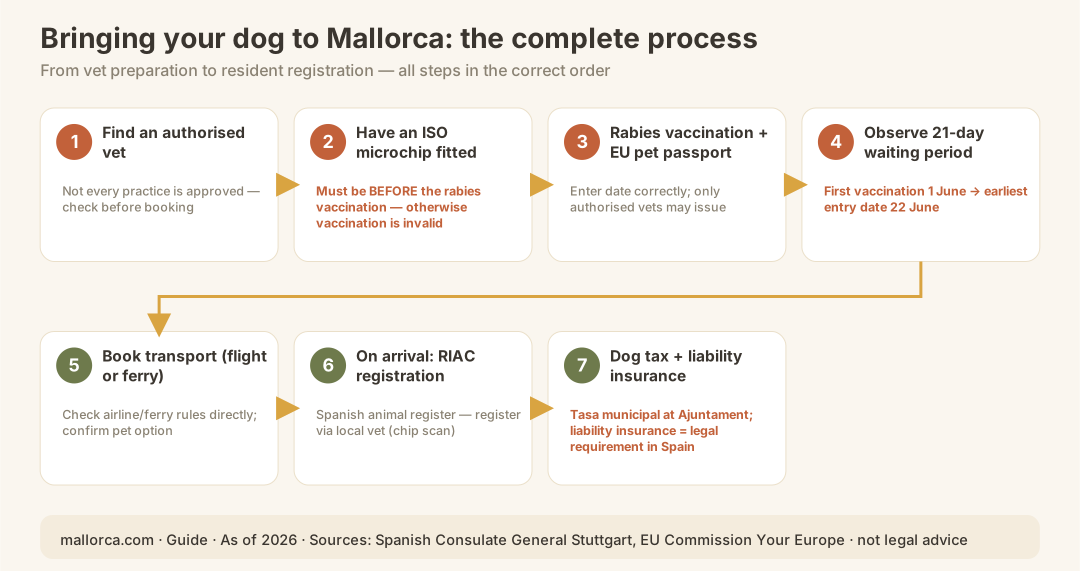
Step by step: what needs to be done after arrival
- Find a Spanish vet – Have your dog seen by a local vet. This gives you a practice on the ground, and the vet can guide you through the next steps.
- Registro de Animales de Compañía (RIAC) – Dogs must be registered in Spain's official animal register. This is normally handled by the vet, who reads the chip and completes the registration.
- Municipal dog tax (Tasa municipal) – Most municipalities in Mallorca charge an annual dog tax. The amount and due date vary depending on the municipality.
- Dog liability insurance – Spanish animal welfare legislation requires liability insurance for every dog kept permanently in Spain.
Please note: The exact requirements for municipal registration may vary slightly depending on the municipality (Ajuntament) in Mallorca. Check directly with the relevant Ajuntament or ask your vet for assistance.
Dog liability insurance: a legal requirement, not an option
Spanish animal welfare legislation requires liability insurance for all dogs kept permanently in Spain. This comes as a surprise to many newcomers from Germany – in Germany, dog owner liability insurance is compulsory in some federal states but otherwise voluntary.
In Spain the rule is clear: without proof of valid liability insurance you risk fines. Spanish and international insurance companies offer suitable policies. Make sure the policy explicitly covers Spain.
Listed breeds in Mallorca: special rules to be aware of
Certain dog breeds are subject to additional requirements in Spain. Anyone moving to Spain with a so-called listed breed (Perro Potencialmente Peligroso, PPP) should expect considerably more bureaucracy:
- Special licence (Licencia) from the municipality
- Stricter requirements for lead and muzzle in public
- Higher coverage amounts for liability insurance
You can find more on this topic in our dedicated guide:
👉 Listed breeds in Spain: breeds, requirements, licences
The most common mistakes when bringing a dog to Spain
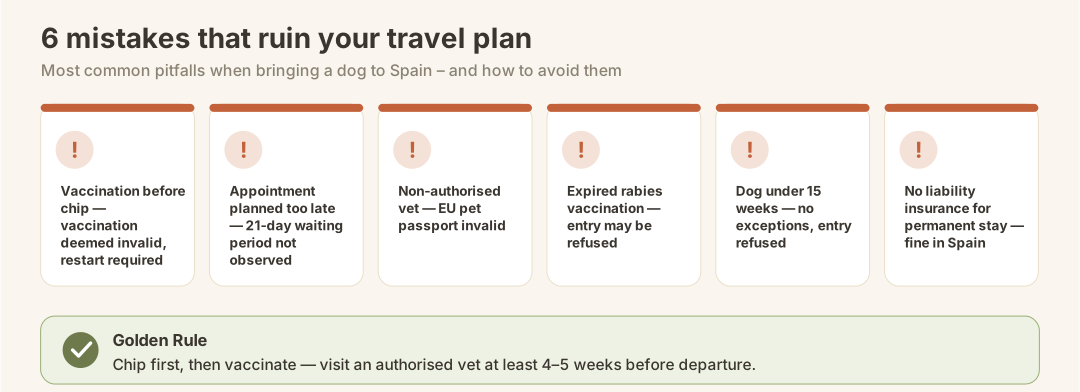
These mistakes happen time and again – and almost all of them are avoidable if you know about them early enough:
| Mistake | Consequence | How to avoid it |
|---|---|---|
| Vaccination before the chip | Vaccination deemed invalid, restart required | Always microchip first, then vaccinate |
| Appointment booked too close to departure | 21-day waiting period not observed | Allow at least 4–5 weeks' lead time |
| Wrong vet (not authorised) | EU pet passport invalid | Ask about authorisation before your appointment |
| Expired rabies vaccination in the passport | Entry may be refused | Note vaccination dates in your calendar and refresh in good time |
| Dog under 15 weeks old | No exceptions — entry refused | Plan the trip after the 15th week of life |
| No third-party liability insurance for permanent residence | Fine in Spain | Take out a policy before or shortly after arrival |
| More than 5 animals without commercial paperwork | Classed as commercial transport — different rules apply | Obtain the relevant permits |
What comes next? Your dog as a resident on Mallorca
Once you are living as a resident on Mallorca, your dog becomes part of your everyday Spanish life — with all the bureaucratic implications that entails. Here are the most important points for the long term:
- Regular rabies boosters: Depending on the vaccine used, either annual or every three years. Keep the date in the EU pet passport up to date.
- Keep the animal register up to date: If your address changes (e.g. moving within Mallorca), the animal register must be updated.
- Vet costs: Spain has no statutory health insurance for animals. Pet health insurance is voluntary but worthwhile — treatment costs can be considerable.
- Public beach rules: Many beaches on Mallorca are closed to dogs during the high season. There are dog-friendly beach sections that are explicitly designated. Rules vary by municipality and time of year.
If you are not yet registered as a resident, you should pursue your own residency registration alongside registering your dog:
👉 Applying for residencia in Spain: step by step 👉 Empadronamiento on Mallorca: the municipal registration explained
Checklist: taking your dog to Spain
Print out this list and tick every item before you book your flight or ferry:
Before the vet appointment:
- Found an authorised vet near you
- Appointment made at least 5–6 weeks before departure
At the vet appointment:
- ISO microchip fitted (if not already in place)
- Chip documented in the EU pet passport
- Rabies vaccination administered (after the chip)
- Date of vaccination correctly entered in the EU pet passport
- EU pet passport issued and complete
Before departure:
- 21-day waiting period after initial vaccination observed
- Dog is at least 15 weeks old
- Rabies vaccination still valid at the time of travel
- Transport booked with airline/ferry and pet option confirmed
- Carrier meets the transport provider's requirements
After arriving in Mallorca:
- Visited a Spanish vet
- Dog registered in the Spanish animal register (RIAC)
- Municipal dog tax registered with the Ajuntament
- Dog liability insurance taken out
Conclusion
Taking your dog to Spain is not a bureaucratic marathon for EU citizens – but it is a process that requires precision. The order must be correct (chip first, then vaccination), the deadlines must be met (21 days, minimum age 15 weeks), and the EU pet passport must be correctly completed by an authorised vet. Anyone who tackles this four to six weeks before the trip is in good shape.
For a permanent stay in Mallorca, registration in the Spanish animal register, the municipal dog tax, and the mandatory dog liability insurance are also required – all perfectly manageable, once you know about them. And if you are still weighing up whether to make the move to Mallorca: when it comes to island bureaucracy, your dog is genuinely the most straightforward chapter.
👉 An overview of all pet-related topics for Mallorca 👉 Living & everyday life in Mallorca: what to expect
Official sources
- Spanish Consulate General Stuttgart – Veterinary regulations for bringing pets to Spain: https://www.exteriores.gob.es/Consulados/stuttgart/es/Comunicacion/Noticias/Documents/Veterin%C3%A4rbeh%C3%B6rdliche%20Bestimmungen%20f%C3%BCr%20die%20Mitnahme%20von%20Haustieren%20nach%20Spanien.pdf
- European Commission / Your Europe – Travelling with pets and other animals in the EU: https://europa.eu/youreurope/citizens/travel/carry/pets-and-other-animals/index_de.htm
- Ministerio de Agricultura, Pesca y Alimentación (MAPA) – Official Spanish information on importing pets: https://www.mapa.gob.es
- Idealista.com – Moving to Spain with a dog, guide 2026: https://www.idealista.com/de/news/recht-in-spanien/2026/04/09/890327-umzug-nach-spanien-mit-hund-leitfaden-2026