
Listed Dogs Spain: PPP Owner's Licence, Insurance & Muzzle on Mallorca
You want to bring your Staffordshire Terrier, your Rottweiler, or another listed dog to Mallorca – or you're planning to get one there? Then you're operating under Spanish law, which differs considerably from the German system. Spain has the category perros potencialmente peligrosos (PPP) – potentially dangerous dogs – and regulates their ownership at national level through Real Decreto 287/2002, supplemented by Balearic and local regulations. What this means in practice: an official owner's licence, a specific liability insurance policy, a muzzle requirement in public, and a lead requirement – without exception. This guide explains step by step which breeds are affected, how to apply for the Licencia PPP, what the insurance must cover, and which mistakes can end up costing you dearly.

What is a listed dog – and which breeds are affected in Spain?
In Spain, the law does not refer to 'listed dogs' (a term more at home in German administrative law), but rather to perros potencialmente peligrosos – PPP for short. The national legal basis is Ley 50/1999 on the keeping of potentially dangerous animals, as further defined by Real Decreto 287/2002. This decree specifies which breeds are classified as PPP by virtue of their breed alone – regardless of whether the individual dog has ever caused an incident.
Note: In addition to the breed list, crossbreeds can also be classified as PPP if they display certain physical characteristics (muscle mass, head shape, jaw). In cases of doubt, an official vet or the local authority will decide.
Breeds classified as PPP in Spain by virtue of breed
| Breed | Spanish designation |
|---|---|
| Pitbull Terrier | Pit Bull Terrier |
| Staffordshire Bull Terrier | Staffordshire Bull Terrier |
| American Staffordshire Terrier | American Staffordshire Terrier |
| Rottweiler | Rottweiler |
| Dogo Argentino | Dogo Argentino |
| Fila Brasileiro | Fila Brasileño |
| Tosa Inu | Tosa Inu |
| Akita Inu | Akita Inu |
Source: Real Decreto 287/2002, Annex I [2][4]
For dogs of these breeds – and for crossbreeds displaying predominantly their characteristics – all the obligations described below apply automatically. There is no 'temperament test' that can exempt you from them; unlike in some German federal states, Spain has so far introduced no standardised testing system that can lead to a breed exemption.
The Legal Foundations: National, Balearic, and Municipal
Spanish PPP law is structured on three levels – and this is important for understanding why the regulations on Mallorca can sometimes be stricter than the national minimum.
| Level | Legal Act | Key Content |
|---|---|---|
| National Level | Ley 50/1999 | Core obligations: Licencia, insurance, lead, muzzle |
| National Level | Real Decreto 287/2002 | Breed list, minimum cover amount, registration requirements |
| Balearic | Ley 1/1992 de Protección de Animales (Baleares) + implementing regulations | Municipal enforcement, penalty framework |
| Municipal | Ordenanzas municipales (e.g. Palma) | Lead requirement for non-PPP dogs as well, special rules for parks |
Please note: The municipalities of the Balearen can go beyond the national minimum. Check with the Ajuntament of your place of residence whether local supplementary rules apply.
The Licencia PPP: the keeper's permit for listed dogs
The cornerstone of the Spanish system is the Licencia para tenencia de perros potencialmente peligrosos – without this official keeper's permit, you are not permitted to keep or walk a PPP on Spanish soil. It is issued by the responsible municipal authority (Ajuntament / Ayuntamiento).
Requirements for the Licencia PPP
- Minimum age 18 years – no exceptions
- No relevant criminal record – you must provide a certificado de antecedentes penales (criminal record certificate); convictions for assault, animal cruelty, or firearms offences will disqualify you
- Psychological and physical fitness – demonstrated by a medical certificate (certificado médico) confirming eyesight, reaction capability, and mental fitness
- Valid third-party liability insurance for the dog (see dedicated section)
- No drug or alcohol dependency – certificate required
Required documents (typical council list)
| Document | Issuing authority | Note |
|---|---|---|
| Completed application | Ajuntament | Form available in person or online |
| DNI / NIE / Passport | — | Copy + original |
| Police clearance certificate | Ministerio de Justicia / Embassy | No older than 3 months |
| Medical fitness certificate | Registered doctor | Incl. vision and psychological assessment |
| Proof of public liability insurance | Insurance company | Policy + confirmation of cover |
| Proof of fee payment (tasa) | Bank / Ajuntament | Amount varies by municipality |
Please note: If you are residing in Spain as a resident, you will need a valid NIE number before applying for the Licencia. Find out how to obtain your NIE in our NIE guide.
Validity period and renewal
The Licencia PPP is generally valid for five years and must be renewed afterwards – with all supporting documents submitted again. There is no automatic renewal. Anyone who misses the deadline is keeping their dog without a valid licence – which is a punishable offence.
Public liability insurance: what the policy must cover
The Spanish mandatory insurance for PPP owners is not an ordinary dog liability policy – it is specifically tailored to the risks associated with potentially dangerous dogs and must meet certain minimum requirements.
Minimum requirements under Real Decreto 287/2002
| Criterion | Minimum requirement |
|---|---|
| Cover for personal injury | 120.000 € (national minimum framework) |
| Cover for property damage | included in the tariff |
| policyholder | must be identical to the licence holder |
| validity | must remain in force throughout the entire period of ownership |
Please note: The sum specified in Real Decreto 287/2002 represents a nationwide minimum. Individual insurance companies and local authorities may require or recommend higher levels of cover. Before taking out a policy, clarify whether your policy provides full coverage for incidents in Spain – a dog liability policy taken out in Germany does not necessarily cover PPP risks in Spain, and not every insurer will underwrite listed breeds at all. [8]
If you are already taking out a health insurance policy in Spain or other policies, ask your insurance broker in Mallorca about PPP liability cover at the same time – this saves time and allows for bundle discounts.
Muzzle and lead requirements in everyday life
In public spaces, PPP dogs in Mallorca – as throughout Spain – are subject to strict behavioural requirements. These apply regardless of how placid your dog actually is.
Requirements at a glance
| Situation | Requirement |
|---|---|
| Public roads, squares, parks | Muzzle + lead |
| Maximum lead length | 2 metres |
| Handling multiple PPP dogs simultaneously | one person, one PPP only |
| Public transport | Muzzle compulsory, additional rules depending on the operator |
| Own property (fenced) | no muzzle required, but a 'Dangerous Dog' sign is recommended |
Note: The muzzle must be designed so as not to cause the dog harm – it must not impede breathing or panting, but must reliably prevent biting. Basket muzzles made of leather or plastic, suited to the individual head shape, are considered the standard.
The question of whether non-PPP dogs are also subject to lead requirements in many of Mallorca's municipalities is a separate matter of local regulations. For PPP owners, however, the framework is binding at a national level.
Registration: RCCAE and Censo Municipal
In addition to the Licencia PPP, there are two registration requirements you must comply with as an owner:
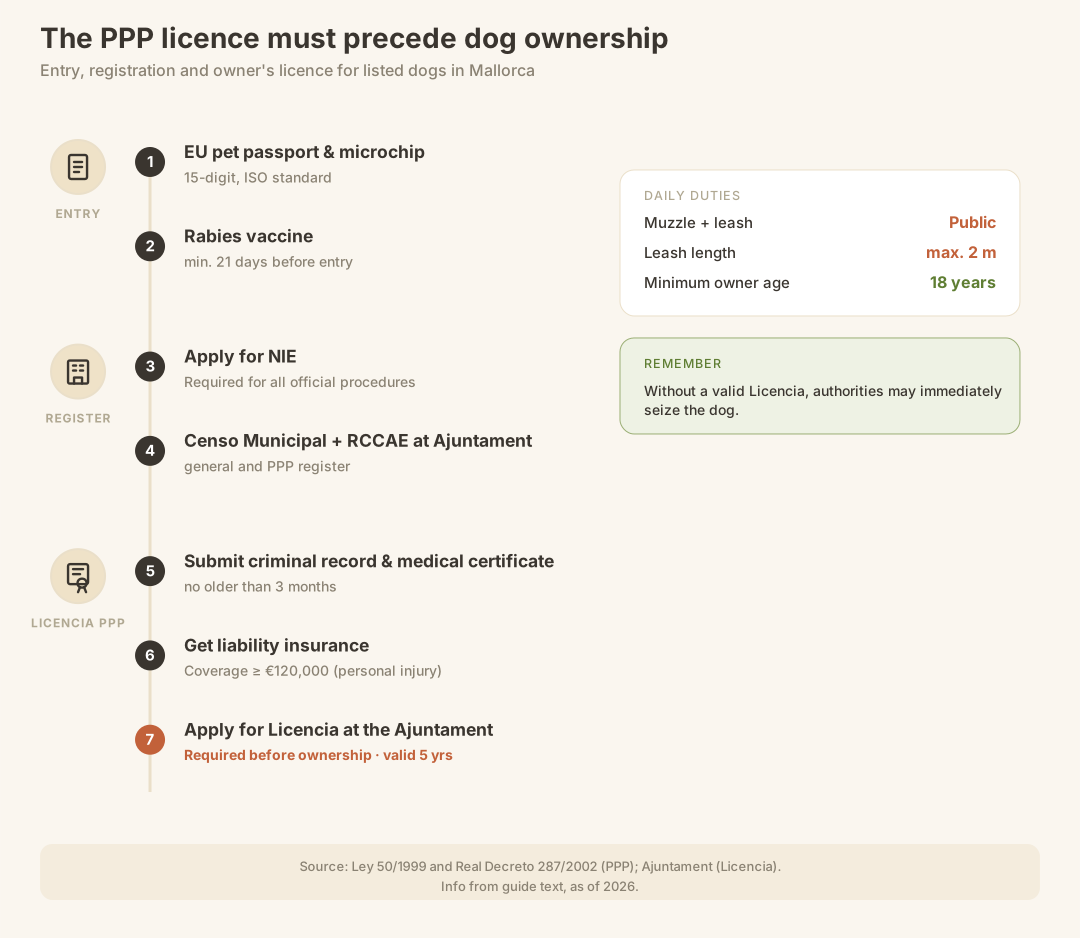
1. Registro de Animales de Compañía – Censo Municipal
Every dog must be entered into the local animal register held by the municipal authority (Ajuntament). This is based on the microchip (15-digit ISO standard). Registration is not possible without proof of Empadronamiento (registered address) – for more on this, see the Empadronamiento guide.
2. RCCAE – Registro de Animales Potencialmente Peligrosos
PPP owners must also register their dog in the Registro de Animales Potencialmente Peligrosos registered – in a separate official register for potentially dangerous animals. Registration is usually carried out at the Ajuntament at the same time as, or immediately after, the Licencia PPP is issued.
| Step | Responsible authority |
|---|---|
| Get a microchip fitted | Vet (before anything else) |
| Censo Municipal (general animal register) | Ajuntament |
| PPP register (RCCAE) | Ajuntament / Consell |
| Apply for the Licencia PPP | Ajuntament |
| Submit proof of insurance | Ajuntament (with licence application) |
Bringing a listed dog to Mallorca
If you are travelling to Mallorca with your PPP from Germany (or another EU country), the general EU rules for travelling with pets apply first — plus the Spanish PPP rules from the very first day of your stay.
Basic EU entry requirements
- EU pet passport (the "blue passport") — mandatory [2][3]
- Microchip — 15-digit ISO standard [3]
- Rabies vaccination — valid, administered at least 21 days before entry, animal was at least 12 weeks old at the time of the first vaccination [3][4]
- Maximum 5 dogs per person for non-commercial travel [2][3]
Puppies under 15 weeks may not enter, as they cannot yet have a valid rabies vaccination. [3][4]
Transport by car and ferry
When transporting a dog by car in Spain, a restraint requirement applies: dogs must be carried in a sturdy transport crate or behind a fixed partition — not loose on the back seat. [2]
For the Barcelona–Palma ferry, pet cabins or air-conditioned kennels on deck are available depending on the operator. Book early, as capacity is limited — particularly during peak season. [1] Check with the ferry operator in advance regarding their own rules for PPP, as some operators may impose additional requirements.
Please note: Even when travelling through France in transit (e.g. by car across the border), the national regulations of that country apply to listed dogs. Find out about the rules of any transit countries before setting off. [7]
Fines and consequences for violations
Spanish law provides for substantial fines for breaches of the PPP regulations. The exact amounts may vary depending on the municipality and the severity of the violation; the Ley 50/1999 distinguishes between minor, serious, and very serious offences.
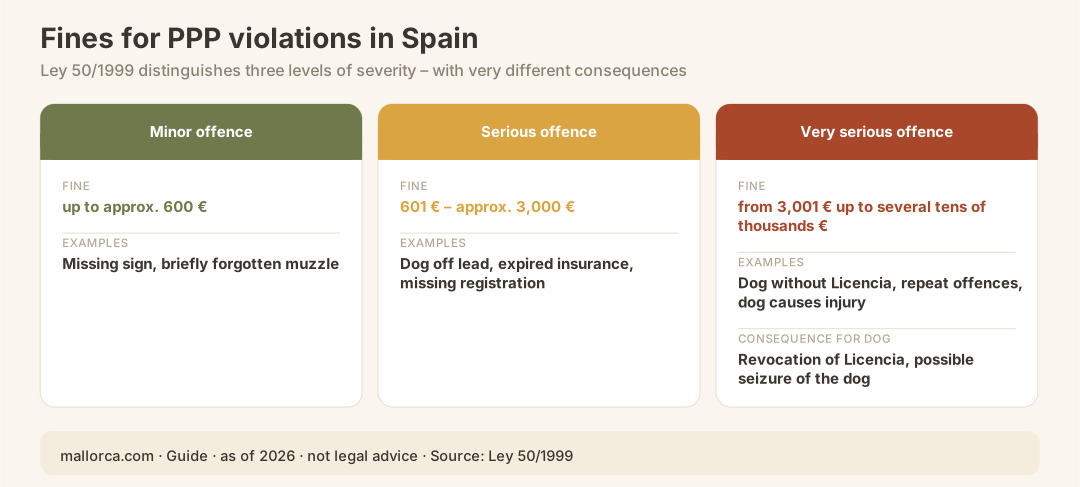
| Violation category | Examples | Possible range |
|---|---|---|
| Minor | Missing sign, briefly forgotten muzzle | up to approx. €600 |
| Serious | Dog off lead, lapsed insurance, missing registration | €601 – approx. €3,000 |
| Very serious | Dog without Licencia, repeated violations, dog causes injury | from €3,001 up to several tens of thousands of euros, revocation of the Licencia, possible seizure of the dog |
Warning: If your PPP is found without a valid Licencia or insurance, the authorities may take the dog into custody immediately. Return of the dog is conditional on full regularisation. In the worst case, euthanasia is possible if no suitable placement can be secured.
Most common mistakes when keeping a PPP on Mallorca
Treating a German dog liability policy as sufficient – it usually does not fully cover the Spanish PPP risk and does not meet the formal requirements for the Licencia. Take out a policy that is valid in Spain.
Applying for the Licencia only after moving in – the obligation applies from the very first day of keeping the dog in Spain. Plan your application before the dog moves in.
Forgetting the renewal deadline – the Licencia expires after generally five years. There is no automatic renewal.
Not registering mixed-breed dogs – anyone who believes their "non-purebred" dog does not fall under PPP regulations may well be mistaken. If an official vet or the local authority determines breed membership, all obligations apply retrospectively.
Ignoring the lead length rule – the legal maximum lead length of 2 metres for PPP is circumvented by some owners using extendable leads. This is not permitted.
Missing NIE at the time of application – no Licencia without an NIE number. Obtain one in good time. NIE guide
Not reporting a move within the island – if you change municipality, you must update your registration at the new Ajuntament.
What comes next? Day-to-day life with a PPP on Mallorca
Once all the formalities are taken care of, everyday life with a PPP on Mallorca is very manageable – the island has many dog-friendly areas, beaches (outside the bathing season on certain stretches) and a good network of vets.
The following are things you should keep an eye on permanently:
- Keep veterinary check-ups and vaccinations up to date – keep the EU pet passport current
- Check your insurance policy regularly – is it due to expire? Is the level of cover still adequate?
- Note the Licencia expiry date in your calendar – start the renewal process early (at least 3 months in advance)
- Municipal newsletter or local authority – local changes to dog regulations do occur; stay informed
- When moving to another property or municipality on Mallorca: update your PPP registration at the new Ajuntament
Anyone living on Mallorca as a resident should also be aware of Authorities & registration bear in mind – many PPP formalities are handled by the same offices as Empadronamiento and Residencia.
Checklist: Keeping a PPP on Mallorca
- EU pet passport present and up to date
- Microchip implanted (15-digit ISO)
- Rabies vaccination valid
- NIE number applied for and received
- Empadronamiento (registration) completed at the Ajuntament
- Dog registered in the Censo Municipal (general animal register)
- Dog registered in the PPP register (RCCAE)
- Third-party liability insurance for PPP in Spain taken out (cover ≥ 120.000 €)
- Criminal records certificate obtained (max. 3 months old)
- Medical certificate of suitability for the owner in place
- Licencia PPP applied for and obtained from the Ajuntament
- Expiry date of the Licencia entered in the calendar
- Muzzle (appropriate size/type) purchased
- Lead max. 2 m in possession
- In the car: transport crate or divider
Conclusion
Keeping a listed dog on Mallorca is perfectly legal and, with the right preparation, entirely straightforward – but it requires clear administrative groundwork. The Licencia PPP is not a formality you can sort out after the fact: it must be in place before you take ownership. The third-party liability insurance must be valid in Spain and meet the minimum cover amount. A muzzle and a short lead are not optional in public spaces – they are mandatory. Anyone who takes these basic rules on board will enjoy life with their PPP on Mallorca just as relaxed as any other dog owner – just with a little more paperwork upfront.
Official Sources
- Ley 50/1999, de 23 de diciembre, sobre el Régimen Jurídico de la Tenencia de Animales Potencialmente Peligrosos (BOE): https://www.boe.es/buscar/act.php?id=BOE-A-1999-24419
- Real Decreto 287/2002, de 22 de marzo (breed list, minimum cover amounts, register): https://www.boe.es/buscar/act.php?id=BOE-A-2002-5809
- Ajuntament de Palma – Servei de Medi Ambient (Llicència PPP): https://www.palma.cat
- Govern de les Illes Balears – Conselleria de Medi Ambient: https://www.caib.es
- Ministerio de Justicia – Certificado de Antecedentes Penales: https://www.mjusticia.gob.es
- Spanish Consulate General Stuttgart – Veterinary Regulations for Pets: https://www.exteriores.gob.es/Consulados/stuttgart