
Healthcare System in Mallorca: Doctors, Hospitals & Emergencies
If you live on Mallorca or are setting up a second home there, there's one thing you'll want to know before you actually need it: how does the healthcare system on Mallorca work in an emergency? The good news upfront — medical care on the island is excellent. The public system (IB-Salut) includes Son Espases, one of the most modern hospitals in the Mediterranean, and private clinics such as Quirónsalud and Juaneda offer short waiting times and German-speaking staff. This guide explains which facilities handle what, how to apply for a health card, which emergency number to call, and what treatment costs without insurance.

Public (IB-Salut) vs. private — the two-pillar system
Mallorca, like the whole of Spain, has a two-track healthcare system. Both pillars are of high quality, but they work in fundamentally different ways.
The public system is operated by the Balearic health service IB-Salut (Catalan: Servei de Salut de les Illes Balears). Those covered by this system pay nothing for GP appointments, A&E, or inpatient treatment (some medication co-payments may apply). Access always starts through the assigned health centre (Centro de Salud) in your area of residence, which refers you to specialists or hospitals as needed. The downside: for non-urgent specialist appointments and elective procedures there can be waiting times, and German is not spoken everywhere — although interpreters are available at the major hospitals.
The private sector complements the system. It scores points for short waiting times, personalised care, multilingual staff, and private rooms. You pay either directly (see the costs section) or through a private health insurance policy, which in Spain typically costs around €50 to €200 per person per month depending on age and plan. For many international residents and retirees who value discretion and care in their own language, the private route is the first choice.
| Feature | Public (IB-Salut) | Private (Quirónsalud, Juaneda, etc.) |
|---|---|---|
| Cost for insured patients | free (some medication co-payments may apply) | via policy or self-pay |
| Access | via the local Centro de Salud | freely selectable, often walk-in |
| Specialist waiting times | sometimes longer | usually short |
| Language | Spanish/Catalan, interpreters at major hospitals | German & English commonly available |
| Requirement | Tarjeta Sanitaria or EHIC | policy or direct payment |
For tourists: With the European Health Insurance Card (EHIC), as a statutory insured person you receive the same care as local residents within the public system — free of charge or heavily subsidised. However, it is not valid at private clinics. If you are treated by a recommended private doctor at the beach or at your hotel, you will generally pay out of pocket and then submit the invoice to your insurer — retrospective reimbursement is possible only to a limited extent at best. A travel health insurance policy (from around €15/year) is therefore strongly recommended.
Applying for the Tarjeta Sanitaria Individual (TSI)
Anyone living permanently on Mallorca needs the Tarjeta Sanitaria Individual (TSI) — the personal health card issued by IB-Salut. It contains a personal identification code (CIP), gives you access to all public healthcare services, and allows you to collect prescribed medication from any pharmacy in Spain.
Two prerequisites must be met before you can obtain the card:
- Empadronamiento — registration in your municipality's residents' register (padrón municipal). This serves as proof of your place of residence.
- Entitlement to public healthcare — usually through the Seguridad Social (as an employee, self-employed person, pensioner, or dependant covered under another person's insurance). EU citizens without Spanish social security cover demonstrate their entitlement via the non-exportability document (documento de no exportabilidad) or through the Seguridad Social.
How the application process works
- Complete your Empadronamiento at the town hall (Ayuntamiento) of your municipality.
- Clarify your entitlement with the Seguridad Social (INSS) — you will need your NIE and proof of insurance (e.g. número de afiliación / vida laboral).
- Book an appointment at your Centro de Salud by calling INFOSALUT CONNECTA on 971 220 000, or digitally using Cl@ve / a digital certificate via the CAIB online portal.
- Bring the required documents (see table) — including a recent colour photo measuring 26 × 32 mm.
- Collect the card or receive it by post. When applying online, the card is typically issued within around 10 to 15 days; in urgent cases, a temporary document (justificante) can be issued, allowing you to receive treatment immediately.
| Document | Details |
|---|---|
| Identity document | DNI/NIF or NIE (valid) |
| Proof of residence | Empadronamiento (not the "certificado para viajar") |
| Photo | Recent colour photo 26 × 32 mm, as required for the DNI |
| Proof of entitlement | INSS document / vida laboral / TSI from another region |
| EU citizens without Spanish social security cover | documento de no exportabilidad |
Important details: The TSI is valid for 4 years and is subsequently renewed through the same process. Regarding the Empadronamiento: it is only strictly required when you change your place of residence — if your details are already on record, you do not need to present it each time. In several municipalities — including Palma, Calvià, Esporles, Valldemossa, and Deià — you do not need to bring your Empadronamiento certificate separately, as the system checks the padrón directly. The card is now also available as a virtual TSI (TSV) with a QR code in the EspaiSalut app — however, it does not fully replace the physical card.
The health card is closely linked to your insurance status. You can read in detail about how to get properly insured as an expat — either through the state system via the Seguridad Social or privately — in the Guide to Health Insurance in Spain. If you don't yet have a NIE, the first step is the Guide to the NIE Number.
The most important hospitals on Mallorca
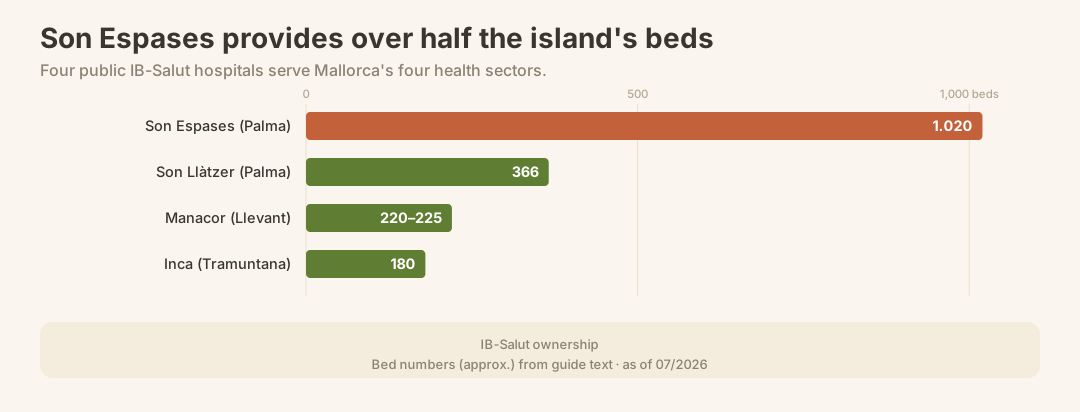
The island is divided into four public health sectors — which public hospital is responsible for you as a resident depends on where you live. In an emergency, however, everyone is treated everywhere.
| Hospital | Provider | Location / Address | Profile |
|---|---|---|---|
| Hospital Universitari Son Espases | public (IB-Salut) | Ctra. de Valldemossa 79, 07120 Palma | Reference clinic for the Balearic Islands, approx. 1.020 beds, highest level of care |
| Hospital Universitari Son Llàtzer | public (IB-Salut) | Ctra. de Manacor km 4, Palma | second largest hospital, around 366 beds, Migjorn sector |
| Hospital de Manacor | public (IB-Salut) | Ctra. Manacor–Alcúdia, Manacor | around 220–225 beds, eastern Mallorca (Llevant) |
| Hospital Comarcal d'Inca | public (IB-Salut) | Ctra. Vella de Llubí, Inca | around 180 beds, northern Mallorca (Tramuntana) |
| Quirónsalud Palmaplanas | private (Quirónsalud) | Camí dels Reis 308, 07010 Palma | 24-hour A&E, international department |
| Clínica Rotger | private (Quirónsalud) | C/ Santiago Rusiñol 9, Palma | the only private hospital in the city centre with 24-hour A&E; multilingual care |
| Clínica Juaneda | private (Juaneda) | Palma & island-wide network | largest private hospital network on Mallorca |
Son Espases in the north of Palma is the supra-regional referral centre: opened at the end of 2010, it replaced the old Son Dureta and covers the full spectrum of highly specialised medicine with departments for cardiology, oncology, neurology, orthopaedics and many other specialities. The island's most complex cases end up here — as a result, the emergency department is frequently very busy.
On the private side, Clínica Rotger and Quirónsalud Palmaplanas (both part of the Quirónsalud group) are among the best-known private hospitals in the Balearic Islands. Rotger is the only private centre in the city centre with an accident and emergency department for adults and children open around the clock all year round — with care available in Spanish, English and, on request, further languages. The Juaneda Group (founded 1917) operates the largest private network on the island, with several hospitals and over 50 centres, including locations as far afield as Muro and Manacor.
In an emergency: 112, 061 and the Urgencias
In a medical emergency on Mallorca, the same rule applies as throughout Spain and the EU:
- 112 — the EU-wide, free emergency number, staffed 24 hours a day, for any emergency (ambulance, fire, police). Reachable from any phone, without a dialling prefix and without credit. When in doubt, always call 112. The control centre will direct you to the appropriate service.
- 061 — the number for the medical emergency service (urgencias y emergencias sanitarias). In the Balearic Islands, the medical emergency service is largely integrated into 112; 061 continues to work and connects directly to the medical coordination centre (SAMU principle, derived from the French SAMU system).
- Urgencias — the accident and emergency department of a hospital. If you are able to drive yourself and it is not a life-threatening emergency, head to the nearest Urgencias.
For less acute cases outside of surgery hours, there are the Puntos de Atención Continuada (PAC) — out-of-hours care points attached to health centres (opening hours vary by location; not all are staffed around the clock). Only if a case cannot be treated there should you proceed to the nearest hospital.
| Situation | Number / Point of contact |
|---|---|
| Life-threatening emergency (any kind) | 112 |
| Medical emergency line / ambulance | 112 or 061 |
| Acute symptoms outside surgery hours | PAC (Punto de Atención Continuada) |
| Attend accident and emergency | Urgencias at the nearest hospital |
| Guardia Civil | 062 |
| Policía Nacional | 091 |
| Policía Local | 092 |
Tip: In an emergency, have your EHIC, TSI or travel insurance details to hand, along with the name and any allergies of the person affected — this will significantly speed up treatment.
Pharmacies (farmacia) and out-of-hours service
Pharmacies are called farmacia in Spain and are recognisable by the green cross. They are the first port of call for over-the-counter medicines and advice — many products that in Germany are only available from a pharmacy can also be obtained here quickly and without a doctor's visit.
Regular opening hours are typically 09:00–14:00 and 17:00–20:30 (Monday to Friday, Saturday mornings only in many cases), although many pharmacies in Palma are open continuously throughout the day. Outside these hours — at night, on Sundays, and on public holidays — there is an on-call service (farmacia de guardia): in each zone, one pharmacy takes turns remaining open. Which one is currently on duty is posted on every pharmacy door and can also be found online via the Colegio Oficial de Farmacéuticos de las Islas Baleares (the Balearic pharmacists' association).
In Palma there are also 24-hour pharmacies that remain open throughout the year — for example the Farmacia Balanguera (Carrer de la Balanguera 15), which is open around the clock 365 days a year. For prescription medicines you will generally need the electronic prescription linked to your TSI.
Finding German-speaking doctors
You do not necessarily need to speak Spanish on Mallorca to receive good medical care. According to a commercial medical directory, an estimated 100 to 150 German-speaking doctors practise on the island — almost all of them trained in Germany and worked there for many years. They cover virtually every specialism, from general medicine and internal medicine to orthopaedics, gynaecology, cardiology, dermatology, and dentistry. (This figure is an estimate from the directory, not an official census.)
How to find a German-speaking practitioner:
- German specialist medical centres — group practices with German-speaking teams, such as the Deutsche Facharztzentrum (DFZ) in Peguera and Santa Ponça or the Palma Clinic in Palma, with their own out-of-hours emergency numbers.
- Practice directories such as Best of Mallorca list German-speaking doctors by specialism and region.
- Private clinics (Rotger, Quirónsalud, Juaneda) employ German- and English-speaking staff and have international departments.
- Recommendations from the German-speaking community (clubs, forums, neighbours) are particularly valuable on Mallorca.
Watch out for costs: most German-speaking practices bill privately. Clarify in advance whether your insurer settles directly with the practice or whether you pay upfront and claim back.
Dentists on Mallorca (private)
Dental treatment in Spain is almost exclusively private — public provision covers only the bare minimum at the dentist (emergencies, extractions for children). Consultations, fillings, root canal treatments, implants, and prosthetics are paid for out of pocket or through supplementary dental insurance.
The good news: there are numerous German-speaking dental practices on Mallorca, and the price level is often more attractive than in Germany. An important point regarding reimbursement: as a member of a German statutory health insurer you are free to receive treatment anywhere within the EU, but your German Krankenkasse will only reimburse dental treatment abroad up to the amount it would pay for the same procedure in Germany (the German fixed subsidy / statutory rate) — minus your co-payment and an administrative deduction. There is no flat percentage reimbursement of what is often a higher private bill from abroad. For dental prosthetics, prior approval from your insurer is generally required. Always clarify the scope of reimbursement in writing with your insurer before treatment begins; any remaining amount can potentially be covered by travel or supplementary dental insurance.
Costs without insurance
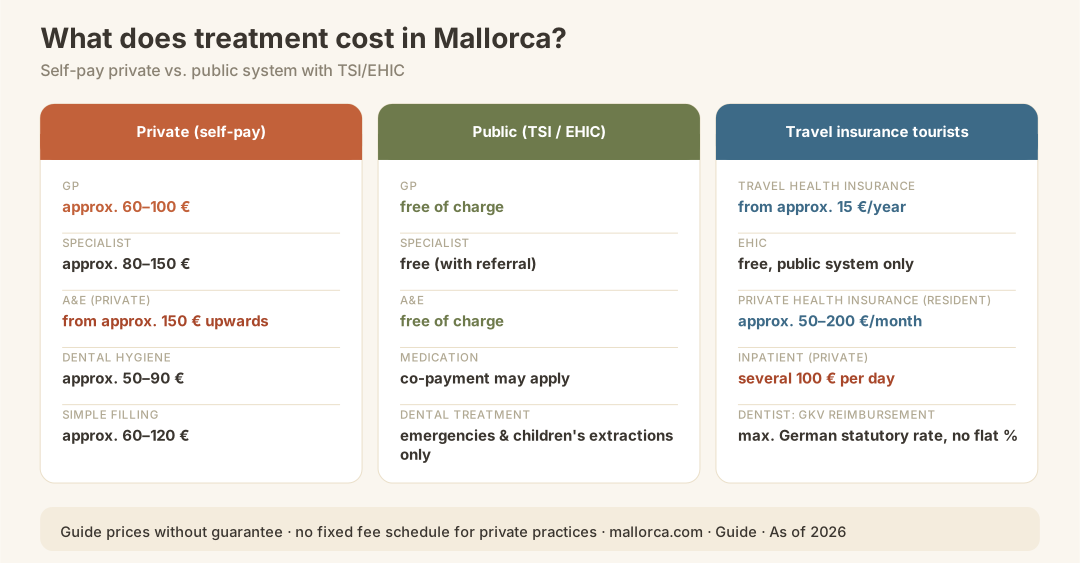
If you are covered neither by a TSI/EHIC nor by a private policy, you pay as a self-paying patient. Important to know: for private practices and clinics in Mallorca, there is no statutory fee schedule capping charges — prices vary considerably depending on the provider and the service. The following figures are indicative values and not fixed rates.
| Service (private, self-pay) | Indicative price |
|---|---|
| GP/general practitioner consultation | approx. 60–100 € |
| Specialist consultation | approx. 80–150 € |
| Private emergency department (Urgencias) | from approx. 150 € upwards |
| Dental hygiene/scale and polish | approx. 50–90 € |
| Simple filling | approx. 60–120 € |
| Inpatient day (private) | several hundred € per day |
With private billing you almost always have to pay upfront and submit the original invoice to your insurer afterwards — which for statutory fund members is only partially reimbursed (capped at the relevant German fund rate). In the public system with a valid TSI or EHIC, GP visits and emergency department attendance are free of charge; only prescription medicines may attract a co-payment depending on your status.
Most common mistakes
- No overseas or private insurance as a resident. Without a TSI and without a policy, you pay the full cost of every private treatment yourself — and private emergency departments are expensive.
- Applying for the TSI without Empadronamiento. Without an entry in the padrón and without proof of entitlement (Seguridad Social), the card will not be issued. Register first, then apply.
- Going to the hotel's "recommended" private doctor. Hotels and tour operators frequently refer guests to private doctors — you bear the costs yourself, even if you would ordinarily be entitled to public healthcare.
- Confusing emergency numbers. If in doubt, always dial 112, don't deliberate over whether 061 would be "more correct". The 112 redirects everything.
- Wrong Empadronamiento certificate. The "certificado para viajar" is not accepted for the TSI — you need the regular, valid padrón certificate.
- Dental prosthetics without prior cost clarification. Clarify the scope of reimbursement in writing with your insurer before treatment begins — for dental prosthetics, advance authorisation from your fund is usually required.
What comes next
The healthcare system is just one piece of the puzzle when it comes to life on Mallorca. If you're planning the move, these steps are all logically connected:
- Applying for your NIE number on Mallorca — the tax identification number is a prerequisite for almost everything, including the Seguridad Social.
- Health insurance in Spain — public vs. private, and how to make sure you're properly covered as an expat.
- Emigration guide — an overview of every step, from Empadronamiento to establishing residency.
- Property guide — buying, renting, and the legal essentials for your home on the island.
Checklist: Properly covered for healthcare on Mallorca
- NIE number applied for
- Empadronamiento completed in your municipality of residence
- Seguridad Social registered (or entitlement via no-exportabilidad clarified)
- TSI applied for at the Centro de Salud (appointment: 971 220 000)
- Centro de Salud and associated hospital at your place of residence identified
- Supplementary private insurance reviewed (dental in particular)
- Emergency numbers 112 / 061 saved in your phone
- Nearest 24-hour pharmacy and farmacia de guardia noted
- German-speaking practice in your area researched
Conclusion
The healthcare system on Mallorca is high-performing and easily accessible — as long as you know the rules. The public IB-Salut network, with Son Espases at its helm, offers high-quality care that is free of charge for those insured; the private hospitals Rotger, Quirónsalud, and Juaneda complement it with short waiting times and multilingual support. There are three things you should take care of early on: register your address (Empadronamiento), clarify your insurance status, and apply for your TSI — and in an emergency, don't hesitate to dial 112 . That way, you'll be fully covered on the island.
Official sources
- IB-Salut — Tarjeta Sanitaria Individual (Tramitación)
- IB-Salut — Hospital Universitario Son Espases
- Govern de les Illes Balears — Trámite Tarjeta sanitaria
- Hospital Universitari Son Llàtzer (official website)
- Consejo General de Colegios de Farmacéuticos — Farmacias de guardia Baleares
Note: This guide is intended for general orientation purposes and does not replace individual medical, insurance, or legally binding advice. Procedures, responsibilities, deadlines, and prices are subject to change and may vary in individual cases. The official information provided by IB-Salut, the Seguridad Social, and your local municipality is always authoritative. In the event of a medical emergency, contact 112 or your nearest A&E immediately.