
Garden in Mallorca: Irrigation, Fire and Planting Season
A garden on Mallorca follows different rules than a garden in Germany – not only climatically, but also legally. If you water, plant or burn garden waste here, you're operating within a system that depends heavily on the current water situation and on proximity to forest areas. This guide explains three things that are typical for a garden on Mallorca: first, the mechanism behind garden irrigation – the official drought scenario, which is reassessed monthly and from which municipalities derive their restrictions. Second, the legal situation regarding fire and barbecuing in and near forests, which is directly relevant for many fincas. And third, why there is no fixed planting calendar for the whole island – and what you should pay attention to instead. You will deliberately not find fixed water quantities, fines or monthly lists for individual plants here, because there is no reliable official source for that.
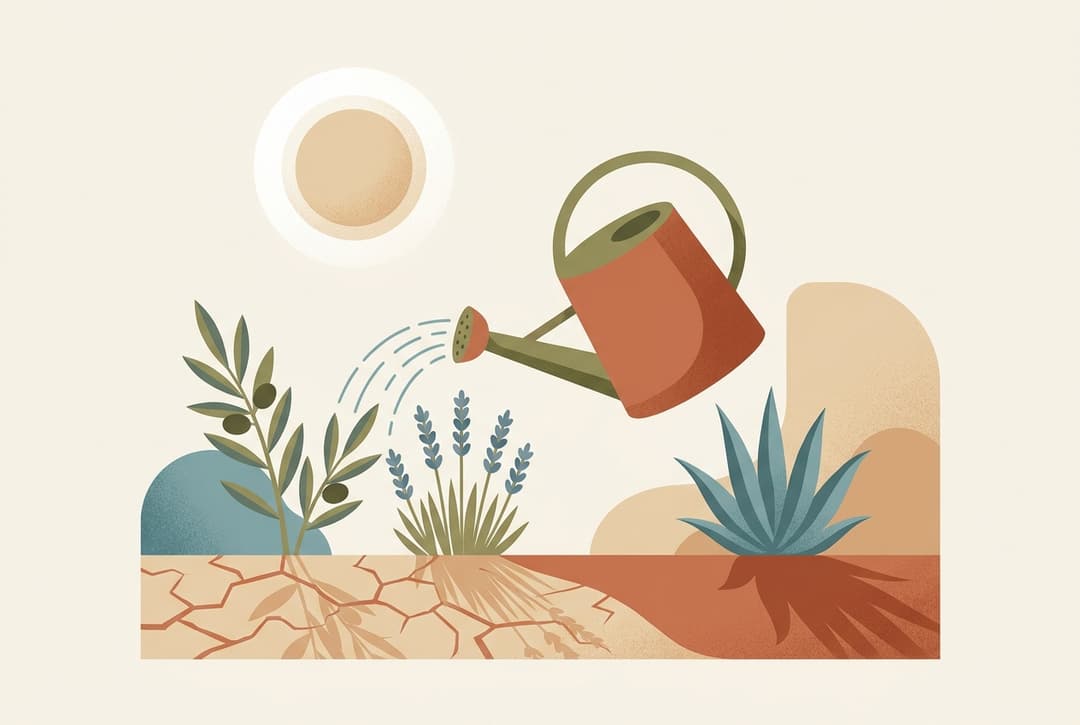
Why Mallorca's climate treats the garden differently
The Mediterranean climate turns the logic of a Central European garden year upside down: the critical phase is not in winter, but in high summer. In high summer, many plants tend to rest rather than grow – the soil is dry, evaporation is high, and new plantings struggle to take root at all during this time. The cooler, wetter half of the year – roughly autumn to spring – is therefore more favourable for most gardening work than summer.
However, this is a general climatic tendency, not an official schedule. Mallorca has very different microclimates: a plot in the Serra de Tramuntana behaves differently to a finca in the flat Pla de Mallorca or a garden near the beach. Soil, altitude, orientation and wind exposure influence when and what makes sense to plant far more than a blanket calendar date. Anyone who needs reliable recommendations tailored to their plot is better served by a local nursery or garden service on the ground than by a generic monthly table.
Irrigation: how the drought scenario works
The most important rule regarding garden irrigation on Mallorca is: there is no fixed, permanently valid rule. What is permitted depends on the official drought scenario, which the Govern de les Illes Balears continuously assesses via its Portal del Agua for individual demand units (Unidades de Demanda).
The basis for this is the Plan especial de actuaciones en situación de alerta y eventual sequía (PESIB), approved by Decreto 54/2017, de 15 de diciembre, published in BOIB No. 155 of 19.12.2017. The plan defines the demand units, a monthly hydrological drought index per unit, and, based on this, a drought scenario. In addition, the Plan Hidrológico de la Demarcación Hidrográfica de las Illes Balears (2022–2027), approved by Real Decreto 49/2023, de 24 de enero.
| Legal act | Content | Source |
|---|---|---|
| Decreto 54/2017, de 15 de diciembre | Establishes the PESIB, defines demand units, the drought index and drought scenario | BOIB No. 155, 19.12.2017 |
| Real Decreto 49/2023, de 24 de enero | Plan Hidrológico of the Balearics 2022–2027, overarching framework | BOE |
The system works with several, successive levels; officially documented in this research are the levels prealerta (pre-alert) and alerta (alert). As soon as a demand unit slips into the drought alert scenario, a specific legal consequence takes effect: municipalities and water suppliers without a connection to a desalination plant must then implement mandatory restrictions – explicitly named are garden irrigation, street cleaning, ornamental water use and beach showers.
| Drought scenario | What is officially documented |
|---|---|
| prealerta (pre-alert) | Documented in this research as a classification; a detailed regulation on this has not been evaluated here. |
| alerta (alert) | The legal consequence is documented here: municipalities and water suppliers without a connection to a desalination plant must implement mandatory restrictions, explicitly named for garden irrigation, street cleaning, ornamental use and beach showers. |
| further levels | The plan provides for a graduated scale. Exactly how many levels there are and what they are called is not documented in this research — what matters is the current classification of your demand unit. |
Note: This article deliberately does not name any current percentage values for water reserves, no current scenario and no date for it. These figures change monthly – any fixed number would be outdated within a few weeks. What matters is the mechanism, not a snapshot value.
Where you can look up the currently applicable scenario
Because the drought scenario keeps changing, it's worth taking a quick look at the official source for anyone who waters regularly before making bigger irrigation decisions – for example before installing a new system or laying a water-intensive lawn.
- Open the page „Índice de Sequía" of the Govern de les Illes Balears (Portal del Agua, caib.es) and find the demand unit in which your property is located.
- Check which scenario is currently indicated there.
- Also contact your local council: they implement the specific restriction and may have their own, stricter or more detailed rules (for example on permitted types of irrigation).
- Repeat this check at intervals, especially at the start of the hot season – the scenario can change several times within a year.
Note: A local council can impose stricter rules than the overarching drought scenario requires. Don't rely on information from neighbours or older online posts – if in doubt, ask the council directly which regulation currently applies.
Fire and barbecuing in and near forests
Anyone who owns a finca with land bordering or lying within forest area is subject to a separate regulation that applies year-round. It is based on Decreto 125/2007, Art. 6, as amended by Ley 4/2026, de 11 de junio.
| Paragraph | Rule |
|---|---|
| Para. 1 | Fire on forest land is only permitted year-round with authorisation from the relevant Directorate-General for Forestry |
| Para. 2 | Barbecuing without authorisation is only permitted in designated fire pits (fogones) in recreational areas – and only if there is no fire risk and no signage prohibits it |
| Para. 3 | Camping on public forest land is prohibited without authorisation from the relevant administrative body |
| Para. 4 | Driving motor vehicles off roads, paths or tracks, as well as parking outside designated areas, is prohibited |
For your own garden, what matters is this: these rules apply to terreno forestal, i.e. forest land – not automatically to a fenced private plot in the middle of a town. Barbecuing on your own terrace generally does not fall directly under Art. 6, but may be additionally restricted by local noise or fire-safety regulations.
Burning garden waste: the distinction that matters
This is exactly where the distinction between garden and forest land becomes practically relevant. Many fincas on Mallorca are located directly adjacent to or within forest areas, and burning green cuttings, branches or leaves is the classic case in which the rules mentioned above apply.
- Principle: As soon as burning affects or could affect woodland, it requires a permit – it's not generally forbidden, but it's not generally allowed either.
- The permit is issued by the relevant Directorate-General for Forestry.
- Municipalities also have their own, often stricter rules – especially during dry periods, when open fires can be banned altogether.
- An alternative is the orderly disposal of green waste; our guide explains how rubbish is correctly separated and disposed of on Mallorca in the Waste Separation Mallorca.
Attention: Before any open fire in the garden – even the seemingly harmless burning of brushwood – actively check with the municipality or the relevant forestry authority whether your property counts as woodland under the regulation and whether a permit is required.
Planting without a fixed calendar: what the Mediterranean climate means
Contrary to what many websites suggest, there is no officially published planting calendar for Mallorca giving monthly dates for each plant species. This isn't due to a lack of interest, but because location, altitude, soil conditions and microclimate vary too much across the island to justify a single reliable table for the whole island.
What can generally be said:
- The dormant period for vegetation tends to be in high summer rather than winter – heat and drought slow growth more than the mild winter temperatures do.
- The cooler, wetter half of the year is often considered more favourable for new plantings, as young plants are exposed to less evaporation stress.
- For certain plant species there are restrictions on planting, transport or trade related to plant health. Which species are specifically affected is a separate, strictly regulated topic – ask a nursery or the relevant authority specifically before importing or relocating certain species.
Note: For specific plant recommendations, questions about location, or disease patterns, a local nursery or garden service is the right place to turn – in the Home, Garden & Services Directory you'll find suitable providers on the island.
Wells, boreholes and groundwater
Anyone considering their own well or borehole to be more independent of public irrigation rules should know: extracting groundwater requires a permit and is handled through the relevant water authority. Details on procedures, deadlines or costs have not been verified here and vary depending on location and water body – clarify this on a case-by-case basis directly with the authority or via a local specialist firm before planning or investing.
If your property doesn't yet have a water connection, or if you still need to apply for one, you'll find the basics in our guide Registering water in Spain.
Irrigation technology in everyday life
Regardless of the drought scenario currently in force, it's common practice on Mallorca to design irrigation as sparingly as possible – not least because restrictions can be tightened at short notice. Anyone planning an automatic system should choose one that can easily be adapted to stricter requirements, rather than one designed for fixed, high water volumes. For installing, maintaining or converting an irrigation system, a local tradesman or garden service will usually help – you can find suitable businesses via our guide Tradesmen Mallorca or in the business directory.
Most common mistakes
| Mistake | Why this is problematic |
|---|---|
| Relying on a generic online planting calendar | Ignores the microclimate, altitude and soil of your own property |
| Only checking the drought scenario once and never again afterwards | The scenario changes monthly – an old assessment may be incorrect |
| Burning garden waste without checking, even though woodland is nearby | The permit requirement under Decreto 125/2007 is overlooked |
| Assuming that private gardens are generally exempt from fire regulations | The distinction between woodland and garden must be checked on a case-by-case basis, not assumed generally |
| Planning to build a well without prior permission | Groundwater extraction requires a permit |
Checklist for your garden on Mallorca
- Identified your property's demand unit via the Índice de Sequía
- Checked the current drought scenario and any additional municipal rules
- Clarified before any open fire in the garden whether woodland is affected
- Planned green waste disposal instead of burning as the standard solution
- Adapted the planting time to the local microclimate instead of a generic calendar
- Contacted the water authority early on for well plans
- Established contact with a local nursery or garden service
What comes next?
A garden on Mallorca is not a one-off, finished project, but requires ongoing observation: the drought scenario changes, municipal rules are adjusted, and suitable planting develops with the seasons. It makes sense to check the Índice de Sequía at regular intervals, especially before summer, and for larger projects – well construction, a major irrigation system, burning larger quantities of green waste – to contact the relevant authority in advance in each case rather than relying on other people's experience.
Conclusion
A garden Mallorca-style means, above all, being able to work with a system that adapts to the actual water situation rather than relying on rigid rules. Garden irrigation follows the official drought scenario, fires and barbecues near woodland require a permit, and there is deliberately no fixed planting calendar – the conditions on the island are simply too varied for that. Anyone who regularly checks official sources, knows their municipality, and turns to local experts when in doubt can garden on Mallorca in a legally sound way and in tune with the climate rather than against it.
Official sources
- Govern de les Illes Balears, Portal del Agua – Special Action Plan for Alert Situations and Potential Drought (PESIB): https://www.caib.es/sites/aigua/es/plan_especial_de_actuacion_en_situaciones_de_alerta_y_eventual_sequia-23087
- Govern de les Illes Balears, Portal del Agua – Drought Index: https://www.caib.es/sites/aigua/es/index_de_sequia
- Govern de les Illes Balears, Portal del Agua – Hydrological Planning: https://caib.es/sites/aigua/es/planificacion_hidrologica
- Boletín Oficial del Estado – Decree 125/2007, Art. 6, as amended by Ley 4/2026: https://www.boe.es/buscar/act.php?id=BOE-A-2026-15579
- Boletín Oficial del Estado (homepage): https://www.boe.es
- CAIB – Govern de les Illes Balears (homepage): https://www.caib.es