
Waste sorting in Mallorca: Which bin for what?
Anyone living on Mallorca quickly realises that waste separation is no leisurely Sunday stroll here — it's an everyday obligation, for residents and short-term visitors alike. The island generates around 500,000 tonnes of waste each year, with roughly half attributable to tourism. Since 1 January 2021, Mallorca has operated under a tightened waste law that bans single-use plastics, mandates compostability, and makes colour-coded separation a binding standard. This guide walks you through the entire system: which colour corresponds to which type of waste, how door-to-door collection and communal bin locations work, what belongs in the Parc Verd — and what happens if you put things in the wrong bin.
The colour system: five bins, clear rules
Mallorca's waste separation is based on a colour-coded system with labels written in Catalan — knowing this will immediately save you a great deal of confusion. The main colours are the same across the entire island, although some municipalities provide additional bins.
| Colour | Catalan label | Contents (what goes in) |
|---|---|---|
| 🟡 Yellow — Groc | Envasos lleugers | Plastic bottles and containers, aluminium cans, Tetra Paks (milk, juice), aerosol cans, plastic bags, metal lids |
| 🟢 Green — Verd | Vidre | Glass bottles, glass jars (without lids) — no ceramics, no mirrors, no light bulbs |
| 🔵 Blue — Blau | Paper i cartró | Newspapers, magazines, office paper, flattened cardboard boxes, paper packaging — no greasy pizza boxes, no paper tissues |
| 🟫 Brown — Marró | Matèria orgànica | Fruit and vegetable scraps, meat and fish waste, coffee grounds, tea bags, eggshells, kitchen roll and paper serviettes, small garden cuttings |
| ⚫ Grey/Black — Gris/Negre | Rebuig | Residual waste: nappies, hygiene products, cigarette butts, pottery and porcelain shards, ash — anything that does not fit into any other bin |
Warning: Dirty containers (e.g. greasy pizza boxes or bottles with liquid residue) do not belong in the relevant recycling bin – they will not be accepted there and contaminate entire batches.
One important difference that surprises many Germans: in some villages, instead of a brown food waste bin, there is still a grey container for organic waste. The colour coding can therefore vary slightly – if in doubt, refer to the label on the bin.
What goes where – the most common cases of uncertainty
Certain types of waste regularly cause confusion. Here is an overview of the most important cases:
| Waste | Correct bin | Reason |
|---|---|---|
| Tetra Pak (milk carton) | 🟡 Yellow | Classed as lightweight packaging, not paper |
| Pizza box (greasy) | ⚫ Grey | Soiled paper cannot be recycled |
| Paper serviette / kitchen roll | 🟫 Brown | Organic residue predominates |
| Yoghurt pot (rinsed out) | 🟡 Yellow | Plastic packaging |
| Nappies / sanitary towels | ⚫ Grey | Hygiene items go in general waste – nappies in a white/transparent bag where possible |
| Cigarette butts | ⚫ Grey | Not in the food waste bin |
| Coffee capsule (aluminium/plastic) | ⚫ Grey | Not compostable – exception: certified compostable capsules in 🟫 Brown |
| Porcelain/ceramics | ⚫ Grey | Not in the glass container |
Tip: The Spanish web portal dondelotiro.com lets you enter any item and shows you the correct bin along with the nearest container. Very handy for any doubtful cases.
Special containers: oil, clothing, batteries, electronics
In addition to the five main bins, there are further collection points you should know about:
| Waste | Container / Location | Colour / Note |
|---|---|---|
| Used cooking oil (Oli usat) | Dedicated container in the area | Orange |
| Second-hand clothing and textiles (Roba) | Clothing container in the area | Colour varies |
| Batteries (Piles) | Supermarket, town hall, electrical retailer | Small container at the till |
| Electrical appliances / electronic waste (RAEE) | Parc Verd / Deixalleria | Special note |
It is common practice in Mallorca to leave still-usable clothing and household items beside the textile recycling containers — this is considered a social gesture for those in need and is perfectly acceptable.
The Parc Verd (Deixalleria): Disposing of Special Waste Correctly
For everything that neither fits into the five standard bins nor is collected via special containers, there are the Parcs Verds — also known in Catalan as Deixalleria. These are municipal recycling centres where you can drop off special waste free of charge.
What goes there?
- Paints, varnishes, solvents, chemicals
- Large electrical appliances and electronics (fridges, televisions, computers)
- Furniture and bulky waste
- Garden waste in larger quantities
- Building materials and renovation debris (in limited quantities)
- Motor oil, batteries, tyres
Important: To access the Parc Verd you will need the Targeta d'Accés al Parc Verd — an access card that you must apply for free of charge at your local Ajuntament (town hall). Without this card you will be turned away at the entrance.
Please note: Holiday visitors and finca guests are generally not eligible for the access card. They can arrange disposal of special waste through the finca landlord or by contacting the nearest town hall.
Doorstep Collection: Porta a Porta
In many areas of Mallorca, waste is not only collected via street containers but also picked up directly from your door — the so-called Porta-a-Porta system (door-to-door). This now applies to numerous municipalities and is being gradually expanded.
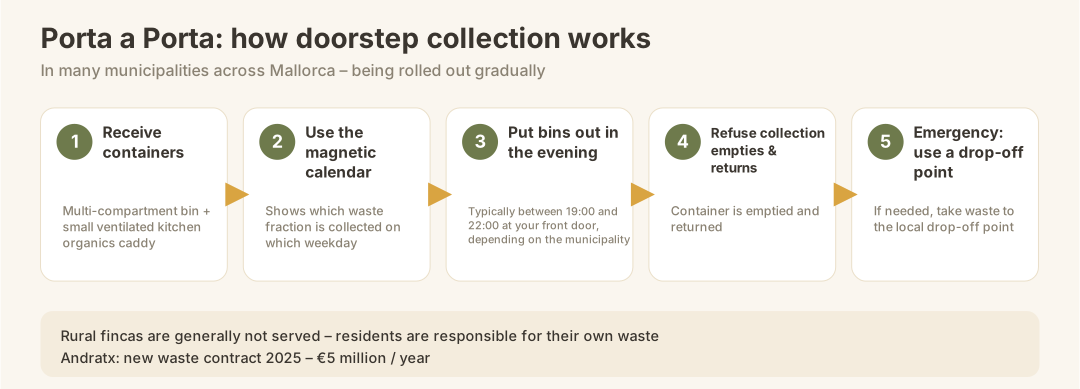
How it works:
- Every household receives a multi-compartment wheelie bin as well as a small ventilated container for organic waste to keep in the kitchen.
- In addition, there is a magnetic calendar showing which waste fraction is collected on which day of the week.
- You put the bin out in front of your front door in the evening – usually between 19 and 22 Uhr, depending on the municipality.
- The refuse collection empties it and places it back.
- In an emergency, you can take waste to the local collection point.
Santanyí has introduced this system with detailed information booklets (also available in English), for example; the municipality of Andratx approved a new waste collection contract in April 2025 with a total value of 5 Millionen Euro per year, covering door-to-door collection, tree cuttings, textile waste, and bulky items.
Note: Rural fincas and remote properties are generally not served by refuse collection. In those cases, you are personally responsible for taking your waste to container sites or the collection point – daily disposal is recommended to avoid pests.
Finding container sites: how to go about it
| Situation | Solution |
|---|---|
| You live in a town or larger village | Containers are usually located at roundabouts, village entrances, or car parks |
| You live on a rural finca | Ask the owner or the town hall about the nearest container site |
| Porta-a-Porta municipality | Check collection times and days with the Ajuntamiento or on the municipal website |
| Hazardous waste, cooking oil, electronics | Find locations via dondelotiro.com or ask the Ajuntamiento directly |
| Travelling / short-term stay | Use container clusters at village entrances, dispose of waste daily |
The TIRME company (Tractament i Eliminació de Residus de Mallorca) operates the island's central waste treatment park in Son Reus. Since 2011 there have been no landfill sites on Mallorca – whatever cannot be recycled is processed in the energy recovery facility. In 2021, the energy generated in this way was equivalent to supplying around 88.000 households.
What has applied since 2021: the new waste law
Since 1 January 2021 a waste management law applies in Mallorca that goes beyond existing sorting systems:
- Single-use plastics (cutlery, plates, drinking straws, cotton buds) are banned or must be replaced with biodegradable alternatives
- Coffee capsules may only be sold in supermarkets if they are compostable
- Food waste from restaurants, supermarkets, hospitals and schools must be passed on to charitable organisations by at least 50 % before being disposed of
At national level, Spain has also had a plastic tax of 0.45 €/kg on non-recycled plastic packaging since 2023 – this primarily affects manufacturers and importers, but also has an indirect impact on what is available in shops.
The most common waste disposal mistakes in Mallorca
New arrivals in particular tend to fall into the same traps time and again. Here are the most common ones – and how to avoid them:
- Putting Tetra Pak in the blue bin instead of the yellow – Milk and juice cartons are lightweight packaging (yellow), not paper.
- Putting organic waste in the grey bin instead of the brown – Food waste belongs in the organic bin, not in general waste.
- Putting glass in with the lid on – Remove lids and caps beforehand; metal goes in the yellow bin.
- Putting a greasy pizza box in the blue bin – Soiled paper cannot be recycled and contaminates entire batches of paper.
- Visiting the Parc Verd without a card – The Targeta d'Accés is mandatory; no entry without the card.
- Leaving rubbish at a finca – There is no refuse collection in rural areas. Rubbish left outside attracts rats and other vermin.
- Missing the collection time – In Porta-a-Porta municipalities, the bin must be outside at the correct time. Wrong categories or the wrong day of the week may result in non-collection.
- Putting hazardous waste in ordinary bins – Paints, batteries and electronics belong at the Parc Verd – not in general waste.
Checklist: waste sorting for new arrivals
- Know the colour-coded system (yellow, green, blue, brown, grey)
- Check your local council's collection schedule at the Ajuntamiento or look it up online
- Apply for an access card (Targeta d'Accés al Parc Verd) at the town hall
- Find out where your nearest Parc Verd / Deixalleria is
- Locate the nearest cooking-oil containers and battery collection points
- Bookmark dondelotiro.com as a quick reference for any items you're unsure about
- Set up separate bins at home for organic, yellow, blue, glass and general waste
- If you live on a finca or in a rural area: factor in trips to the nearest container points
What comes next? Waste, costs and everyday life
Getting to grips with recycling is a typical first practical test for anyone who has just arrived on Mallorca. Once you've sorted this out, you'll notice that life on the island works in many ways similarly to what you may be used to – but not identically. If you're currently organising your day-to-day life on Mallorca, you might also find these useful:
- Cost of living in Mallorca – what life here really costs
- Setting up a water account on Mallorca – how to get your supply contracts right
- Setting up electricity in Spain – from the NIE to your first contract
- Internet on Mallorca – providers and connection options
- Empadronamiento Mallorca – no registration, no Targeta
If you're planning a smooth move, the Relocation Service Mallorca offers professional support – from finding a property to registering with the authorities.
Conclusion
Recycling on Mallorca is not a bureaucratic exercise for its own sake: the island has had no landfill sites since 2011 – the entire system depends on residents doing their part correctly. The colour-coded system is straightforward once you've learned it; the biggest stumbling blocks are the edge cases (Tetra Pak cartons, soiled cardboard, coffee capsules) and gaining access to the Parc Verd. Anyone who applies for their access card early, knows the local collection schedule and checks dondelotiro.com when in doubt is well prepared. On an island with limited space and millions of visitors, every correctly sorted bin bag counts.
Official sources
- Consell de Mallorca – Medi Ambient (Environment): https://www.conselldemallorca.net — the authority responsible for waste management on the island
- TIRME (Tractament i Eliminació de Residus de Mallorca): https://www.tirme.com — operator of the Son Reus recycling and energy recovery facility
- Dondelotiro.com: https://www.dondelotiro.com — bin finder by item and address (in Spanish/Catalan)
- Santanyí – Porta a Porta information brochure: https://www.santanyiresidus.net
- Ley 7/2022 de residuos y suelos contaminados para una economía circular (BOE): https://www.boe.es/eli/es/l/2022/04/08/7 — Spain's national waste management act