Registering a dog in Mallorca: microchip, census and new obligations
Anyone wanting to register their dog on Mallorca quickly discovers: there's no dog tax as in Germany, but instead a different system involving mandatory chipping, a central register and – since 2023 – a compulsory course for all dog owners. Anyone moving from Germany or who has already adopted a dog on the island needs to know which register is responsible, what deadlines apply for the so-called dog licence, and when the register for potentially dangerous dogs (PPP) additionally applies. In this guide you'll learn how registration at the vet works, which three Balearic registers exist, which transitional deadlines for existing owners have already expired, and exactly what husbandry obligations the Spanish animal welfare law prescribes.

Are you moving to Mallorca with your dog and want to know which administrative steps are really necessary locally?
- 📩 Submit a personal enquiry — we'll review your individual case and refer you to suitable contacts
- Find vets on Mallorca in the business directory
RIACIB: the Balearics' central pet register
Every dog, cat and ferret on the Balearics must be recorded in the RIACIB – the Registre d'identificació dels animals de companyia de les Illes Balears. The Servei de Sanitat i Benestar Animal des Govern de les Illes Balears is responsible, with the technical processing in practice handled via the Col·legi Oficial de Veterinaris de les Illes Balears (COVIB). You don't carry out the registration yourself in person at an authority: your vet implants the microchip and then enters the data directly into the register.
Note: Unlike in Germany, there's no municipal dog tax on Mallorca and no separate registration with the local council's regulatory office. The RIACIB entry via the vet is the central and generally the only mandatory step for "normal" dogs without a PPP classification.
| Register | Body | Responsible for |
|---|---|---|
| RIACIB | Servei de Sanitat i Benestar Animal / COVIB | Chip identification of all dogs, cats and ferrets on the Balearics |
| Registre autonòmic d'animals potencialment perillosos | Govern de les Illes Balears | Potentially dangerous dogs (Section 1) and other animals classified as dangerous (Section 2) |
| Registre d'associacions de protecció i defensa dels animals | Govern de les Illes Balears | Animal welfare associations and organisations |
Microchip: technical requirement and correct order
The microchip is mandatory on the Balearics for dogs, cats and ferrets. It must comply with the international ISO standard 11784/11785 and carry a unique 15-digit number. Only tattoos demonstrably applied before 3 July 2011 still count as a valid alternative to the chip.
The order matters: the chip must be implanted before the rabies vaccination, so that the vaccination can be correctly assigned to the animal in the EU pet passport. If the animal is vaccinated first and only chipped afterwards, the vaccination is considered invalid, and the 21-day waiting period starts over after a repeat vaccination.
| Criterion | Requirement |
|---|---|
| Chip standard | ISO 11784/11785, 15-digit, readable |
| Alternative | Tattoo, only if applied before 03.07.2011 |
| Order | Chip before the rabies vaccination |
| Minimum age for entry/vaccination | 15 weeks |
| Waiting period after first vaccination | At least 21 days until valid |
| Who implants and registers | Authorised vet, entry directly in RIACIB |
If you're only bringing your dog over from Germany later, it's worth taking a look at our separate guide on bringing your dog to Spain – there we explain the EU pet passport and the entry requirements in detail. The RIACIB registration on-site in Mallorca is independent of this and additionally required as soon as the dog lives permanently on the island.
Register for potentially dangerous dogs (PPP)
Alongside the general RIACIB, the Balearics have a separate register for cans potencialment perillosos – potentially dangerous dogs. The legal basis is Ley 50/1999 of 23 December and Real Decreto 287/2002 of 22 March, which regulate the handling of these animals across Spain. In the Balearics, this register was formally established by a resolution of the Consellera d'Agricultura i Pesca of 17 May 2006.
Attention: Whether your dog is considered potentially dangerous doesn't depend only on the breed, but can also be based on individual behaviour. Which breeds are typically affected and what additional requirements (leash, muzzle, licence) apply are explained in detail in our guide on listed breeds in Spain.
Dogs classified as PPP generally come with additional obligations such as mandatory liability insurance and a separate owner's licence – independent of the standard RIACIB chip registration, which applies to every dog.
The competence course under Article 36: passed, but not yet in force
Spain's animal welfare law (Ley 7/2023) provides in Article 36 for a free, recognised training course for all dog owners. Important in practice: the course requirement only takes effect once the associated implementing regulation (reglamento de desarrollo) sets out the content, providers and recognition of the courses. As long as this reglamento is not in force, there is no officially recognised course you could take — and accordingly no enforceable obligation or sanction based solely on a missing course certificate.
Note: The situation may change once the Reglamento is passed. You can get reliable and up-to-date information from your Ajuntament (local council) or your vet — they'll also tell you whether, and from when, a recognised course is available.
Dog liability insurance
For dogs listed in the register for potentially dangerous animals, liability insurance is mandatory. For all other dogs there's no general legal requirement as in several German federal states, but dog liability insurance is strongly recommended – especially since dogs in Mallorca are frequently out in public spaces, on beaches and in parks, and liability issues can quickly become expensive in the event of an incident.
Daily care obligations under the Tierschutzgesetz (Animal Welfare Law)
The Tierschutzgesetz regulates not only registration and course requirements, but also everyday life with your dog. The most important requirements include species-appropriate housing, access to water and food, as well as regular exercise and social contact.
| Requirement | Rule |
|---|---|
| Leaving a dog alone | Maximum 24 hours at a stretch |
| Leaving a cat alone | Maximum 3 days at a stretch |
| Leash requirement | In public facilities and parks, especially in towns and cities |
| Muzzle requirement | Partially in public facilities, especially for dogs classified as dangerous |
Note: Violations of the care regulations – such as leaving dogs alone for more than 24 hours on a permanent basis – can be sanctioned under the Tierschutzgesetz. The exact amount of possible fines varies depending on the individual case and the municipality.
No dog tax – but these costs still apply to you
A common misunderstanding among German expats: there's no dog tax in Mallorca, as is levied by municipalities in Germany. However, that doesn't mean keeping a dog is free. Instead, other, sometimes recurring costs arise:
| Cost item | When due |
|---|---|
| Chip implantation and RIACIB registration | One-off, at the vet |
| Dog licence course | Free, but allow time for it |
| Annual rabies vaccination | Regularly, through the vet |
| Dog liability insurance | Voluntary (except for PPP dogs), annual premium |
| Additional requirements for PPP classification | Licence, insurance, any additional fees |
Step by step: how to register your dog in Mallorca
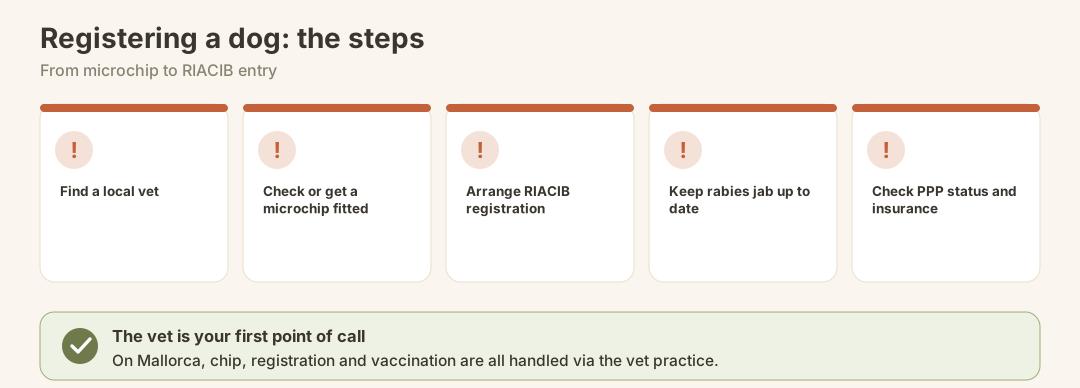
- Find a local vet. Look for a practice near you, ideally via the business directory for vets in Mallorca.
- Have the chip checked or implanted. If your dog is already chipped (e.g. from Germany), the vet will check ISO compliance. Without a chip, implantation takes place on site.
- Have the RIACIB entry made. The vet enters the chip number, owner details and basic data about the dog directly into the Balearic register.
- Keep the rabies vaccination up to date. Check whether the vaccination is still valid or have it refreshed.
- Keep an eye on the competency course requirement – the course obligation under Article 36 will only take effect once the implementing regulation is issued; check the current status with your local council
- Check whether your dog is classified as a PPP (potentially dangerous dog). If so, clarify the additional registration in the register for potentially dangerous dogs, as well as liability insurance and licensing.
- Take out liability insurance – voluntary, but recommended for every dog.
Most common mistakes
Many new owners confuse the German system ("registration with the local authority plus dog tax") with the Spanish system and search in vain for a municipal registration office – but everything actually runs through the vet and the RIACIB. A second common mistake: assuming the dog-handling course is only relevant for newly acquired dogs – in fact, the now-expired two-year deadline also applies to long-standing owners. And thirdly, it is often overlooked that a PPP classification triggers additional obligations, such as insurance and licensing, beyond the normal RIACIB registration.
What comes next?
After successful registration in the RIACIB and, if necessary, in the PPP register, you should keep an eye on the annual rabies vaccination and keep your EU pet passport up to date if you travel regularly between Mallorca and Germany. Anyone planning to stay on the island permanently should also check whether further documents, such as their own residencia or the empadronamiento, are due – these are not directly linked to dog registration, but affect many expats during the same period. For everyday pet needs such as grooming, training or care, you'll find suitable providers in the pet services directory.
Checklist: registering a dog in Mallorca
- Local vet selected
- Chip status checked (ISO 11784/11785 or tattoo before 03.07.2011)
- RIACIB entry made by the vet
- Rabies vaccination up to date
- Dog-handling course completed or appointment booked
- PPP status clarified (if relevant: licence and insurance organised)
- Dog liability insurance taken out
Conclusion
Registering a dog in Mallorca is less complicated than the German route via the Ordnungsamt and dog tax, but demands just as much care in other respects: correct chip, timely RIACIB entry via the vet, the dog handling course (Hundeführerschein) that now applies to practically all owners, and – if relevant – the additional PPP registration with compulsory insurance. Anyone who deals with these points early on is completely in the clear legally with their dog on the island and can focus on the truly lovely part: a relaxed dog's life between the beach, the finca and everyday Mediterranean living.
Official sources
- Servei de Sanitat i Benestar Animal, Govern de les Illes Balears – Registres de control dels animals potencialment perillosos: https://www.caib.es/sites/ramaderia/ca/registres_de_control_dels_animals_potencialment_perillosos_de_les_illes_balears/
- RIACIB – Identificació d'animals de companyia (Govern de les Illes Balears / COVIB): https://www.caib.es/sites/ramaderia/ca/httpswwwcoviborgidentificacionphplangestenidodomkeym106langcacont54641/
- Information on the new animal welfare law for companion animals (Govern de les Illes Balears): https://www.caib.es/sites/ramaderia/ca/benestar_dels_animals_de_companyaa/
- EU Regulation (EU) No. 576/2013 on the movement of pet animals (EUR-Lex): https://eur-lex.europa.eu/eli/reg/2013/576/oj/eng