
Long-term care insurance in Spain: what expats moving to Mallorca need to plan for
Anyone planning their retirement on Mallorca thinks first of sunshine, sea and quality of life – the question of long-term care insurance tends to land at the very bottom of the list. Yet this is precisely the kind of mistake you'd rather correct before the move than after. Becauselong-term care insurance in Spain follows different rules than in Germany: care allowance from the German long-term care fund can continue under certain conditions, but classic care-in-kind benefits – such as outpatient care services or residential care costs covered directly by the German fund – largely cease to apply abroad. Add to this the Spanish dependency system (Ley de Dependencia), which can establish its own entitlements. This guide explains which benefits you will actually receive as a resident on Mallorca, what the S1 form has to do with it, how to apply for a care grade from abroad, and what care options the island offers.

Not sure how to structure your long-term care cover for Mallorca?
- 📩 Submit a personal enquiry — We'll connect you with experienced expat advisers and local specialists
- All topics relating to health & insurance on Mallorca
The German long-term care insurance system: what still applies after the move?
German long-term care insurance is a compulsory insurance linked to statutory health insurance (GKV). Anyone who was covered by statutory health insurance in Germany and maintains that membership remains, in principle, covered for long-term care as well – regardless of whether they live in Germany or in an EU member state such as Spain.
A key factor is a European Court of Justice ruling from 1998: it obliged Germany to pay care allowance to German nationals with permanent residence in Spain who are insured under the German GKV. Prior to this ruling, Germany refused payment on the grounds of foreign residence. Today that matter is settled – care allowance also flows to Mallorca, provided the eligibility requirements are met.
Please note: Anyone who leaves the German GKV upon moving to Mallorca and takes out private insurance thereby also loses access to German long-term care insurance. Cover must then be arranged by other means – for example, through a private supplementary long-term care insurance policy.
Care allowance from Germany: who receives how much?
The care allowance is a cash benefit that enables those in need of care to decide for themselves who cares for them and how. It is paid directly to the insured person – including to a Spanish bank account.
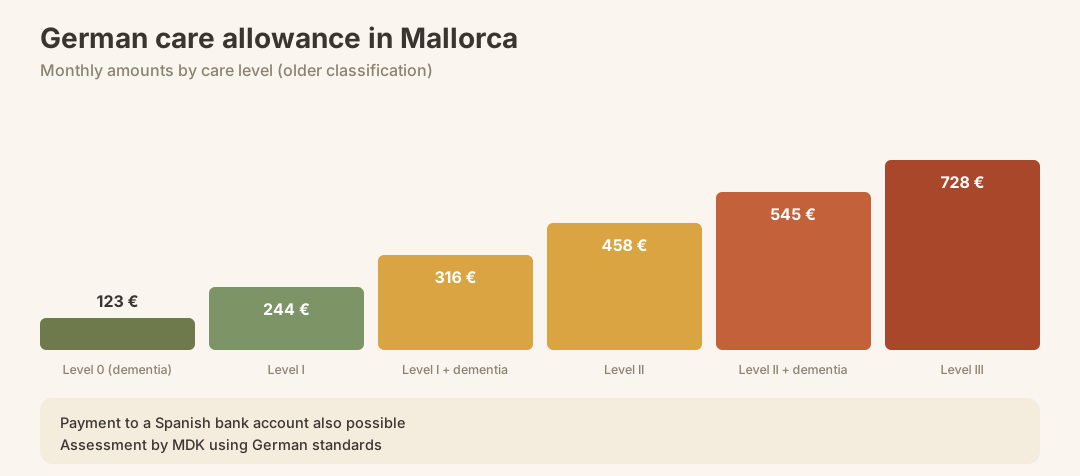
The following table shows the care allowance amounts under the older care-grade classification system, as documented in the available research. In Germany, this system has since been replaced by the current care grades (1–5). Which classification and which amounts apply to you specifically will be determined by the Medical Review Board (Medizinischer Dienst) as part of the assessment process – please check with your long-term care fund for the currently applicable figures.
| Care level (older classification) | Monthly care allowance (documented values) |
|---|---|
| Care level 0 (dementia) | 123 € |
| Care level I | 244 € |
| Care level I with dementia | 316 € |
| Care level II | 458 € |
| Care level II with dementia | 545 € |
| Care level III (with and without dementia) | 728 € |
Please note: Applications are submitted informally to the relevant German health insurance fund. The date of receipt is taken as the application date – even if the application is initially received by a Spanish authority and forwarded. Care allowance is granted at the earliest from the point at which all eligibility requirements are met.
Care benefits in kind: What does not apply abroad
Whilst care allowance can be exported to other EU countries, the situation is different when it comes to so-called care benefits in kind. These include:
- Outpatient care services that are billed directly by the German long-term care insurance fund
- Short-term care and substitute care
- Full inpatient residential care (proportional contribution by the long-term care insurance fund)
- Day and night care
These benefits require that approved service providers operate in accordance with German standards – which Spanish care services generally do not. In practical terms, this means: in Spain you will not receive care allowance plus additional benefits in kind from the German fund for Spanish carers.
What this means for planning: The care allowance must be sufficient to cover at least part of the actual care costs on the ground – whether for a care service, domestic help, or a residential place. The remainder must come from personal funds or from the Spanish dependency system.
Applying for a care level from abroad: How the process works
Even if you live in Mallorca, your German health insurance fund handles the application and assessment of your care level. The process:
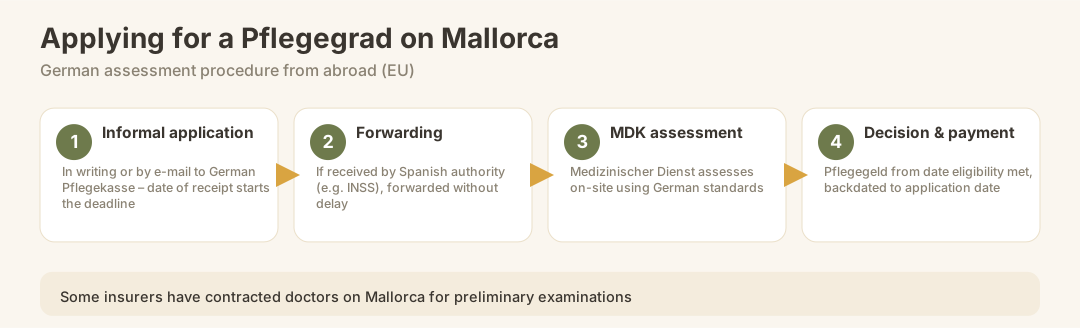
- Submit an application – informally, in writing or by e-mail to your German health insurance fund. The date of receipt at a forwarding body (e.g. INSS in Spain) already counts as the application date.
- Commissioning of the MDK – The umbrella associations of the long-term care insurance funds have agreed to arrange assessments within the EU abroad through the Medical Review Board (MDK).
- Assessment on site – The assessment is carried out according to the same standards as in Germany. This applies provided that the need for care was not already established prior to the stay abroad.
- Panel doctors on Mallorca – Some German health insurance funds have panel doctors on Mallorca who can be involved in preliminary examinations or medical certificates. Ask your insurer directly about this.
- Classification notice and payment – After the care level has been determined, payment begins retroactively from the date of application.
| Step | Responsible party | Deadline/Note |
|---|---|---|
| Informal application | German long-term care insurance fund | Date of receipt = start of deadline |
| Forwarding upon receipt in Spain | Spanish authority (e.g. INSS) | Without delay |
| MDK assessment | MDK on behalf of the insurer | Same standards as in DE |
| Payment of care allowance | German long-term care insurance fund | From the date eligibility conditions are met |
The Spanish care system: Ley de Dependencia
Spain has created its own care provision system with the Ley de Dependencia (Law on Personal Autonomy and Care for Dependent Persons). It is aimed at people who permanently require assistance with basic everyday activities.
If you live on Mallorca as a resident with an Empadronamiento and a valid residence permit (Residencia), you can in principle apply for benefits under the Ley de Dependencia. The Comunidades Autónomas are responsible – in the Balearic Islands this means the regional government (Govern de les Illes Balears).
The system recognises three levels of dependency:
| Level | Designation | Meaning |
|---|---|---|
| Grado I | Dependencia Moderada | Occasional assistance required |
| Grado II | Dependencia Severa | Extensive daily assistance required |
| Grado III | Gran Dependencia | Full support required |
Note: Access to benefits from both systems – German Pflegegeld and the Spanish Ley de Dependencia – is not automatically mutually exclusive. However, offsetting may apply. Clarify this with your German Pflegekasse and an adviser specialising in German-Spanish social security law.
Health insurance and care provision: what to clarify first?
Pflegegeld and health insurance are closely connected, but they are two separate matters. For healthcare coverage on Mallorca you need:
- As a pensioner receiving a German pension: The S1-Formular, which you apply for from your German health insurance fund. With this you register with the Spanish INSS and apply for the Tarjeta Sanitaria – your access to public healthcare in Spain. Find out more in the guide to the S1-Formular Spanien.
- As a non-working person without a pension: A private health insurance policy with no co-payment (Copago) and no significant waiting periods – this is also a requirement for the Residencia. Providers such as DKV and Sanitas operate in the market; specific monthly premiums vary depending on age and level of cover – please obtain current quotes directly from the providers. More information in the guide to Krankenversicherung Spanien.
- As a freelancer or autónomo: You are required to register with the Spanish Seguridad Social, which opens access to the SNS.
Long-term care insurance remains separate from this for the time being – it is tied to your German GKV membership, not to your Spanish healthcare cover.
Types of Housing and Care Options in Mallorca
Mallorca has significantly expanded its range of housing options for seniors in recent years. The research identifies the following specific options:
| Type of Housing | Features | Cost Structure |
|---|---|---|
| Shared Senior Housing | Communal living, sometimes with outpatient care support | Less expensive than a care home; personal funds required |
| Senior Residence (e.g. Residencial Es Castellot, Seniors-Gruppe) | Inpatient care, often with a dedicated nursing unit | Full costs from personal funds, plus care allowance where applicable |
| 24-Hour Home Care | Carer living in the household | Monthly cost depending on level of care required; personal funds |
Please note: As a rule, benefits in kind from the German statutory care insurance cannot be billed for Spanish facilities or services. The care allowance is still paid, however — and can be used as a contribution towards funding these services.
One important planning consideration: according to current figures, the cost of living in Mallorca is in some cases lower than in major German cities. This can make the funding gap between the care allowance and actual care costs smaller than feared — though not close it entirely. Find out more in the guide to Cost of Living in Mallorca.
Tax Considerations: What You Should Know as a Care Allowance Recipient
The German care allowance is classified as a tax-free social benefit and is not subject to income tax in Germany. If you are a tax resident in Spain — meaning you spend more than 183 days per year on the island — you are in principle liable to pay tax in Spain (IRPF).
How the care allowance is to be treated under Spanish tax law should be clarified with an adviser who specialises in German-Spanish tax matters, as the double taxation agreement between Germany and Spain is the decisive factor. The same applies to your pension: under the double taxation agreement between Germany and Spain, pensions from Germany are in principle taxable in Spain — with the exception of civil service pensions.
Further information can be found in the guides on Taxes as a Resident (IRPF) and on IRPF Deductions in the Balearic Islands.
The Most Common Mistakes When Planning Care in Mallorca
Cancelling GKV membership when moving abroad — Anyone who gives up their German statutory health and long-term care insurance loses their entitlement to the German care allowance. Rejoining the GKV is generally no longer possible beyond a certain age.
Only applying for a care level in an emergency — The care allowance is paid from the date of application at the earliest. Waiting means any entitlement prior to that date is lost for good.
Expecting benefits in kind from Spanish care services – This leads to disappointment and funding gaps. Plan realistically: care allowance + personal funds + possibly the Spanish dependency system.
No Empadronamiento – Anyone who is not correctly registered has no access to benefits under the Ley de Dependencia. The Empadronamiento is mandatory.
No S1 form applied for – Without an S1, there is no access to public healthcare as a retiree. The form must be applied for from the German health insurance fund in good time before the move.
Choosing a care living arrangement too late – Good retirement residences on Mallorca have waiting lists. Find out early and get on the waiting list if necessary.
Overlooking the tax implications – As a resident in Spain, you are liable to pay tax. Seek advice in good time from a tax adviser for expats in Spain.
What comes next? An overview of the follow-on steps
Once the care insurance question has been resolved, these are the practical next steps:
- Apply for Residencia – Mandatory for EU citizens after three months of residence. Everything about Residencia in Spain.
- Transfer your pension to Mallorca – The German pension continues and is paid into an account of your choice. More information in the guide Applying for a pension in Spain.
- Private health insurance or S1 – Choose the right solution depending on your status. Private health insurance Spain comparison.
- Sort out your taxes – Particularly relevant: Modelo 720 reporting obligation for assets held abroad exceeding €50.000.
Checklist: Care provision for the move to Mallorca
- Check membership of the German statutory health insurance (and therefore care insurance) and secure it if necessary
- Apply for the S1 form from your German health insurance fund (for retirees)
- Complete Empadronamiento and Residencia in Spain
- Submit a care-needs assessment application as soon as the need arises – don't wait
- Enquire with your German health insurance fund about contracted doctors on Mallorca
- Explore the Spanish dependency system (Ley de Dependencia) and apply if applicable
- Research housing options and care facilities on Mallorca well in advance (note waiting lists)
- Clarify your tax situation with an expat tax adviser
- Realistically calculate the funding gap between care allowance and actual costs
- Consider a private supplementary care insurance policy if statutory health insurance membership is not guaranteed
Conclusion
Long-term care insurance in Spain is not an insurmountable problem – but it does require early planning. The care allowance from the German statutory health insurance fund will in principle continue to be paid as long as you maintain your membership and meet all eligibility requirements. Benefits in kind will no longer be available, so the resulting gap in care provision must be covered through personal funds, the Spanish dependency system, and carefully chosen local care services. Anyone who approaches this in a structured way – ideally one to two years before the move – can enjoy retirement on Mallorca without being caught off guard in an emergency.
Official sources
- German Foreign Office – German Consulate Palma de Mallorca: Frequently asked questions on health and long-term care insurance in Spain – spanien.diplo.de
- Deutsche im Ausland e.V. – Long-term care insurance abroad (EU/EEA/Switzerland): application and assessment procedures, entitlement to benefits – deutsche-im-ausland.org
- INSS – Instituto Nacional de la Seguridad Social: Responsible authority for social insurance and Tarjeta Sanitaria in Spain – seg-social.es
- Govern de les Illes Balears – Responsible authority for the Ley de Dependencia in the Balearic Islands – caib.es
- GKV-Spitzenverband / long-term care funds – Information on care allowance and payment abroad: gkv-spitzenverband.de
- Federal Ministry of Health – Fundamentals of the German long-term care insurance system: bundesgesundheitsministerium.de