
Taxes in Mallorca as a Resident: IRPF & Tax Return (Modelo 100)
If you live permanently on Mallorca, you will generally become a Spanish tax resident — and with that, the IRPF (Impuesto sobre la Renta de las Personas Físicas), Spain's income tax, becomes your central annual obligation. As a resident, you pay tax on your entire worldwide income in Spain and submit your tax return via the Modelo 100 for this purpose. This guide explains when you are a tax resident, what the IRPF rates on the Balearic Islands look like in 2026, which deadlines apply, and how the double taxation agreement with Germany protects you. Tax matters are complex and individual — treat this text as well-founded guidance, not as a substitute for a tax adviser (gestor/asesor fiscal).

When are you a tax resident on Mallorca?
Days spent in Spain
Explanation
Days of presence are every day you were in Spain, including days between two documented stays unless you can prove you were abroad. Arrival and departure days each count in full.
Explanation
Sporadic absences (“ausencias esporádicas” — short trips abroad) are days not included in the figure above. The law adds them rather than subtracting them.
Explanation
A tax residence certificate (“certificado de residencia fiscal”) is confirmation from a foreign tax authority that you are tax-resident there; it is valid for one year. It excludes only sporadic absences, not your presence in Spain.
Based on your entries, neither criterion is met.
Interim result: the calendar year is still in progress.
- Total residence days counted
- 150 days
- Statutory threshold (more than)
- 183 days
150 = 150 days
Days needed to cross the threshold: 34.
Legal status: 1 January 2007
This calculation is provided for guidance only and is not a substitute for tax or legal advice in specific cases.
Tax residency has nothing to do with your residence permit or registration with the padrón — it follows its own rules. Article 9 of the Spanish Income Tax Act (Ley del IRPF) recognises three alternative criteria. It is sufficient for just one of them to be met for Spain to treat you as a resident.
| Criterion | What it means | Practical note |
|---|---|---|
| 183-day rule | You spend more than 183 days in the calendar year in Spain | Sporadic absences are counted, provided you cannot prove tax residency abroad |
| Economic centre of interest | The core or base of your activities and economic interests is in Spain | It is sufficient if you hold more assets/income here than in any single other country (relative majority) |
| Family presumption | Your spouse (not living separately) and minor children habitually reside in Spain | Rebuttable presumption — you can provide evidence to the contrary |
The 183 days do not need to be consecutive; they are added up across the entire calendar year. Important: unlike the German concept of domicile, Spain does not split the year — for the entire tax year you are either a resident or a non-resident. Regarding the criterion of "economic centre of interest", the Spanish Supreme Court (Tribunal Supremo, judgment of 08.07.2024) has clarified that not only income counts, but also the location of your movable and immovable assets and the place from which you manage them.
Most common mistakes when assessing residency
- Confusing padrón registration with tax residency. Registration via Empadronamiento is an administrative act — it does not automatically establish your tax liability, but it can be an indicator.
- Believing that "fewer than 183 days = definitely not a resident". The economic centre of interest alone can trigger residency, even if you spend less than half the year here.
- Failing to document your departure from Germany properly. Without clear evidence, dual claims from both tax authorities may arise.
The worldwide income principle
The decisive difference between resident and non-resident: as a resident, you pay tax on your worldwide income under IRPF (known as "obligación personal"). Whether it's German rental income, an occupational pension from Germany, dividends from a US portfolio, or your salary from a Mallorcan employer — all of it is in principle included in your Spanish tax return.
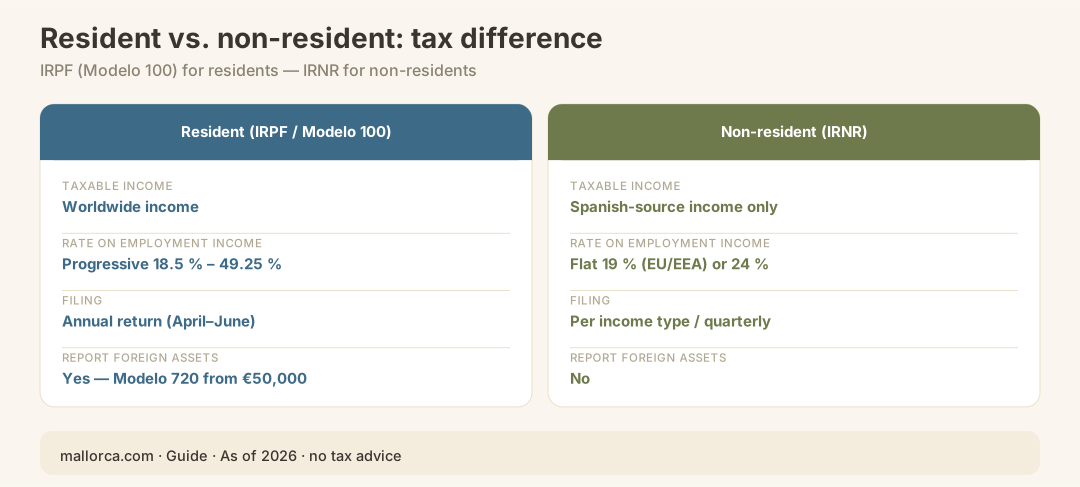
A non-resident, on the other hand, only pays tax in Spain on Spanish-source income (such as rental income from a Finca or capital gains on a property sale) — and this is done via the other model, the IRNR (Impuesto sobre la Renta de no Residentes).
| Aspect | Resident (IRPF, Modelo 100) | Non-Resident (IRNR) |
|---|---|---|
| Taxable income | Worldwide income | Spanish-source income only |
| Rate on earned income | Progressive (see table below) | Flat rate (EU/EEA generally 19 %, otherwise 24 %) |
| Filing | Annual return (April–June) | Per income item / quarterly |
| Report foreign assets | Yes (Modelo 720 from €50.000) | No |
The worldwide income principle is the reason why clearly establishing your residency status is so important — and why the double taxation agreement (covered further below) is your most important layer of protection against being taxed twice.
IRPF rate in the Balearic Islands 2026: national + regional component
German–Spanish tax
Explanation
Your annual gross income from employment, before tax and social-security contributions.
Explanation
Married here means joint assessment under Germany’s income-splitting method and, in Spain, a family unit entitled to choose between a joint and separate return.
- Germany
- €13,747.00
- Spain: IRPF (Spanish personal income tax)
- €16,114.00
Spain costs €2,367.00 more in tax than Germany.
Social contributions: This calculator compares income tax with IRPF, not total contribution rates. German social-security contributions, Spanish cotizaciones and therefore German pension and insurance deductions are excluded. Both taxes consequently look higher than the actual burden, especially the German tax: including the deductions widens the gap; it does not reverse it.
German church tax is not calculated.
Legal status: 1 January 2026
This calculation is provided for guidance only and is not a substitute for tax or legal advice in specific cases.
IRPF uses a split rate: one half ("tramo estatal") is set by the Spanish central government, and the other half ("tramo autonómico") is set independently by each autonomous region. On Mallorca, the rate of the Comunidad Autónoma Illes Balears applies. The Balearic Islands have reduced their rates for the lower and middle bands — the combined top rate stands at 49,25 % on general taxable income above 175.000 euros.
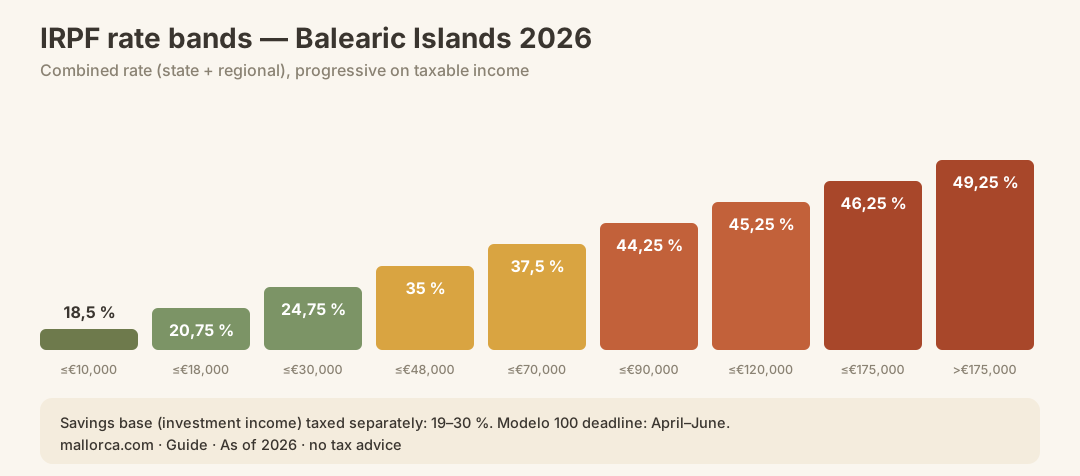
The table below shows the combined rates (national + Balearic) for the 2025 tax year, which you declare in the 2026 campaign via Modelo 100. This is a progressive band structure: each euro is taxed only at the rate of its own band, not your entire income at the top rate.
| Band (taxable income) | Combined Balearic rate |
|---|---|
| 0 € – 10.000 € | 18,50 % |
| 10.000 € – 18.000 € | 20,75 % |
| 18.000 € – 30.000 € | 24,75 % |
| 30.000 € – 48.000 € | 35,00 % |
| 48.000 € – 70.000 € | 37,50 % |
| 70.000 € – 90.000 € | 44,25 % |
| 90.000 € – 120.000 € | 45,25 % |
| 120.000 € – 175.000 € | 46,25 % |
| above €175.000 | 49,25 % |
To illustrate the mechanics, here is just the regional (Balearic) component in isolation, as shown by the Agencia Tributaria in its official guidance — nine bands ranging from 9 % to 24,75 %:
| Tax base up to | Balearic regional rate |
|---|---|
| 10.000 € | 9,00 % |
| 18.000 € | 11,25 % |
| 30.000 € | 14,25 % |
| 48.000 € | 17,50 % |
| 70.000 € | 19,00 % |
| 90.000 € | 21,75 % |
| 120.000 € | 22,75 % |
| 175.000 € | 23,75 % |
| above €175.000 | 24,75 % |
At national level there were no changes to the general bands for 2026 compared with the previous year. The combined rate shown in each case is derived by adding the national and Balearic band rates together.
Modelo 100: deadline and borrador (2026 campaign)
The Modelo 100 is the official annual IRPF return. For the 2025 tax year, the Ministry of Finance has set the deadlines in the Orden HAC/277/2026 established. You submit your return online via Renta WEB on the Sede Electrónica of the Agencia Tributaria.
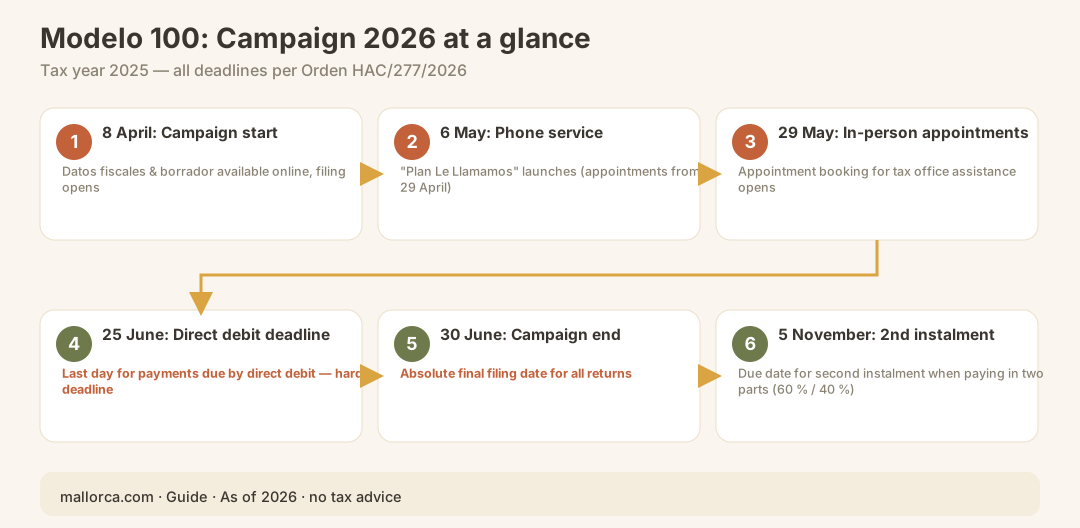
| 2026 Key Dates | What happens |
|---|---|
| 8 April | Campaign launches — tax data ("datos fiscales") and draft return (borrador) available online, online submission opens |
| 6 May | Telephone assistance service ("Plan Le Llamamos") begins (appointments bookable from 29 April) |
| 29 May | Appointments open for in-person filing at tax offices |
| 25 June | Last day for tax due with direct debit (Lastschrift) |
| 30 June | End of campaign — final filing deadline |
| 5 November | Second instalment due, if payment is split in two parts (60% / 40%) |
How to proceed step by step:
- Identify yourself: Log in via Cl@ve, digital certificate, or reference number.
- Check the borrador: Spain provides you with a draft return (borrador) pre-filled with available data. Never confirm it blindly — overseas income and foreign accounts are almost always missing.
- Add missing information: Enter German pensions, rental income, investment returns, and deductions.
- Check the result: Refund ("a devolver") or amount owed ("a ingresar").
- Submit: If paying by direct debit, no later than 25 June; otherwise by 30 June.
A late submission not preceded by a formal demand from the tax authority triggers the surcharges under Article 27 of the Ley General Tributaria — filing on time saves real money.
Key Deductions and Reductions
Before the tax rate applies, reductions ("reducciones") are subtracted from the tax base; deductions ("deducciones") then reduce the tax liability directly. The most important levers:
- Personal and family allowance ("mínimo personal y familiar"): a tax-free base amount that increases depending on age, children, and dependants.
- Contributions to Spanish pension plans ("planes de pensiones"): reduce the general tax base within the applicable annual limits.
- Social security contributions as an employee or autónomo.
- Balearic autonomous-region deductions: in addition to the national ones — for example for children, large families, disability, and certain regional circumstances.
- Donations to recognised organisations (enhanced rates under Ley 49/2002).
Which deductions actually apply to you depends heavily on your individual situation — a gestor can quickly pay for themselves here, especially in your first year of residency.
Pensions and investment income
These two types of income are particularly relevant for German expats on Mallorca.
Pensions are generally treated as earned income ("rendimientos del trabajo") and taxed at the progressive rate above — with one important exception for German civil-service pensions and public-sector funds (see the DBA section). Your statutory or private German pension therefore typically feeds into the Spanish progressive scale. The key question is which country has the right to tax it at all: under the DBA, as a rule only Spain as the country of residence has taxing rights over pensions and retirement payments. Only for statutory social-insurance pensions (such as those from the Deutsche Rentenversicherung) may Germany additionally levy a limited withholding-tax portion — details in the DBA section.
Investment income (interest, dividends, capital gains from shares or property) is instead allocated to its own, less progressivesavings base ("base imponible del ahorro"). From 1 January 2025 the top rate on this base reaches 30 %.
| Savings base (investment income) | Rate 2025/2026 |
|---|---|
| up to 6.000 € | 19 % |
| 6.000 € – 50.000 € | 21 % |
| 50.000 € – 200.000 € | 23 % |
| 200.000 € – 300.000 € | 27 % |
| from 300.000 € | 30 % |
For investors with a German brokerage account, note the following: German dividends are subject to a withholding tax deduction in Germany of 26,375 %. Under the DBA, however, Germany may retain only 15 % — you can reclaim the difference from Germany (application within four years), and the remaining 15 % can be credited against your Spanish tax liability.
Double taxation: the DBA between Germany and Spain
To ensure the same income is not taxed twice, theDouble Taxation Agreement (DBA) between Germany and Spain, signed on 3 February 2011, in force since 18 October 2012 and effective for tax years from 2013, applies. It answers the key question: which country may tax which type of income?
| Type of income | Taxing rights under the DBA |
|---|---|
| Germanprivate or occupational pension(non-statutory) | Exclusively the country of residence (Spain) — Germany may not levy additional tax here (Art. 17.1) |
| Germanstatutory social-insurance pension(e.g. Deutsche Rentenversicherung) | Country of residence (Spain); Germany may additionally levy limited withholding tax (Art. 17.2 — see note below the table) |
| Germancivil-service pension / public-sector fund | As a rule, the country of the paying authority (Germany) — generally tax-exempt in Spain (progression clause may apply) |
| Rental incomefrom German property | Country where the property is situated (Germany); Spain credits or exempts with a progression clause |
| Dividendsfrom Germany | Country of residence (Spain); Germany retains max. 15 % withholding tax (5 % for qualifying shareholdings ≥ 10 %) |
| Gain from the sale of property in Germany | State of source (Germany) |
Important regarding the taxation of pensions (Art. 17 DTA): Pensions and retirement income are, under Art. 17.1, in principle taxed exclusively in the state of residence (i.e. Spain). This applies in particular to private and occupational pensions — Germany may not impose additional tax on these. Only in the case of payments under social security legislation (statutory social insurance pensions such as the Deutsche Rentenversicherung) does Art. 17.2 grant the source state Germany an additional, limited right of taxation: up to 5 %, where the event giving rise to the pension entitlement occurs between 1 January 2015 and 31 December 2029, and up to 10 %, where that event occurs on or after 1 January 2030. Do not confuse private pensions with statutory ones — the 5-/10-% withholding applies only to the latter.
To avoid double taxation, Germany predominantly applies the exemption with progression clause method, whilst for certain types of income (including private pensions, capital gains, and supervisory board remuneration) it applies the credit method ("imputación"). As a resident in Spain, you offset the tax paid in Germany against your Spanish IRPF liability — up to the amount of the proportionate Spanish tax.
Important: The 2011 DTA covers income and wealth tax, not inheritance and gift tax — there is no treaty between the two countries covering that.
Reference: Beckham Regime and Modelo 720
Compare the Beckham regime
Explanation
Annual gross pay from Spanish employment. The Beckham branch taxes this gross amount without deductions.
Explanation
Seguridad Social is Spanish social security. Enter the employee contribution; it reduces only ordinary IRPF, not the Beckham branch.
- Annual Beckham-regime advantage
- €13,734.00
Effective rates on gross pay: Beckham 24%, ordinary 35.45%.
Legal status: 1 January 2024
This calculation is provided for guidance only and is not a substitute for tax or legal advice in specific cases.
Two special topics that are relevant for many new residents:
Beckham Regime (régimen de impatriados, Art. 93 Ley IRPF): Anyone who moves to Spain for professional reasons and has not been tax-resident in Spain during the five preceding years may apply to be taxed as a non-resident during the year of arrival and the following five years — at a flat rate of 24 % on employment income up to 600.000 € (47 % above that). Advantage: only Spanish-source income is taxed; the worldwide income principle does not apply. The application is submitted via Modelo 149 (within six months of commencing employment), with the annual return then filed via Modelo 151 instead of Modelo 100. Since 2023, certain self-employed individuals, digital nomads, and family members may also be included under specific conditions.
Modelo 720 (declaration of assets held abroad): As a resident with assets held outside Spain of more than 50.000 € per category (bank accounts / securities & insurance policies / real estate) you must report these for information purposes only — the deadline is 31 March of the following year (for 2025, therefore by 31 March 2026). In subsequent years, you only need to file again if the value of a block has changed by more thanmore than €20,000 compared to the last declaration — upwards or downwards — or if you have surrendered or disposed of an already reported item (account, securities account, property). Since the ECJ ruling of 27 January 2022 (C-788/19), the mitigated general penalty regime applies; however, the reporting obligation itself remains fully in force. Cryptocurrencies exceeding €50,000 held abroad are handled analogously via theModelo 721 (same deadline: 1 January to 31 March).
Most common mistakes in the IRPF return
- Confirming the borrador blindly: Foreign income and accounts are never pre-filled — you must add them yourself.
- Forgetting the German pension: As a resident, it belongs in your Spanish IRPF return, even if it comes from Germany.
- Overlooking Modelo 720: Anyone who exceeds the €50,000 threshold and fails to report risks penalties and IRPF consequences.
- Failing to reclaim withholding tax on German dividends: Up to 11.375% in excess withholding may otherwise go unrecovered.
- Failing to clarify residency status: Anyone regarded as resident in both countries must apply the DTA 'tie-breaker' rules — otherwise genuine double taxation may result.
- Confusing the 25 June and 30 June deadlines: If paying by direct debit, 25 June is already the cut-off date.
What comes next?
Your tax integration on Mallorca is not complete with the first IRPF return. The following steps follow on logically:
- You will definitely need atax identification number — you can find out how to apply for the NIE in theNIE number guide.
- If you arebuying on the island, there are one-offpurchase transaction costs to consider — separate from the ongoing IRPF.
- For the current market situation and price trends, it is worth consulting thelatest market report.
- We bring together all further topics relating to authorities and relocation in therelocation guide.
Checklist for your IRPF return as a resident
- Residency status clearly established (183 days / centre of life / family)
- NIE and Cl@ve / digital certificate in place
- Datos fiscales and borrador retrieved from 8 April onwards
- All worldwide income recorded (pension, rental, capital, salary)
- DTA treatment checked per type of income, foreign tax credited
- Deductions reviewed (personal and family allowance, pension plan, Balearic deducciones)
- Modelo 720 reviewed (overseas assets > 50,000 €) — deadline 31 March
- Beckham Regime reviewed, if relocating for employment purposes
- Filing before 25 June (direct debit) or 30 June
Conclusion
As a resident on Mallorca, you pay tax on your worldwide income via the IRPF and Modelo 100 — with the Balearic rate, which ranges from 18.5 % to 49.25 %, a separate savings base for capital income (19–30 %), and the annual deadline of 8 April to 30 June. The Double Taxation Agreement between Germany and Spain prevents double taxation, but requires you to correctly classify each type of income. Additional obligations such as the Modelo 720 and opportunities such as the Beckham Regime make the first year particularly advice-intensive. Those who clarify their status early and emigrate with thorough documentation avoid the most costly mistakes.
Official Sources
- Agencia Tributaria — Cuota íntegra autonómica (IRPF 2025, Illes Balears scale)
- BOE — Orden HAC/277/2026 (Modelo 100, Renta 2025 deadlines)
- Ministerio de Hacienda — Double Taxation Agreement Spain–Germany 2011 (full text)
- BOE — Instrument of ratification of the Double Taxation Agreement Spain–Germany
YMYL notice: This guide is intended for general information purposes as of June 2026 and does not replace individual tax or legal advice. Tax rates, allowances and deadlines are subject to change and depend on your personal circumstances. Binding information can only be provided by a qualified gestor/asesor fiscal or the Agencia Tributaria. For decisions with financial implications, please consult a professional adviser.
This guide provides a general overview of the legal position and does not replace legal or tax advice on your individual circumstances. Laws and deadlines may change; the linked official sources are authoritative.