
Health Insurance in Spain: state, private, convenio especial & S1
Anyone living permanently on Mallorca cannot avoid having health insurance in Spain — it is not only strongly recommended, but legally required for almost every residence permit. The Spanish system is structured differently from the German one: there is no statutory health insurance fund in the German sense, but rather a public health system (Sistema Nacional de Salud, SNS), to which you have different levels of access depending on your status. This guide outlines the four realistic routes — statutory coverage via the Seguridad Social, the convenio especial, private health insurance, and the S1 form for EU retirees — with concrete costs, deadlines, and the pitfalls we most commonly encounter on Mallorca.

Are you planning your move to Mallorca and unsure which insurance route suits your situation?
- 📩 Submit a personal enquiry — we will assess your case and connect you with experienced advisers and brokers on the island
- Emigrating to Mallorca: the complete guide
Who is covered and how? The four starting positions
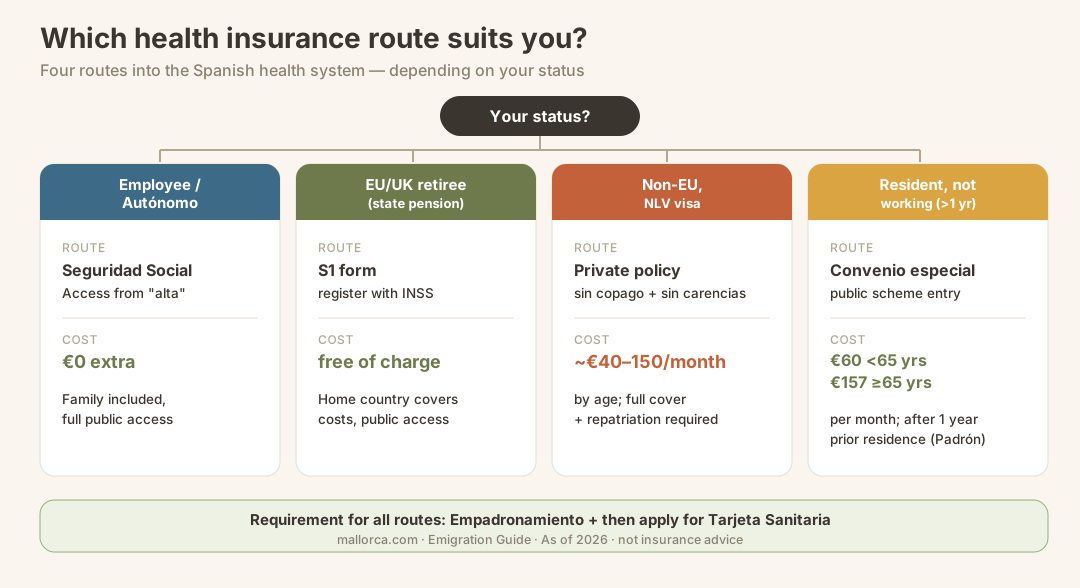
Before you think about costs, you need to know your own status. This determines whether you have access to the public system, whether you need to take out private insurance, or whether a special route applies. Spain ties access to the public system fundamentally to employment or an equivalent status — not to mere establishment of residency.
| Status | Access to public system (SNS)? | Private health insurance required? | Typical route |
|---|---|---|---|
| Employee (cuenta ajena) | Yes, from the date of registration (alta) | No (optional as a supplement) | Employer registers with the Seguridad Social |
| Self-employed (autónomo) | Yes, from alta in the RETA | No (optional as a supplement) | Own alta + contribution (cuota) |
| EU/UK retiree | Yes, via S1 form | No | Register S1 with the INSS |
| Non-working residents (e.g. NLV visa) | No, not initially | Yes, required for the visa | Private policy, later potentially the convenio especial |
The most important distinction is between those in employment (including dependants covered under their policy) and non-working newcomers. Anyone who works or is registered as an autónomo is entitled to public healthcare from the first day of registration — with no separate personal contribution for treatment. Anyone who arrives without employment must demonstrate their own insurance cover, typically through a private policy.
A common misconception: the European Health Insurance Card (EHIC/TSE) only covers temporary stays. It is explicitly not a valid proof for establishing residency in Spain — the Spanish Ministry of Health makes this point explicitly.
Statutory coverage via the Seguridad Social
The standard route for anyone working or running a business on Mallorca runs through the Seguridad Social. Once registration (alta) has taken place, you are in the public system — for an autónomo entitlement arises from the date of alta in the RETA (Régimen Especial de Trabajadores Autónomos), and for an employee from the date of registration by the employer.
What many people underestimate: there is no separate insurance contribution payable for medical care, as there is in Germany. For autónomos, the Asistencia Sanitaria forms part of the monthly social security contributions (cuota) — it is therefore not an additional payment but is already included. Access has been universalised since the 2018 reform and is essentially tax-funded; for employees, however, the funding also runs through social security contributions rather than a ring-fenced supplementary contribution. According to the Seguridad Social, autónomos are therebythe same benefits as employees in the Régimen General: GP, specialists, orthopaedic and prosthetic provision, rehabilitation, and patient transport.
A clear advantage over going private: family members can be co-insured at no extra cost (as beneficiarios). A spouse with no income of their own and children thus receive the same access.
How to get your health card (tarjeta sanitaria) in Mallorca
Entitlement arises with the alta — but to actually see a doctor you will need the individual health card (Tarjeta Sanitaria Individual, TSI) issued by your region, here by IB-Salut (Servei de Salut de les Illes Balears). The process:
- alta with the Seguridad Social (arranged by your employer or, if you are autónomo, by yourself).
- Empadronamiento at the relevant town hall (Palma, Calvià, Andratx, Sóller, etc.) — you will generally need the certificado de empadronamiento. In many Mallorcan municipalities (including Palma, Calvià, Deià, and Valldemossa) the paper certificate is not required thanks to a digital link to IB-Salut; however, you must in any case be registered.
- Apply for your TSI at your assigned health centre (centro de salud) or via the Sede Electrónica of IB-Salut. Bring: ID/NIE, valid Empadronamiento, passport photo 26 × 32 mm.
- Be assigned a centro de salud and choose a GP (médico de cabecera).
The TSI is free of charge in the Balearic Islands and allows you to collect prescribed medicines at any pharmacy in Spain and to access your nationwide health record.
Convenio especial: joining the public system without a job
What do you do if you are not working, are not receiving an EU pension, and still wish to join the public system? For this there is the convenio especial de prestación de asistencia sanitaria — a contract with the regional health service (in Mallorca: IB-Salut), governed by Real Decreto 576/2013. Important: this convenio especial for healthcare is an entirely different matter from the identically named convenio especial of the Seguridad Social, which is used to top up pension contribution periods.
The terms are set at national level:
| Feature | Convenio especial sanitario |
|---|---|
| Contribution under 65 | 60 €/month |
| Contribution from age 65 | 157 €/month |
| Waiting period / carencia | None (cover from the start of the contract) |
| Copago (co-payment) for treatment | None |
| Outpatient medicines, orthotics and prosthetics, dietary products | 100 % self-funded |
| Non-urgent patient transport | 100 % self-funded |
| Prior residence requirement | 1 year uninterrupted (EU/EEA/CH/UK counts) |
| Registration requirement | Empadronamiento in a Spanish municipality |
The major catch that many people overlook: the convenio especial covers treatment, diagnostics and hospital care without co-payment — but outpatient medication, orthopaedic and prosthetic appliances, outpatient dietary products (productos dietéticos) and non-emergency patient transport must be paid 100 % out of pocket. Anyone who relies on regular medication should factor this in.
The second hurdle is the one-year prior residence requirement: you must have lived continuously in Spain (or an EU/EEA country, Switzerland or the UK) for one year beforehand, evidenced by an Empadronamiento or a residency certificate. The convenio especial is therefore not an entry-level option for new arrivals — during the first twelve months you will need another solution, typically a private insurance policy.
It is taken out on Mallorca through IB-Salut via its Sede Electrónica (using a certificado digital, DNI electrónico or Cl@ve) or in person. Each family member must submit a separate application.
Private health insurance: Adeslas, Sanitas, DKV, ASSSA & Co.
Private health insurance (seguro de salud privado) is the most common route for new arrivals on Mallorca — and in practice the only viable one for holders of the Non-Lucrative Visa (NLV). The Spanish private market is large: according to IDIS/ICEA (as at 31.12.2025), more than 14 million people in Spain hold a private health policy; four providers account for around 70 % of the market — SegurCaixa Adeslas (approx. 30.7 %), Sanitas (16.7 %), Asisa (13.7 %) and DKV (6.2 %). Exact market shares vary slightly depending on the reference date and source. In the Balearic Islands, ASSSA is also widely used — a provider focused on international residents, with a tariff model that does not apply loadings for pre-existing conditions.
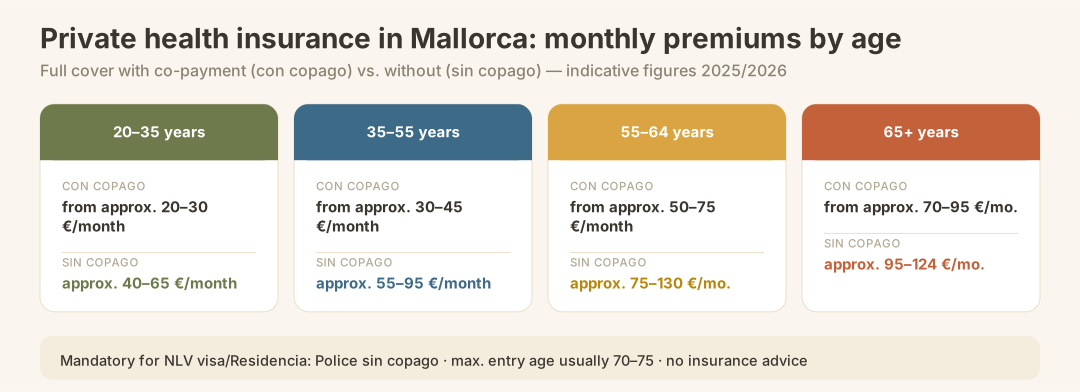
By far the biggest pricing factor is your age at entry. Someone joining at 35 pays a fraction of what a 68-year-old pays. A rough guide for comprehensive policies (approximate market values 2025/2026, depending on provider, tariff and location):
| Age group | With co-payment (con copago) | Without co-payment (sin copago) |
|---|---|---|
| 20–35 years | from approx. 20–30 €/month | approx. 40–65 €/month |
| 35–55 years | from approx. 30–45 €/month | approx. 55–95 €/month |
| 55–64 years | from approx. 50–75 €/month | approx. 75–130 €/month |
| 65+ years (comprehensive policy) | from approx. 70–95 €/month | approx. 95–124 €/month |
For those aged 65 and over, it is worth taking a close look at the scope of cover: Comprehensive policies with hospitalisation cost approximately 95–124 €/month depending on the provider (industry figures 2025), while basic specialist or entry-level policies without hospital cover are considerably cheaper. For extensive additional cover, the average for comprehensive policies exceeds 145 €/month. Some insurers also cap new applications at a maximum entry age (often 70–75 years). Products tailored specifically to older applicants include Sanitas Único, Adeslas Senior, and the senior tariffs from DKV (entry limit usually 75 years).
copago vs. sin copago — the crucial difference
With a con-copago policy, you pay a small fixed amount per GP or specialist visit or service (e.g. 7 € for a GP, 10 € for a specialist) — in return, the monthly premium is lower. With sin copago, everything is included in the premium, though it is correspondingly higher. Important for those relocating: the NLV visa strictly requires a policy without co-payments (sin copago) — a con-copago policy is routinely rejected by the immigration authorities.
Mandatory minimum cover for Residencia and NLV
Anyone moving to Spain on the Non-Lucrative Visa (residencia no lucrativa) — the standard route for retirees and those of independent means from outside the EU — must provide proof of health insurance with full cover in Spain that meets specific minimum criteria. In practice, most applications fail at this stage due to formal errors.
In formal terms, the consulate wording permits both a public and a private policy ("seguro público o privado"). In practice, however, a private policy is required: NLV applicants are not permitted to work in Spain and are therefore generally unable to demonstrate public cover. According to the requirements of the immigration authority (extranjería), the policy must have the following characteristics:
- Contract with an insurer authorised to operate in Spain (a travel insurance policy alone is not sufficient).
- Without co-payments (sin copago) — excess payments will result in rejection.
- Without waiting periods (sin carencias) — cover from day one.
- Cover equivalent to public provision — GP, all specialist disciplines, diagnostics, hospital, emergency care 24 h.
- Repatriation in the event of illness or death to the home country.
- Valid throughout the entire territory of Spain, for the full duration of the permit applied for (at least one year).
- Official insurance certificate (certificado), which you present at the consulate or to the extranjería.
Providers have created dedicated products for this purpose, whose names typically include "Residents" or "Visado": Sanitas Residents / Más Salud, DKV Visado / Residentes, ASISA Health Residents, Adeslas Plena Total. These products generally issue the required certificado within a matter of days.
Note on the Golden Visa: The Spanish Golden Visa/investor visa was abolished under law LO 1/2025 (effective 3 April 2025). For non-EU citizens, the Non-Lucrative Visa (or the digital nomad visa) is now the standard route. Please seek independent legal advice regarding your specific circumstances.
S1 form: the special route for EU retirees
If you receive a statutory pension from an EU/EEA country, Switzerland, or the United Kingdom, your path is particularly straightforward: with the S1 form you gain free access to the Spanish public health system — at the expense of your pension home country. You then need neither a private policy nor the convenio especial. The Spanish Ministry of Health confirms: anyone receiving a public pension and able to demonstrate the corresponding entitlement (for example via an S1) does not need to take out a convenio especial.
The S1 replaces the former forms E121/E106/E109/E120 and works as follows:
- Request the S1 in your home country — for German pensioners, contact your responsible health insurance fund; for UK pensioners, apply through the NHS Overseas Healthcare Service.
- Register the S1 with the INSS — at the Instituto Nacional de la Seguridad Social, at the relevant CAISS on Mallorca, or online via the Sede Electrónica (using a certificado digital / Cl@ve). The S1 must be issued for you and each family member accompanying you.
- Await recognition — the INSS will grant you the status of "person entitled to healthcare at the expense of the S1-issuing state".
- Apply for your TSI at IB-Salut — with your INSS certificate and your Empadronamiento you can obtain your health card at your centro de salud.
Register the S1 promptly after moving — until the formal registration is complete, access to the public system may be unreliable. EU/EEA citizens who have lived legally and continuously in Spain for five years acquire permanent right of residence in any case (permanent residency under RD 240/2007) with full public entitlement, and no longer need a convenio especial.
Public vs. private: a direct comparison
Many residents on Mallorca combine both: covered by the public system (through employment, an S1, or a convenio especial) plus a private policy for shorter waiting times and free choice of doctor. Here is how the two systems differ:
| Criterion | Public (SNS / IB-Salut) | Private (Adeslas, Sanitas, DKV, ASSSA) |
|---|---|---|
| Cost | 0 € (employed/S1) or 60/157 € (convenio) | approx. 40–150+ €/month depending on age |
| Specialist waiting times | often weeks to months | usually days |
| Free choice of doctor | no (assigned centro de salud) | yes, within the cuadro médico |
| Language | predominantly Spanish/Catalan | often multilingual service |
| Outpatient medication | subsidised (employed/pensioners) or 100% self-funded (convenio) | depends on policy, often not fully covered |
| Serious/expensive treatments | very strong, world-class public medicine | limited depending on the sum insured |
| Valid for the NLV visa | not in practice | yes (sin copago + repatriation) |
Rule of thumb for Mallorca: For routine care, specialist appointments and convenience private insurance comes into its own. For serious or very costly cases (oncology, intensive care, transplants) the public system is often the more robust safety net — which is why the combination is so popular.
Most common mistakes
- Travel insurance instead of health insurance for the visa. A travel policy does not meet the NLV requirements — it carries co-payments, waiting periods or too short a term. The extranjería will reject it.
- Policy with copago for the NLV visa. Excess payments lead to rejection. It must be sin copago.
- EHIC/TSE as proof of residence. The European Health Insurance Card is only valid for temporary stays, not for establishing residency.
- Expecting convenio especial too soon. The one-year prior-residency requirement is frequently overlooked — it does not apply during the first twelve months.
- S1 not registered. EU retirees take out unnecessarily expensive private policies because they are unaware of the S1 or do not register it with the INSS.
- Underestimating medication costs under the convenio especial. Outpatient medications must be paid for 100 % out of pocket.
- Forgetting the Empadronamiento. Without registering at the town hall you will receive neither a TSI nor a convenio especial — it is the cornerstone of almost every route.
- Ignoring the maximum entry age. Anyone who puts off taking out private cover as a senior for too long risks insurers refusing to accept them at all.
What comes next?
Health insurance is one building block of your move to Mallorca — closely intertwined with the next bureaucratic steps:
- Applying for your NIE number: Almost nothing works without a NIE. Find out how to obtain one on Mallorca in the NIE number guide.
- Planning your move in full: Registration, taxes, residencia and more in the emigration guide.
- Sorting out accommodation: Whether buying or renting — you will need an address for the Empadronamiento. See long-term rentals on Mallorca.
- Understanding the market: Where you live affects your budget and daily life — take a look at the Market report helps with choosing a location.
Checklist: your health insurance for Mallorca
- Own status clarified (employee / autónomo / EU pensioner / non-working)
- Appropriate route chosen (Seguridad Social / S1 / private / convenio especial)
- NIE number obtained
- Empadronamiento completed at the town hall
- If employed: alta with Seguridad Social / RETA
- If EU pension: S1 requested and registered with INSS
- If NLV: private policy sin copago, sin carencias, with repatriation + certificado
- Family members co-insured / individual policies clarified
- TSI applied for with IB-Salut and centro de salud assigned
- Medication and co-payment costs realistically budgeted
Conclusion
Which health insurance in Spain is right for you depends almost entirely on your status. Employees and autónomos are covered through the Seguridad Social with no personal contribution, including family members. EU and UK pensioners use the S1 form and receive free access to public healthcare at the expense of their home country. Non-working residents initially need a private policy — practically essential for the NLV visa: sin copago, sin carencias and with repatriation cover — and after one year of prior residence can switch to the convenio especial (60 € under 65, 157 € from 65). In practice, many Mallorca residents combine basic public cover with a private policy for speed and comfort. The common denominator of all routes is the Empadronamiento — sort this out early and everything else falls into place.
Official sources
- Ministerio de Sanidad — Convenio especial de asistencia sanitaria (costs 60/157 €, requirements, RD 576/2013)
- Seguridad Social (INSS) — registering the S1 form
- IB-Salut — Convenio especial de asistencia sanitaria (Illes Balears)
- IB-Salut — applying for the Tarjeta Sanitaria Individual
- Infoautónomos — Asistencia sanitaria for autónomos
This guide is intended for general information purposes only and does not replace individual legal, tax or insurance advice. Requirements from immigration authorities and consulates, contribution levels and tariffs are subject to change and may vary in individual cases. Check the conditions with the relevant authority or insurer before signing any contract, and seek professional advice on visa and residence matters.