Kho Thai is a Thai restaurant on Camí de la Vileta in Palma, in the Sa Vileta – Son Rapinya quarter. This is the Ponent district, a good way west of the old town: a residential area rather than a going-out street, with neighbourhood shops and apartment blocks instead of terraces set out for passing trade. People who eat here either live nearby or have made the trip on purpose.
The house sums up its own kitchen in a single line: typical Thai food, cooked with fresh and natural products, prepared in-house at the wok. The menu bears that line out. It is short, it stays consistently with Thai dishes, and it is built around the wok rather than around the longest possible list. The pan-Asian detours into Japan or China that many Thai addresses pick up along the way are simply absent here.
What is on the menu at Kho Thai
The starters stay brief: a roll with chicken and vegetables, plus two skewer options with peanut sauce, one with chicken and one with prawns. Then come the two soups any Thai kitchen has to be measured against — Tom Kha Kai with coconut milk and lemongrass, and beside it the hotter, citrus-driven Tom Yam. Both are available with chicken or with prawns.
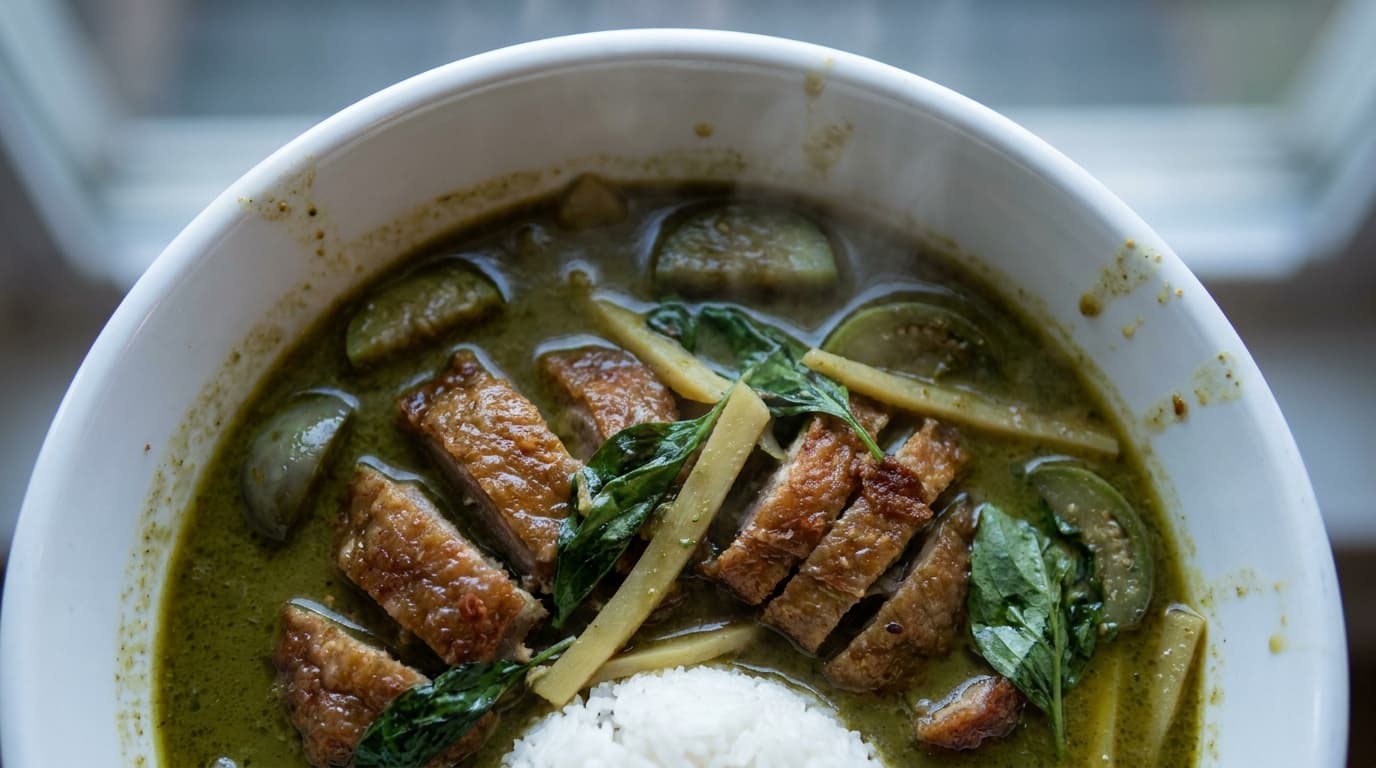
The curries run under their Thai names: Kang Dang as the red curry, Kang Kiew Waan as the green one, both with vegetables and rice, and both additionally in a version where rice noodles take the place of the rice. The longest section is the wok one. Pad Thai appears three times over — with rice noodles, with glass noodles and with wheat noodles. The same underlying idea, three different textures, and it is a distinction hardly anyone else bothers to make. Alongside them sit Kao Pad as wok-fried rice with egg, Pad Pak with mixed vegetables, the hot-rated Pad Kra Prao with soy sauce, Pad Med Mamuang with cashews, and Pad Kee Mao, which comes either with noodles or with rice.
The duck gets a section of its own
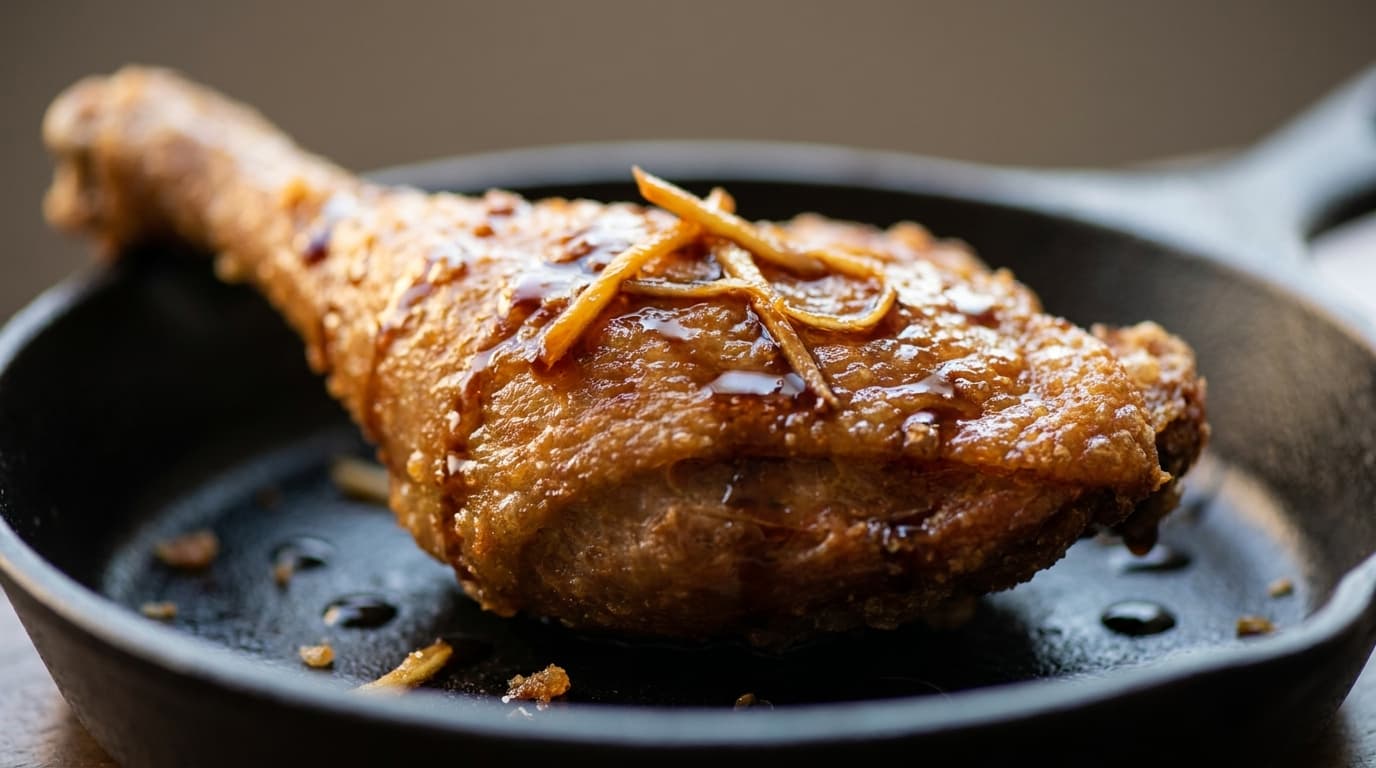
What stands out on the menu is that the crispy duck is not a single line item among the curries but has a heading to itself. Three dishes sit under it: Ped Kop with vegetables, rice and soy sauce, Kang Ped Kop with red curry, and Ped Kho Thai, sour and hot and likewise served with rice. That the kitchen named the third of them after the house says something about where it sets its store.
Vegetables, tofu and the question of heat
Almost every curry and every wok dish can be put together as you order: with vegetables, with chicken, with beef, with prawns or with tofu, and in several combinations of those. For vegetarians that is more than a token line at the foot of the menu, because the plain vegetable version and the tofu version are offered on every single curry and every single wok. The menu does not shrink to two dishes when no meat is wanted at the table.
The heat is marked dish by dish. It runs from the unmarked Pad Thai up to the green curries and Pad Kra Prao at the top end. Anyone who prefers things mild can find a route through the menu just as readily as someone after genuine Thai heat.
Thai juices, Singha and Chang
Alongside the usual soft drinks, Kho Thai keeps a section of its own for Thai fruit juices: mangosteen, coconut, lychee, pomegranate, tamarind, mango and guava. That is unusually complete for a house of this size and turns the drinks page into a small chapter in its own right. To them are added the two Thai beers Singha and Chang, plus a short choice of Spanish wines by the glass or the bottle.
The dining room itself is small. If you want to be sure of a table, it is better to book ahead.
Facilities & services
Parking
- Street parking
- Free
Accessibility
- Entrance
- Restroom
Payment
- Credit card
- Debit card
- Contactless
Service
- Delivery
- Takeout
- Dine-in
- Table service
Features
- Vegetarian
- Wi-Fi
Atmosphere
- Casual
- Cozy
- Trendy
- Quiet
Reservations
- Reservations accepted
- Reservation recommended
Good for
- Groups