
Capocorb Vell: Mallorca's Talayotic Settlement near Cala Pi
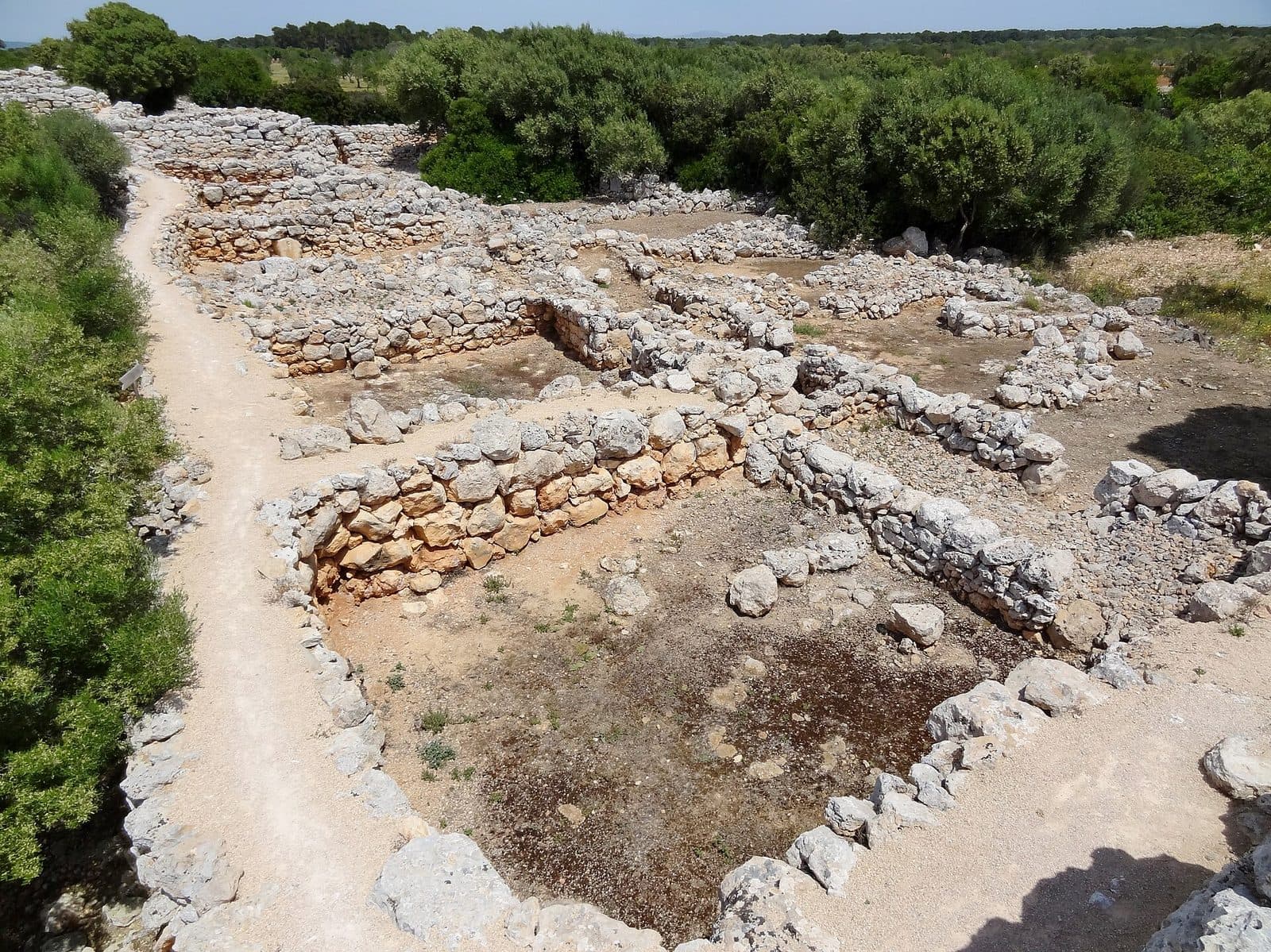

Between Llucmajor and the south coast stand walls whose builders needed neither mortar nor dressed stone blocks. Capocorb Vell is an extensive archaeological site near Cala Pi and one of the best places to experience Mallorca's Talayotic culture not only on an information panel, but in its actual dimensions.
At its heart are five massive talayots: three round and two square towers, surrounded by dwellings, stretches of wall, and the remains of other buildings. Up close, you can see how carefully the large, irregular stone blocks were stacked. Even without fully preserved roofs and upper floors, the broad walls still convey an impressive sense of the power of this architecture.
Capocorb Vell is especially rewarding for anyone who wants to discover Mallorca's history beyond castles, churches, and manor houses. Families can also find an accessible introduction to prehistory here: instead of passing display cases, the route leads directly between towers and house foundations. Visitors with little interest in archaeology should begin by taking time to examine a single talayot. Once its masonry, shape, and relationship to the adjoining rooms become apparent, what initially looks like a field of ruins suddenly reads like a village plan.
The site demands attention, however. Capocorb Vell is not a reconstructed open-air museum or a stage-set attraction, but an archaeological site composed of original stone structures. That is precisely its strength: the gaps are as much a part of the visitor experience as the surviving towers.
History and significance
Long before Roman cities, medieval walls, or Mallorca's present-day coastal resorts emerged, talayots shaped the landscape of the Balearic Islands. According to the account provided by the municipality of Llucmajor, the people who carried this culture arrived on the island from the eastern Mediterranean in the 14th century BC. They practiced agriculture and livestock farming and built permanent settlements of large stone structures. Capocorb Vell developed into one of the most extensive known sites from this period on Mallorca.
The Talayotic settlement
The culture takes its name from its most distinctive structures: the talayots. In Capocorb Vell, these monumental towers formed the architectural core of a larger settlement area. Smaller residential and utility buildings stood around them, while additional buildings continued beyond the center that is most clearly visible today. The village extended farther northeast than the main area currently apparent at first glance.
The towers are often associated with control, representation, and the organization of the surrounding territory. However, no explanation of their use that is certain in every detail can be read from the surviving masonry. This open question is precisely what makes the tour interesting: the talayots were not isolated monuments but stood at the heart of a community whose daily life revolved around houses, livestock farming, and agricultural land.
Loss and preservation
For many centuries, old stone buildings on Mallorca served as easily accessible sources of building material. Large blocks could be reused for later walls and buildings without quarrying new stone. Parts of the prehistoric settlement at Capocorb Vell were also lost in this way. Nevertheless, five talayots and numerous residential structures have survived—enough to make the layout of the site unusually easy to understand.
Its significance therefore lies not only in the individual towers, but in the ensemble as a whole. Round and square talayots, adjoining rooms, and traces of the more extensive village demonstrate that this was not a random collection of stone buildings. Capocorb Vell is among the most thoroughly studied Talayotic sites in the Balearic Islands and is also regarded as one of Mallorca's most important surviving settlements.
The first scientific excavations
Early researchers included the Frenchman L. Ch. Watelin and the German Albert Mayr. The first scientific excavations took place between 1910 and 1920. Josep Colominas Roca carried out the work on behalf of the Institut d’Estudis Catalans and with support from the prehistorian Luis Pericot. A monolith at the site commemorates Colominas and, among the much older walls, represents a piece of research history in its own right.
On June 3, 1931, Capocorb Vell was declared a historic-artistic monument by government decree. This protected status recognized the site's value. In February 2018, the association ARCA also honored the care of the Talayotic settlement.
What to see
First impressions can be misleading. From a distance, the low walls look like a confusing field of limestone. As you approach, however, clear forms emerge: curved outer lines, right-angled tower structures, narrow passageways, and the foundations of adjoining rooms. Capocorb Vell does not reveal itself in a single glance, but step by step.
The three round talayots
Three talayots have circular ground plans. Their outer walls consist of large, barely worked blocks stacked without mortar. The mass of the stones and the thickness of the walls suggest how far the structures originally rose above the sections preserved today.
Talayots could take the form of a truncated cone and have several levels. A central column supported the roof structure. Although not every structural relationship at Capocorb Vell has survived intact, this basic principle helps visitors interpret the ruins: the interior was not merely an open area enclosed by walls, but part of a load-bearing system. By slowly following the courses of stone, you can recognize the work behind the seemingly rough construction.
Comparing the exterior and interior is particularly rewarding. From outside, a round talayot appears compact and almost closed. Inside, passageways, wall junctions, and relationships with neighboring rooms change the picture. This makes it clear why the towers should not be viewed separately from the village.
The two square talayots
Alongside the round towers, two square talayots form part of the site's core. Their straighter alignments and corners stand out clearly from the curved shapes of the circular structures. The contrast between the two ground-plan types is one of Capocorb Vell's most important features: two characteristic forms of Talayotic monumental architecture can be compared directly at a single site.
The construction method is nevertheless related. Large, undressed stones were stacked without mortar, and the massive base could support additional levels. From a suitable viewpoint, edges and stretches of wall can be followed across several rooms. Only then does it become apparent that the rectangular structures were not simply larger houses, but architectural focal points within the settlement.
The dwellings
The site's official presentation lists a total of 28 dwellings in addition to the five talayots. Today, their stretches of wall and ground plans are the most informative features. Some stand close to the monumental structures, forming a network of small rooms, extensions, and passageways. Where only individual rows of stones are initially noticeable, groups of houses become visible with a little patience.
These residential areas bring daily life back into the site. The talayots immediately attract attention because of their size, but it is the smaller rooms that turn five towers into a settlement. Family groups lived here within an economy that included farming and the keeping of sheep and goats. Do not expect actual furniture or complete interiors; the spatial organization must be inferred from thresholds, wall junctions, and ground plans.
Some rooms were built directly against larger structures. Instead of hastily assigning a function to every stretch of wall, it is therefore worth comparing them: Where is an entrance visible, which wall continues, and where was a later structure added to an existing building?
The peripheral structures
The particularly striking core visible today was only part of the original settlement area. Additional talayots and other types of structures stood on the periphery; to the northeast, Capocorb Vell extended beyond the central area. This information changes how the site is perceived. The surviving main buildings did not stand at the edge of an empty plain, but within a larger network of residential and working areas.
When looking back at the end of the tour, you should therefore focus on more than just the highest walls. Low lines, interrupted foundations, and seemingly isolated stone settings mark the transition from the clearly legible center to the less completely preserved parts of the village. Capocorb Vell conveys its extent precisely through this gradual change.
The dry-stone masonry
The common feature linking all the large buildings is their mortarless construction. Large, undressed stone blocks were stacked on top of one another. From a distance, the surface looks rough; up close, it becomes clear how tightly the large and smaller stones interlock.
Light dramatically changes the appearance of these walls. When the sun is lower, joints, edges, and irregular surfaces stand out more clearly, while the towers cast longer shadows across neighboring ground plans. This is appealing for photography, but even without a camera, the side lighting helps reveal structural forms that appear flatter in the evenly bright midday sun.
The monolith for Josep Colominas Roca
Among the prehistoric remains, a monolith commemorates the archaeologist Josep Colominas Roca. It is not part of the Talayotic settlement, but it is important for understanding the site as it appears today. Capocorb Vell is not only a preserved village, but also a setting for the early scientific study of Mallorca's prehistory.
The memorial stone draws attention to an often-overlooked question: Why are the walls legible today at all? Excavations uncovered relationships, classified structures, and made Capocorb Vell a key site in the island's archaeology. The monolith therefore provides a fitting conclusion after viewing the talayots and residential rooms.
Visiting the site
The best way to begin the tour is not by trying to understand the entire site immediately. A large round talayot offers the clearest introduction. First, walk around its outer wall, then look into the interior, and finally examine the adjoining residential structures. This pattern also makes it easier to interpret the other buildings.
From tower to village plan
The actual tour often takes less than an hour. Visitors who only want to see the five talayots and take a few photos can move through the site fairly quickly. More time is worthwhile if you want to examine the house foundations, the differences between round and square towers, and the memorial stone for Colominas rather than merely noticing them in passing.
A digital tour description, reportedly accessible via a QR code, can be helpful. Explanatory information at the site may be less legible depending on its condition. A charged smartphone and the ability to open the information at your leisure therefore make it easier to navigate between stretches of wall that may look similar.
Light and visitor numbers
Earlier or later in the visiting day, the masonry is usually easier to interpret than when the sun is high. The lower light emphasizes the joints and visually separates the courses of stone stacked on top of one another. Photographers will also find more distinct shadows on the round and square tower structures at these times.
Check current information beforehand
Opening hours and admission prices are not reliably recorded in the available visitor information. As both can change, current details should be checked immediately before traveling. This is particularly important because Capocorb Vell is not a freely accessible field of ruins, and the trip can only be planned effectively if access is actually available.
A small bar at the entrance has been described as a visitor contact point. It may provide a pleasant place to pause before or after the tour, but it should not be treated as a substitute for full tourist facilities. The archaeological site itself remains the focus.
Getting there and parking
Capocorb Vell lies in Mallorca's flat southern region between Llucmajor and the coast near Cala Pi. Access is via the Ma-6014 toward Cala Pi and Cap Blanc. The entrance is located directly on this road and is signposted; the approach to the site branches off shortly before the Cala Pi and Cap Blanc area. As a result, no long walk along country tracks is required.
From Palma
The road distance from central Palma to Cala Pi is 28 kilometers. The drive takes around 32 minutes and follows the Ma-19. These measurements expressly refer to Cala Pi, not the entrance to Capocorb Vell. For the final section to the archaeological site, the route follows the road network near Llucmajor and the Ma-6014; the site lies directly beside the road before the coastal settlement.
For route planning, Capocorb Vell itself should therefore be entered as the destination, rather than simply Cala Pi. Anyone who drives to the bay first will then have to travel inland again to reach the archaeological site.
From Palma Airport
The road distance from Palma Airport to Cala Pi is 22 kilometers, and the drive takes around 21 minutes. This figure also ends at Cala Pi. Capocorb Vell lies inland on the Ma-6014, so the exact final section to the entrance depends on the selected navigation route and direction of travel. Getting there remains straightforward because the site is located directly beside the road.
Parking and public transport
Parking is described as available in the immediate vicinity of the site. Because the entrance lies directly on the Ma-6014, vehicles should only be left in designated areas or places clearly intended for parking; stopping spontaneously at the roadside is not a good option.
No bus stop is recorded in the immediate area. A car is therefore the most reliable option for a dedicated visit. Anyone using public transport to Cala Pi should not assume that a short, clearly signposted footpath to the site begins there: Cala Pi and Capocorb Vell are separate destinations, and the archaeological site lies outside the coastal settlement.
Nearby attractions
After the heavy stone walls, the coast at Cala Pi feels like a deliberate contrast. The settlement stands beside a deeply cut bay in southern Mallorca, with a beach reached below high cliffs. Capocorb Vell and Cala Pi can therefore be easily combined in a day trip: first a focused encounter with prehistory, followed by views of the sea, bay, and cliffs.
Cala Pi
Cala Pi is only a few kilometers by road from the site. The coastal settlement is not a continuation of the archaeological tour, but a separate destination. That is precisely why the combination works: while Capocorb Vell lies on a flat, agricultural plain, the narrow bay cuts deeply into the south coast.
The descent to the beach follows a long stone staircase. Anyone planning to swim after visiting the site should account for this additional change in elevation and the need to carry beach equipment. A stroller that still seems manageable at Capocorb Vell is unsuitable for the stairway down to the bay.
Torre de Cala Pi and the south coast
At the entrance to the bay stands Torre de Cala Pi, a watchtower built in 1663. It belongs to a much later history of defense than the talayots and should not be directly associated with them architecturally. As a second historical stop, however, it shows how long this compact section of the south coast was shaped by observation, protection, and control.
Capocorb Vell alone does not require a full-day itinerary. Instead, the site is well suited as the historical focus of a drive through the south. Llucmajor and the landscape toward Cap Blanc are other possible stops, without reducing the archaeological visit to a mere brief detour.
The place it belongs to
Cala Pi in the place guidePractical information for your visit
Particular attention is needed where low wall remains and narrow passageways follow directly one after another.
Sun and equipment
A smartphone is useful for more than taking photos. Because a tour description has been offered via QR code, the battery should be charged. Anyone wishing to avoid using mobile data can open or save available information at the entrance before proceeding farther into the site.
Visiting with children
Capocorb Vell can work well for families if the visit is structured as a discovery of shapes. Round and square towers, large and small stones, entrances, and house foundations provide specific things to look for. Long, abstract explanations are less helpful than asking how a tower can be distinguished from a residential room.
What not to expect
Capocorb Vell does not feature fully reconstructed houses or furnished interiors. The essential remains are the architecture, its ground plans, and the relationship between monumental talayots and smaller residential buildings.
Anyone looking only for spectacular individual objects may easily overlook the site's true quality. The archaeological remains become meaningful through comparisons: round versus square, tower versus dwelling, massive core versus low peripheral structures. Seen this way, the field of stones becomes a legible settlement—and that is exactly why the detour from Cala Pi is worthwhile.