
Talaiot de Capocorb d'en Jaquetó near Cala Pi
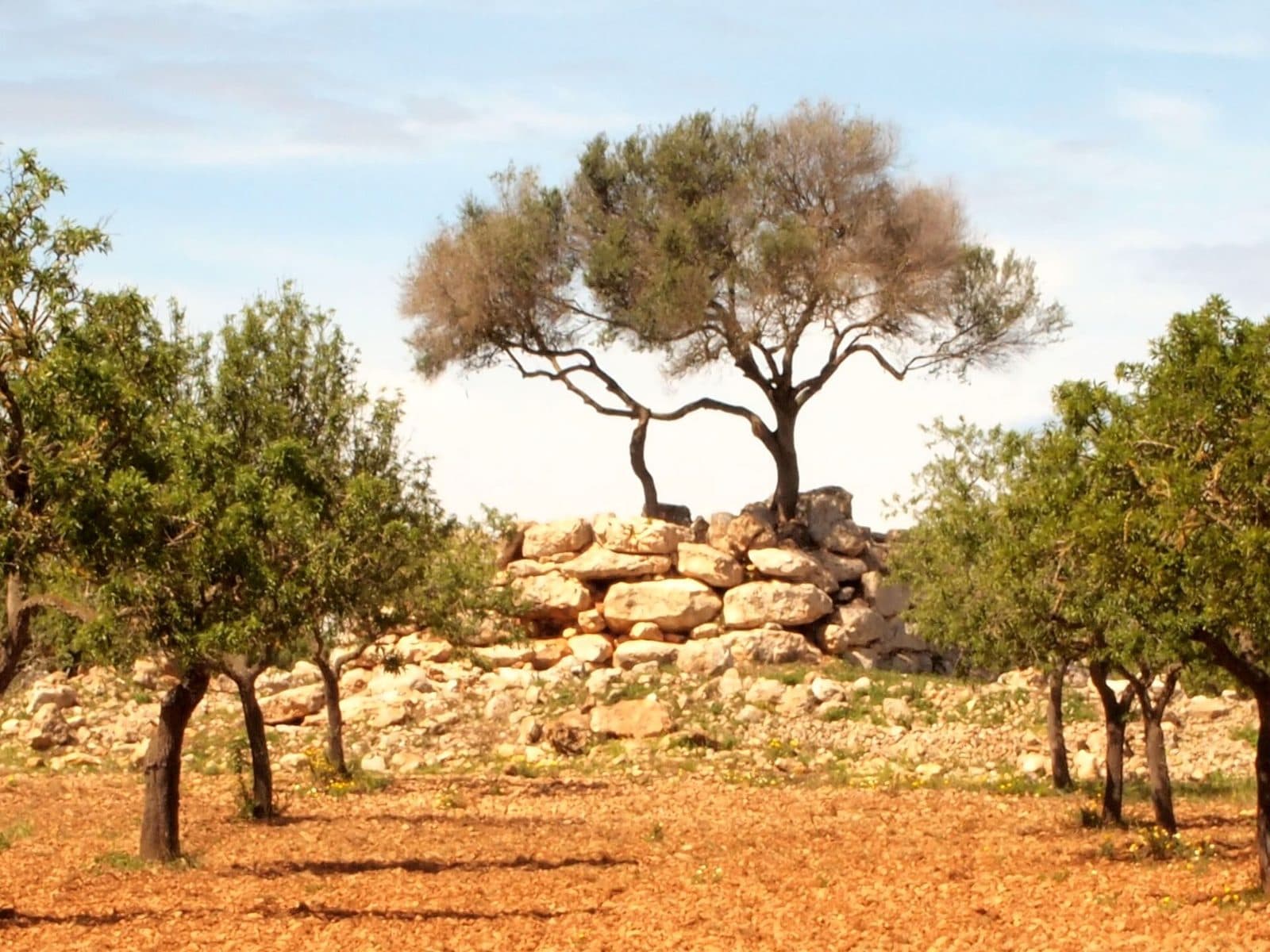

Between the road and Capocorb's prehistoric stone landscape stands a monument easily confused with its far better-known neighbor. The Talaiot de Capocorb d'en Jaquetó near Cala Pi is a single round talaiot, not an alternative name for the main visitor site at Capocorb Vell. This distinction is crucial because descriptions of the five towers and numerous dwellings refer to the large settlement, not this isolated structure.
The appeal of the talaiot lies less in a developed visitor route than in carefully reading what remains. The entrance is hidden beneath collapsed stonework, and the former roof is missing. Even so, the original layout of the interior can still be discerned from above: among the walls are the remains of the central pillar that once supported the heavy roof slabs.
Later generations also left their mark. During the Middle Ages, or possibly as early as the Islamic period, a small hut was built on the prehistoric structure. At the beginning of the last century, the roof slabs also disappeared, having been used as building material for the road running directly past the site. The talaiot therefore tells not only of Mallorca's prehistory but also of the centuries-long reuse of ancient stone structures.
The site is especially suitable for visitors with an interest in archaeology who want to identify individual architectural features and understand the wider archaeological landscape of Capocorb. Anyone expecting a fully excavated tower chamber should adjust their expectations accordingly, because careful observation matters more here than the number of stops.
History and significance
In the prehistoric Balearic Islands, a talaiot was far more than a loose pile of stones. These massive, tower-like structures defined the Talaiotic culture of Mallorca and Menorca and later gave it its name. The purpose of each individual monument has not been conclusively established. Communal, representative, supervisory, and defensive roles have all been proposed for talaiots, but the surviving remains of the Talaiot de Capocorb d'en Jaquetó do not reveal an unambiguous use.
Part of a larger archaeological landscape
Today the round structure appears isolated, but it originally belonged to the extensive prehistoric context of Capocorb, whose best-known section has been developed for visitors as the settlement of Capocorb Vell. North of the main archaeological area, woodland and terrain conceal further Talaiotic remains known collectively as Capocorb d'en Jaquetó. The individual monument should therefore be described neither as an independent village nor as one of the five talaiots in the well-known visitor area.
Its position outside the familiar visitor route is archaeologically revealing, as it shows that the Capocorb Vell presented today represents only part of a much more extensive prehistoric landscape. Paths, modern property boundaries, and the developed main site suggest a clearly defined place, but the ancient structures did not follow these present-day lines. The Talaiot de Capocorb d'en Jaquetó is a visible fragment of this broader context.
A quarry for the modern road
The most striking chapter in its recent history concerns the missing upper covering. Like the round talaiots in the main complex, the structure once had large roof slabs. At the beginning of the 20th century, these slabs were removed and reused to build the immediately adjacent road. This loss explains why the interior is now open to the sky and why its original spatial character can be understood only from the surviving walls and supports.
Such interventions were not exceptional in Mallorca. Ancient megalithic structures provided readily available, already quarried material for walls, courtyards, buildings, and transport routes. At the Talaiot d'en Jaquetó, this history of reuse is particularly clear: the prehistoric tower and the modern road do not merely stand next to each other but are materially connected.
Use during the Islamic period or Middle Ages
After the end of the Talaiotic culture, the talaiot did not lose all significance. During the Islamic period or Middle Ages, a small hut was built on its upper section, giving the monument a new and considerably more modest purpose. The massive older structure now served as a foundation and elevated building site for a smaller utility structure.
This superimposition makes the talaiot more than evidence of a single era. Its walls show how later inhabitants treated prehistoric monuments: they were not merely observed or avoided but incorporated into the cultural landscape of their own time. Today, the talaiot is protected as a Bien de Interés Cultural and thus recognized as part of Spain's cultural heritage.
What to see
The circular mass of the structure is the first feature to stand out. In its basic form, the Talaiot de Capocorb d'en Jaquetó resembles the three round talaiots at Capocorb Vell, but it has its own, distinctly more fragmentary appearance. Without a roof or an exposed portal, it cannot be read like a fully accessible tower. Its most important details are instead found along the upper edge and among the visible remains of the interior.
The round structure
The exterior form clearly identifies the monument as a round talaiot. Large stones form a compact, tower-like structure whose present silhouette has been altered by collapse, material removal, and later interventions. At first glance, visitors may see only a massive arrangement of stones. Closer inspection reveals that it is the outer shell of what was once a roofed interior.
Comparison with the round structures of the main complex helps place it in context, but should not encourage an unsupported mental reconstruction. Neither a complete entrance nor the original roof survives at the d'en Jaquetó talaiot. Its architecture must therefore be understood from its remains: the curve of the outer wall, the wall lines visible inside, and the position of the central support element.
The buried portal
The original entrance has not yet been discovered. It lies beneath collapsed material that has accumulated around and within parts of the structure. An apparent opening between stones should therefore not be hastily interpreted as the historic entrance. Collapse changes the legibility of masonry in ruins and creates openings that may have no connection to the original building plan.
The hidden portal also limits the visitor experience because the talaiot cannot be entered through a clearly recognizable ancient access point or experienced from within as an enclosed space. Its threshold remains archaeologically invisible. This is not an insignificant loss, as the location and orientation of an entrance can provide important clues about the organization and use of a prehistoric structure.
Interior walls and central pillar
The inner wall lines can be distinguished in the upper part of the talaiot. Of particular importance is the surviving drum-like remnant of the central pillar. Together with the walls, this support originally carried the large stone slabs of the roof. The remains help explain how the massive round structure could contain a roofed interior: the load did not rest solely on the outer wall ring but was additionally supported at the center.
This detail is one of the most informative features of the monument. Without the roof slabs, the pillar drum initially looks like just another stone remnant. In combination with the inner wall lines, however, it becomes the key to imagining the space. The missing covering can be visualized above it without having to speculate about the roof's form or height.
The missing roof slabs
Where the sky is now visible above the interior, there was originally a covering of large slabs. Knowing that these stones did not simply disappear through natural decay but were reused for road construction changes how the ruin is perceived. The open top is the result of modern material removal and not an original feature of the talaiot.
The directly adjacent road consequently becomes part of the story. It contains material that had previously spanned the interior of the prehistoric tower for centuries. Although it is impossible to assign every individual stone used in the road to the monument with certainty, the documented reuse explains the striking connection between the ruin and the transport route.
The later hut
During the Islamic period or Middle Ages, a small hut was built on the upper section. It is not part of the original Talaiotic structure, but it deserves equal historical consideration. This later addition shows that the ruin was still regarded as a useful building site long after its initial use.
To the untrained eye, the different layers can easily merge. A simple distinction is helpful: the massive round structure with its inner wall lines and central pillar support belongs to the prehistoric talaiot; the small hut is a later addition. This juxtaposition makes the monument particularly instructive, as it brings together several phases of land use in Mallorca within a single structure.
Visiting the site
The Talaiot de Capocorb d'en Jaquetó demands a different kind of attention from the developed settlement of Capocorb Vell. It does not offer the sequence of five talaiots and numerous excavated dwellings that many guidebooks describe under the name Capocorb. Instead, the destination is a single, isolated monument within a larger archaeological landscape. Before visiting, you should therefore check whether the map marker, access route, and intended archaeological site actually correspond.
Identify the correct site first
The name Capocorb is the most common source of confusion. Road signs, photographs of several towers, and descriptions of a visitor route usually refer to Capocorb Vell. The Talaiot d'en Jaquetó lies outside this well-known main area. Anyone who follows only the signs to the tourist site will therefore not automatically find the individual monument described here.
At the site, the architectural evidence helps confirm the location: you are looking for a round talaiot without surviving roof slabs, whose entrance is hidden beneath collapsed material. Inner wall lines and the remains of the central pillar can be seen in the upper section. Several excavated towers and a large group of dwellings, by contrast, identify the main site at Capocorb Vell.
Allow time for careful observation
There is no reliable standard visit duration that can be given in minutes for this site. Viewing the individual structure itself is manageable, but the total time required depends more on orientation, access conditions, and archaeological interest than on the length of a defined visitor route. Anyone looking only for a photograph can easily miss the most important details. Those wishing to distinguish the outer curve, upper wall line, pillar remnant, and later hut will need patience.
It is therefore advisable not to squeeze the talaiot between two tightly scheduled activities. Precisely because the monument has only a few clearly identifiable features, it is worth observing it slowly from different permitted positions. The fragile masonry should never be climbed or treated as a viewpoint.
Time of day and current accessibility
No reliable peak visiting times have been documented for this individual talaiot. Unlike at a highly organized attraction, the best time to visit therefore cannot be determined from visitor flows. Good daylight and enough time to distinguish safely between the roadside, terrain, and stone structures are more important. In poor visibility, the upper interior remains in particular quickly disappear into the masonry's irregular outline.
Current opening hours and admission conditions are not documented and should be checked before traveling. Information about the operation of the neighboring settlement of Capocorb Vell must not be transferred to the Talaiot de Capocorb d'en Jaquetó without verification. The same applies to the ticket office, visitor route, and other facilities at the main site.
Getting there and parking
The regional driving directions lead to Cala Pi rather than directly to the talaiot. From Palma Airport, the road journey covers 22 kilometers; the drive to Cala Pi takes around 21 minutes. From central Palma, the route follows the Ma-19 and covers 28 kilometers. Allow around 32 minutes for this journey to Cala Pi.
The final stretch near Capocorb
Capocorb lies in the southern part of the municipality of Llucmajor on the road toward Cala Pi and Cap Blanc. The Ma-6014 is listed as the access road for the well-known Capocorb Vell site. However, the Talaiot de Capocorb d'en Jaquetó is not the same as its visitor area. The final stretch therefore requires careful map checking and a conscious distinction between the main complex and the archaeological area to its north.
The road runs directly past the talaiot and is also part of its recent history, as its roof slabs were used as building material for this transport route at the beginning of the 20th century. Because of this proximity, do not search for the monument while driving. Only after stopping in a safe place should you check whether the marker actually leads to the individual monument rather than the entrance to Capocorb Vell.
Parking without affecting the site
Parking facilities at the main tourist site should not automatically be regarded as access to the Talaiot d'en Jaquetó. When parking, road safety, property boundaries, and the protection of archaeological remains take priority. Dry-stone walls, field entrances, and unpaved areas are not arbitrary parking bays; even inconspicuous arrangements of stones may belong to the historic site.
No bus stop is documented in the immediate vicinity. It is therefore not possible to recommend a reliable short walk from a nearby stop when traveling by public transport. Anyone visiting without a car should plan the connection to Cala Pi and the onward route separately rather than assuming that a bus stops directly at the monument.
Nearby attractions
Cala Pi is the nearest reference point for the journey and offers a striking scenic contrast to Capocorb's stony archaeological landscape. After exploring a prehistoric tower, the road continues to the deeply cut coastal cove and the village of the same name. Both can be combined on a day trip without reducing the talaiot to a mere stop on the way to the sea.
Capocorb Vell
The most important archaeological complement lies in the same landscape: the well-known Talaiotic settlement of Capocorb Vell. Five talaiots survive there, including two square and three round examples, along with numerous dwellings. The site provides a more coherent impression of Talaiotic architecture than the isolated d'en Jaquetó monument.
The comparison is particularly worthwhile. At Capocorb Vell, different tower forms and spatial groups can be identified; at the d'en Jaquetó talaiot, by contrast, attention focuses on the round structure, the missing covering, and the traces of later reuse. Both sites belong to the wider prehistoric landscape, but they are not interchangeable names for the same attraction.
Cala Pi and the southern coast
Cala Pi is a suitable final stop after the archaeological visit. The village lies on Mallorca's southern coast and provides the geographical context for the attraction page. Anyone planning the combination should remember that the stated driving times from Palma and the airport apply only as far as Cala Pi; finding the talaiot requires additional navigation.
Cap Blanc also lies in the same direction along the southern coast. Combining the monument with the coastal landscape is particularly suitable for visitors who do not want to travel south solely for a single stone structure. The talaiot remains the historical focus, while Cala Pi and the coast provide the scenic setting for the excursion.
The place it belongs to
Cala Pi in the place guidePractical information for your visit
The most important aid is not extensive equipment but precise location information. Online images, directions, and reviews often confuse the Talaiot de Capocorb d'en Jaquetó with Capocorb Vell. Before setting out, check whether the map marker being used really identifies the individual monument. A photograph showing five towers or numerous excavated rooms does not depict this talaiot.
Footwear and conduct around the masonry
Collapsed material is part of the archaeological evidence and not a prepared path. Sturdy, closed shoes are therefore advisable when viewing the monument from a permitted position on uneven terrain. Loose stones must not be moved, even if doing so might appear to reveal an entrance or improve the view. Investigating the buried portal is the task of archaeologists, not private visitors.
Do not climb the structure. The upper interior walls and the remains of the central pillar can be identified as architectural features without stepping onto the historic fabric. The same applies to the later hut, as its more recent date does not make it any less worthy of protection.
Visiting with children
The talaiot can become vivid for children if their attention is directed toward a few specific questions: Where did the round outer wall run? Which stone remnant belonged to the central support? How could a roof made from large slabs be supported? Why is the entrance missing today? In this way, a ruin that is initially difficult to read becomes an understandable structure.
Close supervision is nevertheless essential because of the nearby road, uneven ground, and collapsed material. The site is not a climbing area. Families who prefer a clear visitor route and numerous visible buildings will find the developed main area of Capocorb Vell easier to understand; the d'en Jaquetó talaiot is more suited to patient observers.
What not to expect
The talaiot is not a fully reconstructed chamber or a large exhibition. Its portal remains buried, the roof slabs are missing, and significant parts of its history become apparent only through interpretation of the surviving walls. The structure's precise original function has also not been conclusively determined.
This is precisely what gives it meaning. The site does not present a polished vision of prehistory but a monument marked by loss, alterations, and reused material. Anyone who distinguishes these layers will recognize three different stories in the seemingly silent stone structure: the Talaiotic building, the later hut, and modern road construction.
Local insider tips
Look for the pillar above
The most important architectural detail is not at the buried entrance but in the upper section: the drum-like remnant of the central pillar that once supported the roof slabs can be seen among the inner wall lines.
Read the road as part of the site
The neighboring road belongs to the talaiot's history. The monument's former roof slabs were reused to build it at the beginning of the 20th century.
Do not confuse it with Capocorb Vell
Photographs of five talaiots and numerous dwellings show the developed settlement of Capocorb Vell. D'en Jaquetó is the isolated round monument outside this well-known main area.
Identify the later layer
During the Islamic period or Middle Ages, a small hut was built on the prehistoric structure. It is not part of the original talaiot but evidence of its later use.
Combine it with Cala Pi
The trip can easily be combined with Cala Pi. This brings together Capocorb's prehistoric stone landscape and the southern coast without requiring further long journeys across the island.