
Far de la Mola Lighthouse near Port d’Andratx
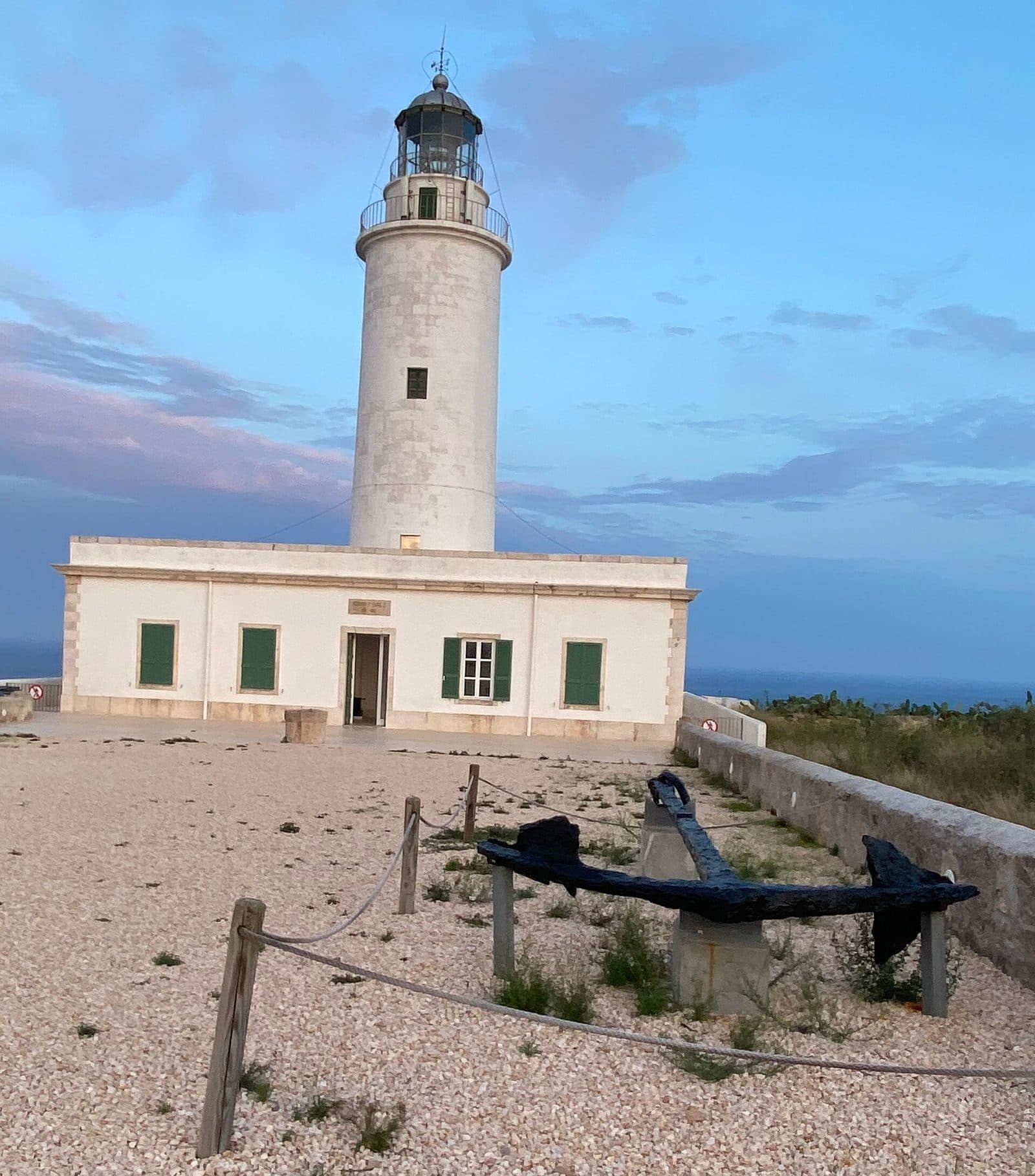

High above the coast of Port d’Andratx, Far de la Mola stands in a place where the structure itself almost recedes behind the view. The small white lighthouse occupies the tip of the La Mola peninsula; in front of it, the land drops toward the sea, while bays and coastlines open up on either side.
A visit is worthwhile less as a conventional attraction with interiors and an exhibition than as a short excursion to a striking point on the southwestern coast. From the viewpoint, the view extends across Cala Llamp, the harbor side with Cala en Fonoll and, in clear conditions, as far as the island of Sa Dragonera. These different viewing directions are precisely what make the site more interesting than the lighthouse’s modest size might initially suggest.
Anyone expecting architecture on a grand scale has come to the wrong place. Its appeal lies in the combination of a compact navigational facility, a high clifftop setting and the immediate proximity of the open Mediterranean and the sheltered harbor entrance. For photographers, coast lovers and anyone wishing to see Port d’Andratx from a different perspective, Far de la Mola is a fitting destination. It is important to identify the location clearly: This is the lighthouse on La Mola near Port d’Andratx on Mallorca. The lighthouse of the same name on Formentera is a different structure.
History and significance
The modernization of 1993
At the entrance, an inscription from the Balearic port authority refers to the year 1993. In that year, Far de la Mola was renovated and modernized. This is consistent with its present appearance: no historicist tower architecture, no large keeper’s house and no prestigious complex, but a restrained structure focused on its maritime function.
This restraint is particularly important when assessing the lighthouse. It is not a monument from the great era of staffed lighthouse stations, nor is it a museum about the lives of lighthouse keepers. It is one of Mallorca’s functional navigational aids, deriving its impact from its setting: From the sea, it marks the rocky coastline; from the land, its location becomes a viewpoint over the island’s western coast.
One name, several places
Different spellings appear on maps and in travel reports: Far de la Mola, Far de sa Mola, Faro de Sa Mola or Port d’Andratx Lighthouse. “Far” is the Catalan word for lighthouse. Here, “La Mola” refers to the peninsula near Port d’Andratx. Anyone searching only for the name can quickly end up at the lighthouse of the same name on Formentera. Its history, dimensions and technical equipment expressly do not belong to this site on Mallorca.
What to see
The white operations building
Far de la Mola consists of a small, white-painted structure with a square floor plan. Its clean shape resembles a compact operations building more than a traditional lighthouse keeper’s house. A door breaks up the otherwise understated facade. Decorative elements or an imposing entrance play no role; the architecture remains subordinate to its technical purpose.
Against the rugged coastal edge, this simplicity is particularly striking. The white color visually sets the facility apart from the rock, vegetation and sea without dominating the location. Anyone approaching the building quickly realizes that the destination is not an accessible monumental structure, but a small navigational aid. The best overall impression therefore comes not from standing directly beside the wall, but from some distance, when the building, tower and horizon can be seen together.
The round lighthouse tower
The round tower is attached to the sea-facing side of the square building. It is ten meters high and forms a compact unit with the lower base structure. Unlike large historic lighthouses, there is no tall shaft rising above an extensive keeper’s house. The tower appears squat, functional and closely connected to the coastal station.
From close up, the unusually simple composition is easy to recognize: a rectangular white structure, the round tower attached to it and open sky beyond. Its position on the seaward side also indicates the facility’s true line of sight. While visitors look across the water and bays, the beacon is directed toward ships off the coast and vessels approaching the natural harbor of Port d’Andratx.
Mirador de Sa Mola
The location is also known as Mirador de Sa Mola. The name describes the visitor experience more accurately than any architectural classification: The lighthouse is both a destination and a landmark at the viewpoint. The cliff rises 128 meters above sea level here. As a result, the water is not immediately beside the structure, but far below the high coastal edge.
This elevation changes the view. Individual coastal features can be followed as if on a relief map, and the sheltered indentations of the bays stand out clearly against the open Mediterranean. At the same time, the landscape does not remain static: Depending on the viewing direction, it appears either broad and open or heavily divided by rocks and peninsulas. In windy conditions, the exposed position is particularly noticeable; on clear days, the view extends far beyond the nearby harbor entrance.
Cala Llamp
On one side, the view opens toward Cala Llamp. From above, it appears as an indentation in the steep coast, framed by rocky terrain and the development of the southwest. This direction is interesting for photography because the scene includes more than water: The coastline, rock and bay give the image depth and show how strongly the terrain shapes the area around Port d’Andratx. Later in the day, the light brings out the contours of the western coast particularly clearly, without the lighthouse itself necessarily having to be the main subject.
Cala en Fonoll and the harbor entrance
On the other side lies Cala en Fonoll, in the direction where the harbor of Port d’Andratx opens. Here, it becomes clear why the position is suitable for a beacon: The peninsula separates the open sea from the more sheltered approach to the natural harbor. Boats and coastlines appear from above in a spatial context that is barely perceptible from the promenade below.
This view is especially interesting for visitors who have already experienced the harbor from the quay. There, masts, terraces, fishing boats and yachts dominate the scene. From Far de la Mola, by contrast, the harbor’s geographical form emerges. The houses become part of the landscape, and the entrance can be traced between the stretches of coast.
Sa Dragonera
In clear conditions, Sa Dragonera can also be seen. The offshore island is one of the most distinctive silhouettes off Mallorca’s southwestern coast. From the viewpoint, it appears not as an isolated excursion destination, but as part of the broad coastal panorama between Andratx and the open sea. It is worth taking a moment to orient yourself when looking for Sa Dragonera, because anyone focusing only on the lighthouse can easily overlook how far the view extends beyond the immediate location. The horizon and the offshore island give the small structure its broader geographical context: Far de la Mola does not mark just any rock, but a widely visible point on Mallorca’s far southwest.
Visiting the lighthouse
Arriving at the viewpoint
The final section leads through the residential area on the La Mola peninsula. At the end of Carrer Pi, the lighthouse stands above the rocky coast. The approach therefore feels different from reaching isolated lighthouses that appear only after a long coastal hike: Residential streets initially define the route before the view opens toward the sea at the end of the peninsula.
The layout is quickly understood on arrival. First, the white structure catches the eye, followed by the round tower and finally the height of the clifftop setting. A useful panoramic look begins on the harbor side, then moves to Cala Llamp and finally searches the western horizon for Sa Dragonera. In this way, a short photo stop becomes a small geographical introduction to Port d’Andratx.
Time required
There is no prescribed sightseeing route at Far de la Mola. Since no extensive interiors or exhibition are documented, the length of a visit mainly depends on how much time is allowed for the views and photography. Anyone who simply wants to see the lighthouse and look across the coast can treat the location as a short stop. Those who wish to study the bays and harbor entrance at leisure will stay correspondingly longer.
The lighthouse should therefore not be regarded as a stand-alone attraction that fills an entire day. Its strength lies in combining it with Port d’Andratx or another destination in the southwest. This is when the change in perspective is particularly effective: first the activity beside the water, followed by the quiet overview from the peninsula.
Light and time of day
Mallorca’s southwest is known for its late-day light. As the sun drops lower, rocky edges and coastal contours gain definition, while the western horizon becomes more prominent. Far de la Mola is a viewpoint for the late afternoon and sunset. However, this does not provide any reliable indication of quieter visiting times. Anyone primarily seeking clear views of the building should give greater consideration to the weather and the position of the sun than to a supposedly guaranteed time without other visitors. Good visibility is more important for the view than a rigid schedule.
Access, opening and admission
Current opening hours and an admission price have not been recorded. It is therefore advisable to check the applicable information before visiting, especially if access to the facility rather than only the viewpoint is expected. The visible door in the operations building does not indicate that the lighthouse is normally open for interior visits.
The realistic expectation is a visit to the site and viewpoint. No exhibition, tower climb or publicly accessible keeper’s rooms are documented. Anyone coming for the coastal views will experience the site’s essential appeal regardless of whether technical areas are accessible.
Getting there and parking
From Palma Airport
From Palma Airport, the route initially follows the Ma-20 and then the Ma-1 toward the southwest. Port d’Andratx is 43 road kilometers away, and the drive takes around 38 minutes. These details expressly apply only as far as Port d’Andratx, not directly to the lighthouse.
In the town, the final section onto the La Mola peninsula begins. Far de la Mola is located at the end of Carrer Pi in the Las Brisas residential area. The main route along the Ma-1 transitions into local streets there. Current navigation is helpful for the final turns, as the lighthouse is not located on a major through road.
From central Palma
From central Palma, the route follows the Ma-1. The road distance to Port d’Andratx is 33 kilometers, and the drive takes around 37 minutes. This journey time also ends in the harbor town. Additional time must be allowed for the local road network on the peninsula when continuing to Far de la Mola.
Anyone combining the visit with time at the harbor should decide on the order beforehand. The waterfront promenade and lighthouse occupy different settings: below, the lively natural harbor; above, the residential area and clifftop location. Direct navigation to Far de la Mola leads to the small white beacon at the end of Carrer Pi.
The final section on La Mola
The access route passes through a built-up area to Carrer Pi. Unlike a freestanding lighthouse in a nature park, there is no long, clearly visible final stretch through uninhabited terrain. The tower only becomes clearly visible when you are close to it. Consideration for residents and keeping property entrances unobstructed are therefore more important than searching for a supposedly ideal parking place directly beside the destination.
No confirmed description of designated parking areas at the lighthouse is available. It is therefore sensible to pay close attention to local signs and stop only where this is clearly permitted.
By bus
No bus stop has been recorded in the immediate vicinity of Far de la Mola. A bus journey to Port d’Andratx therefore does not automatically mean that the final section to the viewpoint can also be covered conveniently by public transportation. Before departure, the current connection to Port d’Andratx and the onward journey onto the peninsula should be checked separately.
Anyone traveling without a car must consider the return journey in particular. The location above the harbor and the destination at the end of a residential street make spontaneous onward travel less straightforward than at an attraction directly on the promenade. Arranging local transportation in advance prevents unnecessary time pressure during the visit.
Bus lines to Far de la Mola at a glance
| Line | Route | Departures/day | First | Last |
|---|---|---|---|---|
| 122 | Port d'Andratx - Santa Ponça | 68 | 06:20 | 23:55 |
| 101 | Port d'Andratx - Palma | 33 | 06:10 | 23:55 |
| 121 | Sant Elm - Andratx | 26 | 07:25 | 21:45 |
From the official GTFS feeds (TIB/SFM), no real-time data. The figures cover all stops in the town; weekend and holiday services differ — check with the operator before travelling.
Getting there by bus
Club de vela (5012) · 2.7 km as the crow flies
- 101Port d'Andratx - Palma · Daily
- 121Sant Elm - Andratx · Daily
- 122Port d'Andratx - Santa Ponça · Daily
Timetable data: official GTFS feeds (TIB/EMT), no real-time — check with the operator before travelling.
Nearby places
Port d’Andratx
Down by the water, Port d’Andratx presents a completely different side from the viewpoint. The natural harbor developed from a fishing port into a lively destination with a marina, shops and restaurants. Most of the activity is concentrated along the promenade and quay. There, boats, masts and terraces dominate the scene; from Far de la Mola, the same bay becomes visible as a landscape feature.
This contrast is precisely what makes combining the two worthwhile. A walk around the harbor offers proximity to the water and everyday nautical life. The subsequent detour onto La Mola reorganizes what you have seen from above. The harbor entrance, which can hardly be grasped as a whole from the quay, can be read from the lighthouse as a sheltered indentation in the coast.
La Lonja and Es Saluet
On the harbor promenade, La Lonja recalls the fishing tradition of Port d’Andratx, which remains visible today. Nearby, the route passes the small Torrente Es Saluet. Both places give the harbor greater depth than a simple backdrop of yachts and restaurants. For a day around Far de la Mola, a brief explanation is enough: La Lonja represents the harbor’s economic history, while Es Saluet is a small torrente beside the harbor promenade. Such details are difficult to distinguish from the viewpoint above; below, they become specific stops on a walk around the harbor.
Cala Llamp and Cala Marmassen
Cala Llamp is already part of the panorama from the lighthouse and is therefore a natural reference point for another excursion. Cala Marmassen lies on the way from the harbor to the lighthouse. Neither bay is merely an addition to a lighthouse visit; each offers a different way to experience the coastal landscape seen from above.
Anyone wishing to combine several stops should nevertheless avoid trying to check off every bay in quick succession. Far de la Mola works best as a quiet viewpoint between the harbor and coast. A walk around the harbor and one selected bay already form a coherent itinerary without overloading the day with constant changes of location.
The place it belongs to
Port d'Andratx in the place guideUseful information for your visit
What to expect
Far de la Mola is not a conventional lighthouse museum. No exhibition, regular tower climb or publicly accessible historic living quarters are documented. The destination is primarily the location itself: a small white navigational structure above a high cliff, combined with expansive views of the coast, bays and harbor entrance.
This expectation prevents disappointment. Anyone seeking an extensive interior tour will find the visit brief. Anyone wishing to observe and photograph coastal features and understand the geography of Port d’Andratx will find exactly what makes the location special.
Sun, wind and the clifftop setting
The clifftop location requires care. Only safe ground should be used for viewing and photography; a better camera angle does not justify approaching unsecured rocky edges.
Visiting with children
With children, Far de la Mola is more suitable as a manageable viewpoint stop than as a place with its own entertainment. No exhibition or playful interpretation is documented. The visit becomes interesting when you look together for boats in the harbor approach, the shapes of the bays and Sa Dragonera.
Because of the high coastal position, children must be supervised especially closely near the cliffs. The focus should be on safe vantage points and observing the surroundings together. Families can easily combine the short visit with the harbor, where boats, the promenade and restaurant breaks provide more variety.
Photography and orientation
For a complete picture, it is worth photographing more than just the tower head-on. From some distance, the combination of the square building, round tower and sea horizon becomes visible. Cala Llamp, the harbor side and Sa Dragonera then each provide a separate subject.
Anyone identifying photos later should name the location clearly. Images of the lighthouse on Formentera are listed online under similar names. Far de la Mola near Port d’Andratx is the small white beacon at the end of Carrer Pi—not the lighthouse of the same name on Formentera.
Local insider tips
Frame the tower and horizon together
Do not take photos only from directly in front of the facade: From some distance, the square white structure, round tower and sea can be captured together. This is what makes the distinctive clifftop setting understandable in the image.
Make use of the late light
The southwest is especially valued as a viewpoint destination in the late afternoon and at sunset. Low light defines the rocky edges more clearly, although a quiet visit is not guaranteed during this popular time of day.
Look at both sides
The view toward Cala Llamp shows the open rocky coast, while the opposite side reveals Cala en Fonoll and the approach to the natural harbor. Only by switching between both directions does the beacon’s strategic location become clear.
Do not confuse it with the watchtower
Torre de Sa Mola, also known as Torre de Sant Carles, is a separate historic defensive tower. Far de la Mola is the small white beacon at the end of Carrer Pi; the two tell different chapters in the history of coastal use.
Harbor first, then the heights
A walk along the quay in Port d’Andratx before visiting the lighthouse sharpens your perspective: From above on La Mola, the harbor entrance experienced earlier can be seen as a complete landscape feature.