
Liedtke – Art Museum Above the Sea near Port d’Andratx
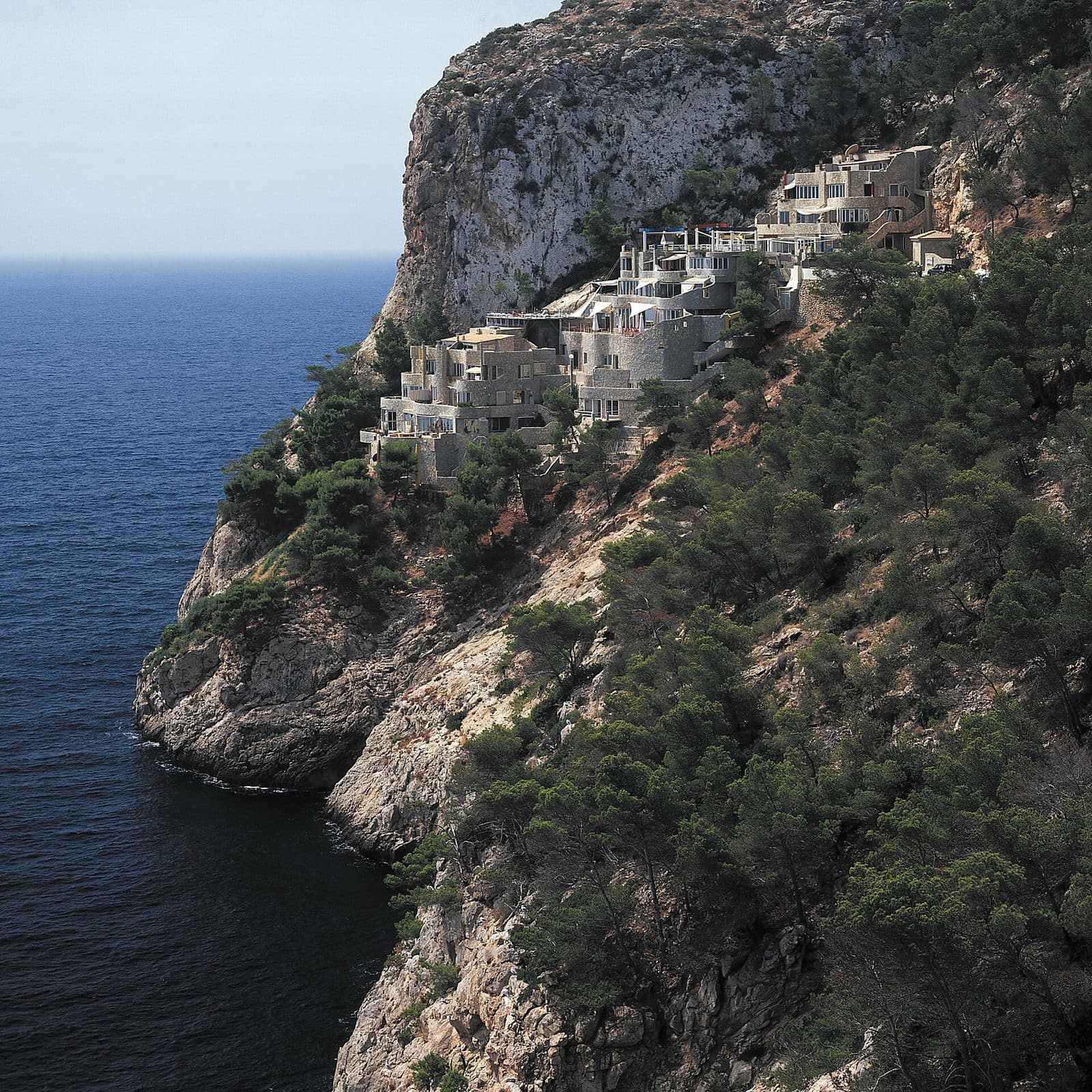

High above the coast of La Mola stands a museum where architecture, art, and worldview are almost impossible to separate. Liedtke near Port d’Andratx is not a conventional exhibition venue with neutral galleries: the artist Dieter Walter Liedtke designed the building himself, left sections of the natural rock visible, and gave the complex the form of a human brain.
This architectural concept alone makes the place unusual. Inside and throughout the outdoor grounds, visitors encounter paintings, photographs, three-dimensional works, and sculptures from Liedtke’s oeuvre. Rather than following a sober art-historical arrangement, the presentation attempts to connect art, creativity, knowledge, and social development. Those expecting clear answers may find it puzzling; those who enjoy unconventional systems of thought will find plenty to discuss.
Equally distinctive is its location outside the harbor center on a steep slope of La Mola. Terraces and outdoor areas open onto the Mediterranean and the coast of Andratx. The journey is therefore worthwhile not only for individual exhibits: architecture, rock, sculptures, and landscape form one continuous route here.
Liedtke is particularly suitable for visitors interested in contemporary art, architecture enthusiasts, and people deliberately seeking small, personal museums on Mallorca. It is neither an encyclopedic art museum nor merely a viewing terrace, but a highly individual total work of art whose ideas are as important as the objects on display.
History and Significance
The Construction Years from 1987 to 1993
Dieter Walter Liedtke designed and built the complex himself between 1987 and 1993. Born in Essen in 1944, the artist sought an architectural form on La Mola for his ideas about creativity and consciousness. The museum opened in 1993.
The lengthy construction period explains its idiosyncratic craftsmanship and spatial character. Instead of leveling the hillside plot and placing a regular structure on it, the architecture responds to the topography. Exposed sections of stone and rock formations left in place were incorporated into the building. Walls, rooms, and terraces therefore follow no strictly symmetrical order, making the museum feel in places more like a walk-in sculpture than a conventionally planned exhibition venue.
A Homage to Michelangelo
Liedtke conceived the building’s brain shape as a homage to Michelangelo. It originated in his interpretation of a motif in the Sistine Chapel: in the depiction of God, he saw the outline of a human brain, or the human mind as a protective mantle. This reading became the museum’s architectural program. Creativity appears here not as the gift of a chosen few, but as a human ability and a responsibility toward society and the environment.
This is important for understanding the building. The brain shape is not a decorative idea that works only from a bird’s-eye view, but points to the core of Liedtke’s artistic thinking: knowledge, innovation, and consciousness should be connected. The architecture is intended not merely to illustrate this idea but to make it physically tangible as visitors move through the symbolic brain.
Museum, Studio, and Living Space
The original concept extended beyond a museum alone. It envisioned exhibition rooms, a studio, areas for outdoor events, dining, apartments, and a pool. Living, working, reflecting, and viewing art were all intended to take place in the same location. This combination explains why the complex feels less institutional than large public museums and why transitions between private, artistic, and publicly used areas are part of the design.
In 1999, art historian Harald Szeemann particularly emphasized how Liedtke had realized his vision on the steep slope while respecting Mallorca’s natural environment. This perspective is revealing when assessing the museum’s significance, because the collection alone is not what matters. The building itself is one of the principal works, as it spatially condenses Liedtke’s ideas about art and consciousness.
What to See
The Brain-Shaped Architecture
There is little sense of a conventional museum floor plan. The asymmetrical complex responds to curves, changes in elevation, and rocky outcrops; its overall form is intended to resemble a human brain. This idea is most clearly recognizable in views from an elevated perspective. On site, it becomes apparent in the asymmetrical architecture and the incorporation of the topography and rocks.
This contrast between the overall image and immediate perception is part of the appeal. Those who stop only in front of the façade will not immediately see an anatomical model. Knowing the design concept changes the way the individual sections are perceived: rooms then appear as areas within a larger organism, while corridors and transitions recall connections between thoughts. The building does not demand such an interpretation, but clearly suggests it.
The brain shape is also a key to the exhibits. Liedtke’s art revolves around how new ideas arise and how innovation can be recognized. His frequently quoted principle defines art as innovation at the time of its creation. In the museum, this thesis is not presented cautiously, but as the starting point for a comprehensive model of thought. Visitors do not have to agree with it; the tour becomes especially productive where disagreement and curiosity arise at the same time.
The Exposed Rock
Some of the strongest architectural moments occur where the building does not conceal the ground beneath it. Natural rock formations were visibly incorporated into the complex. The slope is therefore not an interchangeable backdrop, but part of the construction and spatial effect. Smooth, human-made surfaces meet irregular stone, while planned architecture directly encounters geological forms.
This makes the building appear closely connected to La Mola. A comparable structure on level ground would lose its essential relationship to the site. The asymmetrical form is not merely a formal extravagance, but a response to the steep location. While walking through the complex, it is therefore worth paying attention to more than paintings and sculptures. Rock edges, wall junctions, and transitions between indoor and outdoor spaces reveal as much about the museum as the labeled works.
This integration of nature distinguishes Liedtke from a white-walled gallery designed to exclude its surroundings as much as possible. Here the ground remains visible and asserts itself alongside the art. It can appear rough and improvised, but that is part of the concept: nature, body, mind, and built form are not meant to be neatly separated.
The Dieter Walter Liedtke Exhibition
The exhibition presents paintings, photographs, three-dimensional works, and other objects from various phases of the artist’s career. It ranges from works associated with his so-called concrete evolutionism from earlier decades and the 1990s to later pieces, thus encompassing different creative periods.
A central concept is his “Art Formula.” It represents an attempt to describe creativity and innovation according to a universal structure rather than leaving them to mere taste. Other works refer to his “General Information Theory” and the formula “i = E = MC².” These concepts come from Liedtke’s own philosophical and artistic system; they should not be confused with accepted scientific formulas or a science museum.
This distinction is helpful during a visit. The exhibition does not provide a neutral introduction to neurobiology, epigenetics, or philosophy. It shows how an artist combines scientific-sounding terms, social ideas, and visual forms into a personal model of the world. Approaching the works in this way makes it easier to understand their visual language and intellectual ambition without having to accept every claim.
The Sculpture Grounds
Around the building, the museum lists 31 accessible sculptures. They extend the exhibition into the landscape and lead the route out of the interior. Natural light changes their appearance more dramatically than it would in an enclosed gallery: outlines stand out against the sky and sea, surfaces cast shadows, and the background itself becomes part of the image.
According to the museum’s own account, the sculptures document important stages in Liedtke’s artistic and theoretical development. For visitors, they also provide the most immediate access to his work, since not every object first requires familiarity with his concepts and formulas. Some works can be understood through their materials, silhouettes, and positions on the slope, while others appear as spatial signs within a larger system of thought.
The outdoor route should not be treated as an appendix to the indoor exhibition. This is precisely where the place’s fundamental idea becomes clear: art does not stand isolated on a pedestal, but enters into a relationship with architecture, rock, and coast. Those who walk slowly and change their viewing direction will discover different overlaps between sculpture and landscape than they would on a hurried visit.
Terraces and Sea Views
The terraces open over the Mediterranean and parts of the Andratx coast. Wind, the scent of the sea, and the open horizon are among the sensory impressions explicitly highlighted by the museum. The view is therefore more than a pleasant pause between exhibits. It forms part of the staging of a building that repeatedly dissolves the boundary between indoors and outdoors.
La Mola is also known for views of the open sea and Dragonera on the horizon. In suitable visibility, it becomes clear why Liedtke chose this particular place for his museum. The landscape creates distance from the lively harbor while providing an expansive setting for the exhibition’s often far-reaching ideas. Even visitors who have little affinity with Liedtke’s theories will recognize the combination of terraces, sculptures, and coast as a distinctive quality in its own right.
Visiting the Museum
A Tour Without a Fixed Narrative
It makes sense to begin the visit with the building itself. Before focusing on individual works, it is worth observing the course of the walls, the changes in elevation, and the exposed rocks. The indoor exhibition and sculpture grounds can then be read as two parts of the same concept. Anyone rushing directly from exhibit to exhibit may easily miss that the architecture is the most important link between the themes.
Historical visitor accounts describe guided tours in which Liedtke’s question “What is art?” served as the introduction. Such personal interpretation could transform an initially enigmatic object into part of his theoretical framework. Whether guided tours are currently offered, and in what form, should be checked before traveling. The same applies to current opening hours and admission, as neither should be assumed to follow a reliable fixed schedule.
Time for Art and Outdoor Spaces
An older visitor report gives a duration of approximately 45 minutes for a guided tour. A tightly scheduled visit is not ideal for the entire complex, however, if the architecture, exposed rock, exhibition, sculptures, and terraces are all to be explored. The place rewards pauses, because some connections become apparent only after looking back from an interior space toward the structure or landscape.
The actual duration of the visit depends greatly on how deeply visitors engage with Liedtke’s texts and theories. Those mainly interested in the architecture and sculpture grounds will progress more quickly. Those wishing to understand, read, and discuss the concepts behind the works will need more time. The museum is therefore better suited to being a deliberately planned part of the day than a brief stop while passing through.
Light, Heat, and Atmosphere
One surviving visitor account describes intense afternoon heat and a guided tour that was consequently limited to the indoor exhibition. This is not an insignificant detail, because an important part of the complex is outdoors and the slope of La Mola is exposed to the sun. On warm days, temperature and light help determine how comfortable the sculpture route will be.
The later hours can be particularly appealing for the landscape, as La Mola is known for sunsets and views toward Dragonera. A visit at this time of day only makes sense, however, if current access to the museum allows it. Those coming specifically for the light should confirm visiting arrangements in advance rather than relying solely on older reports.
Getting There and Parking
From Palma and the Airport to Port d’Andratx
From central Palma, the route follows the Ma-1 to Port d’Andratx. The harbor town is 33 road kilometers away, and the journey takes around 37 minutes. From Palma Airport, the route to Port d’Andratx covers 43 road kilometers and takes around 38 minutes; it first follows the Ma-20 and then the Ma-1.
These directions expressly end in Port d’Andratx, not at the museum. Liedtke is located outside the actual harbor area on La Mola. For the final stretch, follow the local road network uphill from the town onto the peninsula. The road gains elevation and leads through an area characterized by hillside properties and villas. Navigation to the specific destination is advisable because the museum is not located on the central waterfront promenade.
The Final Stretch on La Mola
The museum is described as being about two kilometers outside Port d’Andratx. More important than this short distance is the nature of the terrain: La Mola rises above the sea, and the building stands on a steep slope. Anyone previously exploring the harbor should therefore not expect a level walk along the promenade.
The approach is already part of the experience. As the road climbs, the enclosed harbor recedes while the view increasingly opens toward the sea. This transition explains the museum’s special atmosphere: it is close enough to be combined with Port d’Andratx, yet clearly removed from the lively center.
Parking and Public Transportation
The museum’s own information refers to free parking. Because access, signage, and available spaces may change, visitors should pay attention to designated areas on site. Given the hillside location, it is advisable to use only marked parking spaces.
No bus stop is recorded in the museum’s immediate vicinity. Bus services to Port d’Andratx therefore do not automatically provide transportation all the way to Liedtke. Anyone arriving without a car must organize the final stretch on La Mola separately or plan for the uphill walk. A car or taxi is consequently more practical for visiting the museum than relying solely on a scheduled bus service.
Bus lines to Liedtke at a glance
| Line | Route | Departures/day | First | Last |
|---|---|---|---|---|
| 122 | Port d'Andratx - Santa Ponça | 136 | 06:20 | 23:55 |
| 121 | Sant Elm - Andratx | 76 | 07:24 | 21:49 |
| 101 | Port d'Andratx - Palma | 66 | 06:10 | 23:55 |
From the official GTFS feeds (TIB/SFM), no real-time data. The figures cover all stops in the town; weekend and holiday services differ — check with the operator before travelling.
Getting there by bus
Llotja (5011) · 2.1 km as the crow flies
- 101Port d'Andratx - Palma · Daily
- 121Sant Elm - Andratx · Daily
- 122Port d'Andratx - Santa Ponça · Daily
Club de vela (5012) · 2.1 km as the crow flies
- 101Port d'Andratx - Palma · Daily
- 121Sant Elm - Andratx · Daily
- 122Port d'Andratx - Santa Ponça · Daily
S'Aluet (5027) · 2.2 km as the crow flies
- 101Port d'Andratx - Palma · Daily
- 121Sant Elm - Andratx · Daily
- 122Port d'Andratx - Santa Ponça · Daily
Timetable data: official GTFS feeds (TIB/EMT), no real-time — check with the operator before travelling.
Nearby Attractions
Port d’Andratx
Down by the water, Port d’Andratx presents a very different face from the quiet, thought-provoking museum on the slope. The natural harbor developed from a former fishing refuge into a cosmopolitan coastal town with motorboats, sailing yachts, shops, and restaurants. Fishing has not disappeared entirely, however: at the Llotja, it continues to recall the town’s earlier economic foundations.
A walk along the waterfront promenade is a good addition before or after visiting the museum. The harbor routes are more urban and easier to access than the terrain on La Mola; from below, it is also possible to appreciate how strongly the surrounding hills enclose the bay. Those who visit the harbor first and Liedtke afterward will experience the transition from the busy waterfront to the open sea particularly clearly.
La Mola and Dragonera
La Mola is not only the site of the museum, but also one of the main viewpoints around Port d’Andratx. From the peninsula, the view opens from the sheltered bay toward the sea. Dragonera may appear on the horizon, its elongated silhouette lying off Mallorca’s west coast. Especially toward evening, this view becomes an important part of the experience.
The historic defensive tower Sant Carles is also located on La Mola. It is not part of the Liedtke museum, however, and should not be confused with its architecture. As another landmark, it demonstrates that the exposed peninsula held strategic importance for the harbor long before the modern museum was built.
Waterfront Promenade and Es Saluet
Most of Port d’Andratx’s activity is concentrated along the promenade, the quays, and around the sailing club. The route passes the Llotja and the small wetland or stream area of Es Saluet. Restaurants and terraces face the water; fishing boats, leisure craft, and larger yachts share the harbor.
This setting provides a fitting contrast to the museum. Liedtke requires attention to one artist’s worldview, while the harbor communicates without explanation through movement, water, and everyday life. For a coherent excursion, it is enough to combine both places at a relaxed pace rather than packing numerous distant destinations into the same day.
The place it belongs to
Port d'Andratx in the place guidePractical Information for Your Visit
Footwear and Terrain
The museum stands on a steep slope, and an important part of the visit passes through outdoor areas with integrated rocks. Comfortable, secure footwear is therefore more suitable than smooth soles or delicate shoes. Even inside the complex, attention should not be focused solely on the artworks: changes in elevation, irregular transitions, and natural rock surfaces are part of the place’s character.
Anyone expecting only a level gallery route will be surprised by the complex. The spatial experience arises precisely from the transitions between interiors, terraces, rock, and sculpture grounds. This makes the visit vivid, but demands more attention than a museum with straight corridors and uniform floors.
Sun and Outdoor Areas
Sun protection and sufficient water are sensible for the sculpture grounds, particularly on warm days. A historical visitor account makes clear how strongly the afternoon heat can affect the tour. Shade on individual terraces is not a substitute for protection during an extended outdoor stay.
Wind is also part of the location beside the open sea. It can make the heat more pleasant, but may be stronger on exposed terraces than down in the sheltered harbor. Loose hats, lightweight scarves, and paper materials should therefore be secured. In changeable weather, it is worth coordinating the indoor and outdoor portions of the visit flexibly.
Visiting with Children
Children may find more immediate access through the unusual brain shape, the rocks, and the sculptures than through the theoretical texts. The museum is not an interactive science center or a conventional hands-on museum, however. Liedtke’s philosophical and social explanations are aimed more at visitors willing to engage with abstract ideas.
Attentive supervision is important on the hillside and terrace grounds. Families should not plan the visit around the indoor exhibition alone, but should also consider the outdoor paths, sun, and wind. Whether the place is suitable for a particular child therefore depends more on interest and the ability to move calmly through the site than on a formal age limit.
What Not to Expect
Liedtke does not provide a representative overview of Mallorcan art or a chronological introduction to European art history. The complex is essentially devoted to the work and ideas of one artist. Scientific terms are used within his personal theoretical framework; they should not be understood as an academic specialist exhibition.
Nor is the place merely a photo stop with a sea view. Those who engage with the combination of architecture, sculpture, and intellectual world will better understand its distinctive character. It is precisely the friction between sweeping theoretical ambition, rough rock, and personal presentation that makes Liedtke one of the more unusual museum visits in southwest Mallorca.