
mirador de na Burguesa – Views over Palma and the Bay
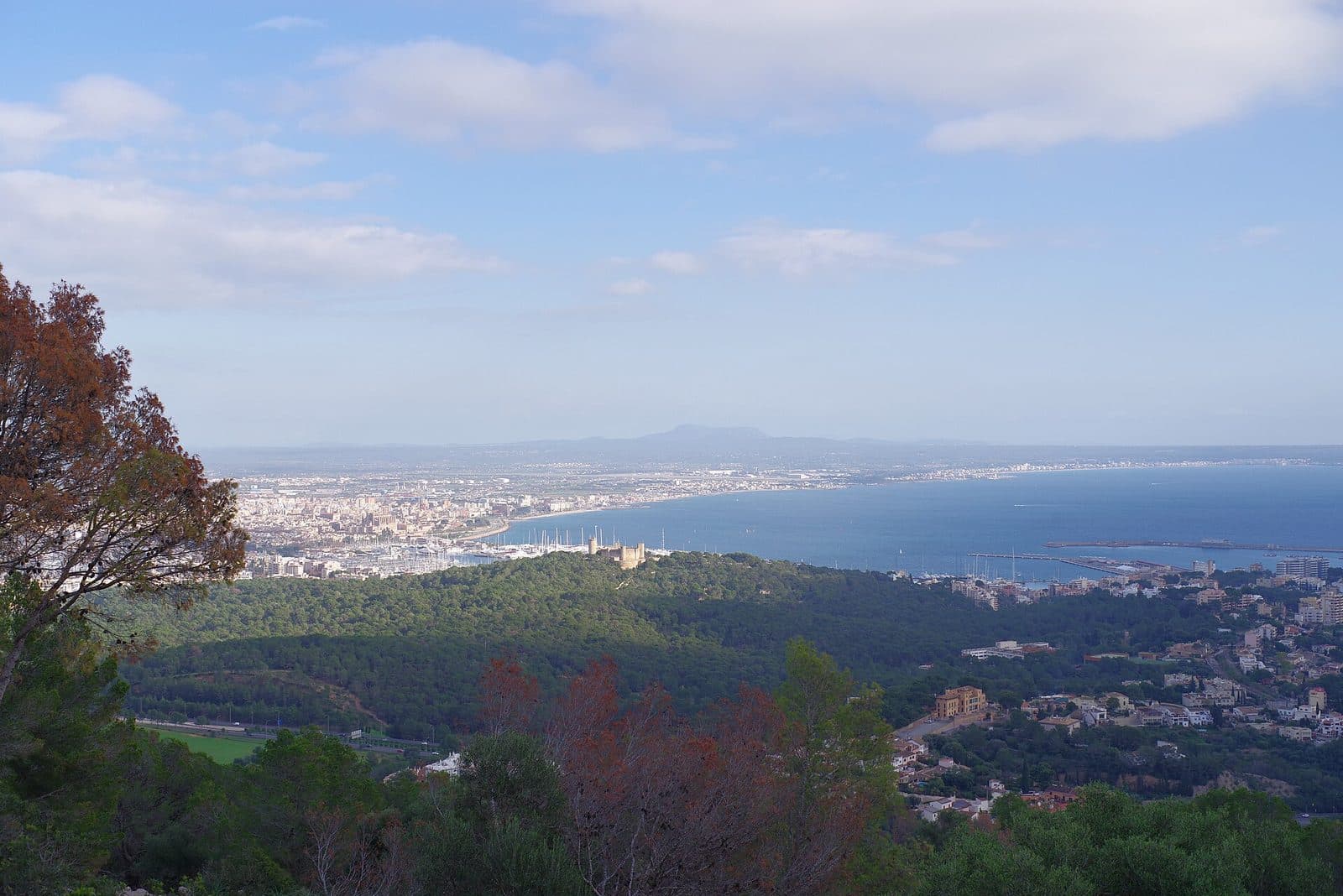

The mirador de na Burguesa reveals a side of Mallorca that is difficult to appreciate from street level: Palma spreads out below the mountain ridge, while beyond it the bay sweeps in a broad arc towards the Mediterranean. In clear conditions, the panorama extends across large parts of the capital and as far as the distant outline of Cabrera.
The viewpoint lies in the Serra de na Burguesa, the southernmost extension of the Serra de Tramuntana. Here, city and mountains meet directly: while densely built-up districts, harbour facilities and coastlines dominate the scene below, the Mirador is surrounded by wooded mountain scenery. This contrast is precisely what makes a visit so appealing.
It is not a conventional attraction with a set route, collections or historic interiors. The focus is on the elevated setting, the statue of the Virgin Mary and the panorama. The Mirador is therefore particularly suitable for a dedicated scenic stop, for photographers, and as the starting or finishing point of a hike or cycle tour through the Serra de na Burguesa.
What to see
As soon as you approach the viewpoint, it becomes clear why the journey uphill is worthwhile: the landscape opens out not merely onto a single stretch of coastline, but into a broad panorama of city and sea. The Mirador is more interesting for its location than for its architectural details, yet there is still more to discover here than an open spot on the mountainside.
Palma and the bay
Below the Mirador, Palma lies across the landscape almost like a city map. Buildings extend from the districts at the foot of the mountains to the coast, with the Bahía de Palma spreading out beyond them. From here, the relationship between harbour, city and sea becomes easy to understand. The clearer the air, the more distinctly the curve of the coastline and the horizon stand out.
The view also changes with the light. During the day, the structure of the city and the outline of the bay are easy to distinguish. Towards evening, broader shapes become more prominent, while after dark the streets and houses turn into an expansive field of lights. This is why the Mirador is popular not only with travellers but also, especially in the evening, with local residents.
The Mediterranean and Cabrera
Beyond the bay, the view stretches out across the open Mediterranean. When long-distance visibility is favourable, Cabrera may even be visible on the horizon. This is not something to expect in every kind of weather, as haze over the sea can significantly reduce visibility. On a clear day, it is therefore worth looking not only down towards Palma but also scanning the horizon carefully.
The elevated location also reveals the shape of the landscape. The sharply defined ridges of the Serra de na Burguesa descend towards the coast, while further sections of the Tramuntana appear beyond them. The Mirador thus forms a transition between the densely populated Bay of Palma and the mountainous region in northwestern Mallorca.
The statue of the Virgin Mary
A prominent landmark at the Mirador is the statue of the Virgin Mary. It gives the site a distinctive character and prevents it from feeling like just another roadside pull-off with a view. Anyone who immediately turns towards the panorama may easily overlook how strongly the figure defines the location. It also serves as a useful point of orientation for hikers and cyclists incorporating the Mirador into a tour through the surrounding hills.
Forest and mountain scenery
Around the viewpoint begins a landscape characterised by woodland and Mediterranean scrub. The transition is striking: the large city lies on one side, while paths and tracks lead into quieter terrain on the other. The Serra de na Burguesa is used by hikers and mountain bikers; the Mirador can therefore be either a destination in its own right or the beginning of a longer excursion. Anyone continuing onwards should, however, clearly distinguish it from the Mirador de n’Alzamora farther west, which is a separate hiking destination.
Visiting the viewpoint
A scenic stop without a set route
There is no prescribed order to follow at the Mirador. It makes sense to begin by taking in the complete panorama and then identifying individual features: the line of the coast, the extent of Palma, the harbour and, in clear conditions, Cabrera. Afterwards, there is time to see the statue of the Virgin Mary and look at the paths leading into the Serra de na Burguesa.
A long stay is not necessary for a simple panoramic stop. Anyone taking photographs, waiting for the light to change or combining the Mirador with a hike should allow correspondingly more time. The surroundings are less suitable for a hurried stop, however, as the winding approach and final section along an unpaved access road are otherwise disproportionate to spending only a few moments at the viewpoint.
Evening light and Palma at night
Late in the day is the most sought-after time to visit for atmosphere. The view then changes from a clearly structured urban landscape into a sea of lights across the bay. This evening mood also attracts local residents. Anyone seeking greater tranquillity should therefore arrive before the evening crowds and leave the Mirador before the most popular viewing spots fill up.
A visit after dark requires additional care. The access road is described as winding, unpaved and not continuously protected by barriers. Anyone staying to see Palma illuminated should therefore not treat the return journey like an ordinary drive through the city.
Weather and long-distance views
Visibility matters more than the season. Haze over the bay can obscure distant outlines, while a clear day opens up far-reaching views across Palma and the sea. For photography, it is therefore worth checking the weather and cloud cover before driving uphill.
No reliable current information about opening hours or admission has been recorded. As access and the operation of food and drink venues may change, these details should be checked immediately before visiting.
Getting there and parking
From the airport and Palma
From Palma Airport, the recorded route follows the Ma-20 to S’Arxiduc. It covers 18 kilometres by road, and the drive takes around 19 minutes. From central Palma, it is 8 kilometres by road to S’Arxiduc; this journey should likewise take around 19 minutes. These details expressly apply only as far as the recorded destination in S’Arxiduc, not directly to the mirador de na Burguesa.
Additional time is therefore required for the final section. Descriptions of the approach refer to the western outskirts of Palma near Gènova. The road uphill is considered winding, while the final section is described as unpaved and without continuous safety barriers. Driving slowly and with foresight is more important here than the journey time itself, particularly as the route becomes even more demanding after dark or in poor weather.
The final section to the viewpoint
The Mirador is generally accessible by car and on foot, but the road uphill should not be mistaken for a wide, comfortable access road. Uneven ground and bends can place greater demands on a vehicle than an ordinary city street. Before continuing, visitors should therefore check whether the current conditions are suitable for their vehicle and level of driving experience.
By bus and on foot
Bus stops are located in the wider area around Gènova and the Camí dels Reis, but they do not eliminate the uphill walk to the viewpoint. Anyone using public transport must complete the final ascending section on foot and should check the route beforehand on an up-to-date hiking map. The same applies to the return journey after sunset.
Getting there by bus
140-Gènova · 0.6 km as the crow flies
- 47Gènova - la Bonanova - Sindicat (esquerra) · 08:00–08:00 · Daily
148-Gènova · 0.6 km as the crow flies
- 46la Bonanova - Gènova - Sindicat (dreta) · 08:00–08:00 · Daily
139-camí dels Reis - camí des TramVia · 0.6 km as the crow flies
- 47Gènova - la Bonanova - Sindicat (esquerra) · 08:00–08:00 · Daily
149-camí dels Reis - camí des Tramvia · 0.6 km as the crow flies
- 46la Bonanova - Gènova - Sindicat (dreta) · 08:00–08:00 · Daily
141-camí dels Reis - carrer de la Coma · 0.7 km as the crow flies
- 47Gènova - la Bonanova - Sindicat (esquerra) · 08:00–08:00 · Daily
147-camí dels Reis - carrer de la Coma · 0.7 km as the crow flies
- 46la Bonanova - Gènova - Sindicat (dreta) · 08:00–08:00 · Daily
1060-camí dels Reis - Tren de sa Pedrera · 0.8 km as the crow flies
- 47Gènova - la Bonanova - Sindicat (esquerra) · 08:00–08:00 · Daily
1061-camí dels Reis - Tren de sa Pedrera · 0.8 km as the crow flies
- 46la Bonanova - Gènova - Sindicat (dreta) · 08:00–08:00 · Daily
146-Cementeri de Gènova · 0.9 km as the crow flies
- 46la Bonanova - Gènova - Sindicat (dreta) · 08:00–08:00 · Daily
142-Cementeri de Gènova · 1.0 km as the crow flies
- 47Gènova - la Bonanova - Sindicat (esquerra) · 08:00–08:00 · Daily
1049-Poliesportiu Rudy Fernàndez · 1.2 km as the crow flies
- 47Gènova - la Bonanova - Sindicat (esquerra) · 08:00–08:00 · Daily
1050-Poliesportiu Rudy Fernàndez · 1.2 km as the crow flies
- 46la Bonanova - Gènova - Sindicat (dreta) · 08:00–08:00 · Daily
Timetable data: official GTFS feeds (TIB/EMT), no real-time — check with the operator before travelling.
Practical information for your visit
Footwear and equipment
Because of the unpaved access and surrounding woodland paths, sturdy shoes with good grip are the better choice. This is especially true if the visit is to extend beyond the immediate viewpoint. The Serra de na Burguesa is a hiking and mountain-biking area; its tracks are not comparable to level paths in a city park. Anyone continuing onto the surrounding trails should therefore save the planned route in advance and avoid confusing the Mirador de na Burguesa with the Mirador de n’Alzamora.
Sun, wind and shade
Although the wooded surroundings provide some shelter in places, the viewpoint itself is exposed to the weather.
Visiting with children
Children can enjoy the panorama. However, close supervision is required on the winding, partly unpaved access road and around unsecured areas. For families, a visit in daylight is easier to manage than a late return journey in the dark.
What not to expect
The appeal lies in the view, not in an exhibition or an elaborate visitor programme. Anyone planning to drive uphill solely for a restaurant or café should also check its current operating status beforehand. The Mirador works best as a landscape experience: arrive, take in Palma and the bay, see the statue of the Virgin Mary, and continue into the Serra de na Burguesa only with suitable equipment.
Local insider tips
Arrive before the evening crowds
The Mirador is particularly popular with local residents in the evening. Anyone wishing to enjoy the view in greater tranquillity should arrive before the popular sunset period and choose a viewing spot before Palma turns into a field of lights.
Scan the horizon
The view does not end at the Bay of Palma. In clear conditions, Cabrera may be visible on the horizon. Haze often determines whether the island’s outline can be seen, so it is worth looking carefully.
Do not underestimate the access road
The final section is described as winding, unpaved and not continuously protected by barriers. Drive slowly, allow for oncoming traffic and plan the return journey during daylight if the route is unfamiliar.
Do not confuse the Miradores
The mirador de na Burguesa and the Mirador de n’Alzamora are two different destinations. The latter lies on a longer hiking route, so the name should be checked carefully when navigating.