
Castell de Bellver – Palma’s Round Castle
_--_15.jpg)
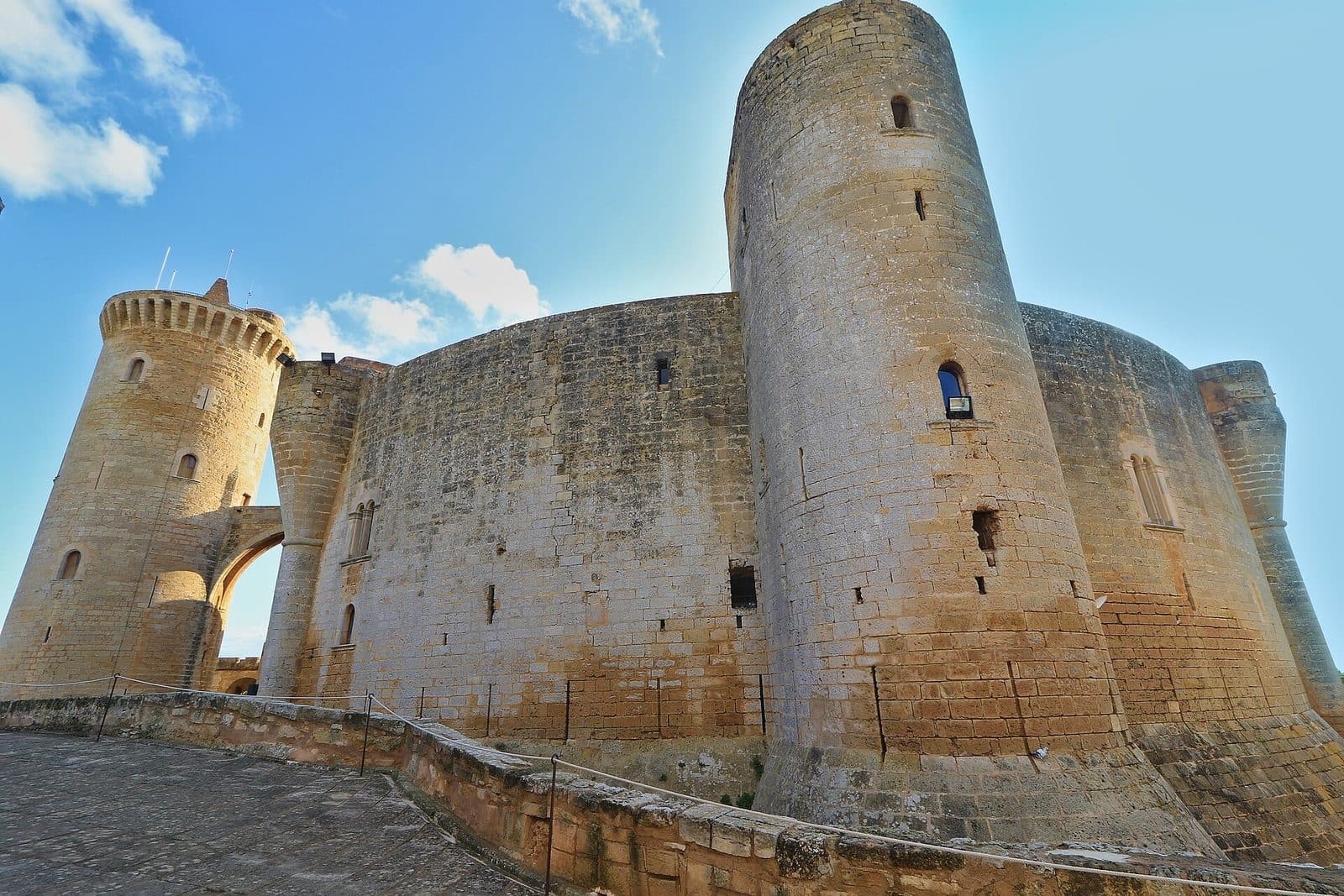
The very first sight of Castell de Bellver turns the familiar idea of a medieval castle on its head. Instead of walls forming an angular quadrangle, a solid ring of stone stands on the wooded hill above Palma. Behind it lies a circular courtyard, above which arcades, towers and the rooftop terrace create an unusually clear sense of order.
The climb is worthwhile for more than the view alone. The castle combines defensive architecture with royal splendour, later served as a prison and is now a museum devoted to the history of Palma. This allows the building to be explored on several levels: as a rare Gothic complex, as a setting for Mallorcan history and as a viewpoint over the city, harbour, bay and Serra de Tramuntana. There is particularly much to discover for anyone who enjoys understanding architecture by walking through it. The route leads from the fortified exterior into a surprisingly elegant courtyard and then upwards to open views. Families can also easily grasp the castle’s clear form, although stairs, heights and historic rooms require care.
Bellver is almost too rewarding for a fleeting photo stop. Only by walking around the moat, moving between the two arcaded storeys and looking down from the roof into the courtyard does it become clear how consistently the circle defines the entire complex.
History and Significance
When King Jaume II. ordered construction to begin on Puig de Sa Mesquida in 1300, the aim was to create more than a military stronghold. Castell de Bellver was both a fortress and a royal residence. Its elevated position allowed control over Palma, the harbour and the approach from the sea, while the interior layout met the requirements of a royal court.
Jaume II. and the Kingdom of Mallorca
Jaume II. initially had a tower built on the hill, followed by the unusual circular complex. Castell de Bellver was intended as a royal residence while also incorporating elements of a fortification. Even so, permanent court life never developed here. King Sanc stayed at the castle in 1314, and Joan I. of Aragón also lived there temporarily in 1395. Such stays show that Bellver could indeed be used as a residence, even though it never became a continuously inhabited royal palace. This intermediate status still defines the building today: a fortress on the outside, with a courtyard of almost palatial elegance within.
From Royal Residence to Prison
For a long period, Castell de Bellver was used as a prison. What had once been designed to provide security for rulers meant isolation for prisoners. This use changes how the rooms are perceived: narrow openings, massive walls and the detached main tower no longer appear solely as elements of medieval defence but also tell of a later history of surveillance and confinement. Bellver is therefore not an unchanged monument to a single era, but a building whose purpose evolved with political circumstances.
The Museum of Palma’s History
Today the Castell forms part of the city’s cultural memory. Its rooms house Palma’s historical museum, whose exhibits and models make the city’s development easier to understand. The location is remarkably fitting: from the rooftop terrace, visitors can look out over the very cityscape whose history is told inside.
Its use as a museum also preserves the connection between the building and the city. Bellver does not stand above Palma as an isolated knights’ castle. Its royal past, strategic location, years as a prison and present-day public use reflect different chapters in the city’s history. A visit therefore reveals more than medieval architecture—it shows how Palma has lived with this widely visible landmark over the centuries.
What to See
The most powerful moment often comes only after passing through the entrance. From the outside, Castell de Bellver appears compact, heavy and almost forbidding. Inside, however, a bright, perfectly circular courtyard opens up. The walls that had just seemed like a solid ring become a sequence of arches, columns and surrounding galleries.
The Circular Castle
The circular ground plan is not merely an isolated decorative idea but determines the entire castle. The outer wall, courtyard, galleries and routes all follow the same circle. As a result, the walk contains hardly any of the usual corners where the perspective changes abruptly. Instead, the eye moves continuously along the stone architecture and repeatedly returns to its starting point.
The consistency of the geometry becomes especially clear from above. The courtyard lies like a disc at the centre, surrounded by the rooms of the circular structure. The three towers integrated into the main building divide the outer line without abandoning the underlying principle. Anyone who photographs only the view may easily overlook the fact that looking down is at least as revealing.
The Circular Courtyard
Defensive construction and courtly architecture meet in the courtyard. The lower storey is defined by stronger, Romanesque-looking arcades. Above it runs a Gothic colonnade whose slimmer forms appear lighter. The two levels can be compared at a glance; hardly any other part of the castle demonstrates more clearly how different its exterior and interior effects are.
As you walk beneath the arcades, the courtyard changes with every step. Each arch frames a new section, while the gallery opposite always remains visible. Conversations and footsteps carry through the enclosed circular space. The pattern of the arches is particularly easy to appreciate from the upper level, while the roofline and towers also move closer into view.
The Three Wall Towers
Three towers project from the circular main structure. They formed part of the defensive system and interrupt the smooth line of the outer wall. Their arrangement makes it clear that the circle was not merely an aesthetic flourish: the walls and surrounding area could be watched from these elevated points.
While walking around the complex, it is worth paying attention to these transitions. From a distance, Bellver appears almost perfectly symmetrical; up close, the different functions of individual structural elements become apparent. The towers and circular building are a reminder that the impressive courtyard is enclosed by a fortification.
The Torre de l’Homenatge
The main tower, the Torre de l’Homenatge, stands outside the actual circular structure. A small bridge connects it to the castle. It does not look like another projection from the wall, but like an independent guardian standing before the ring of stone.
In the floor of the tower is an entrance to a lower room that was used as a dungeon. Only a rectangular opening admitted light. This is one of the places where the castle’s history becomes immediately understandable: above was a strategic observation point with extensive views, while below lay a confined space of imprisonment.
The Moat
A moat about four metres wide surrounds the complex. Today it can be viewed as part of the architecture and walked around in sections. This gives a better understanding of the castle’s exterior than heading directly to the entrance: the circular wall rises from the moat, the towers stand out in relief, and the relationship between the detached main tower and the circular structure becomes clear.
The moat also explains why Bellver, despite its elegant interior, was never merely a palace. Attackers first had to overcome this obstacle before reaching the high, largely solid outer wall. The contrast with the open arcaded courtyard could hardly be greater.
The Rooftop Terrace and Panoramic View
On the rooftop terrace, the view breaks free from the enclosed architecture. Palma and the harbour lie on one side, with the bay and sea beyond. In another direction, the view extends towards Serra de Tramuntana. The elevation of around 112 metres above sea level is enough to take in the cityscape, coastline and mountains together.
Here, without any further staging, the meaning of the name Bellver, associated with a “beautiful view,” becomes clear. The change in perspective is particularly revealing: the panorama over Palma opens outwards, while inward the eye falls into the circular courtyard. In just a few steps, visitors can therefore move between landscape and architecture.
Palma’s Historical Museum
The museum rooms within the circular structure trace Palma’s development through exhibits and models. The exhibition places the castle in a broader urban context and is particularly worthwhile when Bellver is visited as more than just a viewpoint. Models help visitors understand earlier versions of the city and architectural changes in spatial terms.
The rooms do not compete with the architecture but provide the historical foundation for the tour. After exploring Palma’s past, the view from the terrace seems less abstract: the harbour, Old Town and modern districts become readable as the result of a long process of development. The exhibition therefore deserves more than whatever time happens to remain between the courtyard and the roof.
Visiting Castell de Bellver
A good tour does not begin with the fastest route to the top. It is worth first looking at the moat, outer wall and main tower before moving into the courtyard. This reveals the castle’s dramatic strength: from an enclosed fortification to a bright circle of arcades and finally to the open rooftop terrace.
The Best Route
After entering, begin with a slow circuit of the courtyard and the adjoining museum rooms. From the lower gallery, the weight of the arches can be appreciated, while the Gothic structure becomes more prominent on the upper level. The tour concludes on the rooftop terrace, which offers views both over the city and across the entire circular complex.
The length of a visit depends greatly on the level of interest in the museum. Anyone mainly wishing to see the courtyard and views will move through the site much faster than someone who examines the models, exhibits, towers and exterior circuit closely. It is best not to squeeze the castle between two tightly scheduled appointments: the changing perspective between courtyard and terrace alone encourages visitors to linger.
Rooftop Terrace and Panoramic View
On the rooftop terrace, light, wind and visibility have a stronger influence on the experience than in the sheltered interiors. In clear conditions, the harbour, city and mountains can easily be distinguished from one another. Visitors who explore the museum first and save the terrace until the end will also experience the panorama with greater historical context.
Opening Days and Admission
From April to September, the Castell is open Tuesday to Saturday from 10 to 19, closing earlier at 15 on Sundays. From October to March, visits end at 18 from Tuesday to Saturday; Sunday hours remain 10 to 15. The castle is closed on Mondays.
Regular admission is 4 euros. As special rules, temporary closures or changes are possible, it is still advisable to check the latest published information before setting out. This is especially important when planning a visit on a Sunday or shortly before final admission.
Getting There and Parking
The castle stands west of the centre on a wooded hill above Palma. The final section is therefore quite different from travelling to a sight in the Old Town: the access road climbs through the forest and leads close to the complex. Anyone arriving by public transport should allow for an uphill walk at the end.
From the Airport via the Ma-19
From Palma Airport, the route initially follows the Ma-19 to Palma. The distance to Palma is 11 kilometres by road, and the journey takes around 20 minutes. These details refer specifically to the route into the city, not to the castle entrance at the top of the hill. From there, the journey continues through the city to western Palma and then along the ascending section to the Castell.
This distinction is important when planning. Urban traffic and the search for parking may affect the final part of the journey, while the Ma-19 covers only the connection from the airport to Palma. Setting the castle itself as the navigation destination helps prevent the route from ending on the coast or in the surrounding residential streets.
Parking at the Castle
A free car park with 30 spaces is located immediately beside the Castell. Two spaces are designated for disabled visitors, while another two have charging stations. Its limited size explains why the car park can fill quickly at popular visiting times.
Another option is parking along the access road where local signs permit it. This lengthens the walk to the castle, and the remaining section is uphill. Anyone wishing to minimise walking should avoid arriving just before the end of a tight time window. The designated disabled spaces make it easier to approach the castle, but do not mean that the entire historic building is accessible without barriers.
By Bus and on Foot
Several stops are located below the castle hill, including at Plaça Gomila and around Joan Miró and s’Aigua Dolça. From there, the route does not continue on level ground to the entrance but climbs through the area below the castle. Sturdy footwear and some extra time for the ascent are therefore advisable.
The walk has its own appeal because the fortress initially appears only in sections between the trees. However, it should be understood as part of the visit rather than simply a short transfer from the stop to the entrance. In warm weather and with small children, the difference in elevation is more significant than the location on the city map might suggest.
Bus lines to Castell de Bellver at a glance
| Line | Route | Departures/day | First | Last |
|---|---|---|---|---|
| 108 | Son Caliu - Palma | 42 | 00:13 | 22:58 |
From the official GTFS feeds (TIB/SFM), no real-time data. The figures cover all stops in the town; weekend and holiday services differ — check with the operator before travelling.
Getting there by bus
62-pl. Gomila · 0.6 km as the crow flies
- 4Ses Illetes - Pl. Columnes · 08:00–08:00 · Daily
- 20Portopí - Son Espases · 06:06–22:40 · Daily
- 46la Bonanova - Gènova - Sindicat (dreta) · 08:00–08:00 · Daily
97-pl. Gomila · 0.6 km as the crow flies
- 4Ses Illetes - Pl. Columnes · 08:00–08:00 · Daily
- 20Portopí - Son Espases · 06:06–22:40 · Daily
- 47Gènova - la Bonanova - Sindicat (esquerra) · 08:00–08:00 · Daily
98-s'Aigua Dolça · 0.7 km as the crow flies
- 4Ses Illetes - Pl. Columnes · 08:00–08:00 · Daily
- 20Portopí - Son Espases · 06:06–22:40 · Daily
- 47Gènova - la Bonanova - Sindicat (esquerra) · 08:00–08:00 · Daily
61-Joan Miró - s'Aigua Dolça · 0.7 km as the crow flies
- 4Ses Illetes - Pl. Columnes · 08:00–08:00 · Daily
- 20Portopí - Son Espases · 06:06–22:40 · Daily
- 46la Bonanova - Gènova - Sindicat (dreta) · 08:00–08:00 · Daily
166-Francesc Vidal i Sureda - el Terreno · 0.7 km as the crow flies
- 46la Bonanova - Gènova - Sindicat (dreta) · 08:00–08:00 · Daily
- E46Llançadora Bonanova
S'Aigua Dolça 2 (40004) · 0.7 km as the crow flies
- 108Son Caliu - Palma · Daily
11-passeig Marítim - s'Aigua Dolça · 0.7 km as the crow flies
- 1Portopí - Sindicat · 08:00–08:00 · Daily
- 30Marivent-Palau de Congressos · 08:00–08:00 · Daily
- N1Portopí - Porta des Camp · 08:00–08:00 · Daily
S'Aigua Dolça 1 (40023) · 0.7 km as the crow flies
- 108Son Caliu - Palma · Daily
29-passeig Marítim - s'Aigua Dolça · 0.7 km as the crow flies
- 1Portopí - Sindicat · 08:00–08:00 · Daily
- 30Marivent-Palau de Congressos · 08:00–08:00 · Daily
- N1Portopí - Porta des Camp · 08:00–08:00 · Daily
63-Joan Miró - sa Portassa · 0.7 km as the crow flies
- 4Ses Illetes - Pl. Columnes · 08:00–08:00 · Daily
- 20Portopí - Son Espases · 06:06–22:40 · Daily
- 46la Bonanova - Gènova - Sindicat (dreta) · 08:00–08:00 · Daily
96-Joan Miró - sa Portassa · 0.7 km as the crow flies
- 4Ses Illetes - Pl. Columnes · 08:00–08:00 · Daily
- 20Portopí - Son Espases · 06:06–22:40 · Daily
- 47Gènova - la Bonanova - Sindicat (esquerra) · 08:00–08:00 · Daily
157-torrent des Mal Pas · 0.7 km as the crow flies
- 46la Bonanova - Gènova - Sindicat (dreta) · 08:00–08:00 · Daily
- E46Llançadora Bonanova
Timetable data: official GTFS feeds (TIB/EMT), no real-time — check with the operator before travelling.
Nearby Sights and Walks
From the terrace, Palma is more than just a backdrop below the castle. The view gives structure to the city: the harbour marks the coast, the Old Town forms its historic core, and La Seu Cathedral can be recognised as a defining feature of the skyline. Bellver is therefore well suited as the start of a day in the city—or as its conclusion after exploring individual districts on foot.
Palma and the Old Town
Combining the castle with the Old Town brings together two very different sides of Palma. In the centre, visitors experience narrow lanes, squares and a dense sequence of historic buildings; from Bellver, the same city appears as a complete whole. Visiting the castle first provides orientation. Those who travel up later can identify places in the panorama that had seemed barely connected when viewed from street level.
La Seu Cathedral, the historic streets and the areas around the old city walls deserve their own focus. They should not be treated as a rushed addition to the castle. Bellver instead provides the spatial overview, while the Old Town reveals the details either before or afterwards.
Harbour and Waterfront
The harbour is especially prominent from the Castell. The elevated view makes it clear why the castle hill was strategically important: movements in the bay and approaches to Palma could be observed from above. Today this creates a striking contrast between medieval stone architecture, the modern city and maritime infrastructure.
A subsequent visit to the waterfront changes the perspective once again. From the sea, the wooded hill rises above the city, while the coastline dominates the view from the castle. For a coherent excursion, this combination is more rewarding than a long series of unrelated indoor visits.
Bellver Forest
The castle is surrounded by a wooded area with paths between pine trees. It provides distance from traffic and Palma’s dense development. Even the approach through the greenery forms part of the site’s character: the fortress does not stand amid a sea of buildings, but on a hill whose vegetation further emphasises its isolated position.
After touring the castle, the forest offers a peaceful continuation without immediately moving on to the next sight. Its paths are also the natural approach for anyone walking up from the lower parts of the city. In warm weather, the return route should also be considered, as shade in the forest does not reduce the effort required by the climb.
The place it belongs to
Palma in the place guidePractical Tips for Your Visit
At first glance, the route appears straightforward: a circular courtyard, surrounding galleries, museum rooms and the terrace. In practice, however, surfaces, stairs and open areas vary. Planning for these conditions makes the visit more relaxed and helps ensure that the most important part—the view from above—does not have to be missed.
Shoes, Sun and Wind
Comfortable, sturdy shoes are particularly useful for the walk through the forest, the exterior circuit and the steps inside the castle. Bus access ends below the hill, and parking along the access road may also leave an uphill walk. Elegant city footwear is less practical here than a sole with good grip.
The courtyard and arcades provide shelter at times, but the rooftop terrace is exposed. Sun and wind are felt more directly there. During the warmer months, sun protection and water are therefore sensible preparations, especially when also walking up from the lower parts of the city.
Visiting with Children
Children can easily understand the circular design, while the transitions between moat, towers, courtyard and roof make the visit more varied than a museum exhibition alone. The main tower and the idea of a castle that served as both a palace and a prison provide good starting points for historical stories.
Supervision is needed on stairs, galleries and elevated areas. The climb from the bus or a more distant parking space should also be considered when planning. A route that begins in the courtyard and then heads to the terrace keeps the visit easy to follow; the museum can be explored in greater or lesser detail depending on the children’s attention span.
Assess Accessibility Realistically
Two disabled parking spaces are designated in the car park. However, this does not mean that every historic level of the castle can be reached without steps. The Castell has several storeys, staircases and a high terrace. Anyone who requires a step-free route should check the current access conditions directly with the operator in advance.
The choice of transport is also important for people with limited stamina. The route from the stops below the hill requires more effort than the short approach from the upper car park. A nearby parking space reduces the climb, but cannot be assumed because capacity is limited.
What Bellver Is Not
The castle’s strengths lie in its architecture, varied uses, historical museum and panoramic view. Anyone interested in interpreting walls, proportions and sightlines will find an unusual amount to explore. Nor should the castle be reduced to its views: the courtyard with its two arcaded levels, the detached Torre de l’Homenatge and the interaction between the circular structure and moat form the true heart of the visit. The panorama is the impressive conclusion—not the only reason to make the journey uphill.