
Monestir de Miramar: Monastery, Museum and Sea Views
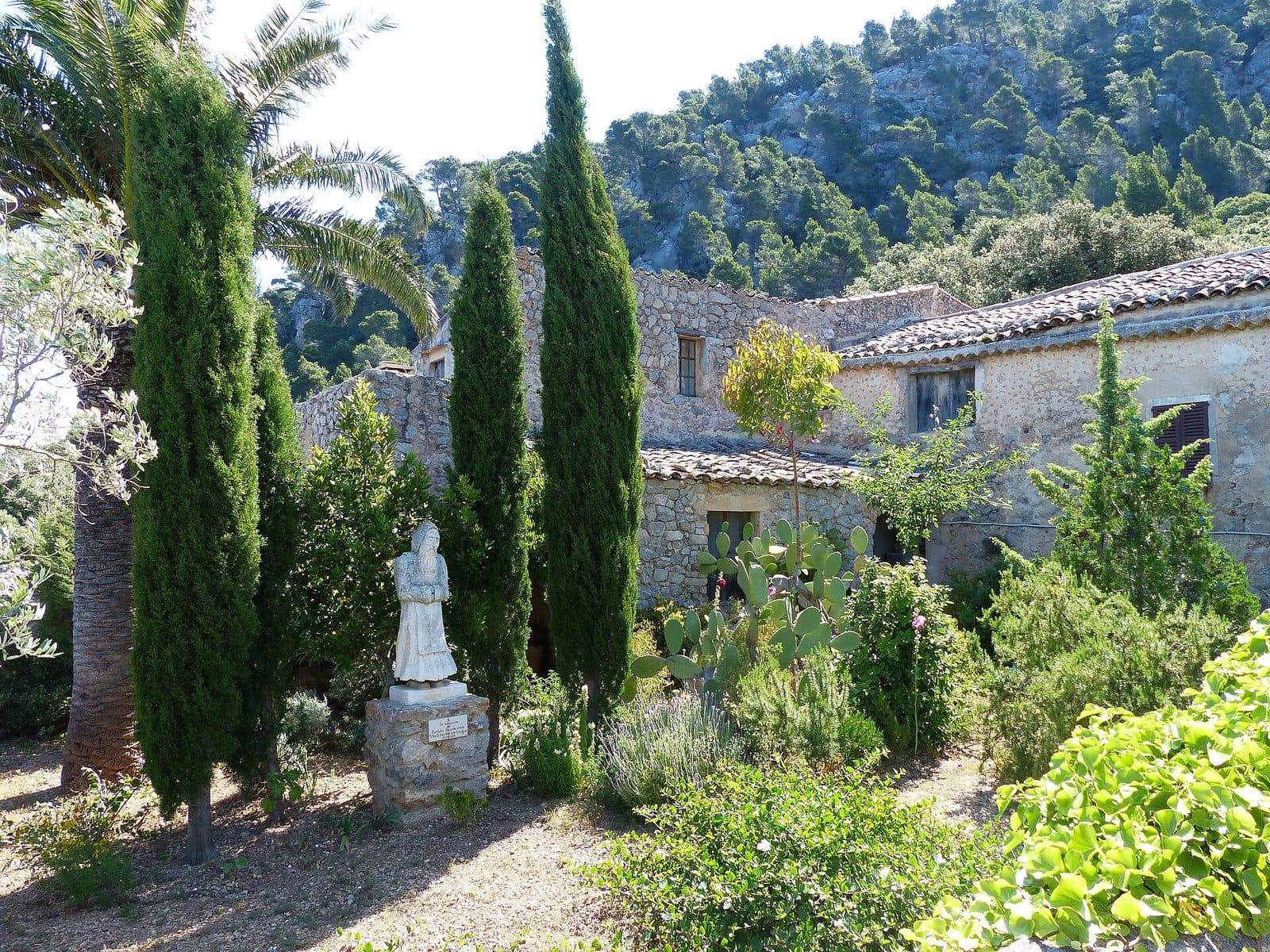

Between Valldemossa and Deià, an inconspicuous entrance leads to a place where Mallorca’s intellectual history and the landscape of the west coast come unusually close together. In the Middle Ages, Monestir de Miramar was a school, a religious retreat and a place of study. Today, the historic estate can be visited as a small museum with a chapel, garden, cloister and old oil press.
Its appeal lies not in a monumental monastery building but in an ensemble that developed over time, bringing together medieval memories, a Mallorcan country estate and the alterations made by Archduke Ludwig Salvator. Between stone arches and museum rooms, views of the Mediterranean repeatedly open up. The name Miramar—roughly meaning a place from which to look at the sea—does not feel like poetic exaggeration here, but like a precise description of the location.
A visit is especially rewarding for anyone interested in Ramon Llull, the cultural history of the Serra de Tramuntana or Ludwig Salvator’s Mallorca. Even those not looking for an extensive museum tour will find a quieter counterpart to the much-visited sights of Valldemossa. Miramar does require attention, however: the entrance from the winding coastal road is easy to miss, and many details on the grounds only reveal themselves when viewed slowly.
History and significance
Miramar did not begin as an ordinary monastery. Its foundation was inspired by an educational project that was remarkable for medieval Mallorca: clergy were to learn languages before setting out as missionaries for the Islamic Mediterranean. This combination of religion, language and study continues to define the site’s historical significance today.
Ramon Llull and the language school
In 1276, Miramar was established on the initiative of the Mallorcan philosopher, theologian and writer Ramon Llull and under the protection of King Jaume II of Mallorca. The house was intended for a community of Franciscans who would study Arabic and other Oriental languages. The aim was to prepare missionaries for their work in North Africa and other parts of the Islamic world.
Llull’s approach was based on the conviction that religious arguments could only be communicated if the language and mindset of the other person were understood. By today’s standards, this was not a school of interreligious dialogue but a Christian missionary institution. Nevertheless, the concept differed from simple training in preaching: language skills, philosophical argument and systematic learning were expressly included. Miramar is therefore sometimes regarded as an early precursor of higher education in Mallorca, although it was not a university in the modern sense.
Lullists and the printing tradition
After the first school closed, Miramar remained connected with the thought of Ramon Llull. The Lullists Bartomeu Caldentey and Francesc Prats later worked here. They continued studying his writings and once again made the site a centre of scholarship.
This phase is associated with one of the most remarkable episodes in Mallorca’s cultural history: in 1487, Nicolau Calafat, a printer from Valldemossa, worked in Miramar; the site is therefore linked to the introduction of the first printing press in Mallorca. The detail fits well with Miramar’s original character, because knowledge here was not only to be preserved but also communicated. Between the medieval manuscript tradition and the new technology of book printing, the remote estate briefly became part of a fundamental transformation in media.
Religious retreat
Even after the original language school ended, Miramar remained a place of religious contemplation. In 1550, Catalina Thomàs, who was later venerated as a Mallorcan saint, received spiritual guidance in the church of Miramar from the hermit Antoni Castañeda. She subsequently entered the Santa Magdalena convent in Palma.
In the 17th century, Miramar also became associated with the origins of today’s Mallorcan order of hermits. Its founder is considered to be Joan Mir i Vallès from Alaró; his mortal remains rest in Miramar. Such episodes explain why, despite changing owners and uses, the estate was never perceived merely as an agricultural finca. Study, the hermit’s life and the contemplative landscape remained closely intertwined.
Archduke Ludwig Salvator
A new era began in 1872, when Archduke Ludwig Salvator of Austria-Tuscany acquired Miramar and made the estate an important part of his holdings on Mallorca’s northwest coast. He had buildings repaired and remodelled, rearranged historic architectural elements and developed the estate as a place to live, work and remember the past. Scientists, writers, artists and other guests came here. Empress Elisabeth of Austria was so impressed by Miramar that she named her sailing ship after it; her connection with Ludwig Salvator belongs to the history of European society that overlaps in Miramar with the older Mallorcan tradition.
It is precisely this second major influence that makes Monestir de Miramar unusual. The site tells not only of Ramon Llull’s Middle Ages but also of the imprint left by Ludwig Salvator in the 19th century.
What to see
The tour does not lead through a fully preserved medieval abbey. Miramar consists of monastery remains, residential and agricultural buildings, museum rooms and a garden. The ensemble therefore feels more like a historic country estate with a monastic memory. Those who understand this character will look more closely: a Gothic arch, an old press or a map is just as important here as the larger rooms.
The chapel
The small chapel stands close to the entrance to the inner grounds. Its understated appearance suits Miramar’s history as a place of study and retreat. The interior can be viewed through the open doors and a grille, even if direct access is not always part of the tour.
The chapel should be regarded less as a richly furnished monastery church than as the spiritual centre of the estate. It makes tangible the site’s long religious use, extending from Ramon Llull’s Franciscans and later hermits to the memory of Catalina Thomàs. Its small size removes any sense of museum-like distance: the room appears to have been part of everyday life rather than a representative monument.
The Ramon Llull rooms
Part of the exhibition is devoted to Ramon Llull and the project that established Miramar in the Middle Ages. Documents, works of art and memorabilia place the philosopher within his period. Visitors who previously knew only his name will gain a better understanding of why a language school could be established on this secluded coast.
The connection between the person and the place is crucial, because Llull’s project cannot be understood as biography alone. The seclusion provided space for study and religious community, while the location beside the Mediterranean also recalled the world towards which the training was directed. The view across the sea therefore takes on historical meaning: beyond the horizon lay the regions whose languages the Franciscans were meant to learn.
The Archduke’s rooms
Other museum areas commemorate Archduke Ludwig Salvator. They display objects, documents, works of art and maps relating to his life and his study of the Balearic Islands. The maps in particular point to a researcher and chronicler who wanted not only to enjoy landscapes but also to document them systematically.
These rooms also explain why Miramar is not an unchanged medieval monastery today. Ludwig Salvator treated the estate as a historic site but continued to shape it according to the ideas of his era. The result was a multilayered house: medieval memory, a Mallorcan finca and a scholarly country residence of the 19th century cannot be neatly separated from one another.
The Tafona
Among the most vivid reminders of rural daily life is the old Tafona, the estate’s oil press. It recalls that Miramar was not only a school, monastery and later meeting place for prominent guests. The grounds formed part of a working Possessió, a large Mallorcan rural estate.
Set between the intellectual stories of Llull and Ludwig Salvator, the oil press may initially seem like a minor feature, but in fact it grounds the entire visit. Olive cultivation, processing and storage shaped the rhythm of such estates for a long time. The Tafona therefore reveals another side of Miramar: knowledge and contemplation here were surrounded by a tangible agricultural landscape.
Garden and cloister
The medieval impression of Miramar is most immediate in the garden. Particularly striking is the small cloister with Gothic arches. Ludwig Salvator had it assembled from historic architectural elements; the arches are attributed to the 13th century. The cloister is therefore not an untouched monastery courtyard but a deliberate reconstruction and staging of older architecture.
This does not diminish its appeal, but it changes how it should be interpreted. The Archduke wanted to make the past visible and created a place that concentrates the tranquillity of a monastery. Stone arches frame views of the garden, light falls through the arcades, and the mountain and coastal landscape remains present beyond the architecture. The cloister thus tells both of the Middle Ages and of the 19th century’s understanding of history.
Views of the west coast
The strongest impression lies outside the museum rooms. Miramar stands on the slopes of the Serra de Tramuntana above the northwest coast. From the estate’s open areas, views extend across the Mediterranean and along the rocky coastal landscape.
This view is not merely an added attraction but part of the site’s history. Ramon Llull sought seclusion for his school; centuries later, Ludwig Salvator was captivated by the combination of sea, rock, vegetation and a cultural landscape shaped by human activity. Anyone who pauses at a viewpoint after touring the museum therefore sees the same landscape that connects both eras.
Visiting Monestir de Miramar
Beyond the entrance, Miramar begins without any grand staging. From the car park, the path leads to the ticket office and then through a stone wall into the area containing the chapel, garden and buildings. Visitors can then explore the museum rooms, the Tafona and the cloister. The precise route is less important than maintaining a slow pace, as interiors and landscape repeatedly alternate.
Tour of the estate
A historical sequence is recommended as an introduction: begin with Ramon Llull and the medieval school, then continue to the traces of Ludwig Salvator. This makes it easier to understand why monastic features overlap with the character of a manor house. The Tafona then introduces the everyday history of the Possessió, while the garden and cloister open the tour to the outdoors.
Miramar is not a museum that impresses through a large number of spectacular individual exhibits. Its most important exhibit is the estate itself. Doors, walls, arches, agricultural spaces and sea views form a complete picture together. Anyone who merely checks off the interiors will therefore miss an essential part of the visit.
Timing and tranquillity
It is difficult to specify a universally applicable visit duration. The museum areas themselves are manageable, but the garden, cloister and views invite visitors to pause. The tour can be kept compact for a quick look; anyone who studies the maps, documents and historical context more closely should allow considerably more time.
Miramar is described as a quiet and less heavily visited site. However, there is no reliably documented time of day guaranteed to have fewer visitors. It is sensible not to arrive just before the end of the visiting window. This leaves enough time for the outdoor areas without reducing the tour to the museum rooms.
Opening hours and admission
Monestir de Miramar is open from Monday to Saturday, from 10:00 to 17:00. Admission is 3 euros. As operating arrangements can change and some older travel reports provide differing information, checking the latest official information is recommended before making a longer journey.
A café or museum shop should not be expected as a fixed part of the experience. This contributes to the site’s understated character: Miramar is not a large visitor centre but a historic estate whose impact comes from its rooms, garden and location.
Getting there and parking
The route does not end in the centre of Valldemossa. Monestir de Miramar lies outside the village on the road towards Deià. The stated distances and driving times therefore apply expressly only as far as Valldemossa; from there, the final section follows the winding road through the Serra de Tramuntana.
From Palma Airport
From Palma Airport, the route follows the Ma-20 and then the Ma-1110 to Valldemossa. The distance to that point is 25 road kilometres, and the drive takes around 30 minutes. From there, continue along the coastal road towards Deià to reach the estate.
Despite appearing short on the map, the final section should be approached without rushing. The road is winding, and the entrance to Miramar is not immediately obvious among the vegetation and curves. Anyone who misses it should not turn abruptly but should safely try again from a suitable place.
From central Palma
From central Palma, the route follows the Ma-1110 to Valldemossa. The 19 road kilometres to Valldemossa take around 35 minutes. The difference in journey time compared with the airport route is due to city traffic and the direct drive out of Palma.
The additional section towards Deià, which is not included in this calculation, follows afterwards. It leads deeper into the mountain landscape and requires more attention than the broad approach road to Valldemossa. The journey is therefore better regarded as part of an excursion through the northwest than as a short local drive.
Entrance and car park
A wooden sign marks the turn-off, but the entrance can easily be missed. Depending on the direction of travel, the turn is tight. Beyond the gate, a steep driveway leads down to the car park beneath olive trees. The sheltered location is pleasant but does not remove the need for caution when driving downhill and manoeuvring.
Those using public transport will find several stops in the wider area around Miramar and Ermita de la Trinitat. As the final section is not comparable to an urban bus connection, the timetable, appropriate stop and walking route should be checked together in advance. The remote location is less suitable for getting off spontaneously without knowing the route.
Bus lines to Monestir de Miramar at a glance
| Line | Route | Departures/day | First | Last |
|---|---|---|---|---|
| 203 | Valldemossa / Deià | 174 | 06:43 | 22:38 |
From the official GTFS feeds (TIB/SFM), no real-time data. The figures cover all stops in the town; weekend and holiday services differ — check with the operator before travelling.
Getting there by bus
Ca Madò Pilla 2 (63004) · 0.4 km as the crow flies
- 203Valldemossa / Deià · Daily
Ca Madò Pilla 1 (63005) · 0.6 km as the crow flies
- 203Valldemossa / Deià · Daily
Ermita de la Trinitat 1 (63003) · 0.8 km as the crow flies
- 203Valldemossa / Deià · Daily
Ermita de la Trinitat 2 (63011) · 1.1 km as the crow flies
- 203Valldemossa / Deià · Daily
Son Gallard 1 (18008) · 1.4 km as the crow flies
- 203Valldemossa / Deià · Daily
Son Gallard 2 (18007) · 1.5 km as the crow flies
- 203Valldemossa / Deià · Daily
Timetable data: official GTFS feeds (TIB/EMT), no real-time — check with the operator before travelling.
Nearby places to visit
Miramar lies along one of the most culturally and historically rich routes in the Serra de Tramuntana. Even the drive between Valldemossa and Deià passes through a landscape shaped by olive groves, steep slopes and the nearby sea. Rather than collecting many destinations in one day, it is worth choosing a combination that makes the character of this coast easier to understand.
Valldemossa
Valldemossa is the natural starting point for a visit. The village provides a clear contrast to Miramar: one is a livelier mountain village with well-known historic buildings, while the other is a secluded estate above the coast. Combining both stops reveals two sides of the same region—the established village in the mountains and the quiet place of study and retreat beyond it.
There are good reasons not to treat Miramar as a casual stop between other activities, regardless of the chosen order. After a tour of Valldemossa, the estate offers tranquillity and open space; conversely, the history of Ramon Llull and Ludwig Salvator can add depth to a later visit to the village.
Son Marroig and Na Foradada
Farther along the coastal landscape lies Son Marroig, another estate closely connected with Archduke Ludwig Salvator. The two places tell different chapters of the same person’s story. Miramar places greater emphasis on Llull’s medieval legacy, the language school and the monastery grounds that were later remodelled; Son Marroig is especially associated with views of the striking Na Foradada peninsula.
Combining the two estates makes Ludwig Salvator’s enthusiasm for this stretch of coast easier to understand. However, it should not become a hurried comparison. Miramar’s effect comes primarily from its layers as a school, religious site, country estate and museum, while the surrounding landscape provides the connecting framework.
Deià and the coastal road
Deià lies farther north. The village is a suitable next stage on a drive through the Tramuntana without reducing Miramar to a mere stopover. The road itself is part of the experience: beyond its curves, wooded slopes, old cultivated landscapes and openings towards the sea alternate.
For a well-paced excursion, combining Valldemossa, Miramar and one additional coastal location is enough. This leaves time to truly appreciate the views from the estate. Anyone planning too many stops can easily reduce Miramar to a chapel and photo opportunity—and overlook the historical transitions that make the site particularly distinctive.
The place it belongs to
Valldemossa in the place guidePractical information for your visit
The quiet location should not be mistaken for a completely level museum site. The driveway already descends steeply, and a historic country estate combines interiors, garden paths and open areas. Comfortable, sturdy shoes are therefore more suitable than delicate city or beach footwear.
Clothing and weather
Part of the visit takes place outdoors. The olive trees by the car park and areas of the garden provide shelter in places, but the views depend on open sections. Sun and weather protection should therefore not be chosen solely on the basis of the short distance between the car and the entrance.
As Miramar combines indoor and outdoor areas, it is worth wearing clothing selected for more than an air-conditioned museum. Although the visit is a cultural tour rather than a hike, it requires slightly more care than a level exhibition hall.
Visiting with children
The grounds are also described as a destination for family outings. For children, the Tafona, the movement between the house and garden, and the views are usually more engaging than a purely documentary exhibition. The history can be explored through practical questions: Why did monks learn Arabic, how was oil extracted from olives, and what role do the maps play in the museum rooms?
Supervision is important on the steep driveway, along the paths and in open outdoor areas. Miramar is therefore suitable for families who want to explore a historic estate together.
What Miramar is not
Monestir de Miramar is not a large active monastery or a fully preserved medieval abbey. Today’s visit leads through a former monastery and museum site that was altered over the centuries. The cloister shows this particularly clearly: its Gothic arches are historic, but they were assembled into a new ensemble under Ludwig Salvator.
Nor should visitors expect extensive tourist infrastructure. The site’s value lies in the combination of small museum rooms, historic agriculture, religious memory and landscape. Anyone arriving with this expectation will discover more than scenery in Miramar: it is a place where several very different chapters of Mallorcan history can still be read alongside one another.
Local insider tips
Do not miss the entrance
The turn-off on the winding road between Valldemossa and Deià is easy to miss. A wooden sign points towards Miramar; depending on the direction of travel, the turn can be tight.
Do not overlook the Tafona
Between the Llull exhibition and the sea views, the old oil press may seem inconspicuous. However, it is the key to Miramar’s everyday history as a working Mallorcan Possessió.
Look closely at the cloister
The Gothic arches appear medieval, but the cloister was reassembled from historic architectural elements under Archduke Ludwig Salvator. It therefore tells the story of two eras at once.
View the sea in its historical context
The grounds offer views across the west coast. The horizon was already part of Llull’s project: beyond the sea lay the regions towards which the missionaries’ Arabic-language training was directed.
Combine it with Son Marroig
Miramar and Son Marroig reveal two sides of Ludwig Salvator’s work on the northwest coast. The combination is especially rewarding when enough time remains between the two visits for the gardens and views.