
Museu Balear de Ciències Naturals near Sóller
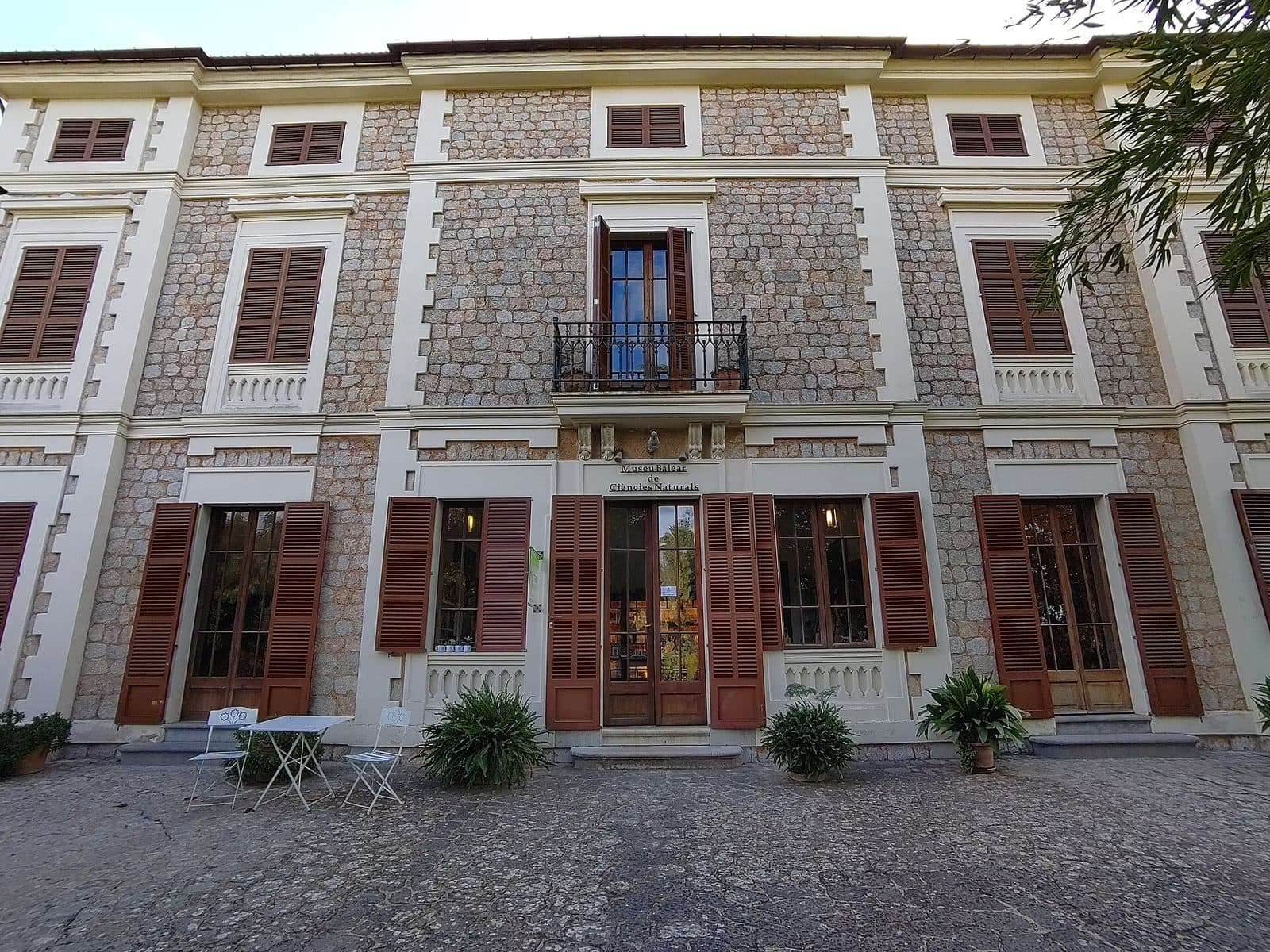

Between Sóller and the edge of L’Horta, the Museu Balear de Ciències Naturals tells a side of Mallorca that is easily overlooked on a typical island itinerary. Instead of beaches, manor houses, or sacred art, the focus here is on fossils, rocks, animals, and the natural-history exploration of the Balearic Islands. The museum shows that the island’s landscape is not merely a beautiful backdrop but the result of geological processes, biological adaptation, and decades of scientific work.
The collection is housed in a small palace on the Finca Camp d’en Prohom. The building is part of the grounds of the Botanical Garden of Sóller, but the museum has its own distinct profile: it preserves natural-history collections, communicates earth and life sciences, and commemorates the naturalists who collected, drew, described, and compared specimens in the Balearic Islands. The tour therefore leads not only through natural history but also through the history of its discovery.
A visit is especially worthwhile for anyone who wants to understand Mallorca’s mountains, coasts, and wildlife better. Families will find tangible objects rather than abstract theory, fossil enthusiasts will encounter paleontological holdings, and hikers will gain a new perspective on the rocks and habitats of the Serra de Tramuntana. The museum is not a vast science center with spectacular displays; its strength lies instead in its regional focus and in the close connection between collection, research, and landscape.
The link with the neighboring Jardí Botànic is particularly coherent in terms of content. In the museum, nature and earth history appear as preserved, organized, and explained evidence, while outside visitors encounter living plants. A compact museum visit can thus become a deeper encounter with the nature of the archipelago.
History and significance
It began not with a finished museum building but with the persistence of a group of naturalists. Experts and dedicated amateurs from various fields of biology and earth sciences wanted to create a place in Sóller where the natural heritage of the Balearic Islands could be collected, studied, and explained to the public. This circle gave rise to a nonprofit association whose aim was to establish both a natural-history museum and a botanical garden. The brief chronology gives 1981 as the year this association was founded; other accounts place the decisive initiative in the immediately preceding year.
Opening in 1992
On 9 May 1992, the Museu Balear de Ciències Naturals and the Jardí Botànic opened their doors to the public. This shared beginning explains why the two institutions remain closely connected in their subject matter. The founders did not want to present nature solely in display cases. Scientific collections, environmental education, and the living plant world were intended to provide different approaches to the same subject: the exceptional biological and geological character of the Balearic Islands.
The museum was established as a municipal institution of the town of Sóller. Until 2019, it was jointly managed with the nonprofit association of the same name that had initiated the development of the museum and garden. Today it belongs to MUCBO, the joint organization of the Botanical Garden of Sóller and the Balearic Museum of Natural Sciences. Behind this name lies not only an exhibition venue but an institution that combines research, collection care, education, and nature conservation.
From collecting to preserving
Natural-history museums generally display only part of what they own. That is also true here: the holdings include fossils, microfossils, rocks, fungi, crustaceans, and insects, as well as other zoological collections. Some objects are owned by the municipality, while others were entrusted to the museum or resulted from the scientific work of its staff and supporters. The workrooms and storage areas behind the exhibition are therefore an essential part of the institution, even though they do not take center stage during a regular tour.
The value of such holdings goes beyond any single beautiful or unusual exhibit. Only labeled, organized, and permanently preserved specimens allow comparisons between findspots, habitats, and periods. This is particularly important on islands: geographical isolation can produce distinctive species and adaptations, but it also makes small habitats vulnerable to change. The museum therefore treats the nature of the Balearic Islands not as decorative inventory but as a subject of research and a heritage worthy of protection.
A natural-history institution for the Balearic Islands
The location in Sóller suits this mission. The valley lies between the northwestern coast and the Serra de Tramuntana, surrounded by rugged terrain and diverse Mediterranean plant life. What appears outside as a rock face, coastal formation, forest, or wildlife sighting receives a chronological and scientific framework in the museum. The exhibition helps place individual impressions in broader contexts: How do islands and rocks form? Which organisms evolve in isolation? And how was this knowledge acquired in the first place?
Lectures, seminars, courses, scientific meetings, and educational programs form part of the mission alongside exhibitions. The Museu Balear de Ciències Naturals is therefore more than a display collection for rainy days. It is a working institution where knowledge about the fauna, flora, and geology of the Balearic Islands is gathered and shared. This connection between a public museum and scientific infrastructure gives the relatively small institution its significance.
What to see
The scale alone distinguishes the museum from large natural-history institutions. The exhibition is spread across a small, multi-story building from the early 20th century on the Finca Camp d’en Prohom. Instead of a monumental hall, visitors encounter a sequence of manageable rooms. This creates a sense of closeness to the objects and suits the regional narrative: the aim is not to unfold the entire natural history of the earth, but primarily to explore the nature of the Balearic Islands and its scientific study.
The paleontological exhibition
Fossils offer one of the clearest routes into the archipelago’s past. They show that today’s animal and plant life represents only a snapshot in time. Fossilized remains and comparative paleontological specimens lead back to periods when habitats and species looked different from those of today. They are complemented by rocks and mineralogical objects that make the islands’ geological foundations tangible.
The real value lies less in simply viewing individual specimens than in connecting find, layer, and landscape. Anyone who has previously driven or hiked through the Serra de Tramuntana will understand in the museum why rock is so fundamental to understanding Mallorca. Folding, deposition, erosion, and the eventful history of the Mediterranean region appear not as abstract concepts but as the prehistory of the mountains and coasts that shape the island’s northwest.
The history of natural sciences
Another focus turns attention to the people behind the knowledge. Photographs, documents, specimens, reproductions, and historical records commemorate naturalists who worked in the Balearic Islands or visited them. This section is especially revealing because it shows how natural history was practiced before digital databases and high-resolution remote sensing: through observation, collecting, measuring, drawing, describing, and comparison with species already known.
The objects therefore tell a double story. On the one hand, they document animals, plants, and geological finds; on the other, they reveal the methods and interests of earlier generations of researchers. An old photograph or a carefully labeled specimen is not merely illustrative material but also evidence of when and under what conditions particular knowledge emerged. The museum thus makes visible how scientific knowledge grows from many individual observations.
The natural-history collections
Behind the exhibitions stands a more diverse collection profile. It includes fossils and microfossils, rocks, fungi, insects, and crustaceans, among other holdings. Additional areas of work cover various groups of vertebrates and invertebrates. Not every collection is permanently displayed to the public; storage rooms and scientific workspaces are as much a part of the museum as the display cases.
This distinction is particularly important for understanding the institution. A museum collection is not a storehouse of randomly assembled curiosities. Findspot, identification, and documentation give the specimens their scientific value. Many examples serve as comparative material for later research or preserve information about habitats that have changed. The tour therefore conveys only the visible tip of long-term collecting and research work.
The exhibition rooms
Exhibition rooms are open to visitors. Their manageable size allows for a focused tour in which fossils, natural-history specimens, and historical documents do not disappear into an overwhelming mass. The institution feels more like a specialized regional museum than a technology-focused experience center. Visitors who read the labels carefully and compare the objects will gain considerably more than those who rush through.
The building also includes an audiovisual lecture room, a reading and library area, and spaces for collection work and scientific consultation. These rooms show the breadth of the institution’s mission: exhibitions take place here, but so do reading, identification, discussion, and teaching. The museum’s operations thus continue the work of the naturalists whose initiative led to its creation.
The nature classroom
The museum has its own nature classroom for educational work. Workshops and school activities can take place there, allowing participants to encounter nature as more than a finished answer inside a display case. Observation, comparison, and precise identification take center stage. Families can sense this educational approach even outside organized activities, since many exhibits can be viewed and described together and linked to experiences in the Mallorcan landscape.
Current events and temporary exhibitions may alter the tour. MUCBO also reports regularly on research, new acquisitions, and selected plants or collection pieces. Returning visitors will therefore not necessarily encounter exactly the same presentation. The enduring framework, however, remains the natural history of the Balearic Islands, from geological evidence to the scientific documentation of their organisms.
Visiting the museum
The tour is best approached with a simple question: What should look different outdoors after visiting the museum? Anyone who engages with the fossils, rocks, and historical documents will subsequently see even a rock face or a small animal as more than an isolated subject. The museum provides concepts and connections that can be explored further on hikes, coastal excursions, and in the Botanical Garden.
A compact tour
The museum can be explored independently on a focused tour. A quick look takes considerably less time than reading the explanations and comparing the specimens. A rigid visit duration would therefore be of little help. Natural-history enthusiasts may spend a long time with fossils and records of scientific research, while families with younger children may prefer to choose individual highlights and then move on to the garden.
It makes sense to begin with the geological and paleontological foundations and then explore the history of natural-science research. This creates a clear progression from natural evidence to human interpretation. Anyone who also wishes to visit the Botanical Garden should reserve a separate block of time for it. The outdoor grounds are not merely an addition to the museum rooms but the living counterpart to the preserved collection.
Time of day and visitor flow
From Tuesday to Saturday, the museum is open from 10 to 18, and on Sunday from 10 to 14. Monday is not listed as a visiting day in the recorded opening hours. Anyone wishing to read the exhibit texts in peace can begin the tour as soon as the museum opens. When combining the visit with the garden, it is also worth remembering that light and temperature outdoors have a greater effect on the overall experience than they do inside the museum.
The shorter Sunday opening requires somewhat more careful planning, particularly if both the museum and garden are on the itinerary. On the longer opening days, it is easier to extend the indoor visit with a break or a detailed garden tour. Special events, workshops, and temporary presentations may alter the normal schedule, so checking the institution’s latest information before traveling is advisable.
What the visit requires
The Museu Balear de Ciències Naturals emphasizes careful observation rather than loud effects. Fossils, specimens, documents, and pieces of rock do not always reveal themselves at a glance. The tour becomes particularly rewarding when forms, find contexts, and labels are compared. Historical photographs also deserve attention because they show not only subjects but the working world of earlier naturalists.
For children, the visit works best with specific search tasks: Which object was once part of a living organism? How does a fossil differ from a modern specimen? What does a rock reveal about how it formed? Such questions suit the museum’s educational work and prevent the rooms from being perceived merely as a sequence of display cases. When workshops are scheduled, the nature classroom provides an additional way to engage.
Admission and current information
No admission price is recorded in the available visitor data. Since pricing models, combination tickets, and special rules may change, the current conditions should be checked before visiting. This is especially important for guests who wish to visit the museum and Botanical Garden together or participate in a special activity.
The opening hours are also displayed on the page in a separate data module. Nevertheless, checking for current information is advisable in the event of public holidays, events, or operational changes. This leaves enough time for both parts of MUCBO without having to rush through the garden or the final museum rooms shortly before closing.
Getting there and parking
The journey from Palma leads into the Sóller valley and through a striking transition from the plain into northwestern Mallorca. The Museu Balear de Ciències Naturals is located near L’Horta on the grounds of the Finca Camp d’en Prohom, at the southern edge of Sóller’s built-up area. For navigation, the museum or MUCBO should therefore be selected as the specific destination rather than simply the center of Sóller.
From Palma Airport
The road distance from Palma Airport to L’Horta is 30 kilometers. The journey takes around 35 minutes and initially follows the Ma-20, then the Ma-11 toward Sóller. These figures expressly apply as far as L’Horta. For the final section to the museum, follow the local access road to the Camp d’en Prohom grounds or the signs for the museum and Botanical Garden.
The Ma-11 is the main road connection between Palma and Sóller. After entering the valley, navigation should be set to the specific museum destination in good time, since entering only Sóller as the destination can easily lead farther toward the town center. The museum is not at the harbor of Port de Sóller, even though some directories inaccurately place it there.
From central Palma
From central Palma, the road distance to L’Horta is 25 kilometers. The journey via the Ma-11 takes around 39 minutes. Here too, the distance and driving time refer to L’Horta, not to a guaranteed parking space immediately by the entrance. The final section leads from the main route to the museum access road and should be driven according to local signs.
The longer driving time compared with the airport route, despite the shorter distance, is explained by the starting point within the urban area. Depending on current traffic, reaching the Ma-11 may affect the journey more than the drive through the valley. A small time buffer is therefore sensible, especially if an event or workshop is also planned.
By bus and on foot
Sóller sud and Sóller centre are possible stops for further orientation. From there, the final section to the grounds must be covered on foot or combined with a suitable local onward connection. Before departure, check the current route, the correct direction of travel, and the walking route, since the stop names are used for different platforms and sides of the road.
Anyone walking from the center of Sóller should head toward the southern edge of town and the Botanical Garden. The museum should not be expected to appear as a large freestanding building but as part of the Camp d’en Prohom grounds. This distinction is especially helpful on a first visit: the destination is the shared site of the natural-history museum and garden, not an exhibition in the old town.
Parking at the destination
When looking for parking, follow the signs on the grounds and the applicable local regulations. The road distances and driving times end in L’Horta and say nothing about the availability of a parking space directly by the entrance. Anyone arriving for an activity at a fixed time should therefore allow additional time to park and walk across the grounds.
A car is practical for combining the museum with other destinations in the valley, but the visit can also be organized from a stay in Sóller. This avoids searching for a new parking space for every individual stop. The museum, garden, and town center should be treated as separate stages rather than compressing the entire excursion into a single brief stop under time pressure.
Bus lines to Museu Balear de Ciències Naturals at a glance
| Line | Route | Departures/day | First | Last |
|---|---|---|---|---|
| 204 | Port de Sóller - Palma | 304 | 00:28 | 23:37 |
| 232 | Port de Sóller - Fornalutx | 290 | 06:53 | 21:22 |
| 203 | Valldemossa / Deià | 203 | 06:08 | 23:07 |
| 231 | Port de Sóller - Alcúdia | 40 | 09:02 | 20:22 |
From the official GTFS feeds (TIB/SFM), no real-time data. The figures cover all stops in the town; weekend and holiday services differ — check with the operator before travelling.
Getting there by bus
Sóller sud 1 (61011) · 0.3 km as the crow flies
- 204Port de Sóller - Palma · Daily
Sóller sud 2 (61010) · 0.3 km as the crow flies
- 204Port de Sóller - Palma · Daily
Sóller centre 2 (61031) · 0.3 km as the crow flies
- 203Valldemossa / Deià · Daily
- 204Port de Sóller - Palma · Daily
- 231Port de Sóller - Alcúdia · Daily
- 232Port de Sóller - Fornalutx · Daily
Sóller centre 1 (61009) · 0.4 km as the crow flies
- 204Port de Sóller - Palma · Daily
Son Angelats 1 (61033) · 0.9 km as the crow flies
- 203Valldemossa / Deià · Daily
- 204Port de Sóller - Palma · Daily
- 231Port de Sóller - Alcúdia · Daily
- 232Port de Sóller - Fornalutx · Daily
Son Angelats 2 (61032) · 0.9 km as the crow flies
- 203Valldemossa / Deià · Daily
- 204Port de Sóller - Palma · Daily
- 231Port de Sóller - Alcúdia · Daily
- 232Port de Sóller - Fornalutx · Daily
Sóller nord 2 (61005) · 1.4 km as the crow flies
- 203Valldemossa / Deià · Daily
- 204Port de Sóller - Palma · Daily
- 231Port de Sóller - Alcúdia · Daily
- 232Port de Sóller - Fornalutx · Daily
Sóller nord 1 (61004) · 1.5 km as the crow flies
- 203Valldemossa / Deià · Daily
- 204Port de Sóller - Palma · Daily
- 231Port de Sóller - Alcúdia · Daily
- 232Port de Sóller - Fornalutx · Daily
Timetable data: official GTFS feeds (TIB/EMT), no real-time — check with the operator before travelling.
Nearby attractions
Around L’Horta begins the part of the Sóller valley where settlement, cultivated gardens, and the foothills of the Serra de Tramuntana closely follow one another. The museum is not located here by chance. Its themes—island geology, regional flora and fauna, and natural-history research—can be related directly to the surrounding landscape. Even the approach via the Ma-11 makes the transition between Palma and the enclosed valley clear.
L’Horta and Sóller
L’Horta lies on the edge of Sóller and offers a quieter starting point than the town’s central square. From here, a museum visit can be combined with a walk into the center without confusing the distinct character of the two places. Sóller represents urban life, architecture, and the history of the valley; the Museu Balear de Ciències Naturals directs attention to its natural foundations and habitats.
Visitors who begin with the museum will notice many details more consciously afterward. The mountains appear as geological formations rather than merely a panorama, plants can be viewed as part of particular Mediterranean ecological communities, and even historical collection pieces gain context through the real surroundings. Conversely, a museum visit after a hike can answer unresolved questions about rocks, fossils, or island species.
Jardí Botànic de Sóller
The most obvious combination is the Botanical Garden on the same grounds. The museum and garden opened to the public together and are now managed under MUCBO. In terms of content, they offer two perspectives on natural heritage: preserved and documented evidence indoors, and living plants in scientifically organized collections outdoors.
When planning the visit, the museum rooms should not be treated merely as a passageway to the garden. A focused look at fossils, rocks, and historical research documents first creates the chronological framework in which the living collections reveal their full significance. In warm weather, the reverse order may also make sense: begin with the outdoor grounds under more favorable conditions, then move into the sheltered interior rooms.
Serra de Tramuntana and Port de Sóller
The Serra de Tramuntana is more than an impressive backdrop to the museum. Its rocks, elevation zones, and varied habitats are among the landscape connections that a natural-history visit helps explain. A later hike gains greater depth as a result, without the museum itself needing to serve as the starting point for a particular route.
Port de Sóller can also be included on the same day trip. The harbor presents another side of the valley: its opening toward the sea and the transition between coastal and mountain landscapes. The museum, however, is near L’Horta and not in the harbor area. Both destinations should therefore be treated as separate stops with their own access arrangements when planning the day.
A themed day in the Sóller valley
Instead of checking off as many sights as possible in succession, a clearly themed day can be planned around the museum. Begin with natural history in the palace at Camp d’en Prohom, followed by the living plant world of the Botanical Garden. Afterward, Sóller, the surrounding landscape, or the harbor can broaden the scale from individual exhibit back to the valley as a whole.
This sequence works especially well for families and natural-history enthusiasts. What has been learned does not remain inside the museum but can be tested and explored further outdoors. This is precisely one advantage of the location: the collection, garden, and real landscape are close enough to be experienced as a connected narrative.
The place it belongs to
L'Horta in the place guidePractical visitor information
A small natural-history museum calls for different expectations from a large attraction. At the Museu Balear de Ciències Naturals, original objects, collections, and scientific connections take center stage. Anyone expecting large interactive installations, an extensive technology show, or an all-day indoor attraction will miss the character of the institution. Those who observe and read carefully, however, will discover a remarkably rich introduction to the nature of the Balearic Islands.
Clothing and footwear
Everyday footwear is sufficient for the museum rooms. Once the Botanical Garden is included in the visit, comfortable and secure shoes are more suitable than purely urban footwear. The tour then alternates between indoor and outdoor areas, and conditions depend more strongly on the weather. Sun protection and water are sensible preparations for the garden on warm days, even though the museum section itself is indoors.
On rainy or cooler days, the museum provides a sheltered main attraction, but the garden remains an essential part of the shared site. Before setting out, it is therefore worth checking not only museum operations but also the weather. This makes it possible to decide whether to visit the outdoor area first or plan it as a shorter addition.
Visiting with children
Fossils, animals, and unusual rock forms provide good conversation starters, but the exhibition is not a conventional adventure playground. Younger children benefit when adults divide the tour into small observation tasks. Examining a single fossil closely or comparing historical images with modern research methods is often more rewarding than attempting to read every label in full.
The nature classroom and educational workshops show that interpretation is central to the museum’s mission. However, such activities do not necessarily take place during every individual visit. Anyone wishing to participate in a workshop should check the current program in advance. Even without an event, the museum remains suitable for families, provided the tour is adapted to the children’s age and attention span.
Language and deeper exploration
With a specialized natural-history subject, technical terms may play a greater role than in a purely visual exhibition. It helps to take time over headings, object names, and graphic explanations. The displayed pieces can often be understood initially through their form and material, but their scientific context emerges only through the labels.
Anyone wishing to explore more deeply should pay particular attention to findspot information, chronological classification, and assignment to animal, plant, or rock groups. The historical documents should not be skipped either. They explain how an observation becomes scientifically usable evidence and why carefully maintained collections remain significant over long periods.
Treat the museum and garden separately
Although the two institutions present themselves together, sufficient attention should be reserved for each part. The museum answers questions about earth history, collections, and research; the garden displays living plants and their geographical relationships. Moving too quickly between them reduces both to mere scenery. A deliberate break between the areas is better, especially when visiting with children or in warm weather.
Current admission conditions, events, and possible operational changes should also be checked before visiting. The regular hours provide a longer visiting window from Tuesday to Saturday than on Sunday, usually allowing the combination with the outdoor grounds to be planned more flexibly on those days.
Local insider tips
Museum first, then mountains
Seeing the geological and paleontological rooms first changes how you view the Serra de Tramuntana. On the subsequent excursion, rocks and landscape no longer appear merely as scenery.
Compare two collections
The museum and Jardí Botànic tell the story of the same natural heritage in different ways: indoors through fossils, specimens, and documents, outdoors through living plants. Deliberately reserve time for both parts.
Read the findspot labels
With fossils and rocks, do not focus only on shape and color. Findspot, classification, and geological context turn a beautiful piece into evidence of Balearic natural history.
Do not skip the old photographs
The historical photographs, documents, and reproductions show how naturalists worked in the Balearic Islands. They are the key to the museum’s other major theme: the development of natural-history knowledge.
Search questions for children
With children, the tour works especially well through specific questions: What was once alive, what is rock, and what does a fossil reveal? This suits the educational approach of the nature classroom.