
Jardí Botànic near L’Horta: Mallorca’s Living Plant Archive
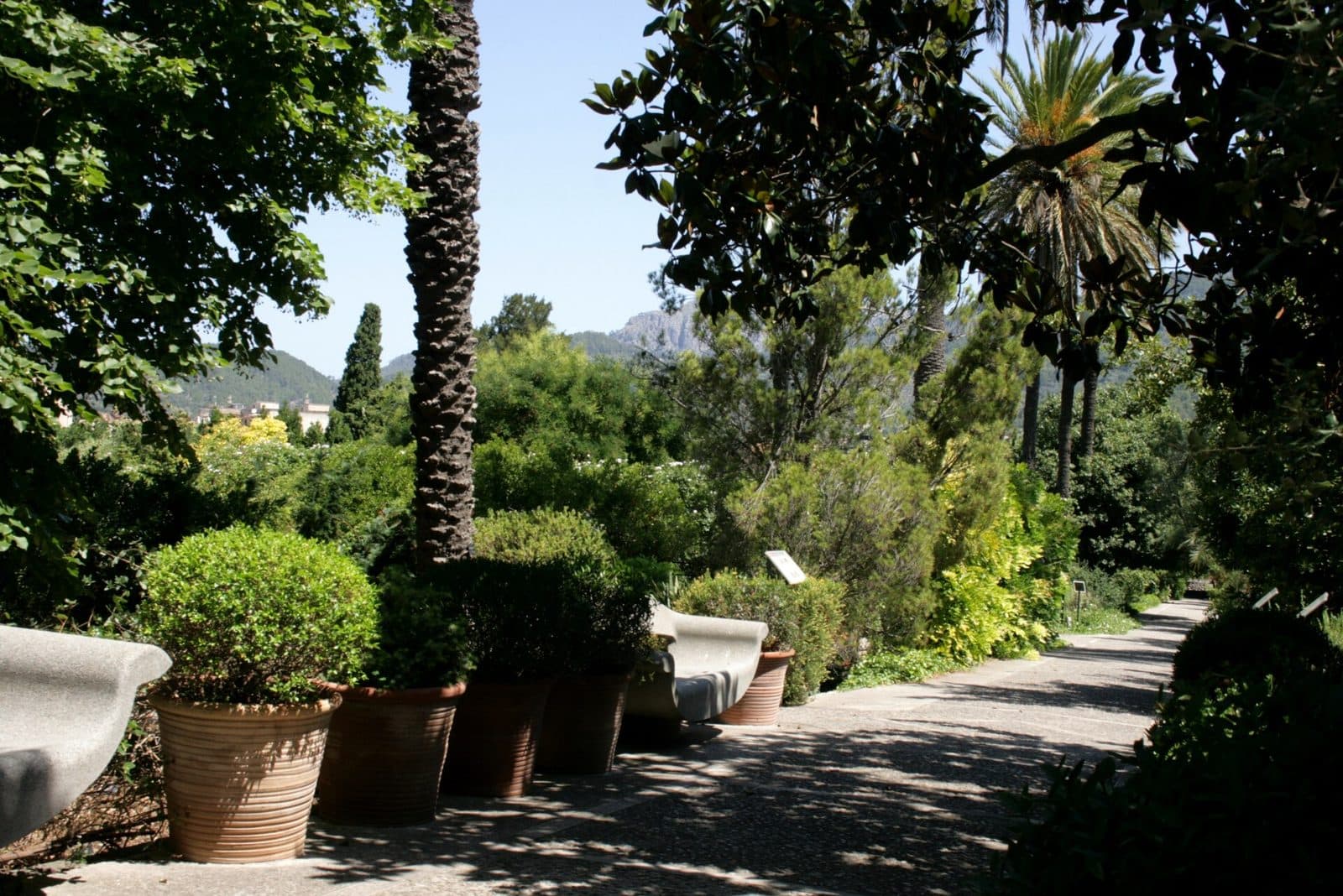

On the outskirts of Sóller, a journey through Mallorca begins without the need for hairpin bends or long stages. At the jardí botànic near L’Horta, mountain plants, coastal vegetation, wetland species, and traditional crops follow one another. Stone paths, beds, ponds, and water channels translate the landscapes of the Balearic Islands into a garden that can be explored on foot.
Anyone expecting a decorative park with lawns and a backdrop of exotic flowers will misunderstand the character of the place. The garden is first and foremost a scientific collection: plants are identified, documented, propagated, and preserved as part of a fragile natural heritage. That is precisely why the tour feels so closely connected to Mallorca. What visitors see is not just any Mediterranean garden, but a concentrated portrait of the island and its neighbors.
Nature enthusiasts can spend hours here exploring habitats and the subtle differences between related species. Families will find an accessible introduction to the island’s natural world, while hikers will recognize many plants they may previously have encountered in the Serra de Tramuntana. Even without prior botanical knowledge, the garden reveals itself through shapes, leaf structures, scents, and the transition between dry and wetter areas.
The complex also includes the natural history museum of the Balearic Islands. Its collections of geology, paleontology, and zoology broaden the perspective from living plants to the origins and development of the island environment. Together, the garden and museum explain why the Balearic Islands are biologically exceptional—and why protecting their species requires more than an attractive flower bed.
History and significance
The garden began not as a tourist beautification project, but as a response to the loss of rare plants. The Jardí Botànic de Sóller was founded in 1985 with the aim of researching and permanently preserving the flora of the Balearic Islands. Its location in the Sóller valley was particularly fitting: directly against the backdrop of the Serra de Tramuntana, an institution could be established whose subject remained far from abstract and was visible in the surrounding landscape itself.
From research project to visitor garden
During its early years, the work was primarily aimed at specialists in botany and nature conservation. A germplasm bank was established in 1989 to safeguard plant material capable of reproduction for the future. Such a collection is, in a sense, the garden’s memory: while the beds show the present condition of the plants, stored seeds can help researchers study, propagate, and, where necessary, reinforce endangered populations.
The garden has been open to the public since 1992. This transformed the research site into a place of learning as well. Visitors not only see individual rare species but also learn from the way the collection is arranged which habitats they belong to. Opening the garden to the public did not change its scientific purpose; it made that purpose easier to understand.
New collections and areas of work
The botanical perspective gradually expanded beyond Mallorca. A collection dedicated to the flora of the Canary Islands and Macaronesia was added in 1994. The greenhouse and shaded propagation area were completed in 1995. Some of the work that is barely noticeable in the public garden takes place there: plants are grown from seed, cared for under controlled conditions, and propagated for the scientific collections.
Between 1998 and 2003, additional areas were gradually opened to visitors, including collections of ornamental and medicinal plants and the flora of other Mediterranean islands. These expansions make comparisons possible: similar climatic conditions produce related adaptation strategies, yet islands also develop their own distinct forms and species.
The Botanical Institute
The Botanical Institute, opened in 2003, gave the work behind the scenes a dedicated center. It houses the herbarium, germplasm bank, and specialist library. A herbarium preserves dried and scientifically documented plant specimens; it is not a decorative plant album, but an archive that allows occurrences, characteristics, and changes to be traced over long periods.
Today, the institution combines four mutually supporting tasks: conservation, research, education, and public engagement. The garden therefore does more than show what grows in the Balearic Islands. It preserves material for future studies, teaches visitors how to recognize species, and demonstrates how easily island populations with restricted ranges can be endangered by landscape change or other pressures.
What to see
The paths themselves begin to explain the concept. The route leads over stone sections and past cultivated beds, ponds, and an interconnected irrigation system. The plants are arranged not simply by color or flowering season, but according to origin, habitat, and use. This makes the garden read like a greatly reduced landscape map.
Flora of the Balearic Islands
Wild plants from the Balearic Islands form the heart of the collection. The flora of the Balearic Islands takes center stage here, although some plants may appear inconspicuous at first glance. Their varied growth forms, however, reveal a great deal about the diversity of Mediterranean flora.
The collection helps visitors view plants as part of a wider context rather than in isolation. Species from mountain environments appear in a different setting from coastal plants or species from damp habitats. Anyone who has already hiked through the Tramuntana will recognize familiar forms; those who visit the garden first will notice more details in the wild afterward.
Mediterranean islands and Macaronesia
Other beds focus on plants from additional Mediterranean islands and on the flora of the Canary Islands and Macaronesia. These areas are especially revealing because island plants often evolve separately from one another over long periods. Similar environmental conditions may produce comparable leaf shapes, while botanical relationships and geographical histories can be entirely different.
The tour thus becomes a quiet comparative study. Instead of national borders, the focus is on adaptation, isolation, and diversity. Visitors do not need to memorize scientific names. It is enough to observe leaf surfaces, growth forms, and the ways plants cope with sun and drought.
Crops, medicinal plants, and ornamentals
Not everything in the garden comes from supposedly untouched wilderness. Collections of medicinal and ornamental plants show how closely the plant world is connected to cultural history; this area also includes fruit trees, vegetables, and other crops. This section broadens the idea of conservation, because what is preserved is not limited to rare wild species but also includes knowledge of plants cultivated for food, medicine, or decoration. Among the beds, visitors can trace how people select and propagate plants and pass them down through generations—and how biological diversity gives rise to cultural diversity.
Ponds, waterways, and irrigation
Ponds and stone water channels provide a clear contrast to the dry areas. Water is more than an atmospheric feature here. It makes it possible to represent damp habitats and illustrates how strongly even small differences in water availability can alter vegetation.
The irrigation system connects several parts of the garden. Visitors who look beyond the plants and follow the course of the water will recognize a second organizing principle across the grounds: the garden is structured not only by paths, but also by the controlled distribution of a resource that is precious on Mallorca.
Greenhouse and propagation areas
The greenhouse and shaded cultivation areas form part of the scientific infrastructure. They represent work that may look less spectacular than a flowering bed but is essential to the survival of a collection. Here, delicate young plants can be protected, rare species propagated, and different conditions controlled.
Not every working area is presented like a display garden. That is part of the experience: the Jardí Botànic is not a finished landscape composition, but an active institution where plants are grown, documented, and preserved for future purposes.
Museu Balear de Ciències Naturals
The adjoining natural history museum is housed in a building from the 19th century. Its exhibition includes minerals, rocks, fossils, and animals from Mallorca and the other Balearic Islands. After viewing the living outdoor collections, a museum visit leads deeper into the geological and biological history of the archipelago.
Fossils show earlier forms of life, rocks explain the material foundations of the landscape, and zoological objects place animals alongside their plant neighbors. This makes it clear that flora never exists in isolation. Soil, water, climate, animals, and human use collectively shape the habitats represented in miniature by the garden.
The Serra de Tramuntana as a backdrop
The mountain range remains visible above the collections. This proximity is more than a beautiful backdrop. Many of the garden’s ecological themes can be found directly in the Serra de Tramuntana: dry rocks, dramatic elevation changes, varying moisture levels, and small-scale refuges for specialized species.
The view from the beds to the mountains connects the collection with the landscape where its plants originate. This clearly distinguishes the site from a botanical garden where plants from unrelated regions of the world stand side by side without any evident connection. Here, Mallorca remains the unifying theme.
Visiting the Jardí Botànic
It is best to begin the tour without rushing. The most striking plants are not necessarily the rarest, and some of the most interesting differences only become visible at close range. Anyone looking only for large flowers will miss an essential part of the collection.
Touring the plant collections
It is difficult to recommend a single fixed length of stay. A quick overview takes considerably less time than a visit spent comparing habitats and looking for photographic details. Sufficient time should be allowed for both the garden and the museum; the two complement each other in content and should not be treated as unrelated items on an itinerary.
A good rhythm emerges by alternating between dry and wetter areas. After the Balearic wild plants, the crops and medicinal plants offer a more accessible contrast. The collections from other island regions then deepen the question of how climate and geographical isolation shape plants.
Flowering periods and seasons
April and May are considered especially appealing because many plants are in bloom. However, the garden remains informative outside the main flowering season. In a Mediterranean climate, seed heads, evergreen leaves, woody structures, and strategies for coping with drought are at least as characteristic as flowers.
In summer, light, heat, and water scarcity become more apparent. The differences between plants and growth forms then stand out especially clearly. The best season therefore depends on personal interests: spring offers more flowers, while drier periods sharpen the eye for survival strategies.
Opening hours
The Jardí Botànic is open Monday to Saturday from 10:00 to 18:00. As operational changes or special closure days are possible, checking the latest information before traveling is recommended.
For the quietest possible observation, it makes sense not to arrive just before the end of the visiting window. The value of the garden lies in looking slowly, not in quickly completing a circuit. Anyone who also wishes to visit the museum should allow a separate time buffer for it.
Getting there and parking
The drive to Sóller is already part of the landscape experience: from Palma, the route follows the Ma-11 into the valley enclosed by the Tramuntana. The garden is located near L’Horta on the edge of the urban area, not in the dense center. Navigation should therefore be set to the actual garden destination rather than simply to the place name Sóller.
From Palma Airport
The road distance from Palma Airport to L’Horta is 30 kilometers. The journey takes around 35 minutes, initially following the Ma-20 and then the Ma-11 toward Sóller. These details apply explicitly only as far as L’Horta.
From central Palma
The road distance from central Palma to L’Horta is 25 kilometers. The journey via the Ma-11 takes around 39 minutes. This travel time also ends in L’Horta and is not timed precisely to the garden gate.
Parking at the destination
Arrival should be planned using the garden’s current destination listing. This is especially important if the garden visit is combined with time in central Sóller and the vehicle is not intended to be moved again afterward.
Arriving by bus
Possible stops include Sóller centre 1, Sóller centre 2, Sóller sud 1, and Sóller sud 2. They are located within the urban area of Sóller, so the garden should not be mistaken for having a stop directly beside the beds. Before traveling, check which connection suits the chosen visiting time and how the final section from the relevant stop to the entrance runs.
Bus lines to jardí botànic at a glance
| Line | Route | Departures/day | First | Last |
|---|---|---|---|---|
| 204 | Port de Sóller - Palma | 304 | 00:28 | 23:37 |
| 232 | Port de Sóller - Fornalutx | 290 | 06:53 | 21:22 |
| 203 | Valldemossa / Deià | 203 | 06:08 | 23:07 |
| 231 | Port de Sóller - Alcúdia | 40 | 09:02 | 20:22 |
From the official GTFS feeds (TIB/SFM), no real-time data. The figures cover all stops in the town; weekend and holiday services differ — check with the operator before travelling.
Getting there by bus
Sóller centre 2 (61031) · 0.3 km as the crow flies
- 203Valldemossa / Deià · Daily
- 204Port de Sóller - Palma · Daily
- 231Port de Sóller - Alcúdia · Daily
- 232Port de Sóller - Fornalutx · Daily
Sóller centre 1 (61009) · 0.3 km as the crow flies
- 204Port de Sóller - Palma · Daily
Sóller sud 1 (61011) · 0.3 km as the crow flies
- 204Port de Sóller - Palma · Daily
Sóller sud 2 (61010) · 0.3 km as the crow flies
- 204Port de Sóller - Palma · Daily
Son Angelats 1 (61033) · 0.8 km as the crow flies
- 203Valldemossa / Deià · Daily
- 204Port de Sóller - Palma · Daily
- 231Port de Sóller - Alcúdia · Daily
- 232Port de Sóller - Fornalutx · Daily
Son Angelats 2 (61032) · 0.8 km as the crow flies
- 203Valldemossa / Deià · Daily
- 204Port de Sóller - Palma · Daily
- 231Port de Sóller - Alcúdia · Daily
- 232Port de Sóller - Fornalutx · Daily
Sóller nord 2 (61005) · 1.4 km as the crow flies
- 203Valldemossa / Deià · Daily
- 204Port de Sóller - Palma · Daily
- 231Port de Sóller - Alcúdia · Daily
- 232Port de Sóller - Fornalutx · Daily
Sóller nord 1 (61004) · 1.4 km as the crow flies
- 203Valldemossa / Deià · Daily
- 204Port de Sóller - Palma · Daily
- 231Port de Sóller - Alcúdia · Daily
- 232Port de Sóller - Fornalutx · Daily
Timetable data: official GTFS feeds (TIB/EMT), no real-time — check with the operator before travelling.
Nearby places to visit
L’Horta forms the quieter transition between Sóller and the cultivated landscape of the valley. Orchards and agricultural land are as much a part of the scenery here as the steep mountain slopes all around. After the botanical tour in particular, it becomes clear how closely wild flora, agriculture, water management, and the valley’s settlement history are interconnected.
Sóller
Central Sóller combines well with a visit to the garden, and the thematic connection is equally close. Those who visit the garden first will later recognize familiar features in the valley’s gardens and fruit-growing areas. In the reverse order, the Jardí Botànic provides explanations for plant forms, irrigation, and the distinctive conditions between the mountains and coast.
Port de Sóller
Port de Sóller adds the coastal side of the region. This combination is especially suitable for visitors who want to experience different landscapes in one day: the sheltered valley, the scientifically organized plant world, and finally the maritime surroundings. An extensive additional itinerary is unnecessary; the change of perspective alone makes Sóller’s geographical setting easier to understand.
Serra de Tramuntana
Hikes or viewpoints in the Serra de Tramuntana deepen the garden’s themes. Outdoors, the plants appear not in ordered collections but as parts of natural communities. Anyone who has previously paid attention to leaf shapes and habitat requirements in the Jardí Botànic will look more closely at scrubland, rock vegetation, and shadier mountain areas.
For a single day, however, the combination should remain manageable. The garden and museum reward close attention; a large sightseeing circuit immediately afterward would tend to overshadow their calm character. Combining the visit with Sóller itself or with one carefully selected section of the nearby landscape is especially fitting.
The place it belongs to
L'Horta in the place guidePractical visitor information
The paths lead through different garden areas and over stone sections. Comfortable shoes with a good grip are therefore more suitable than delicate city footwear. Even those who are not planning a long hike will be moving through botanical grounds rather than exclusively across level museum floors. Many of the collections are naturally located outdoors.
Visiting with children
The garden is suitable for children when the tour is presented as a journey of discovery. Differences between large and small leaves, dry and damp beds, or wild plants and crops can be recognized without specialist language. The site is also suitable as a learning destination for school groups, demonstrating how effectively nature observation and scientific education can be combined here.
Children should not, however, expect a play park, as the collections serve to preserve delicate plants.
Protecting the collections
Dogs are not permitted in order to protect the garden’s sensitive areas. Visitors should also not expect a traditional pleasure garden or an uninterrupted floral display. Some beds are intentionally natural in appearance, while others show plants in seasonal dormant phases. The appeal lies in their ecological meaning and the diversity of adaptations—not in every corner blooming colorfully at every time of year.
Local insider tips
Look at leaves, not just flowers
The most fascinating adaptations are often visible in small, tough, or hairy leaves. Comparing these characteristics among mountain, coastal, and dry-habitat plants provides a better understanding of the garden than simply searching for flowers.
Follow the water
Ponds, stone channels, and the interconnected irrigation system form a second route through the garden. Their course illustrates especially clearly how strongly a change in water availability can alter the vegetation.
Visit in spring for more flowers
April and May are considered especially rewarding for observing flowers. Outside this period, seed heads, leaf structures, and the drought adaptations of Mediterranean species are equally worthwhile.
Do not skip the museum
After the living collections, the minerals, rocks, fossils, and animals in the natural history museum explain the geological foundation and development of the island environment. This provides a more complete picture of the Balearic Islands.
Look from the beds to the mountains
While exploring the collections, it is worth looking toward the Serra de Tramuntana. Many of the habitat conditions explained in the garden—rock, drought, wind, and localized moisture—can be seen there directly.