
Palma Aquarium: Mallorca’s Great Underwater World

Only a pane of glass separates visitors from rays, sea turtles and sharks that seem to glide weightlessly through deep-blue water. Palma Aquarium near Can Pastilla is far more than a sequence of illuminated fish tanks: the route combines the underwater world of the Mediterranean with tropical reefs, extensive gardens, an immersive jungle and modern experience areas.
More than 8.000 marine animals live in the habitats. The shifts in scale are particularly impressive. One moment, your gaze searches among rocks for small Mediterranean creatures; shortly afterwards, Big Blue opens up into an immense body of water where sharks circle through the depths. Between them, living corals glow, jellyfish drift almost weightlessly through the water and tropical fish move through densely populated reef worlds.
The aquarium is especially worthwhile for families, marine-life enthusiasts and anyone who wants to spend an extended visit exploring accessible natural history. It is also an obvious destination in changeable weather, although parts of the route pass through open garden areas. Anyone expecting only a quick look at a few fish underestimates the attraction: its strength lies in the carefully constructed journey from Mallorca’s coasts to the tropical oceans.
History and significance
When Palma Aquarium opened in 2007, what emerged at Playa de Palma was not a traditional zoological display collection but a complex of aquariums, garden landscapes and educational areas. The architect Bartolomé Blanch Carrió was responsible for the design. Even the exterior was intended to stand apart from an ordinary exhibition hall: curved structures and a colourful, ventilated glass façade give the building a flowing form that evokes movement in water rather than rectangular functional architecture.
An aquarium as an ecosystem
The 55 tanks were created as distinct marine habitats. Together, they contain around 5 million litres of water and display more than 700 species from the Mediterranean, Atlantic, Indian Ocean and Pacific. From the outset, the concept therefore went beyond simply presenting striking animals. Corals, plants, rock formations and smaller organisms form part of the recreated communities and explain how closely the inhabitants of a marine environment depend on one another.
This idea still shapes the route today. It does not begin with the largest animals, but with the sea immediately off Mallorca. Only afterwards does the perspective widen to include tropical reefs and the open ocean. This creates a clear transition from the familiar to the unfamiliar—and at the same time serves as a reminder that the Balearic Sea is also a fragile habitat.
Conservation, research and education
Alongside its visitor operations, the aquarium pursues goals in marine conservation and environmental education. A particular focus is placed on corals and the question of how damaged reef systems can be preserved or restored. School visits, educational programmes and presentations are intended not only to teach visitors about species but also to make the vulnerability of marine ecosystems visible.
The project was recognised as an entrepreneurial initiative in the Balearic Islands during its opening year. More significant than such awards, however, is the combination of a visitor attraction with a commitment to conservation. Anyone who looks closely at the living corals is not seeing mere decoration: the colonies are animals themselves and form the foundation of entire communities. It is in precisely such moments that Palma Aquarium fulfils its educational role most convincingly.
What to see
The route thrives on contrasts. Bright Mediterranean water gives way to the intense colours of tropical reefs, indoor spaces open onto Mediterranean gardens, and small, richly detailed tanks are followed by the immense depth of Big Blue. The individual areas are organised thematically and can be experienced like consecutive chapters.
Mediterranean
The journey begins with the Balearic Sea. The tanks show the rocky coastal and underwater landscapes surrounding Mallorca and draw attention to animals that often go unnoticed while swimming. Fish and other inhabitants of the western Mediterranean move among rocks, sandy areas and aquatic plants. Large specimens alternate with species that only emerge from their surroundings when observed closely.
This opening section is deliberately more restrained than the tropical worlds that follow. Instead of vivid colours, muted stone and blue tones dominate the scene. That is precisely why it is worth resisting the urge to move on too quickly. The smaller structures reveal just how diverse the sea off Mallorca’s coast is.
Tropical seas
The colour palette changes abruptly in the tropical tanks. Corals form branching, compact or fan-like structures, while schools of luminous fish move between them. Along the route, 275 different coral species are displayed. Palma Aquarium therefore holds an exceptionally extensive collection of living corals in Europe.
The crucial difference from artificially decorated reef tanks lies in the living nature of the landscape. Corals grow, respond to their surroundings and provide shelter for other animals. From a distance, some look like plants or mineral formations; only up close do their delicate polyps become visible. Visitors who take their time at the quieter tanks will discover numerous tiny movements within the reef structures alongside the more conspicuous fish.
Mediterranean gardens
After the darkened aquarium rooms, the route leads outdoors. The Mediterranean gardens reflect the island’s vegetation and atmosphere, creating a deliberate pause between the underwater areas. Plants adapted to the sun, dry conditions and climate of the Balearic Islands grow across an area of 12.000 square metres.
The change is more than a design interlude. After the tanks’ subdued lighting, colours, warmth and wind become distinctly noticeable. At the same time, the garden makes clear that the aquarium was conceived as a larger experience park. Depending on the weather, this section becomes either a sunny place to rest or a quicker transition to the next indoor area.
Jungle
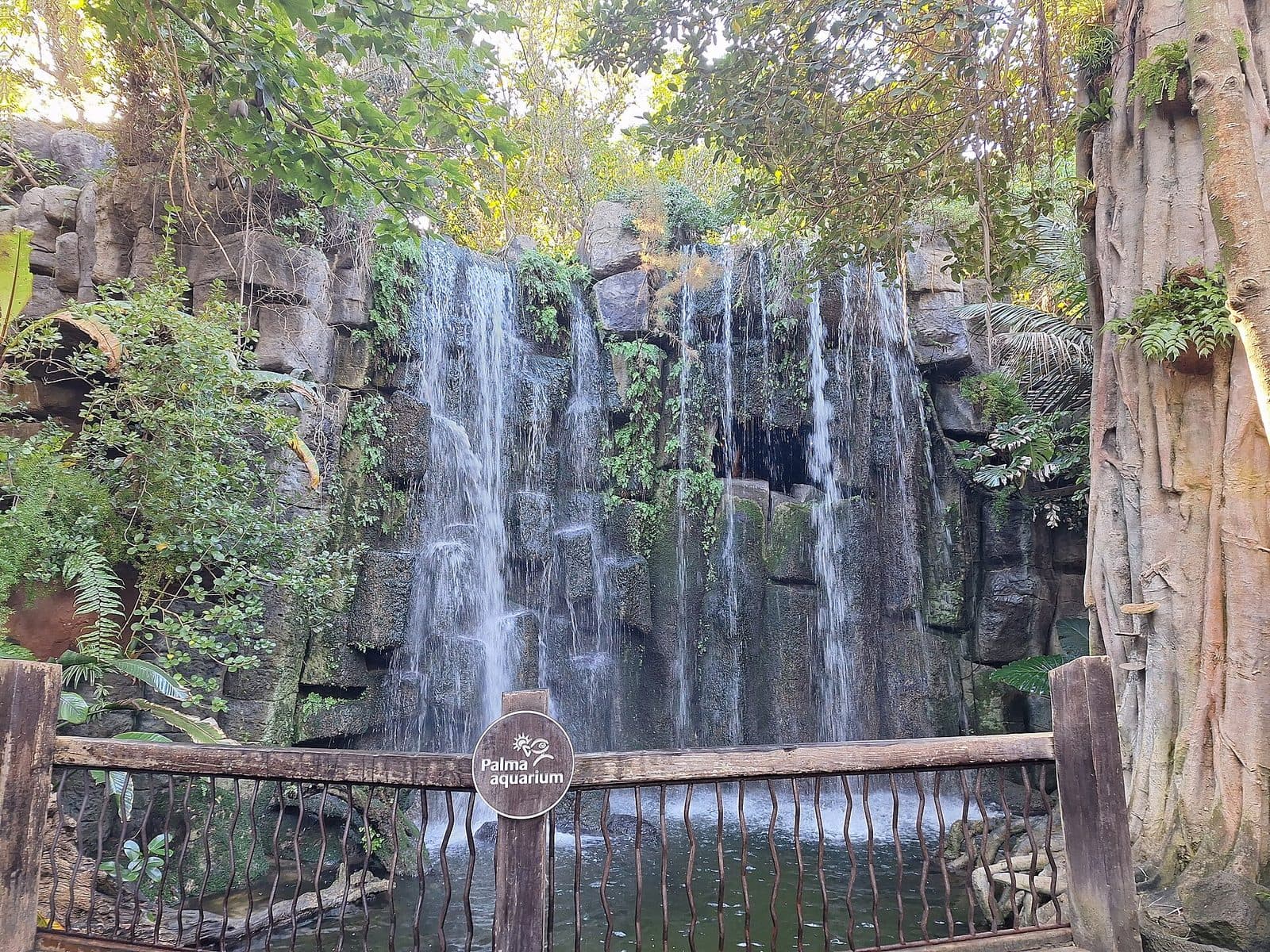
The jungle area intensifies the vegetation and leads into an immersive tropical landscape. A 7-metre-high cascade forms its most striking focal point. Humidity, the sound of water and dense greenery create a powerful contrast with the drier Mallorcan garden world that precedes it.
The setting is not intended to replace a walk through a botanical garden, but to convey the environment of tropical forests through the senses. Shade, water and lush plants define the space. For children, this section is often a welcome change because the route feels less like a traditional exhibition here and more like a landscape that can be explored on foot.
Big Blue
The light then darkens again, and the dimensions expand. Big Blue is the centrepiece of Palma Aquarium: an 8,5-metre-deep shark tank where 10 sharks live alongside around 1.000 other animals. The great column of water prevents the inhabitants from appearing like exhibits. Sharks first emerge in the distance, calmly turn away and only later glide close past the viewing panels.
The view through the acrylic tunnel at the bottom of the tank is particularly immersive. Shadows pass overhead while fish occupy different levels of the water. The depth creates a spatial effect that smaller display tanks cannot achieve: the eye becomes lost in the blue, and even large animals can disappear for a moment behind a school of fish or into the tank’s darker zone.
Anyone who rushes through Big Blue misses an essential part of the experience. It is worth choosing a fixed position at one of the large viewing areas because the scene changes constantly. At one moment, a shark passing close by dominates the view; at another, the interaction of the many smaller fish comes into focus. The power of this space lies not in one spectacular movement, but in the calm, sustained act of observation.
Jellyfish
In the jellyfish area, the surroundings recede almost completely. The animals drift in front of illuminated backgrounds, contracting their bells and trailing their tentacles through the water. Because jellyfish consist of 95 percent water, their bodies appear both clearly defined and almost transparent.
The room directs attention towards rhythm and movement. Unlike fast-moving schools of fish, the scene changes slowly. This makes the area a tranquil counterpoint to Big Blue. It also becomes clear that jellyfish are not an unusual fringe phenomenon in the oceans: 2.000 species are known worldwide, and their evolutionary history stretches back 600 million years.
Whales
The whale world is designed as an immersive experience. It extends the route beyond what can be displayed in an aquarium tank, as the dimensions and migrations of large whales can only be conveyed through media. Images, sound and spatial staging focus attention on animals whose habitat is the open ocean.
The emphasis is less on a single exhibit than on scale and distance. Humpback whales travel 5.000 kilometres on their annual migrations. Such ranges of movement stand in clear contrast to the closely observable micro-worlds of the coral tanks and complete the journey from coastal habitat to open sea.
Visiting Palma Aquarium
The most enjoyable route begins slowly. Visitors who only glance briefly at each tank in the first rooms may reach the sharks quickly, but they lose the narrative structure. It makes more sense to follow the path from the Mediterranean through the tropical reefs and gardens to Big Blue. In this way, the colours and dimensions grow step by step instead of allowing the highlight to overshadow every preceding area.
Time needed for the route
How much time the route requires depends on how long visitors remain at the individual tanks and whether they make extensive use of the garden and experience areas. Anyone who only wants to see the main stations will move through more quickly, but the coral worlds and Big Blue in particular benefit from calm observation.
The route alternates between indoor and outdoor areas. This is important when planning the day: Palma Aquarium is not a completely enclosed bad-weather attraction. Most of the animal tanks are sheltered inside the building, but the Mediterranean gardens and parts of the connecting paths deliberately bring light, air and vegetation into the visit.
Crowds and time of day
The viewing windows usually feel quietest early in the visiting day, before the larger influx of families begins. Anyone who primarily wants to experience Big Blue and the tunnel without dense groups should arrive as close as possible to the start of the respective visiting day. Before midday, there is often more room to change position or remain in front of a viewing panel for longer.
On rainy days and during school holidays, the aquarium is particularly popular as a weather-protected family destination. It is then advisable to allow more time for admission and heavily visited areas. Crowds can sometimes be avoided by letting one group move ahead and returning later to a favourite tank, provided the current route permits this.
Programme and additional experiences
Alongside the permanent habitats, there are presentations and additional experiences whose availability may change. Anyone wishing to take part should check the current daily programme before starting the route and plan accordingly. The same applies to opening hours and admission: both may change for seasonal or organisational reasons and should be checked before visiting.
A first visit does not necessarily require every additional experience. The regular habitats, living corals, garden and Big Blue already form an extensive route. Additional experiences are especially worthwhile when the visit is intended to focus on a particular subject, such as sharks or whales.
Getting there and parking
The location near Can Pastilla makes Palma Aquarium one of the easiest excursion destinations to reach in the greater Palma area. It stands at the western end of Playa de Palma, close to the coast and only a short drive from the airport. The broader journey initially leads to Can Pastilla.
From central Palma
The road distance from central Palma to Can Pastilla is 11 kilometres. The drive takes around 20 minutes and follows the Ma-19 towards the airport and Playa de Palma. From the motorway, the route then continues through the local road network of Can Pastilla. As the stated driving time is measured only as far as Can Pastilla, an additional buffer should be allowed for leaving the motorway, navigating the local streets and reaching the entrance.
The route is short enough to plan the aquarium as a half-day trip from Palma. At the same time, it lies outside the historic city centre, so the visit should not be treated as a casual detour between the cathedral and the old town. Anyone combining both destinations in one day should divide the itinerary into a city section and an aquarium section.
From Palma Airport
The road distance from Palma Airport to Can Pastilla is 5 kilometres; the drive takes around 9 minutes. This figure also ends in Can Pastilla rather than directly at the aquarium entrance. The final stretch passes through the coastal district towards Playa de Palma.
Its proximity to the airport makes the aquarium potentially suitable for a visit on an arrival or departure day. However, enough time should be reserved for luggage, vehicle collection and the onward journey. A complete tour is therefore not a brief way to fill time between two appointments.
By bus
Several stops called Àrea d’intercanvi Aquarium or Aquàrium are located in the immediate vicinity. Other services stop at ses Fontanelles. This makes the attraction accessible without a hire car from Palma and the coastal resorts along Playa de Palma. The best route depends on the departure point and current timetable; the key search terms are the stop names Aquarium or Aquàrium.
Bus lines to Palma Aquarium at a glance
| Line | Route | Departures/day | First | Last |
|---|---|---|---|---|
| 25 | s'Arenal - Pl. Reina | Catedral | 8 | 09:31 | 12:22 |
| 35 | Aquàrium - Pl. Reina | Catedral | 7 | 08:10 | 14:26 |
| A2 | Aeroport - S'Arenal | 4 | 07:23 | 08:52 |
| 23 | s'Arenal / Parc Aquàtic - Pl. Espanya | 3 | 09:18 | 13:01 |
From the official GTFS feeds (TIB/SFM), no real-time data. The figures cover all stops in the town; weekend and holiday services differ — check with the operator before travelling.
Getting there by bus
1353-Àrea d'intercanvi Aquarium · 1.0 km as the crow flies
- A2Aeroport - S'Arenal · 08:00–08:00 · Daily
477-ses Fontanelles · 1.0 km as the crow flies
- 23s'Arenal / Parc Aquàtic - Pl. Espanya · 06:27–21:50 · Daily
- 25s'Arenal - Pl. Reina | Catedral · 06:36–21:01 · Daily
- 31Sant Jordi - Sindicat · 08:00–08:00 · Daily
- 32s'Arenal - Sindicat · 08:00–08:00 · Daily
- 35Aquàrium - Pl. Reina | Catedral · 06:21–22:41 · Daily
- A2Aeroport - S'Arenal · 08:00–08:00 · Daily
1356-Àrea d'intercanvi Aquàrium · 1.0 km as the crow flies
- 23s'Arenal / Parc Aquàtic - Pl. Espanya · 06:27–21:50 · Daily
- 25s'Arenal - Pl. Reina | Catedral · 06:36–21:01 · Daily
- 31Sant Jordi - Sindicat · 08:00–08:00 · Daily
- 32s'Arenal - Sindicat · 08:00–08:00 · Daily
1189-Àrea d'intercanvi Aquarium · 1.0 km as the crow flies
- 23s'Arenal / Parc Aquàtic - Pl. Espanya · 06:27–21:50 · Daily
- 25s'Arenal - Pl. Reina | Catedral · 06:36–21:01 · Daily
- 31Sant Jordi - Sindicat · 08:00–08:00 · Daily
- 32s'Arenal - Sindicat · 08:00–08:00 · Daily
475-Can Pastilla - Racó de Can Ripoll · 1.0 km as the crow flies
- 31Sant Jordi - Sindicat · 08:00–08:00 · Daily
- 32s'Arenal - Sindicat · 08:00–08:00 · Daily
- 35Aquàrium - Pl. Reina | Catedral · 06:21–22:41 · Daily
- A2Aeroport - S'Arenal · 08:00–08:00 · Daily
1192-ses Fontanelles · 1.0 km as the crow flies
- A2Aeroport - S'Arenal · 08:00–08:00 · Daily
432-ses Fontanelles · 1.0 km as the crow flies
- 23s'Arenal / Parc Aquàtic - Pl. Espanya · 06:27–21:50 · Daily
- 25s'Arenal - Pl. Reina | Catedral · 06:36–21:01 · Daily
- 31Sant Jordi - Sindicat · 08:00–08:00 · Daily
- 32s'Arenal - Sindicat · 08:00–08:00 · Daily
- 35Aquàrium - Pl. Reina | Catedral · 06:21–22:41 · Daily
384-Àrea d'intercanvi Aquarium · 1.0 km as the crow flies
- 35Aquàrium - Pl. Reina | Catedral · 06:21–22:41 · Daily
- A2Aeroport - S'Arenal · 08:00–08:00 · Daily
366-Àrea d'intercanvi Aquarium · 1.0 km as the crow flies
- 35Aquàrium - Pl. Reina | Catedral · 06:21–22:41 · Daily
476-Can Pastilla - ses Fontanelles · 1.0 km as the crow flies
- 23s'Arenal / Parc Aquàtic - Pl. Espanya · 06:27–21:50 · Daily
- 25s'Arenal - Pl. Reina | Catedral · 06:36–21:01 · Daily
- 31Sant Jordi - Sindicat · 08:00–08:00 · Daily
- 32s'Arenal - Sindicat · 08:00–08:00 · Daily
- 35Aquàrium - Pl. Reina | Catedral · 06:21–22:41 · Daily
- A2Aeroport - S'Arenal · 08:00–08:00 · Daily
1190-Can Pastilla - ses Fontanelles · 1.1 km as the crow flies
- A2Aeroport - S'Arenal · 08:00–08:00 · Daily
433-Can Pastilla - ses Fontanelles · 1.1 km as the crow flies
- 23s'Arenal / Parc Aquàtic - Pl. Espanya · 06:27–21:50 · Daily
- 25s'Arenal - Pl. Reina | Catedral · 06:36–21:01 · Daily
- 31Sant Jordi - Sindicat · 08:00–08:00 · Daily
- 32s'Arenal - Sindicat · 08:00–08:00 · Daily
- 35Aquàrium - Pl. Reina | Catedral · 06:21–22:41 · Daily
Timetable data: official GTFS feeds (TIB/EMT), no real-time — check with the operator before travelling.
Nearby attractions
After the subdued light of the tanks, the contrast is especially clear: outside, coastal air, the promenade and the bright beach of Can Pastilla await. The aquarium is located at the western end of Playa de Palma and can therefore easily be combined with a seaside walk. No separate transfer to another distant attraction is required.
Can Pastilla
Can Pastilla is a coastal district between Palma and the airport. Its location explains why the aquarium can be reached quickly both from the capital and from the holiday resorts along Playa de Palma. Beach, promenade, hotels and restaurants define the coastal area; unlike Palma’s old town, the focus here is less on historical monuments and more on life beside the bay.
The combination is particularly straightforward for families. The aquarium provides the main structured activity, leaving time afterwards for the beach and outdoor exercise. Alternatively, an early walk along the coast can precede the visit before entering the darkened exhibition rooms.
Playa de Palma
Playa de Palma stretches along the large bay east of the island capital. From the aquarium, the beach is only a few minutes away on foot; one source gives a distance of around 500 metres. This makes the connection between the underwater world and the real Mediterranean particularly natural: first, the tanks show which animals and habitats exist beneath the surface, and afterwards the view opens across that same sea.
A beach visit after the aquarium should nevertheless be planned as a separate part of the day. Anyone who also wants to swim, eat or spend longer on the promenade can easily turn it into a full day out in Can Pastilla.
Palma
Palma can also be combined with the aquarium, provided the day is not scheduled too tightly. The old town, with its cathedral, harbour and historic lanes, offers a completely different focus from the modern marine attraction. A clear order is practical: either visit the aquarium first and spend the evening in Palma, or explore the city in the morning and then take a deliberately limited aquarium tour.
Fully enjoying both activities requires time. Anyone who does not want to rush past the corals, gardens and sharks should avoid squeezing the aquarium between several major city sights. Its proximity to Palma makes it easy to reach, but not small.
The place it belongs to
Can Pastilla in the place guidePractical visitor information
Many visitors remain in front of Big Blue longer than planned. The day’s itinerary should allow room for exactly that. The attraction is not best experienced by completing the fastest possible circuit, but through repeated observation: a shark that initially disappears far into the blue may glide directly past the viewing panel a little later.
Clothing and footwear
Comfortable shoes are advisable because the route includes indoor spaces, garden paths and connecting areas. Clothing for the outdoor sections should suit the day’s weather. On sunny days, a hat and sun protection are useful in the Mediterranean gardens; in rain, remember that the entire route does not run through enclosed halls.
The perceived temperature can change along the way. Subdued aquarium rooms, open garden sections and the more humid jungle setting follow one another. Light clothing that can be adjusted is therefore more practical than an outfit chosen only for air-conditioned indoor spaces.
Visiting with children
Children are not presented with a purely text-heavy natural-history exhibition. Large viewing windows, the acrylic tunnel, moving schools of fish, the jungle cascade and the open garden areas regularly provide new impressions. This is particularly helpful when attention for smaller tanks begins to fade.
Even so, it is worth resisting the urge to head only for the sharks. The Mediterranean area is well suited to explaining camouflage and habitats, while the tropical tanks appeal through their colours and forms. Small observation tasks—such as finding a ray, a sea turtle or especially well-camouflaged animals—make the quieter sections more engaging.
Photography at the tanks
The strongest images are rarely captured while moving quickly onwards. In dark rooms, standing still is more important than frantically tracking the animals. Consideration for other visitors remains essential, especially at narrower viewing points and inside the tunnel.
With jellyfish and corals, it is worth focusing on details, while Big Blue benefits from a wider frame. The animals determine the moment; a shark cannot be directed to a particular spot. Patience therefore usually produces better pictures than blocking a viewing window.
What Palma Aquarium is not
Palma Aquarium is neither a brief display room nor a fully covered indoor attraction. Anyone who only wants to see Big Blue and leave immediately misses a large part of the concept. The route through the Mediterranean, tropics, gardens, jungle and open-ocean world is designed as one continuous journey.
Nor does the attraction replace a day by the sea or a natural-history excursion in the wild. It offers controlled, exceptionally close views of animals and ecosystems that remain hidden during an ordinary beach visit. The experience is therefore most convincing when the aquarium and the coast are understood not as competitors, but as two different perspectives on Mallorca’s location in the Mediterranean.
Local insider tips
See Big Blue early
Before the larger influx of families, the tunnel and viewing windows feel quieter. Visitors who arrive as close as possible to the start of the visiting day can remain at one position for longer and watch the sharks without dense groups.
Do not overlook the corals
Among the striking tropical fish, it is worth examining the living reef structures. Along the route, 275 coral species are displayed; up close, delicate polyps and small inhabitants become visible.
Visit the real sea afterwards
Playa de Palma is only a few minutes away on foot. After the Mediterranean area, a coastal walk provides a fitting conclusion: the explained underwater world becomes the open bay off Can Pastilla once again.
Wait by the viewing panel
For photos in Big Blue, choose a fixed position instead of following the sharks through the tunnel. The animals repeatedly pass the viewing areas; holding the camera close to the glass reduces distracting reflections.