
Parròquia de Santa Eugènia – Village Church in Mallorca
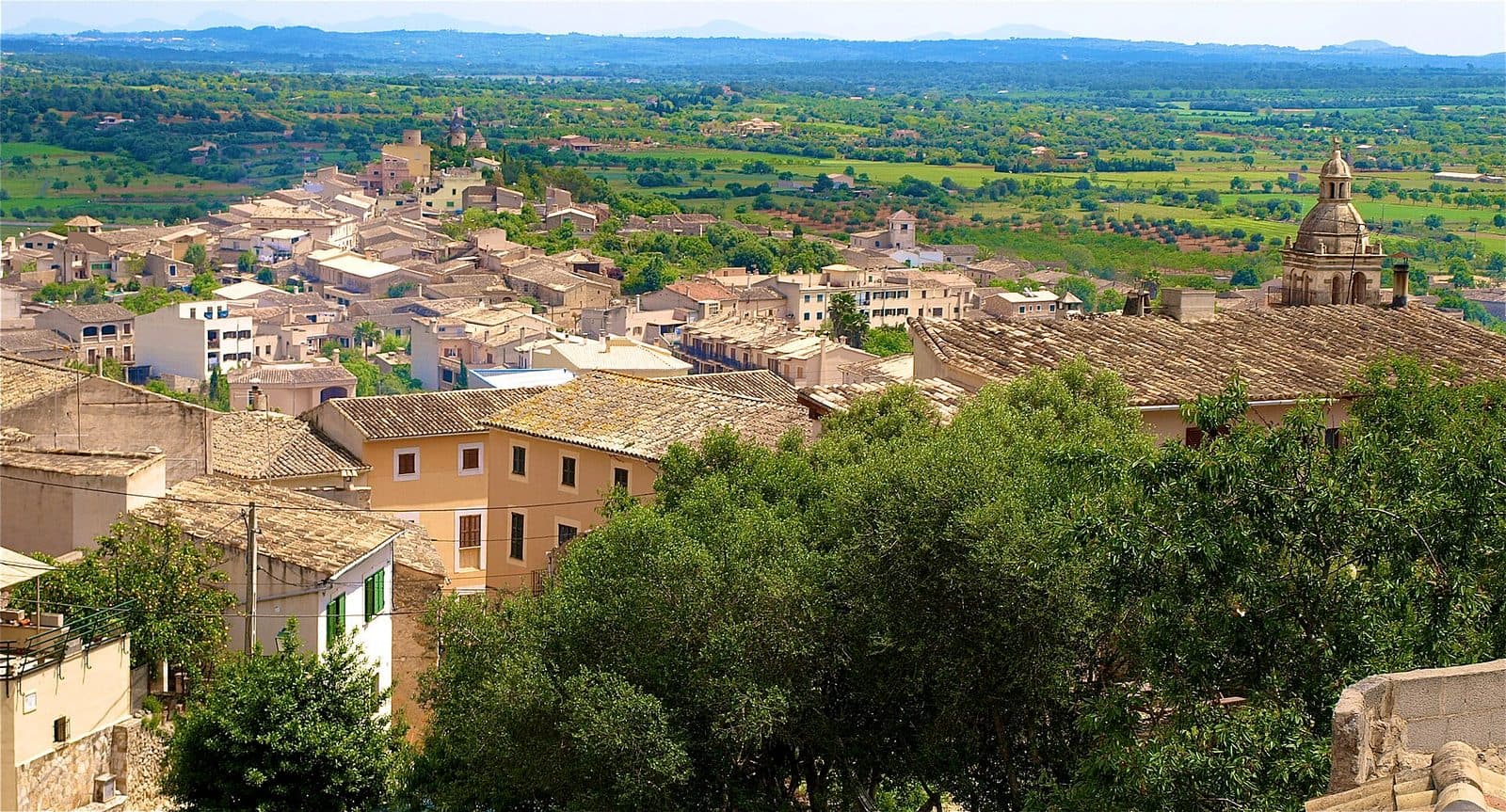

Parròquia de Santa Eugènia stands where one might almost expect to find a village church in Mallorca: at the highest point of the village, visible as its spiritual and architectural center. Its present appearance, however, does not stem from a single building concept, as the chapel, bell tower, and transept were added in different stages and reveal how the village grew and developed its ecclesiastical independence.
A visit is especially worthwhile for travelers who want to experience rural Mallorca as more than just scenery. The church combines local history, religious tradition, and several clearly documented construction phases. Particularly noteworthy is a small reclining figure of the Virgin Mary from the 19th century, associated with the local veneration of the Assumption of Mary.
The Parròquia remains an active village church, and that is precisely part of its appeal. Anyone already exploring Santa Eugènia will find a quiet historical landmark here; those interested in Mallorcan religious architecture can see in a single building how an initially smaller place of worship was expanded over generations.
History and significance
The desire for a church of their own
The story begins not with a prince or a grand representative project, but with a demand from the village. In 1523, the residents of Santa Eugènia approached the bishop at the time, Joan Vich i Manrique. They no longer wanted to travel to the larger Santa Maria del Camí to attend church, but wished to have their own place of worship. Behind this request stood a growing community and the village’s increasing prosperity.
The bishop granted their request, allowing construction of Santa Eugènia’s first proper church to begin. This origin story forms an important part of its significance: the building expressed the determination of a village that confidently articulated its own religious needs. The church therefore became not only a place of worship but also a visible symbol of local independence.
The place name reaches further back. Santa Eugènia developed on the grounds of a medieval estate associated with Bernat de Santa Eugènia. The parish church therefore did not emerge in a place without history, but in a settlement whose roots extend into the medieval agricultural landscape of the Pla de Mallorca.
The major expansion
The place of worship built in 1523 did not remain unchanged. It was enlarged between 1699 and 1716, and the church visible today largely dates from this phase of expansion. Rather than being completely rebuilt, the earlier religious building was extended. This development is typical of a village whose congregation needed more space without abandoning its established ecclesiastical center.
For this reason in particular, the Parròquia should not be seen as the work of a single year. Its historical value also lies in its layers: the core recalls the residents’ demand in the early 16th century, while later additions reflect the village’s growth and changing liturgical needs.
Changes in the 19th century
Santa Eugènia experienced significant population growth in the 19th century. During the same period, the church received several defining additions: construction of the Puríssima Chapel began in 1839, the bell tower followed in 1850, and work on the transept started in 1863. This sequence explains why individual parts of the building belong to different periods.
The small reclining figure of the Virgin Mary inside also dates from the 19th century. Its addition to the church’s collection is associated with the consolidation of the village and the congregation’s growing religious needs. To this day, it serves as a reminder that the church’s history consists not only of masonry, but also of liturgy, devotion, and recurring festivals.
A living parish church
Parròquia de Santa Eugènia remains the village’s church, so its historic architecture cannot be separated from its religious use. The building preserves the memory of the struggle for a church of their own, but it is not merely a monument to that past.
This continuity is especially evident in the local veneration of the Assumption of Mary. A surviving chronicle reports that Santa Eugènia honored this mystery each year with solemn services. The church therefore remains the place where architectural history and living tradition continue to meet in the present day.
What to see
The setting above the village
Even the walk to the church contributes to understanding the building. The Parròquia stands at the highest point of Santa Eugènia and thus dominates the historic village center. It was not placed on the outskirts, but occupies a prominent position above the village’s streets and houses. As you approach, the close relationship between church and settlement becomes visible.
This location makes the building a useful landmark in the village and also recalls its original role: the church was intended to provide the community of Santa Eugènia with a center of its own, after attending church had previously required the journey to Santa Maria del Camí. The elevated location still translates that ambition into the village landscape today.
Main structure and expansion phases
The present church is the result of a long development. The older building was enlarged between 1699 and 1716. Anyone standing outside or looking around the interior is therefore not seeing the church of 1523 preserved unchanged, but a religious building adapted to the needs of later generations.
For a visit, this context is more useful than searching for one uniform style, because the building tells its story in stages. The main structure reflects the major expansion at the transition from the 17th to the 18th century; the chapel, bell tower, and transept mark the changes of the 19th century. Together, they form a parish church that evolved over time.
The Puríssima Chapel
The Puríssima Chapel, whose construction began in 1839, is one of the clearly documented additions. During a tour, it is therefore worth seeing the chapel as more than just a side room. It belongs to the expansion phase in which Santa Eugènia was growing and new religious needs emerged. Its construction came at the beginning of a series of changes that substantially shaped the church’s appearance in the 19th century.
The bell tower
The bell tower built in 1850 is the most visible external element of this later construction phase. It gave the church a striking vertical landmark above the village. Its position is especially easy to understand when viewing the Parròquia from the village streets: the tower forms part not only of the church’s architecture but also of the silhouette of Santa Eugènia.
Historically, it followed the Puríssima Chapel and preceded the construction of the transept. This sequence shows that the expansion did not take place all at once, but that different sections were added over the course of several decades.
The transept
The transept was added from 1863 onward. It altered the floor plan and extended the space across the church’s main axis. For visitors, this part of the building is a particularly clear indication that the interior does not date entirely from the early foundation period.
The transept represents the final one of the documented major expansions of the 19th century. Together with the chapel and bell tower, it can be read as an architectural response to the development of Santa Eugènia. The congregation added new spaces and architectural accents to the existing church rather than erasing its history through complete replacement.
The reclining Virgin Mary
The most unusual item inside the church is a small reclining figure of the Virgin Mary from the 19th century. It represents Mary in connection with her Assumption and belongs to a religious tradition found across Mallorca. The figure was created as a devotional image intended to be dressed: garments form an essential part of its appearance, while the visible parts of the body were probably made from a soft, painted material.
Its small size is striking. Comparable dimensions are often found in enclosed convents, but the figure in Santa Eugènia belongs to the parish church’s collection. A historical ceremonial bed used to display it during the August festivities has not survived. As a result, attention today focuses more closely on the devotional image itself and the religious tradition it represents.
Anyone able to see the figure should note the difference between a sculpture carved entirely from wood and an image intended to be dressed. In the latter, the effect arises from the interplay of modeled and painted sections, textiles, and liturgical presentation. It is less an art object permanently displayed in an unchanging form than an image whose meaning unfolds through religious use.
Visiting the church
Begin by reading the village landscape
The best approach does not begin only at the church door. Because the Parròquia stands at the highest point of Santa Eugènia, the route there already reveals how the building organizes the village. Narrow streets and traditional Mallorcan buildings lead not to an isolated monument, but to the village’s historical and religious center.
Before entering, it is worth taking a moment to consider the overall form. The bell tower belongs to the 19th century, as do the Puríssima Chapel and the transept. With this knowledge, an apparently uniform village church becomes a legible ensemble created by different generations.
A tour through the construction phases
Inside, a simple sequence works well: first take in the main space, then look for the transept and the Puríssima Chapel, and finally pay attention to the Marian furnishings. In this way, the tour follows not only the physical space but also the church’s history.
There is no meaningful standard recommendation for the length of a visit. Anyone simply incorporating the building into a village walk will need considerably less time than someone comparing the 19th-century additions and examining the reclining figure of the Virgin Mary more closely. A slow look at the different parts of the building is worthwhile.
Access and religious use
Reliable general opening hours and an admission price have not been documented. Because this is an active parish church, access and visiting opportunities may depend on services, church celebrations, and local arrangements. Anyone making a special journey to see the interior should therefore check the current situation beforehand.
Even if the church is closed, the walk is still worthwhile. Its elevated setting, bell tower, and integration into the historic village center can all be appreciated from outside. For a complete impression of the building’s history and the veneration of Mary, however, the interior is essential.
A quiet visit rather than a tourist attraction
The Parròquia is a village church where worshippers and private devotion take priority. Those visiting outside a liturgical celebration will experience the building more as a local church than as an organized tourist attraction. This understated character suits Santa Eugènia, which lies away from the major coastal destinations.
Sightseeing should wait while a service is taking place. The reclining figure of the Virgin Mary is also not merely an art-historical object, but part of a living religious tradition. A respectful visit allows room for this function and does not view the furnishings and architecture in isolation from their ecclesiastical significance.
Getting there and parking
From Palma Airport
From Palma Airport, the route to Santa Eugènia follows the Ma-30 and then the Ma-13. The road distance is 25 kilometers, and the journey takes around 25 minutes. These details apply as far as Santa Eugènia, not directly to the church door.
Within the village, the final section leads into the higher historic center. Since the Parròquia stands at the village’s highest point, approaching on foot involves uphill streets. Rather than focusing exclusively on the closest point accessible by car, the route can easily be treated as part of a village walk.
From central Palma
From central Palma, the route to Santa Eugènia follows the Ma-20 and the Ma-13. This journey also covers 25 kilometers and takes around 29 minutes. After leaving the main roads, the route enters the rural center of the island and finally reaches the heart of Santa Eugènia.
Once again, the stated travel time ends in the village. For the final streets leading to the church, visitors should take its position above the village center into account. Parking farther downhill automatically combines the church visit with a brief look at the traditional houses and streets.
Parking in the village
A designated parking area is located at the sports grounds on Carrer de s’Estació. It lies some distance from the actual village center and is therefore better suited to visitors who do not mind walking through Santa Eugènia. Anyone planning only the shortest possible visit to the interior should bear in mind that the church cannot be reached immediately from there.
In the historic center, consideration for residents and access routes should take priority. The church’s elevated position may make the final walk more strenuous than the compact village map initially suggests. In return, walking slowly uphill reveals the Parròquia’s position within the village particularly clearly.
By bus
Santa Eugènia has several bus stops within the village, as well as a stop near Natura Parc. From the central stops, the remaining route to the church is on foot. Since the church stands at the highest point, the final section through the village runs uphill.
The most suitable connection depends on the starting point and the current timetable. Traveling by bus is particularly appropriate for a visit that includes not only the church but also the village center. Anyone specifically planning to see the interior should additionally check whether the church will be accessible on the intended day.
Bus lines to Parròquia de Santa Eugènia at a glance
| Line | Route | Departures/day | First | Last |
|---|---|---|---|---|
| 304 | Inca - Sencelles - Palma | 120 | 06:38 | 22:02 |
| 343d | Santa Eugènia - Santa Maria | 15 | 08:48 | 19:21 |
From the official GTFS feeds (TIB/SFM), no real-time data. The figures cover all stops in the town; weekend and holiday services differ — check with the operator before travelling.
Getting there by bus
Santa Eugènia 2 (53020) · 0.3 km as the crow flies
- 304Inca - Sencelles - Palma · Daily
Santa Eugènia 3 (53022) · 0.3 km as the crow flies
- 343dSanta Eugènia - Santa Maria · Mon-Fri
Santa Eugènia 1 (53019) · 0.3 km as the crow flies
- 304Inca - Sencelles - Palma · Daily
Natura Parc 1 (53004) · 1.1 km as the crow flies
- 304Inca - Sencelles - Palma · Daily
Natura Parc 2 (53005) · 1.1 km as the crow flies
- 304Inca - Sencelles - Palma · Daily
Ses Alqueries 1 (53021) · 1.3 km as the crow flies
- 304Inca - Sencelles - Palma · Daily
Ses Alqueries 2 (53008) · 1.3 km as the crow flies
- 304Inca - Sencelles - Palma · Daily
Ses Coves 2 (53009) · 1.3 km as the crow flies
- 343dSanta Eugènia - Santa Maria · Mon-Fri
Ses Coves 1 (53014) · 1.3 km as the crow flies
- 343dSanta Eugènia - Santa Maria · Mon-Fri
Ses Olleries 1 (53006) · 1.6 km as the crow flies
- 304Inca - Sencelles - Palma · Daily
Ses Olleries 2 (53007) · 1.6 km as the crow flies
- 304Inca - Sencelles - Palma · Daily
Can Xaca 2 (53011) · 1.8 km as the crow flies
- 343dSanta Eugènia - Santa Maria · Mon-Fri
Timetable data: official GTFS feeds (TIB/EMT), no real-time — check with the operator before travelling.
Nearby
Santa Eugènia
Around the church, Santa Eugènia presents a different side of Mallorca from the major holiday resorts. The village lies in the Pla de Mallorca, a region in the island’s interior shaped by agriculture and gentle hills. Vineyards, almond groves, and traditional architecture define the surroundings; within the village itself, everyday life is more noticeable than staged sightseeing.
A walk through the streets also explains why the Parròquia occupies such a strong position. It stands above the village and brings together its historical development. Small cafés and bars in the village square offer an opportunity not to leave immediately after visiting the church, but to spend some time observing local life.
The village center
The church is the natural focal point for a walk through the historic center. The appeal lies less in a sequence of major individual monuments than in the interplay of streets, traditional houses, and the elevated parish church. Those who first walk through the village and only then climb to the Parròquia will perceive the building more clearly as part of the settlement.
Santa Eugènia is therefore well suited to travelers who deliberately seek out smaller places. Regional products and local crafts may feature in shops and local offerings, while the restaurants and cafés around the square provide an easy place for a break. Current dates should be checked before planning a visit to the market.
Ses Alqueries, Ses Olleries, and Ses Coves
In addition to the main village, the municipality includes the smaller settlements of Ses Alqueries, Ses Olleries, and Ses Coves. They illustrate the rural character of the municipal area and can be included in a drive through the island’s interior. No elaborate sightseeing program is necessary; even the routes between the settlements reveal the small-scale cultural landscape of the Pla.
The Parròquia remains the historical reference point in the main village. Its origins in the desire for a church of their own become easier to understand when Santa Eugènia is viewed not as an isolated excursion destination, but as the center of a rural community.
Rural island interior and Natura Parc
The Natura Parc 1 (53004) bus stop is located nearby. Continuing through the Pla de Mallorca is also worthwhile. Santa Maria del Camí has a special connection to the church’s history because the residents of Santa Eugènia had to travel there for services before their own place of worship was built. A short journey through the island’s interior thus becomes a geographically tangible part of the Parròquia’s origin story.
Local insider tips
Look for building phases, not one overall style
Do not look only at the façade: the church was enlarged from 1699 to 1716, while the Puríssima Chapel, bell tower, and transept were not added until the 19th century. Keeping this sequence in mind makes the building much easier to read.
Notice the figure of the Virgin Mary
The church’s distinctive furnishing is the small reclining Virgin from the 19th century. It was designed as a devotional image intended to be dressed; the historical ceremonial bed used for its presentation has not survived.
Walk up to the church from below
The Parròquia stands at the highest point of the village. Parking farther downhill and walking up through the center makes it easier to see how the bell tower and church rise above the streets of Santa Eugènia.
Keep Santa Maria in mind
Continuing to Santa Maria del Camí gives the foundation story a geographical context: residents once had to travel there to attend church before demanding their own place of worship in 1523.