
Santa Eugènia, Mallorca: Guide to the Village and Daily Life

Places to stay in Santa Eugènia
AdTo load the accommodation map by our partner Stay22, we need your consent for marketing cookies. Your consent applies to all marketing content on mallorca.com.
Santa Eugènia lies in the centre of Mallorca, away from the coastal resorts and major visitor flows. Its appeal lies instead in a compact village centre, small religious structures, a cistern, and its immediate proximity to a rural landscape that is easy to explore on foot or by bicycle.
For visitors, Santa Eugènia is particularly suitable as a peaceful stop on a journey through central Mallorca. The church, cistern, and village centre can be seen without time pressure; afterwards, options include the Son Seguí hill, the Natura Parc animal and nature conservation centre, or a route through the surrounding wine country. Anyone expecting a beach day, a shopping trip, or a dense succession of spectacular monuments would be better off choosing another destination for the day.
As a place to live, Santa Eugènia also follows a different logic from Palma or the coastal municipalities. The village is small, manageable, and shaped far more by local daily life than by the holiday trade. The year-round weekly market, the bars and small shops in the centre, and the bus connections give the village its own basic structure. Careful transport planning nevertheless remains important for regular journeys, larger purchases, and trips to Palma.
This is precisely where Santa Eugènia’s distinctive value lies: the village presents Mallorca’s interior not as a backdrop, but as an inhabited and agricultural area. A visit is worthwhile for people who find village architecture, short walks, wine country, and quiet places more interesting than tourist staging.
History of Santa Eugènia
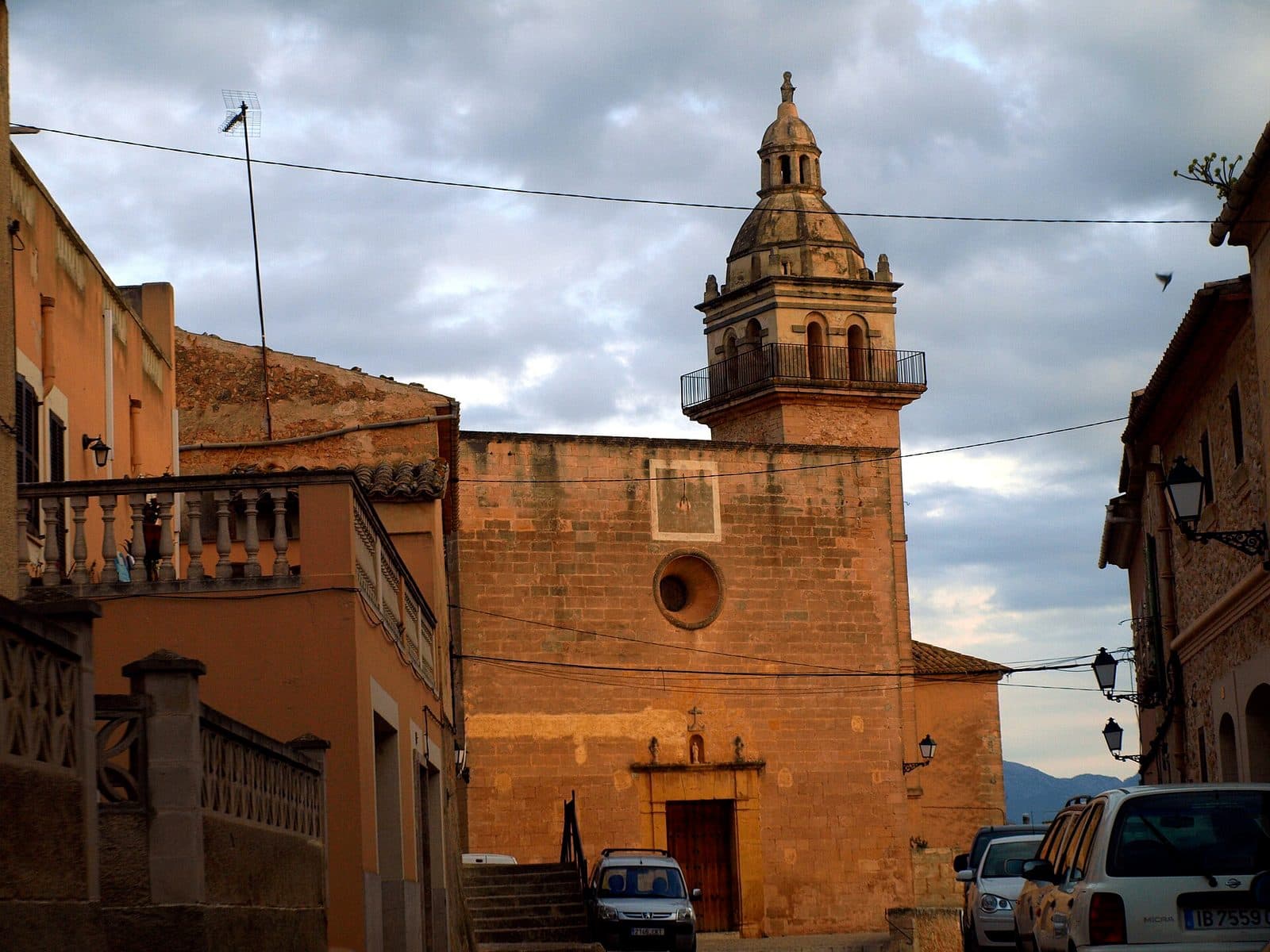
The village’s most tangible historical development can be traced through its parish church. The present church was built over a long period between the 17th and the 20th century. It is therefore less the work of a single construction phase than the result of a gradually growing village and a community whose religious centre was repeatedly adapted to new needs.
The expansion was driven by a growing local parish community. This development was accompanied by efforts to separate from Santa Maria del Camí. The church therefore recalls not only religious practice, but also the process through which Santa Eugènia developed a stronger sense of its own community. Today, Santa Eugènia is an independent municipality, and its central religious building remains the most visible sign of this evolution.
Other traces are considerably more modest. S’Aljub is a cistern. The Cova de Lourdes also represents a local form of devotion expressed not through a monumental building, but through a place of worship set into the rock.
Anyone exploring the village should therefore focus on scale and detail: the church’s position within the village, the simple religious sites, and S’Aljub.
Sights in Santa Eugènia
The sights of Santa Eugènia are spread between the compact village centre and the landscape outside the village. No elaborate sightseeing plan is needed for the central points. A sensible route begins at the parish church, includes S’Aljub, and then continues, depending on the time available, to the Cova de Lourdes or the Son Seguí hill.
Església Parroquial de Santa Eugènia
The parish church is the most important building in the village centre. Its construction history extends from the 17th to the 20th century and shows that the church developed alongside the local community. What is interesting is less a single spectacular architectural style than the church’s role as the religious and social centre of a small village.
The building also represents the local parish community’s growing independence from Santa Maria del Camí. On a walk through the village, the church is a good starting point because it reveals the scale of the historic centre: short streets, traditional houses, and a public space that continues to serve village life.
S’Aljub
S’Aljub is a cistern.
When visiting, it is worth noting how it is integrated into the village. Together with the church and older houses, it forms part of Santa Eugènia’s townscape.
Cova de Lourdes
The Cova de Lourdes is an open-air place of worship set into rocky surroundings. It differs significantly from the parish church: instead of an enclosed church interior, religious devotion is encountered here directly within the landscape. This makes the place feel quieter and more personal than a conventional religious building.
For visitors, the Cova de Lourdes is especially interesting if the stay is not to be limited to the village square. It combines a short excursion with insight into local popular devotion. Quiet behaviour and consideration for people who come here not as sightseers but to pray are appropriate.
Son Seguí
The Son Seguí hill is one of the municipality’s most interesting scenic destinations. The protected natural area is characterised by diverse vegetation and wildlife and contrasts clearly with the village’s built-up areas. Paths in this area offer views across Santa Eugènia and the rural surroundings.
Son Seguí is less suited to a casual photo stop than to a walk or hike in its own right. Sturdy footwear, water, and attention to the weather and trail conditions are advisable.
Ermita de la Mare de Déu de la Pau i del Bon Viatge
The hermitage of Our Lady of Peace and Safe Travel stands on Son Seguí. The combination of a religious site and an elevated landscape setting makes it a destination where the route and surroundings are just as important as the building itself. The Catalan name refers to peace and a safe journey, which is strikingly appropriate for its position above the transport routes and settled areas.
The hermitage should be incorporated into a tour across the hill. Anyone who visits only the village centre will gain a different, more architectural impression of Santa Eugènia; the route to the Ermita, by contrast, reveals the village’s relationship with its landscape and with smaller places of worship outside the settlement.
Monument del Sagrat Cor
The Monument of the Sacred Heart is another prominent point on Son Seguí. Its particular significance for visitors lies in its elevated position and the expansive view across Santa Eugènia and the surrounding area. It is therefore both a religious monument and a viewpoint.
Clear weather is particularly favourable for photography and observing the landscape. The view also helps with geographical orientation: from here, it becomes clear how small the compact village centre is in relation to the fields, paths, and scattered rural properties of the municipality.
Natura Parc
Natura Parc is an animal and nature conservation centre in the municipality and the largest family-friendly excursion destination near Santa Eugènia. Its animals include tropical bird species, native mammals, reptiles, and monkeys. The park sees its work not simply as displaying animals, but as combining visits with a conservation and rescue mission.
For families or travellers with a strong interest in animals, Natura Parc can take more time than the village walk itself. The park should therefore be planned as a separate activity. Anyone mainly interested in historic village architecture can skip it; those travelling with children, however, will find a clear focal point here that the small village centre alone does not offer.
Sights in Santa Eugènia
The Weekly Market
Santa Eugènia’s weekly market is small and geared towards the needs of the village. It is not one of the island’s large markets, where tour groups move between long rows of textiles, souvenirs, and food stalls. Its charm lies in its manageable size and in the fact that shopping by residents shapes its character more strongly than tourist browsing.
The main products on offer are fresh produce, plants, and goods for daily use. The surrounding area’s agriculture and wine production form the backdrop to this market without turning it into a staged showcase. Conversations between neighbours and traders are as much a part of the scene as the shopping itself. For visitors, this provides a direct insight into the village’s weekly rhythm.
The market takes place in the morning in the central village area and is held throughout the year. During the quieter season, the selection may be smaller and even more clearly focused on food. This is not a disadvantage, provided visitors expect a local provisions market rather than an extended shopping trip.
A market visit can easily be combined with the parish church, S’Aljub, and a coffee in the centre. Because Santa Eugènia is compact, the market and the village walk are close together. At the same time, the market changes the otherwise quiet atmosphere: more people are out in the centre, nearby parking is in greater demand, and the bars around the heart of the village play a more visible role in village life.
Anyone visiting specifically for the market should come earlier in the morning rather than towards its end. For many travellers, the market alone is not enough for a complete excursion; it makes more sense when combined with Son Seguí, Natura Parc, or a drive through the neighbouring wine country.
Activities and Excursions
Santa Eugènia is particularly suited to activities centred on the landscape of Mallorca’s interior. Hiking and cycling here do not begin against a dramatic mountain backdrop, but among fields, village streets, low hills, and vineyards. It is precisely this gentle topography that makes the area interesting for leisurely tours.
Hiking on Son Seguí
Son Seguí is the municipality’s most obvious hiking destination. The hill combines nature observation, small religious structures, and viewpoints. The Ermita de la Mare de Déu de la Pau i del Bon Viatge and the Monument del Sagrat Cor serve as destinations; both give the walk a clear direction without making the route purely a sporting challenge.
Because the landscape rather than a developed visitor facility is the main focus, water, sun protection, and suitable footwear are essential equipment.
Cycling in Mallorca’s Interior
Its central location makes Santa Eugènia a useful starting point for cycling tours through rural Mallorca. Side roads and links between villages open up a landscape where fields, vineyards, and small settlements alternate. Depending on fitness, routes can be extended towards Santa Maria del Camí, Sencelles, or Algaida.
The appeal lies in the alternation between quiet stretches and short passages through villages. These are not automatically separate cycle paths, however. Motor traffic, narrow carriageways, and agricultural vehicles should be expected. Anyone cycling with children or with little road experience should choose the route more carefully than experienced road cyclists.
Wine Country Around Santa Eugènia
Wine production is part of the surrounding landscape’s character. From Santa Eugènia, routes can be planned through vineyards and to wineries in central Mallorca. The village is better suited as a starting point or stop on such a trip than as a self-contained wine museum.
Tours and tastings should be arranged in advance directly with the respective producers. Clear planning is particularly important for drivers. Those who prefer to avoid alcohol still gain a great deal from the route itself: the vineyards explain part of the cultural landscape and connect Santa Eugènia with the neighbouring wine-producing villages of the island’s interior.
Natura Parc with Children
For families, Natura Parc is the municipality’s clearest activity option. The different groups of animals provide a change from the church, village square, and hiking trail. Because the visit follows a different rhythm from a short village walk, it is advisable to plan a separate time slot rather than make a hurried detour.
Combining Natura Parc with the village centre works especially well if the day is not overloaded with other distant destinations. A short walk through Santa Eugènia can take place before or after the park. For a hike on Son Seguí, it is also worth considering how much walking time is comfortable for the children.
Excursions Through Central Mallorca
Santa Eugènia is conveniently located for a tour through the island’s interior. Santa Maria del Camí provides a useful connection towards the wine region and Palma, while Sencelles and Algaida continue the rural character of the plain. In this way, Santa Eugènia becomes one part of a day trip without being artificially presented as a full-day destination for monuments.
The village has no beach of its own. A beach day therefore requires travelling onwards to the coast. Visitors wishing to combine village sightseeing with the sea should plan Santa Eugènia as a morning or late-afternoon stop and allow separately for the journey time to their chosen coast.
Getting There and Getting Around
Santa Eugènia lies in central Mallorca, east of the greater Palma area. The village can be reached via the road network of the island’s interior from Palma and Santa Maria del Camí, as well as from the rural municipalities around Sencelles and Algaida. Its location is practical for a tour through several villages because no detour into a coastal area is required.
Arriving by Car
A car offers the greatest freedom if the plan includes not only the village centre but also Son Seguí, Natura Parc, wineries, or other villages. The final sections pass through residential and agricultural areas. Narrower roads, property entrances, cyclists, and slower utility vehicles should therefore be expected.
The centre is compact and can be explored on foot after parking. It is usually possible to park near the village centre, although spaces directly along the central streets are more limited than on the outskirts. On market mornings and during local events, it is best not to insist on finding a space immediately beside the market area. A short walk avoids unnecessary driving through narrow village streets.
Arriving by Bus
Santa Eugènia has several bus stops and can therefore generally be reached without a private car. The current routes and departures are displayed separately on the page. The bus is a realistic option for visiting the village centre because the main points there are close together.
Planning becomes more demanding as soon as Natura Parc, a starting point on Son Seguí, or several neighbouring villages are added on the same day. The crucial factors are then not only the outward and return journeys, but also connections and the final bus of the day. Anyone planning to commute regularly to Palma should assess the personal journey to work using the actual times required rather than relying solely on the geographically central location.
Getting Around the Village
The church, market area, and central streets can easily be linked on foot. Conditions change for destinations outside the compact village centre: distances often look short on a map but may involve roads without continuous pavements or unpaved tracks. Son Seguí calls for deliberate hiking plans; for destinations farther apart, a bicycle or car remains more practical.
Bus lines to Santa Eugènia at a glance
| Line | Route | Departures/day | First | Last |
|---|---|---|---|---|
| 304 | Inca - Sencelles - Palma | 45 | 06:38 | 22:00 |
| 343d | Santa Eugènia - Santa Maria | 6 | 08:50 | 19:20 |
From the official GTFS feeds (TIB/SFM), no real-time data. The figures cover all stops in the town; weekend and holiday services differ — check with the operator before travelling.
Getting there by bus
Santa Eugènia 2 (53020) · 0.1 km as the crow flies
- 304Inca - Sencelles - Palma · Daily
Santa Eugènia 1 (53019) · 0.1 km as the crow flies
- 304Inca - Sencelles - Palma · Daily
Santa Eugènia 3 (53022) · 0.2 km as the crow flies
- 343dSanta Eugènia - Santa Maria · Mon-Fri
Ses Alqueries 1 (53021) · 1.1 km as the crow flies
- 304Inca - Sencelles - Palma · Daily
Timetable data: official GTFS feeds (TIB/EMT), no real-time — check with the operator before travelling.
Living in Santa Eugènia
Santa Eugènia is a small, independent municipality rather than a holiday resort dominated by the tourist season. Daily life is concentrated in a manageable village centre where the church, public spaces, bars, small shops, and weekly market are close together. Journeys within the village are therefore short, while many destinations outside the centre require transport.
Daily Life and Local Amenities
The year-round weekly market is more than a visitor attraction for the village. It is used to buy fresh produce, plants, and individual everyday goods, and it creates a regular meeting place for residents. Small shops and bars around the centre also help ensure that the village centre does not consist solely of homes.
Santa Eugènia should nevertheless not be confused with a larger service centre. Anyone dependent on particular specialist shops, extensive medical care, banking services, or frequent visits to public authorities should check the addresses and journeys they will actually need before moving. The central island location makes it easier to travel to larger towns, but it does not replace a dense range of urban services within the village.
Commuting and Living Without a Car
For everyday life without a private vehicle, bus connections are the decisive factor. Several stops serve Santa Eugènia and the municipal area. Within the village, many journeys can be made on foot; the real challenge begins with commuting, larger shopping trips, and appointments outside the village.
Car-free living is therefore most realistic for people whose daily routine fits the timetables and who do not regularly need to connect several remote destinations. For commuters to Palma, the specific connection at the beginning and end of the working day is what matters. A general journey time would be of little help because transfers, traffic conditions, and the workplace’s location within Palma significantly affect the trip.
With a car, Santa Eugènia offers commuters greater flexibility. Its inland location keeps the village closer to the Palma area than many municipalities in the east or north of Mallorca. At the same time, the daily journey remains a rural and urban drive whose demands during the usual rush hours may differ from those of a weekend excursion.
Winter and the Low Season
Santa Eugènia does not disappear behind closed hotel complexes in winter because the village does not primarily depend on beach tourism. The market, municipal routines, and social life in the centre continue throughout the year. The village then feels quieter, and the market may focus more strongly on food than on a broad range of additional products.
For residents, this continuity is an advantage: Santa Eugènia remains inhabited and functional when the tourist season on the coast subsides. At the same time, the village’s small size becomes more apparent during the cooler months. Anyone seeking a large cultural programme, late-night shopping, or a broad selection of restaurants on the doorstep will need to travel more often.
Village Centre and Rural Municipal Area
Life in the compact centre differs from living outside the village. In the centre, bus stops, the market, and small shops are closer; at the same time, village traffic, church bells, and events are more noticeable. Outside the centre, fields, access roads, and scattered properties shape the surroundings, but everyday journeys become longer and dependence on a private vehicle increases.
Santa Eugènia is therefore particularly suitable for people seeking a small Mallorcan place to live with a local year-round rhythm and who are prepared to make regular journeys. It is less suitable for households wishing to cover all services, leisure activities, and commuting needs without checking timetables or using a car. The proportion of long-established residents to newcomers cannot be meaningfully inferred from the street scene; what matters for integration is daily life within a small community shaped by local traditions.
Practical Information for Your Visit
For an initial walk through the village centre, part of the day is generally sufficient. The church, central streets, and S’Aljub lie within a manageable area. Anyone also wishing to visit the Cova de Lourdes, Son Seguí, or Natura Parc should turn the visit into a half-day or full-day itinerary and not treat these destinations as a mere extension of a short village walk.
Santa Eugènia is most pleasant in the morning or later in the afternoon. Market morning shows the village at its liveliest; on an ordinary weekday, by contrast, its quiet residential and village character is more apparent. Which option suits you better depends on whether social encounters and shopping or architecture and tranquillity are the priority.
Parking directly in the centre is not always the best solution. A space slightly outside the busiest streets followed by a short walk is usually more relaxing, especially during the market. At Son Seguí, cars should be left only where they do not obstruct access roads, agricultural traffic, or private property.
Sensible combinations include a wine route through central Mallorca, a visit to Natura Parc, or a village tour through Santa Maria del Camí, Sencelles, and Algaida. It makes less sense to plan Santa Eugènia as a substitute for a beach resort or a large historic town. There is no seafront promenade and no harbour. The reward lies in its modest scale: village church, cistern, market, hilly landscape, and a view of a Mallorca that keeps its own rhythm outside the holiday season as well.
Eating, drinking and staying in Santa Eugènia
The best-rated businesses from our directory, ordered by Google rating — not by advertising.
Restaurants
Cafés and bakeries
Hotels and fincas
Upcoming dates
Latest news from Santa Eugènia
- 27 Mallorca towns lack Alcover and La Balanguera
- 1,440 places: Balearic police training grows
- Mallorca dogs rescued after collar wounds neck