
Sant Albert Magne Church in Platja de Muro
.jpg)
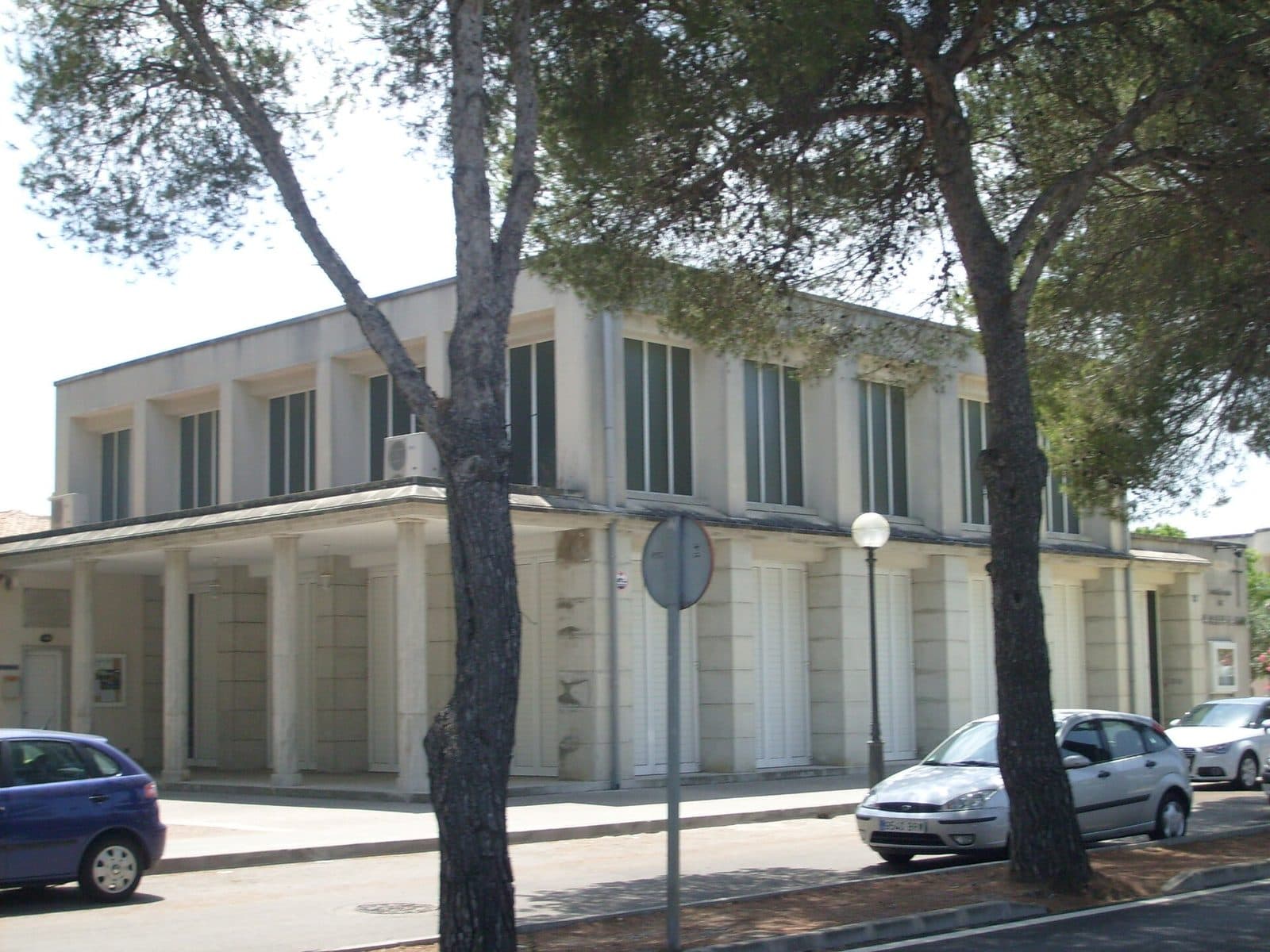
Amid holiday accommodation and coastal roads, Sant Albert Magne creates an unusually clear architectural accent. The Roman Catholic church stands in the Platja de Muro district and attracts attention less through historical ornamentation than through its modern design language: a compact structure, a very low pyramidal roof and, beside it, a tall, strikingly slender bell tower. It is precisely this contrast that makes the church worth seeing. Visitors familiar mainly with medieval parish churches, natural-stone façades and massive towers on Mallorca will encounter a different side of sacred architecture here.
Sant Albert Magne is not located in the historic center of Muro but in the coastal resort of Platja de Muro—an important distinction when navigating. The church is dedicated to Saint Albertus Magnus and is also known by the Catalan name Sant Albert el Gran. It is particularly suitable as a short cultural stop during a stay on the Bay of Alcúdia, as a destination for architecture enthusiasts or as an addition to a beach day.
What to See
Even from some distance, it is clear that the familiar forms of an old Mallorcan village church were not used here. The building has a modern, deliberately restrained appearance. Its impact comes from the relationship between the seemingly lower church building and the bell tower rising separately beside it. Instead of a richly articulated show façade, the roof shape, building volume and silhouette define the first impression.
The Low Pyramidal Roof
The defining feature of the church building itself is its very low pyramidal roof. It rises only gently toward the center, making the structure appear broad and enclosed. This type of roof differs markedly from the steeper gabled roofs and massive façades that define the appearance of many historic churches on Mallorca. At Sant Albert Magne, the emphasis is not on ornamental decoration but on a simple overall geometric form.
The roof is best viewed not only from the front but also from a slightly offset perspective. As you walk along the adjacent streets, its outline changes: from one angle it appears almost horizontal, while from another the pyramidal slope becomes more apparent. This understated roof geometry gives the building its distinctive character.
The Detached Bell Tower
The bell tower stands northeast of the church building as a separate structure. It is tall, narrow and clearly detached from the main building. As a result, it does not appear to be an extension of a façade but rather a vertical landmark beside the low-roofed church interior. The contrast is immediately clear: below is the compact, calm body of the building, with the slender line of the tower beside it.
This separation is crucial to the overall exterior impression. Anyone focusing only on the entrance or façade may easily overlook that the architectural composition consists of two separate volumes. A few steps along Carrer Creuer or around the corner onto Carrer Iola are enough to take in the main building and tower together. The corner location makes it particularly easy to view the complex from more than one direction.
The Corner of Carrer Creuer and Carrer Iola
Sant Albert Magne stands south of Carrer Creuer, where Carrer Iola approaches from the east. The church is therefore not located on an enclosed historic square but directly within the streetscape of Platja de Muro. Its modern architecture responds to this setting with a clear silhouette that can be grasped at a glance.
Its location near the northern boundary of the municipality of Muro also explains why the church can easily be confused with other places on maps. This is neither a church in the old center of Muro nor the parish of the same name in Barcelona. The destination is specifically Sant Albert Magne, also known as Sant Albert el Gran, in the coastal resort of Platja de Muro.
Visiting the Church
Sant Albert Magne is a Catholic church, which shapes how a visit works: the exterior architecture can be viewed independently of an extensive interior visit, while access to the church may depend on religious activities. As no reliable general opening hours are available, it is advisable to check current access arrangements before planning a specific interior visit.
A Short Architecture Walk
Carrer Creuer is a good place to begin an exterior walk. From there, you can take in the relationship between the low roof and the tower standing to the northeast. Continue around the corner onto Carrer Iola for a more lateral perspective. The walk is compact in scope because the focus is on the clearly separated architectural elements.
How much time to allow therefore depends mainly on whether the church is accessible and whether your interest is in the architecture or a church service. Visitors who only want to see the exterior can treat Sant Albert Magne as a short stop. For an interior visit, however, it is best not to rely on a tight schedule unless the current access arrangements have been checked.
Respecting Religious Activities
When the church is open, Sant Albert Magne remains an active place of worship. Visitors should therefore remain quiet and give priority to liturgical activities. For interior photography, it is advisable to observe any local signs. The exterior also reveals the low pyramidal roof, the separate bell tower and the building’s position within the street network of Platja de Muro.
There is no reliable time that can be guaranteed to be less busy. Anyone wishing to view the architecture without time pressure should avoid combining the stop with a tightly scheduled appointment and should check in advance if interior access is desired.
Getting There and Parking
The most important navigation detail is the place name: Sant Albert Magne is located in Platja de Muro on the coast, not in the inland main town of Muro. The destination is on Carrer Creuer at the corner of Carrer Iola. Entering only “Muro” may therefore take you to the wrong part of the municipality. For the final section, specifically select Platja de Muro or Sant Albert el Gran.
From Palma Airport
From Palma Airport, the road route initially follows the Ma-30, then the Ma-13 and finally the Ma-3470 to Platja de Muro. The coastal resort is 62 road kilometers away, and the journey takes around 53 minutes. These details apply as far as Platja de Muro, not directly to the church door. Within the district, the final section follows the local street network to Carrer Creuer.
The Ma-13 covers the longest section toward the north of the island. After turning onto the Ma-3470, the route approaches the Bay of Alcúdia and the developed coastal strip. Within the resort, the church is relatively easy to identify thanks to its corner location and slender, detached bell tower, provided the navigation system is set to the correct street.
From Central Palma
From central Palma, the route follows the Ma-13 and Ma-3470. The road distance to Platja de Muro is 59 kilometers, with a journey time of around 56 minutes. Here too, the distance and duration apply to Platja de Muro. From there, continue through the local street network to the intersection of Carrer Creuer and Carrer Iola.
Sant Albert Magne is located within the resort. The final section is therefore not a remote access road to a mountain monastery or rural hermitage but part of the developed holiday destination.
Bus lines to Sant Albert Magne at a glance
| Line | Route | Departures/day | First | Last |
|---|---|---|---|---|
| 324 | Can Picafort - Alcúdia | 425 | 00:06 | 23:53 |
| 302 | Can Picafort - Palma | 278 | 00:06 | 23:51 |
| 315 | Sa Pobla - Badia d'Alcúdia | 126 | 06:42 | 23:38 |
| A32 | Can Picafort - Aeroport | 106 | 00:11 | 23:22 |
| 325 | Alcúdia - Cala Rajada | 65 | 08:33 | 22:33 |
From the official GTFS feeds (TIB/SFM), no real-time data. The figures cover all stops in the town; weekend and holiday services differ — check with the operator before travelling.
Getting there by bus
Platja dels Francesos 1 (3056) · 0.3 km as the crow flies
- 302Can Picafort - Palma · Daily
- 315Sa Pobla - Badia d'Alcúdia · Daily
- 324Can Picafort - Alcúdia · Daily
- 325Alcúdia - Cala Rajada · Daily
- A32Can Picafort - Aeroport · Daily
Platja dels Francesos 2 (3057) · 0.4 km as the crow flies
- 302Can Picafort - Palma · Daily
- 315Sa Pobla - Badia d'Alcúdia · Daily
- 324Can Picafort - Alcúdia · Daily
- 325Alcúdia - Cala Rajada · Daily
- A32Can Picafort - Aeroport · Daily
Estany dels Ponts 1 (3058) · 1.1 km as the crow flies
- 302Can Picafort - Palma · Daily
- 315Sa Pobla - Badia d'Alcúdia · Daily
- 324Can Picafort - Alcúdia · Daily
- 325Alcúdia - Cala Rajada · Daily
- A32Can Picafort - Aeroport · Daily
Estany dels Ponts 2 (3059) · 1.2 km as the crow flies
- 302Can Picafort - Palma · Daily
- 315Sa Pobla - Badia d'Alcúdia · Daily
- 324Can Picafort - Alcúdia · Daily
- 325Alcúdia - Cala Rajada · Daily
- A32Can Picafort - Aeroport · Daily
S'Albufera 1 (39006) · 1.8 km as the crow flies
- 302Can Picafort - Palma · Daily
- 315Sa Pobla - Badia d'Alcúdia · Daily
- 324Can Picafort - Alcúdia · Daily
- 325Alcúdia - Cala Rajada · Daily
- A32Can Picafort - Aeroport · Daily
S'Albufera 2 (39007) · 1.8 km as the crow flies
- 302Can Picafort - Palma · Daily
- 315Sa Pobla - Badia d'Alcúdia · Daily
- 324Can Picafort - Alcúdia · Daily
Timetable data: official GTFS feeds (TIB/EMT), no real-time — check with the operator before travelling.
Nearby Attractions
Sant Albert Magne stands in the heart of Platja de Muro, making it particularly easy to include in a day that is not devoted exclusively to the church. Its architecture provides a brief cultural counterpoint to the beach, dunes and tourism-oriented streetscape.
Platja de Muro
The beach of Platja de Muro stretches between Port d’Alcúdia and Can Picafort along the large Bay of Alcúdia. Fine sand and gently shelving water make it particularly appealing to families. The coastline is divided into several sections: some are close to hotels and holiday complexes, while others are characterized by dunes and undeveloped natural surroundings.
To combine it with Sant Albert Magne, simply treat the church visit as a deliberate change in perspective. At the beach, water, horizon and open space dominate the view; on Carrer Creuer, the defining features are the geometric lines of the roof and the rising bell tower. Even during a short stay, this creates an impression that Platja de Muro is more than an uninterrupted beach backdrop.
s’Albufera Natural Park
South of the coastal strip and farther inland lies s’Albufera Natural Park, whose wetlands shape a large part of the municipality of Muro. The Canal Gran de s’Albufera runs from the island’s interior to the sea and also marks a prominent point on the coast. A separate block of time should be reserved for wildlife watching and longer walks, while Sant Albert Magne remains the compact architectural stop.
Port d’Alcúdia and Can Picafort
Platja de Muro lies between Port d’Alcúdia and Can Picafort. Both places make suitable additional stops along the bay without turning the church visit into an all-day program. Anyone arriving from the direction of Alcúdia or Can Picafort should nevertheless pay attention to the precise destination: the church is in the Les Gavines area of Platja de Muro, not in the center of the neighboring coastal resorts.
Local insider tips
See the Tower and Roof Together
Do not look only at the church from the front: the corner of Carrer Creuer and Carrer Iola offers an especially good view of how the slender, detached bell tower interacts with the low pyramidal roof.
Enter the Correct Destination
When navigating, specifically select Platja de Muro or Sant Albert el Gran. The church stands in the coastal resort on Carrer Creuer, not in the historic, inland main town of Muro.
Combine It with the Beach and Nature
Sant Albert Magne is ideal as a compact cultural stop between the beach and the natural park. This makes it easy to combine the modern church architecture, Platja de Muro and the s’Albufera wetlands without a major detour.