
Sant Joan Baptista in Calvià: History and Visitor Guide
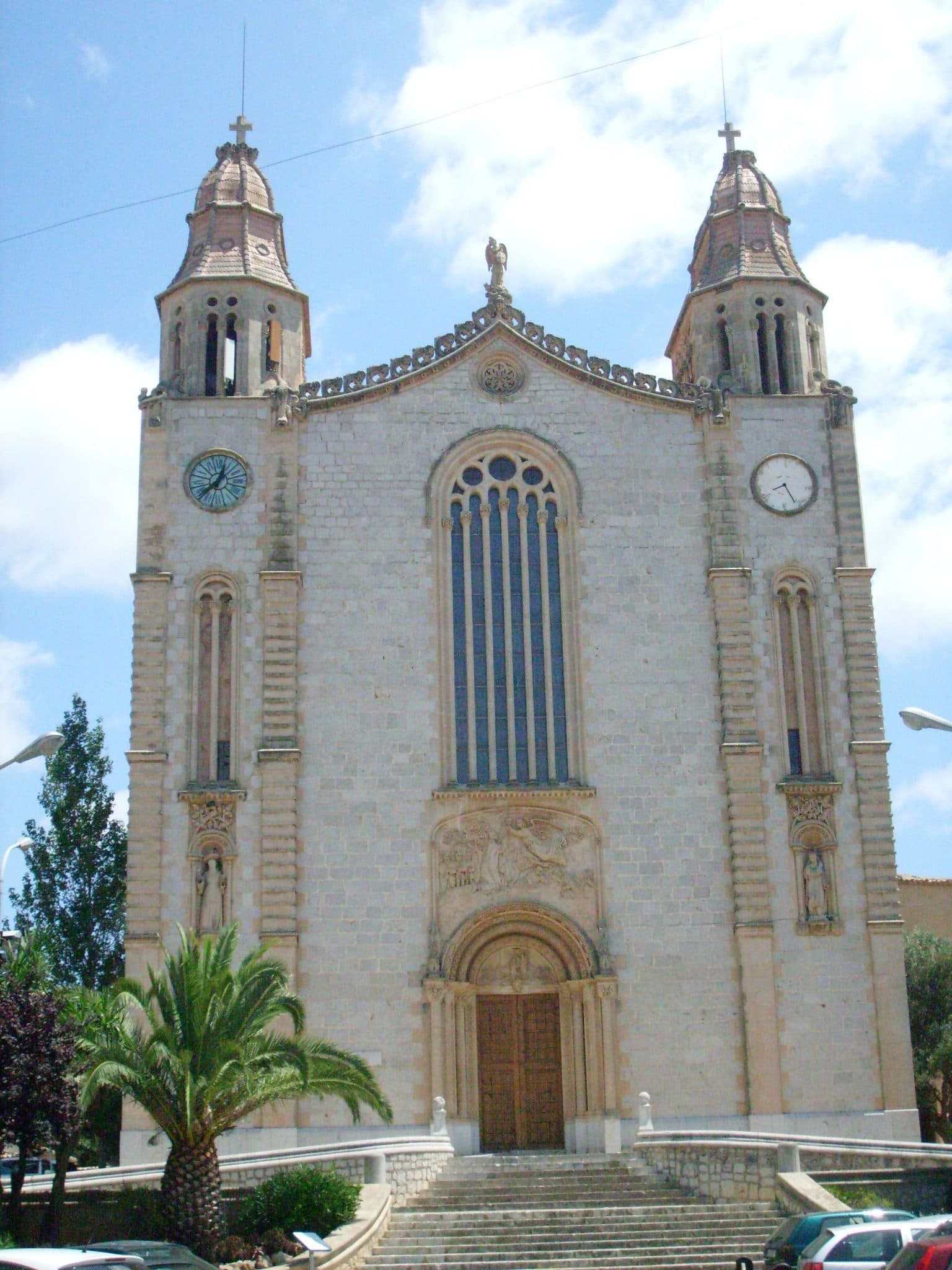

Sant Joan Baptista is one of those buildings where the history of a Mallorcan town can be traced particularly clearly. The parish church stands in the old center of Calvià in southwestern Mallorca—far removed from the image of the large coastal resorts, yet closely connected to the development of the town of Calvià.
The present church dates from the late 19th century and is associated with Historicism and Neo-Gothic architecture. Its roots, however, reach much further back: a church dedicated to John the Baptist was built on this site as early as 1248. Anyone standing in front of Sant Joan Baptista is therefore not looking at an unaltered medieval building, but at the more recent architectural face of a very old parish.
A visit is particularly worthwhile for travelers who want to discover more of Mallorca than its beaches and coastal resorts. The church is linked to Calvià’s gradual growth and the town’s development, and it makes a peaceful cultural stop on a walk through Calvià. However, current access arrangements should be checked in advance if you wish to see the interior.
History and significance
The parish of Sante Ihoannes Caviano
The history of Sant Joan Baptista does not begin with the building visible today. Even before the church was erected in 1248, Calvià had a parish that appears in historical records under the name “Sante Ihoannes Caviano.” Its dedication to John the Baptist was therefore established early and shaped the town’s religious center for centuries.
The connection between the saint and the town may even be reflected in the municipal coat of arms. The lamb depicted there is associated with the veneration of John the Baptist. Regardless of how conclusively the origins of the coat of arms can be explained today, this interpretation shows how closely the church’s patron saint and local identity were perceived to be connected.
The church as the town’s starting point
As late as 1595, the church stood in relative isolation. At the same time, houses had already appeared around it, gradually developing into the town of Calvià. This detail changes how Sant Joan Baptista is understood: the church was not simply added later to an established town center, but was instead one of the focal points around which the settlement became denser.
This development is easier to grasp while walking through Calvià than from a simple timeline. The parish church does not belong to a separate monumental district, but to the organically developed village. Its significance therefore lies as much in its location as in its architecture. It demonstrates that Calvià had its own rural history long before the municipality’s modern coastal resorts emerged.
The 19th-century reconstruction
The medieval origins should not be confused with the age of the present building. The existing structure was founded in the 19th century and completed toward the end of that century. Bartolomé Ferrá y Perelló is named as the architect. He designed the church in a Historicist style that is often described as Neo-Gothic.
Sant Joan Baptista remains a parish church. It is therefore not a decommissioned monument whose significance lies solely in the past, but a religious building still used at the center of local life. This continuity is precisely what distinguishes it from a tourist attraction presented as a museum.
What to see
The Historicist church building
The first impression is defined by the solid stone structure. Sant Joan Baptista does not appear to be a medieval fragment, but a 19th-century church deliberately designed as a unified whole. Anyone familiar with its long history should therefore not expect to find a place of worship preserved unchanged since 1248. What is visible is a later architectural response to that tradition. Bartolomé Ferrá y Perelló drew inspiration from Gothic architecture, which is why the church is usually described as Neo-Gothic despite not itself being a medieval building.
A slight change of perspective is worthwhile when viewing it: first take in the building as a whole before focusing on individual forms. Its effect is created by the relationship between the church and the houses of old Calvià. The historic architecture provides a clear focal point while remaining part of the town that once developed around its religious center.
The Neo-Gothic architectural language
When viewing the church, it is important to keep in mind the difference between its historical origins and its Historicist design. This distinction is precisely what gives Sant Joan Baptista its architectural appeal. The building tells not only of earlier centuries, but also of how the 19th century regarded that past. It is memory in built form, though not a reconstruction of the original church.
This idea can be understood even without extensive knowledge of art history. The church was intended to appear venerable and permanently rooted at the heart of the community. Its stone presence and design inspired by older sacred architecture deliberately distinguish it from ordinary residential buildings. At the same time, it remains closely connected to the town center rather than standing as an isolated monument.
Its relationship with the townscape
A substantial part of the visit takes place outside the walls. Sant Joan Baptista is best understood through its position in old Calvià: over the course of history, houses moved closer to the church site, and the initially sparsely settled surroundings developed into the town. This evolution is as important for understanding the church as its architectural style.
The building is therefore best viewed from more than just the front. A short walk through the neighboring streets shows how its size and impact change with your position. Up close, the architecture moves into the foreground; from a little farther away, its role as a local landmark becomes clearer. In a sense, the most rewarding “exhibition space” here is historic Calvià itself.
If the interior is accessible, remember that you are entering a parish church rather than a tourist setting. The visit should be quiet and respectful, particularly if a service or another church ceremony is being prepared. Since current access times are not reliably established, plans should not depend entirely on seeing the interior. The church’s historical and urban significance can already be appreciated well from outside.
Visiting the church
Approaching through Calvià
Sant Joan Baptista is less suited to a hurried photo stop than to a short walk through the old town. The approach itself reveals the essential context: Calvià is the historic center of a municipality known to many travelers primarily for its coastal resorts. The parish church introduces another layer of the island’s history—more rural, older, and more closely shaped by everyday local life.
It makes sense to first view the church within its surroundings. Walking through the streets helps explain how the settlement developed around its religious center. Once at the building, you can examine its overall Historicist effect and Neo-Gothic inspiration more closely. Anyone focused only on taking a single photograph of the façade will miss a large part of this story.
It is difficult to recommend a fixed length of stay. A compact cultural stop is sufficient for viewing the exterior alone. Those who include the town center, compare different perspectives of the building, and quietly explore the interior if it is accessible should allow more time. The length of the visit depends mainly on whether Sant Joan Baptista is treated as an individual destination or as the focal point of a walk through the town.
Access to the interior
No confirmed opening hours are available. Since Sant Joan Baptista is an active parish church rather than a museum with continuous exhibition hours, access may depend on church schedules and can change. Before making a dedicated trip, it is therefore advisable to check the current situation with the parish or locally.
The same applies to admission: no reliable current price is available. For this reason, neither fees nor supposedly free access periods are stated here. Anyone determined to see the interior should not rely on older information from travel websites, as service schedules and visiting arrangements may be changed at short notice.
When the church is open, it remains first and foremost a sacred space. Conversations should be kept quiet, services in progress should not be entered or disturbed, and photographs should be taken only with consideration for those present. This restraint is not merely a tourist formality, but follows from Sant Joan Baptista’s continuing function as a parish church.
When to visit and crowds
There is no reliable basis for recommending a particular time of day with guaranteed low visitor numbers. Those mainly interested in the architecture and townscape can remain flexible because the exterior does not depend on the church being open. For a quiet interior visit, however, choose a time outside services and events. Current information is more useful for this than general recommendations based on the day of the week or season.
Getting there and parking
From Palma and the airport
The routes provided lead to Calvià, not directly to the church portal. The road distance from Palma Airport to Calvià is 31 kilometers, and the drive takes around 34 minutes. The route follows the Ma-20, then the Ma-1, and finally the Ma-1015. In the town, the final section continues through the local street network toward the historic center and the church.
From central Palma, the road distance to Calvià is 21 kilometers. The drive takes around 33 minutes and follows the Ma-1 and Ma-1015. The fact that the journey is only slightly shorter despite the reduced distance shows that mileage alone is not what matters when planning. Traffic around Palma and the final sections inland can determine the actual journey time.
For navigation, it is important to select Calvià as the destination and continue from there to the parish church. Sant Joan Baptista is located in the old town center; the area around Carrer Serral serves as a local reference point. Allow additional time for the final stretch rather than treating the calculated driving time to Calvià as an exact arrival time at the entrance.
By bus
Several bus stops are located around the town center on Avinguda de Palma and Avinguda d’es Capdellà. From there, the route to the church becomes a short walk through the town. The most suitable connection depends on your starting point and the current timetable, which should be checked immediately before traveling.
Arriving by bus offers a contextual advantage for this visit: Sant Joan Baptista does not suddenly appear beyond a windshield, but gradually becomes part of the townscape. The close relationship between the church, the streets, and the organically developed town of Calvià is easier to recognize on foot.
Bus lines to Sant Joan Baptista at a glance
| Line | Route | Departures/day | First | Last |
|---|---|---|---|---|
| 107 | Es Capdellà - Palma | 136 | 06:31 | 23:01 |
From the official GTFS feeds (TIB/SFM), no real-time data. The figures cover all stops in the town; weekend and holiday services differ — check with the operator before travelling.
Getting there by bus
Av. es Capdellà 2 (11122) · 0.3 km as the crow flies
- 107Es Capdellà - Palma · Daily
Av. Palma (11123) · 0.3 km as the crow flies
- 107Es Capdellà - Palma · Daily
Av. es Capdellà 1 (11121) · 0.4 km as the crow flies
- 107Es Capdellà - Palma · Daily
Zona poliesportiva 2 (11120) · 1.0 km as the crow flies
- 107Es Capdellà - Palma · Daily
Zona poliesportiva 1 (11119) · 1.0 km as the crow flies
- 107Es Capdellà - Palma · Daily
Ses Quarterades 1 (11126) · 1.2 km as the crow flies
- 107Es Capdellà - Palma · Daily
Ses Quarterades 2 (11127) · 1.4 km as the crow flies
- 107Es Capdellà - Palma · Daily
Timetable data: official GTFS feeds (TIB/EMT), no real-time — check with the operator before travelling.
Nearby
Calvià as the historic municipal center
Today, the name Calvià refers to a large municipality in southwestern Mallorca that includes well-known coastal towns and holiday resorts. Sant Joan Baptista, however, stands in the inland town of the same name. This distinction is important when planning: the visit leads not to a beachfront promenade, but to the historic center from which the municipality developed.
The church provides the best starting point for understanding this older character. As late as 1595, it was described as standing in relative isolation, while residential buildings were already gathering around it. The village gradually emerged from this proximity. A walk through the neighboring streets illustrates this development more clearly than a visit in which only the church building is approached and immediately left again.
Calvià therefore offers a counterpoint to the modern settlements along the coast. The parish church is a reminder that the municipality’s history did not begin with tourism.
Combining it with southwestern Mallorca
Sant Joan Baptista fits well into an excursion through the southwest. Anyone already traveling between Palma, the coastal resorts, and the inland areas will find a compact cultural and historical contrast in Calvià. The church does not require an extensive day-long itinerary, but the visit becomes significantly more rewarding when the town center is included.
Combining it with a later stay on the coast reveals two very different sides of the same municipality. In Calvià, the focus is on parish history, Historicist church architecture, and settlement development; on the coast, beaches and more recent tourist resorts shape the scene. This contrast helps prevent southwestern Mallorca from being misunderstood as a uniform holiday landscape.
Travelers visiting from Palma can also choose Sant Joan Baptista as a peaceful cultural stop. The journey is manageable while leading from the urban area into a smaller historic town. What matters is less the number of individual sights than the opportunity to discover Calvià’s older identity at its religious center.
The place it belongs to
Calvià in the place guidePractical visitor information
A parish church, not an exhibition venue
Sant Joan Baptista is first and foremost an active place of worship. Its appeal lies in the combination of a living parish tradition, 19th-century architecture, and the organically developed townscape. Anyone who finds the door locked has not made the journey in vain: the essential historical connections—the location in old Calvià, the late 19th-century reconstruction, and the church’s role as the center of the settlement—can also be understood from outside. For travelers interested exclusively in the interior, however, checking current access before setting out is essential.
Respect during church events
During services, funerals, or other religious ceremonies, tourist visits must take second place. Waiting quietly or returning later is more appropriate than interrupting an event in progress. Even outside ceremonies, phone calls, loud conversations, and elaborate photography arrangements should be avoided inside the church.
With children, the visit works best as part of a walk through the town. The history can easily be introduced through a specific question: why does such a large church stand here, and why did the town grow around it? The same rules that apply to adults also apply inside; short, quiet stages are more suitable there than a long stay without any connection to the building.
Setting the right expectations
Sant Joan Baptista is not a medieval church that has survived unchanged since 1248. The date refers to the early church site and the long parish tradition; the building visible today belongs to the 19th century. Understanding this distinction prevents the most common misinterpretation while also making the present church’s Neo-Gothic design easier to recognize.
It is equally important not to confuse it with churches of the same name elsewhere on Mallorca. John the Baptist is the patron saint of several places of worship on the island. The Sant Joan Baptista described here stands exclusively in Calvià in the southwest and should not be confused with the church in Son Servera or the one in Deià. Their construction histories and architectural features do not belong to this location.
Local insider tips
The lamb on the coat of arms
When looking at the municipal coat of arms, pay attention to the lamb. The motif is associated with the veneration of John the Baptist and shows how deeply the church’s patron saint is rooted in Calvià’s local identity.
Do not view it only from the front
Sant Joan Baptista is best understood on a short walk through the neighboring streets. From a little farther away, it becomes clearer how the church became the focal point of the town that developed around it.
Recognize two historical periods
The date 1248 belongs to the early church and parish, not to the present building. The visible place of worship was created in the 19th century. Knowing this makes it much easier to interpret its Neo-Gothic design accurately.
Do not confuse Calvià
Several churches on Mallorca bear the name Sant Joan Baptista. For this visit, the destination is the historic town of Calvià in the southwest—not Son Servera in the east or the mountain village of Deià.