
Renting Out a Room in Mallorca: Rights, Contracts and Tax
Anyone renting out a room in Mallorca – whether in their own flat or in a house where they also live – is operating in a legal grey area that many people underestimate. Renting out a room in Mallorca is not the same as letting an entire flat: Spanish tenancy law draws a clear distinction between residential tenancy agreements and room rentals, which are subject to different rules. This guide explains which type of contract is appropriate, what rights landlords and tenants have, what the Registro Único has meant since July 2025, and how to declare rental income correctly – whether you are a resident or non-resident. By the end, you will know what to look out for in the contract, which mistakes can prove costly, and what the authorities specifically check.

Do you want to rent out or rent a room and are unsure about the legal situation?
- 📩 Submit a personal enquiry — individual assessment of your specific situation
- Everything about long-term rental in Mallorca
What is alquiler de habitación – and what is it not?
The room rental (alquiler de habitación) describes the letting of a single room within a residential unit, where the landlord typically lives in the flat or house themselves, or is at least the owner of the property as a whole. This is a crucial distinction from the letting of a complete, self-contained flat.
The Spanish tenancy act, the Ley de Arrendamientos Urbanos (LAU) of 1994 – most recently substantially reformed in 2019 – expressly governs residential tenancies in Article 2: it applies only where an entire building is handed over as the tenant's permanent residence. Room rentals, by contrast, fall under Título III LAU (arrendamiento para uso distinto del de vivienda) or are frequently concluded simply as a contract under the Civil Code (Código Civil), because the LAU's protective provisions do not apply automatically.
| Feature | Full residential tenancy (LAU Art. 2) | Room rental (alquiler de habitación) |
|---|---|---|
| Legal basis | LAU Título II | LAU Título III / Código Civil |
| Statutory minimum term | 5 years (private landlord) | Freely negotiable |
| Notice periods | Governed by statute | To be agreed contractually |
| Shared use of common areas | Not applicable | Kitchen, bathroom, communal areas |
| Deposit as required by law | 1 month's rent | 1 month's rent (recommended, not mandatory) |
| Balearic rent control | None (as of 2025) | None |
Please note: If you do not live in the property yourself and are renting out individual rooms to several people, the tax authority or local council may classify this as a commercial activity or holiday letting — with an entirely different set of obligations.
What types of contract are there — and which one is right for you?
Before drawing up a contract, you need to establish the purpose for which the room is being let. In practice, there are three relevant scenarios:
1. Long-term room rental (residential)
The tenant occupies the room as their permanent residence, sharing a kitchen or bathroom with the landlord or other tenants. In this case, a tenancy agreement under the Código Civil is recommended, with clear provisions covering:
- Tenancy duration and notice periods
- Rights of use over communal areas
- House rules (quiet hours, guests, cleaning)
- Utility costs (electricity, water, WiFi — typically split proportionally)
2. Seasonal letting (alquiler de temporada)
The room is let for a specific, pre-agreed period — for example to a student or seasonal worker. This type of contract is not tourist in nature, falls under LAU Title III, and does not require a tourist licence, though from July 2025 it may in certain circumstances require a registration number (see the Registro Único section).
3. Short-term tourist letting of a room
If you are letting a room on a daily or weekly basis to tourists via platforms such as Airbnb, the rules of the Balearic tourism law apply. This is an entirely different legal category — more on this in the ETV licence section.
The tenancy agreement: what must it include?
Even though a room rental agreement can be concluded informally, a written contract is essential — in the event of a dispute, it is your only protection. Every room rental contract in Mallorca should contain the following points:
- Full personal details of both parties (name, NIE/DNI, address)
- Precise description of the room (size, location within the flat, furnishings)
- Rental period with specific start and end dates, along with renewal terms
- Monthly rent in euros, due date and method of payment
- Deposit (depósito): amount, date of payment, conditions for return
- Rights of use of the bathroom, kitchen, terrace, etc. – as precisely as possible
- House rules: guests, pets, smoking, quiet hours
- Utility costs: who pays for electricity, water, Wi-Fi – proportionally or as a flat rate?
- Notice periods for both parties
- Inventory list (as an annex, with photographs)
Please note: If the contract contains no provision regarding termination, the general rules of the Código Civil apply – this can lead to lengthy notice periods or disputes.
Deposit and utility costs: what is standard practice?
| Item | Standard practice in Mallorca |
|---|---|
| Deposit (depósito) | 1 month's rent, sometimes 2 months for furnished properties |
| Additional security deposit | Up to 2 further months' rent contractually permissible |
| Electricity & water | Often included in the rent as a flat rate or split proportionally |
| Wi-Fi | Generally included |
| Refuse charges | 50–150 € / year, depending on the municipality |
| Agency fee | Borne by the landlord for long-term rentals |
Regarding the deposit: in a private rental it is generally due to be returned within a reasonable period after the end of the tenancy, provided no damage is proven. Document any damage in writing and photographically — both before and after the tenancy.
Registro Único: the new registration requirement from July 2025
Since 2 January 2025, a uniform national register for short-term rentals (Registro Único) has applied throughout Spain. The key deadline: from 1 July 2025 all landlords offering accommodation on a short-term basis in exchange for financial remuneration via online platforms must hold a valid Número de Registro Único and display it prominently in every online listing.
This applies expressly not only to entire holiday apartments, but also to:
- Seasonal rental arrangements
- Room rentals to changing guests
- Rentals on ships and boats
What this means for you: If you rent a room on a permanent basis to one person (e.g. an employee or student) without using an online platform, you are generally not affected. However, as soon as you use Airbnb, Booking.com, or similar platforms — even for seasonal rentals — you will need this number.
Please note: The Registro Único is an additional obligation valid throughout Spain. On the Balearic Islands it does not replace the ETV licence for tourist holiday rentals — both requirements apply concurrently.
ETV licence and holiday rentals: steer clear of the grey area
If you wish to rent a room to tourists on a nightly basis, you will need an ETV Licence (Estancia Turística en Viviendas). Here is the most important news upfront: New ETV licences are not currently being issued. The Balearic Government has imposed a freeze on new licences.
Anyone who rents out rooms for tourist purposes without a valid ETV licence risks fines of at least 20.001 Euro – the law explicitly provides for penalties of this amount. Inspectors are actively carrying out checks, and holidaymakers can also verify the legality of an accommodation via an official online application.
The line between permitted seasonal letting and unlawful holiday letting is often a fine one:
| Feature | Seasonal letting (legal without ETV) | Tourist letting (ETV required) |
|---|---|---|
| Purpose of stay | Professional, education, personal | Leisure trip, tourism |
| Marketing | Private, classified ad | Holiday booking platforms |
| Duration | Fixed period | By the day or week |
| Additional services | No hotel-style services | Often laundry service, cleaning, etc. |
→ More on this topic: ETV-Lizenz Mallorca
Landlord rights
As the landlord of a room, you have – regardless of whether you yourself live in the property – clear rights:
- Right of access to your property, provided this is stipulated in the contract and with reasonable prior notice
- Right to punctual rent payment
- Right to terminate the contract in the event of late payment or breach of contract (stipulate notice periods in the contract)
- Right to the return of the room in its original condition (less normal wear and tear)
- Right to oversee the use of communal areas (enforce house rules)
Please note: As you yourself live in the property, you as the landlord of a room generally have more de facto control than with a full flat rental – legally, however, the contract remains the decisive document.
Rights of the tenant
The tenant of a room – despite having weaker statutory protection compared to a full flat tenancy – also has entitlements:
- Right to the contractually agreed use of the room and the communal areas
- Right to privacy within the room (no access without prior notice)
- Right to the return of the deposit after the end of the contract without unjustified deductions
- Right to adequate living conditions (functioning bathroom, electricity, water)
- Protection against termination in accordance with the contractually agreed notice periods
Important: The 5-year minimum term of the LAU does not apply here automatically. Tenants of a room cannot therefore rely on this protective provision, unless a residential tenancy agreement for an entire flat exists.
Taxes: How do you declare rental income from room lettings?
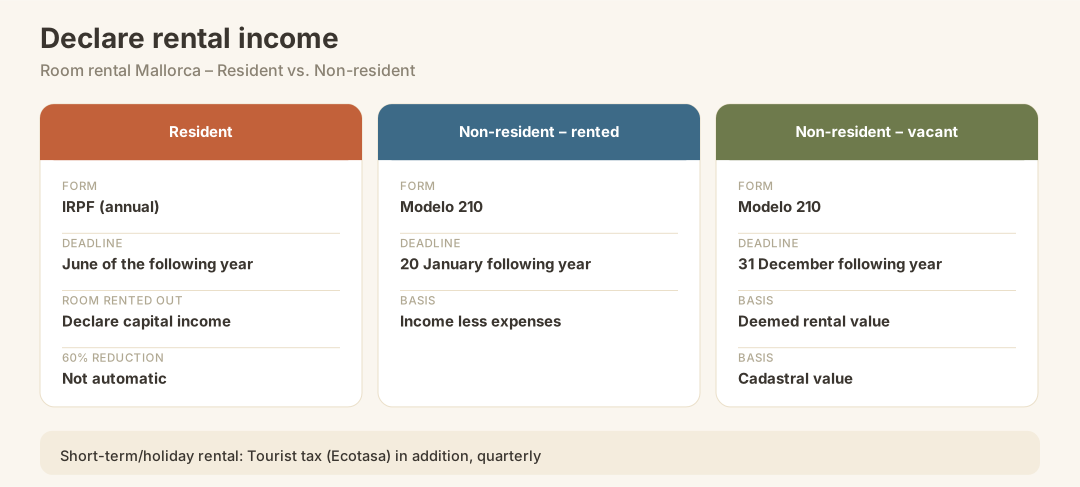
This is the area where most mistakes occur. The tax liability depends on whether you are a resident or a non-resident.
Residents (IRPF)
If you are tax-resident in Spain, you declare rental income from room lettings in your income tax return (IRPF). The income must be declared as capital income from property letting.
Allowable expenses (gastos deducibles) that you can deduct on a proportional basis:
- Proportional mortgage interest
- Proportional depreciation (amortización)
- Repairs and maintenance (proportional for the rented room)
- Proportional IBI, Comunidad, insurance
- Proportional utility costs (electricity, water)
The deductibility is to be calculated proportionally : if you rent out a room of 20 m² in a 100 m² flat, you can claim 20 % of total costs — but only for the days actually rented out.
Please note: The tax reduction of 60 % on net rental income (for residential lettings under LAU Título II) does not generally apply automatically to room rentals, as no standard residential tenancy agreement is in place. Have this checked by a tax adviser.
→ More: IRPF deduction for landlords in the Balearic Islands
Non-residents (Modelo 210)
If you are not tax-resident in Spain, you must declare rental income using Modelo 210. A return must be submitted by 20 January of the following year, declaring the rental income less the proportional allowable expenses.
For days on which the room stands empty and is not rented out, the proportional deemed-use tax (based on the cadastral value) is payable — the filing deadline for this is 31 December of the following year.
→ Details: Taxing rental income as a non-resident in Spain
Overview of tax obligations
| Situation | Tax return | Deadline |
|---|---|---|
| Resident, room let | IRPF (annual) | Usually June of the following year |
| Non-resident, room let | Modelo 210 | 20 January of the following year |
| Non-resident, room vacant | Modelo 210 (deemed rental value) | 31 December of the following year |
| Short-term/holiday letting | Tourist tax (Ecotasa) in addition | Quarterly |
VAT on room lettings?
The simple letting of a room for residential purposes is in principle exempt from VAT. The situation is different if you provide hotel-style additional services (breakfast, daily room cleaning, laundry service): VAT liability may then arise. The same applies if you invoice through agencies that issue invoices on their own account.
If in doubt: consult a tax adviser with Mallorca experience before finalising your business model.
Most common mistakes when letting a room in Mallorca
Lawyers and tax advisers in Mallorca see these mistakes time and again:
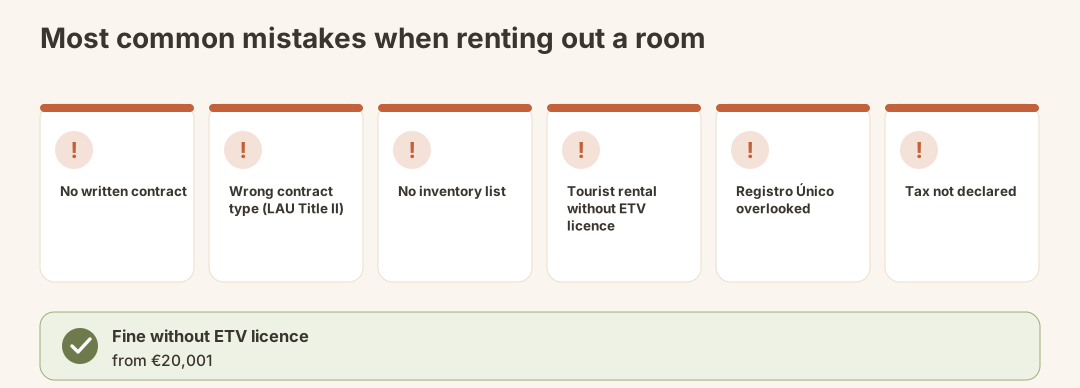
- No written contract – if there is a dispute over the deposit or notice to quit, you are left without protection.
- Wrong type of contract chosen – a LAU Title II contract for a room letting is legally problematic.
- No inventory list – claiming damages is virtually impossible without documentation.
- Letting for tourist purposes without an ETV licence – fines from €20.001.
- Registro Único overlooked – Mandatory from 1. Juli 2025 for rentals via online platforms.
- Tax not declared – Rental income is always taxable, no matter how small.
- 60 % IRPF reduction incorrectly applied – does not automatically apply to room rental agreements.
- Deposit not returned on time – can give rise to liability for damages.
- Ancillary costs not clearly regulated – almost always leads to disputes.
- House rules missing – absolutely essential when a kitchen and bathroom are shared.
Checklist: renting out a room on Mallorca
- Type of contract clarified (permanent residence, seasonal, tourist)?
- Written contract drawn up with all required particulars?
- Deposit agreed and proof of payment documented?
- Inventory list with photos prepared and signed by both parties?
- Tenant's NIE number included in the contract?
- Tax adviser informed of rental income (IRPF or Modelo 210)?
- For online rentals: Registro Único applied for (mandatory from Juli 2025)?
- For tourist use: ETV licence in place?
- House rules attached as an annex to the contract?
- Ancillary costs arrangement set out in writing?
What comes next? Important follow-on topics
Anyone renting out a room should also keep the broader tax and legal dimensions in mind:
- IBI: As a rule, the landlord bears the property tax – you should be aware of any potential IBI reduction. → IBI reduction Mallorca
- Owners' community: Renting out a room within a communal complex may raise questions under community law. → Owners' community Spain
- Cédula de Habitabilidad: The room must be located in a property with a valid habitability licence. → Cédula de Habitabilidad Mallorca
- Bono Alquiler Joven: Young tenants meeting certain conditions can apply for a rental subsidy on the Balearic Islands. → Bono Alquiler Joven Balearen
- Ley Vivienda on the Balearic Islands: The 2023 Housing Act has introduced a number of regulations affecting landlords on the Balearic Islands as well. → Ley Vivienda Balearen
Conclusion
Renting out a room on Mallorca is legally permissible and can be a worthwhile source of income – provided you know the rules. The most important step: choosing the right type of contract. Room rentals are not subject to the strong tenant-protection provisions of the LAU that apply to residential lettings, which gives you as a landlord greater flexibility, but also means you must regulate everything contractually yourself. From July 2025, the Registro Único obligation additionally applies to every rental advertised via an online platform. Renting to tourists without an ETV licence, on the other hand, remains an expensive risk. Have your contract and tax situation reviewed by someone who knows the Balearic market – in a worst-case scenario, that will save you far more than it costs.
Official Sources
- Ley de Arrendamientos Urbanos (LAU): https://www.boe.es/buscar/act.php?id=BOE-A-1994-26003
- Registro Único de Arrendamientos de Corta Duración (Real Decreto 1312/2024): https://www.boe.es
- Agència Tributària de les Illes Balears (ATIB): https://www.atib.es
- Agencia Estatal de Administración Tributaria (AEAT) – Modelo 210: https://www.aeat.es
- Govern de les Illes Balears – Turisme: https://www.caib.es/sites/turisme
- Consell de Mallorca: https://www.conselldemallorca.net