
11-Month Tenancy Agreement in Spain: Landlord's Trick or Genuine Risk?
You've found a flat in Mallorca, the landlord puts a contract in front of you for eleven months – and tells you that's "perfectly normal". Is it? The so-called 11-month tenancy agreement is a widespread construct in Spain that, at first glance, looks like a quick, uncomplicated arrangement. Behind it, however, lies a clear legal distinction: such a contract is not a long-term tenancy agreement within the meaning of Spanish tenancy law, but rather a seasonal tenancy (arrendamiento de temporada) under LAU Artikel 3 – with considerably less protection for you as a tenant. In this guide you will learn what that means in practice, how the three types of tenancy agreement in Spain differ from one another, what rights you have depending on the type of contract, why your Empadronamiento status may depend on it, and when a seasonal contract is legitimate – and when it is being misused.

What Spanish law actually says: the three types of tenancy agreement
Spanish tenancy law (Ley de Arrendamientos Urbanos, or LAU for short) has no contractual category called an "11-month agreement". You won't find that term anywhere in the legislation. What does exist are two fundamentally different forms of residential letting – and a third for tourist lettings.
| Contract type | Spanish term | LAU article | Purpose | Tenant protection |
|---|---|---|---|---|
| Long-term tenancy agreement | arrendamiento de vivienda habitual | Art. 2, 9–10 | Permanent primary residence | Very high: minimum term of 5/7 years |
| Seasonal tenancy agreement | arrendamiento de temporada | Art. 3 | Temporary stay without primary residence | Low: only the contractually agreed term |
| Tourist letting | arrendamiento turístico | Outside LAU | Short-term accommodation | No LAU tenant protections |
The 11-month contract is almost always a seasonal tenancy agreement under Art. 3 LAU. The duration of exactly eleven months is no coincidence: under the law, a seasonal contract must run for longer than one month but less than one year — twelve months would formally already be the threshold at which many courts would examine whether the agreement should be classified as a residential tenancy.
Note: The term "seasonal tenancy agreement" does not mean the contract only applies in summer. It means that the property is not used as a permanent primary residence — this can also apply to a seven-month winter stay or a ten-month work placement.
Why landlords in Mallorca prefer the 11-month contract
From a landlord's perspective, the seasonal tenancy agreement offers tangible advantages — and that is precisely why it is so popular, even when it does not always reflect the actual purpose of use:
1. No statutory security of tenure Under a long-term tenancy agreement (vivienda habitual), you as a tenant have the right to remain in the property for at least five years (with private landlords) or seven years (with legal entities/companies) — even if the landlord wishes otherwise. With a seasonal tenancy agreement, the tenancy ends automatically on the agreed date, with no security of tenure.
2. No automatic contract renewal Long-term tenancy agreements renew automatically under LAU Art. 9 and 10 if the landlord does not give notice in time and in the prescribed form. This obligation does not apply to seasonal contracts.
3. More flexible terms Seasonal contracts may contain clauses that would be unlawful in long-term tenancy agreements — for example, stricter return conditions or higher flat-rate utility charges.
4. No cap on rent increases The statutory ceiling on rent increases (linked to the IRAV index since 2025) expressly applies only to long-term tenancy agreements under Art. 2 LAU. For seasonal contracts, landlords are free to set the rent at whatever level they choose for each new contract period.
5. Fewer hurdles for repossession If a landlord wishes to use the property themselves, strict formal requirements apply under a long-term tenancy agreement. With a seasonal contract, the expiry of the contract suffices.
The decisive question: what is the actual purpose of use?
This is where matters become legally interesting — and where the real point of contention lies. Spanish law does not classify a contract solely on the basis of its label or duration, but rather on the actual purpose for which the property is used.
Spanish case law makes clear: if someone uses a property as their permanent primary residence, they are entitled to the full protections of residential tenancy law — regardless of how the contract was labelled. If a seasonal contract is therefore concluded when both parties know that the property is serving as a permanent residence, a court may recharacterise the contract as a primary residence reclassify.
In practice, this means:
- The term is raised to the statutory minimum duration
- Eviction protection applies retrospectively
- Invalid clauses in the seasonal contract become void
Caution: Reclassification does not happen automatically. You must actively pursue it through a court – which costs time, money, and nerves. If in doubt, seek legal advice beforehand.
When the seasonal tenancy agreement is legitimate and makes sense
It would be wrong to dismiss the seasonal tenancy agreement outright as a dubious construct. There are a number of situations in which it is legally correct and makes sense for both parties:
| Scenario | Seasonal contract appropriate? | Why |
|---|---|---|
| Summer stay (2–5 months) | ✅ Yes | No permanent residence intended |
| Temporary work assignment (e.g. seasonal job) | ✅ Yes | Temporary purpose clearly defined |
| Transitional period before buying a property | ⚠️ Grey area | If primary residence is being relocated, a long-term tenancy agreement is preferable |
| Permanent relocation to Mallorca | ❌ No | Contradiction between contract and actual use |
| Winter stay as a second residence | ✅ Yes | No primary residence, temporary stay |
| Primary residence on Mallorca with empadronamiento | ❌ No | A long-term tenancy agreement is required by law |
The crucial point from legal practice: a seasonal contract should explicitly state the specific temporary purpose underlying the stay — holiday visit, temporary work assignment, study, or similar. Without this statement of purpose, the contract is open to challenge.
The empadronamiento problem: when a seasonal contract blocks your life
For anyone wishing to live on Mallorca permanently, the empadronamiento — the municipal residents' registration — is essential. It is a prerequisite for:
- NIE follow-on processes and residencia
- The Spanish health card
- School enrolment for children
- Many municipal services
- Proof of tax residence
The problem: many town halls (Ajuntaments) on Mallorca and in other Spanish regions refuse to grant empadronamiento on the basis of a seasonal tenancy agreement. The reasoning is consistent with the wording of the law: a seasonal tenancy agreement does not document a permanent place of residence. Some municipalities will accept it nonetheless — but by no means all, and it is not something you can rely on.
Anyone wishing to register their primary residence on Mallorca will generally need a long-term tenancy agreement (arrendamiento de vivienda habitual). This is not bureaucratic formalism, but a direct consequence of the contract classification under LAU.
Note: Ask your landlord in writing, before signing the contract, to confirm that they will sign the empadronamiento paperwork. A landlord who offers a seasonal contract but refuses to sign the registration documents is making it clear that they actively intend to prevent the property from being used as a permanent residence.
Deposit, agency fees and rent increases: what applies under which contract?
The differences between seasonal and long-term tenancy agreements also become apparent when looking at specific costs:
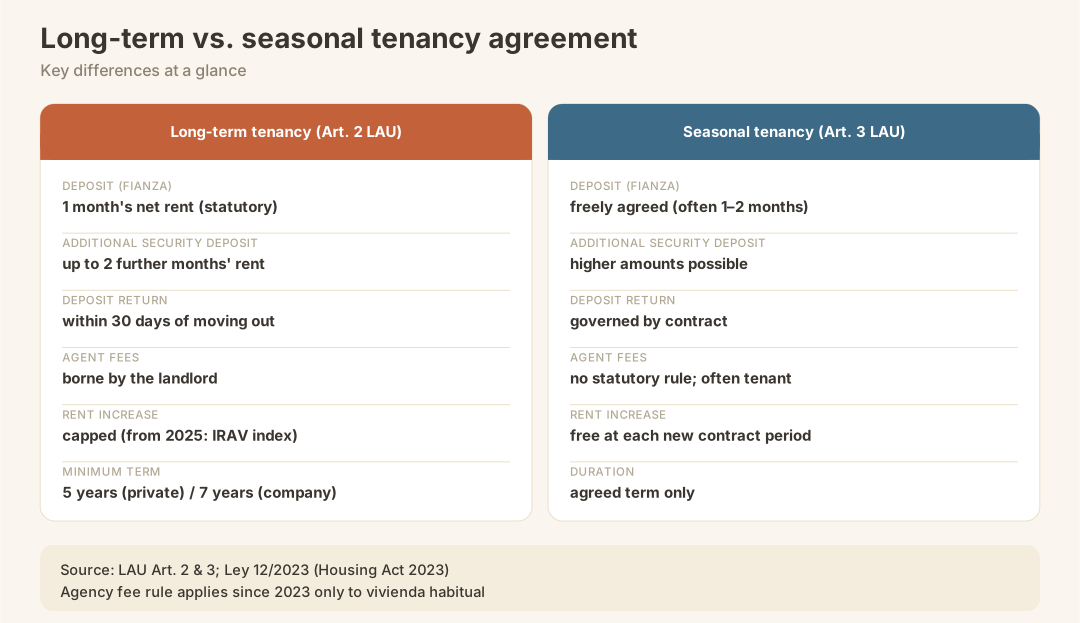
| Provision | Long-term tenancy agreement (Art. 2 LAU) | Seasonal tenancy agreement (Art. 3 LAU) |
|---|---|---|
| Deposit (fianza) | Statutory: 1 month's net rent | Freely negotiable (often 1–2 months) |
| Additional security deposit | Up to 2 further months' rent | Higher amounts possible |
| Return of deposit | Within 30 days of moving out | Governed by contract |
| Agency fees | Borne by the landlord | No statutory rule; often the tenant |
| Rent increase | Capped (from 2025: IRAV index) | Freely set at each new contract period |
| Duration | Minimum 5 years (private) / 7 years (companies) | Agreed term only |
Particularly relevant: the abolition of agency fees for tenants applies expressly only to long-term tenancy agreements (vivienda habitual). Under a seasonal contract, landlords or agents can – and frequently do – charge the commission to the tenant.
What happens when the 11-month contract expires?
Here lies another pitfall that catches many tenants off guard: a seasonal contract does not renew automatically. If the landlord does not offer a new contract after eleven months, you must vacate the property – with no notice period and no protection.
What many landlords do in practice is sign a new seasonal contract for a further eleven months once the previous one expires – and repeat this year after year. This is legally precarious. If it can be shown that the property has been used continuously as a permanent residence and that the succession of seasonal contracts serves solely to circumvent tenant protections, a court may treat the overall arrangement as a long-term tenancy.
Case law on this point is not uniform. Some rulings have found a chain of seasonal contracts to be abusive; others have not. The decisive factor, again, is the demonstrable purpose for which the property is used.
Please note: If you are already in your second or third consecutive 11-month contract for the same property and are using it as your primary residence, you should seek legal advice on your position before signing the next contract.
The most common mistakes when signing a seasonal tenancy agreement
We see these issues time and again – and they cost tenants either money or their home:
1. Failing to check whether the actual purpose of use matches the type of contract Anyone who wants to live permanently in Mallorca should not sign a seasonal contract – regardless of what the landlord says.
2. Not discussing empadronamiento in advance Many tenants only discover after moving in that the local authority will not accept their registration on the basis of a seasonal contract.
3. Signing a higher deposit without a written security agreement Without a clear contractual arrangement governing its return, disputes can arise.
4. Paying agency fees as a tenant without questioning them For long-term tenancy agreements, this has been clearly regulated since 2023 – but not for seasonal contracts.
5. The clause stating the purpose of use is missing or vague A valid seasonal contract requires a clearly defined temporary purpose. If the contract simply states "seasonal rental", that is not sufficient.
6. Automatic renewal expected With a seasonal contract, there is no automatic renewal. Anyone unaware of this may suddenly find themselves without accommodation.
7. Invalid clauses in the long-term tenancy agreement accepted The reverse also applies: anyone who holds a genuine long-term tenancy agreement but signs clauses that undermine their statutory protections should be aware that such clauses are generally void – however, the remainder of the contract remains valid.
What comes next? Your options after the contract expires
| Situation | Recommendation |
|---|---|
| Landlord offers a new seasonal contract | Check whether a long-term tenancy agreement can be enforced |
| Landlord gives notice / you wish to stay | Seek legal advice and provide evidence of use as primary residence |
| You wish to stay long-term | Insist on a long-term tenancy agreement from the outset |
| You are planning to buy after the rental period | Transitional rental potentially via seasonal contract, but clarify all terms in writing |
| Empadronamiento was refused | Lodge an appeal or look for accommodation with a proper contract |
If you are already living in a property and are considering whether buying might make more sense in the long term, it is worth consulting our guide on Buying or Renting in Mallorca.
Checklist: Things to verify before signing
- Which type of contract is the landlord presenting me with? (LAU Art. 2 or Art. 3?)
- Does the contract type correspond to my actual intended use?
- Is the temporary purpose (in the case of a seasonal contract) specifically described in the contract?
- Has the landlord confirmed in writing that they will support the empadronamiento?
- Are the deposit and any additional security clearly set out?
- Has the deadline for the return of the deposit (30 days after moving out) been recorded?
- Who bears the estate agent's fees – and is this governed by law for my type of contract?
- Have I checked all clauses for validity (with a solicitor if necessary)?
- Do I know what happens when the contract expires – is there an option to renew?
- Is the property in a habitable condition (cédula de habitabilidad in place)?
On the last point: whether a Cédula de Habitabilidad exists can be verified before signing the contract.
Conclusion: Keep your eyes open with the 11-month contract
The 11-month tenancy agreement is not an illegal construct – it is a legitimate instrument for legitimate purposes. If you are only on Mallorca for the summer, working for a few months, or need temporary accommodation, it is legally correct and practically sensible.
It becomes a real danger when it is used to strip tenants who want to live on the island permanently of their statutory protections: no security of tenure, no automatic renewal, no rent cap, and often no Empadronamiento. This is not abstract – it determines whether you can live somewhere stably for five years or whether you have to renegotiate every single year.
The most important rule of thumb: The name of the contract is not what matters – the purpose for which it is used is. Anyone who lives permanently on Mallorca and genuinely uses the property as their primary residence has a strong legal case to have a misused seasonal contract reclassified. However, that can only be done through the courts – and is considerably more arduous than getting the right type of long-term tenancy agreement from the outset.
Get advice from a local solicitor before you sign – the effort involved is manageable; the consequences of choosing the wrong type of contract may not be. For everything relating to the tax side as a landlord, see our guide on IRPF deductions for landlords in the Balearic Islands.
Official sources
- Ley de Arrendamientos Urbanos (LAU): boe.es – Ley 29/1994 — Foundational tenancy law in Spain, Art. 2 (vivienda habitual), Art. 3 (temporada)
- Ley por el Derecho a la Vivienda (Housing Act 2023): boe.es – Ley 12/2023 — Estate agent commissions, IRAV index, rent increase caps
- Agència Tributària de les Illes Balears (ATIB): atib.es — Tax-related aspects of letting property in the Balearic Islands
- Govern de les Illes Balears – Habitatge: habitatge.caib.es — Housing policy and tenancy law in the Balearic Islands
- Tribunal Supremo (Supreme Court): poderjudicial.es — Case law on the reclassification of seasonal tenancy agreements
Ending a seasonal tenancy agreement early: What are the rules?
A fixed-term seasonal tenancy agreement ends on the agreed date. If you want to move out earlier, first check whether the agreement provides for early termination: When is it possible, how much notice is required, and are any payments stipulated? If there is no such provision, the tenant and landlord can agree to end the tenancy earlier. Moving out alone does not automatically end your contractual obligations.
It is important to distinguish this from a tenancy agreement for a permanent home. Article 11 of Spain’s Urban Leases Act (LAU) gives tenants of residential properties the right to leave after six months with at least 30 days’ notice. This cannot automatically be applied to a seasonal tenancy agreement under Article 3. Nor can the landlord end an agreement early solely because they want to use the property differently; the terms of the agreement and, where applicable, legal grounds such as a breach of contract are decisive.
If you agree to end the tenancy early, record the move-out date, any outstanding rent and utility charges, and the handover of keys in writing. A handover report helps document the property’s condition and any issues that might later be disputed. If substantial claims are involved, or it is unclear whether your agreement legally qualifies as a seasonal tenancy agreement, have it reviewed individually.
This section does not constitute legal or tax advice.
This guide provides a general overview of the legal position and does not replace legal or tax advice on your individual circumstances. Laws and deadlines may change; the linked official sources are authoritative.