
When can landlords start a desahucio in Spain?
Anyone who rents out a property on Mallorca or elsewhere in Spain may eventually find themselves in the position of having to evict a tenant. The legal term for this is Desahucio – and the Desahucio Spanien Ablauf is strictly regulated: no landlord may act unilaterally without a court order. What is sometimes regarded as a gruelling process in Germany actually has an accelerated route in Spain – the so-called "Desahucio exprés" – but it also comes with treacherous pitfalls. This guide explains to you as a landlord, step by step, what legal foundations apply, what deadlines you must observe, what a procedure costs, when delays occur, and which mistakes you should absolutely avoid.

What is a Desahucio – and when is it permissible?
A Desahucio is the Spanish judicial eviction procedure by which a landlord can compel a tenant to vacate a property. Without a legally binding court order – i.e. without a judgment or judicial ruling – the landlord may under no circumstances evict the property unilaterally, change the locks, or cut off utilities. Such actions are a criminal offence in Spain.
The law distinguishes several grounds on which a Desahucio may be initiated:
| Ground | Spanish term | Special feature |
|---|---|---|
| Rent arrears | Desahucio por falta de pago | Most common case; even a single outstanding instalment suffices |
| End of contract without vacating | Desahucio por expiración de plazo | 4 months' advance notice by the landlord required |
| Breach of contract (other) | Desahucio por incumplimiento | e.g. unauthorised subletting, property damage, illegal activities |
| Own use | Desahucio por necesidad del propietario | Subject to strict conditions |
Please note: Spanish tenancy law does not recognise automatic rent reduction. Even a single unpaid partial rent instalment – regardless of the reason – entitles the landlord to initiate eviction proceedings.
Legal basis: LAU and Spanish civil procedure law
The foundation of all residential tenancy relationships in Spain is the Ley de Arrendamientos Urbanos (LAU), most recently comprehensively reformed in 2019. The procedural provisions of the Ley de Enjuiciamiento Civil (LEC).
The most important parameters of the LAU at a glance:
| Provision | Private landlord (natural person) | Corporate landlord (legal entity) |
|---|---|---|
| Minimum tenancy duration (security of tenure) | 5 Jahre | 7 Jahre |
| Automatic renewal upon expiry | Up to 3 further years | Up to 3 further years |
| Notice period for non-renewal by the landlord | 4 Monate vor Vertragsende | 4 Monate vor Vertragsende |
| Tenant's right to rent reduction | Not provided for | Not provided for |
One important difference from German law: in Spain there is no statutory right to reduce rent. Any tenant who unilaterally reduces the rent due to defects formally gives the landlord the right to bring eviction proceedings. Claims relating to defects must be pursued separately — ideally by means of notarial service.
For landlords, this means: the formal legal position is on their side in many cases. The decisive factor is conducting the proceedings correctly.
The Desahucio Spain process: step by step
The expedited eviction procedure (Desahucio exprés) for non-payment follows a clearly regulated process. Here are the typical stages:
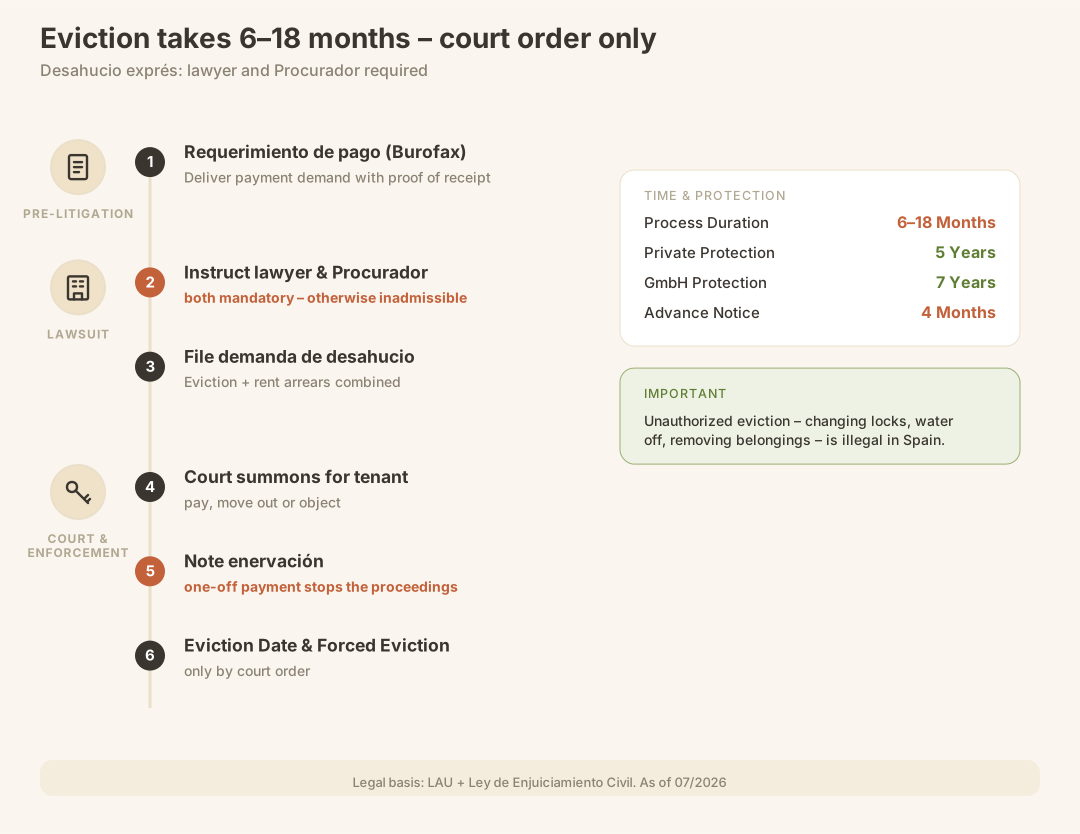
Step 1 – Payment demand (Requerimiento de pago)
Before going to court, it is advisable to issue a formal payment demand to the tenant. This should be done in writing and in a verifiable manner — ideally by burofax (Spanish recorded delivery with acknowledgement of receipt and certificate of contents). The burofax is not a mandatory prerequisite for court proceedings, but it documents the debt-collection attempts and can be important during the process.
Step 2 – Instructing a lawyer and Procurador
The following are mandatory for any court-based eviction procedure in Spain:
- a Abogado (solicitor) – they draft the claim
- a Procurador (court representative) – they represent you procedurally before the court
Both appointments are mandatory and cannot be replaced by the landlord themselves.
Step 3 – Filing the Demanda de desahucio
The Abogado submits the eviction claim (demanda de desahucio) to the competent court (Juzgado de Primera Instancia). The claim simultaneously contains – and this is the decisive advantage of the Desahucio-exprés procedure – two combined applications:
- Eviction of the tenant (desahucio)
- Payment of outstanding rent arrears
Step 4 – Court summons and options for the tenant
The court serves the claim on the tenant and simultaneously notifies them of a fixed eviction date. The tenant then has the following options in principle:
| Tenant's response | Consequence |
|---|---|
| No response, no vacating | Eviction date is enforced |
| Voluntary vacating before eviction date | Proceedings end, no forced eviction |
| Payment of all arrears (Enervación) | Proceedings are discontinued – but only possible once |
| Objection / defence | Oral hearing is scheduled |
Step 5 – Enervación: the tenant's one-time right to halt proceedings
Spanish law grants the tenant what is known as the right of Enervación: they can stop the proceedings by paying all outstanding amounts in full before the hearing. However, this right may only be exercised once per tenancy. If it has already been used, the tenant cannot rely on it again in the event of a further non-payment.
Please note: If, as the landlord, you have already formally rejected the rent arrears in writing prior to filing the claim, or the tenant has already exhausted their right of Enervación, they can no longer halt the proceedings through subsequent payment.
Step 6 – Eviction date and forced eviction
If the tenant neither vacates the property nor pays, the forced eviction is carried out on the scheduled eviction date. This date is generally specified directly in the notice of admission of the claim. A court officer and, where necessary, the police will be present during the process.
Typical timescales: what you need to realistically factor in
The duration of proceedings is one of the most critical aspects of the Desahucio process. The figures vary considerably depending on the court, municipality, and the specifics of each case.
| Scenario | Typical total duration |
|---|---|
| Standard non-payment case, no defence | 6–12 months |
| Tenant files an objection | 12–18 months |
| Tenant is classified as vulnerable (social report required) | Considerably longer possible |
| Okupa situation (illegal occupation) | Separate proceedings, distinct rules |
Please note: Cases in which the tenant is classified as a vulnerable person (e.g. families with children, people without alternative accommodation, recipients of state support) are subject to a requirement to involve the social services. This can significantly extend the proceedings, as the judge must await the social report before enforcing the eviction.
Desahucio for illegal occupation (Okupa): a chapter of its own
Anyone who thinks squatter cases (okupas) follow the same process as a standard desahucio procedure is mistaken. Different legal routes apply here – and Spanish criminal law offers various avenues depending on the situation:
| Offence | Legal basis | Sentencing range | Procedure |
|---|---|---|---|
| Breaking into an occupied home (primary or secondary residence) | Art. 202 Código Penal (Allanamiento de morada) | 6 months – 2 years (up to 4 years if violence is involved) | Criminal proceedings, generally faster |
| Occupation of a vacant property | Art. 245 Código Penal (Delito de usurpación) | Fine of 3–6 months | Slower, more complex |
The decisive factor for criminal classification is the actual use of the property: a holiday home containing personal belongings and with active utility connections is considered a residence within the meaning of Art. 202 – and this is particularly relevant for Mallorca property owners who also use their property as a holiday home.
Please note: A wrong first step when filing a complaint – namely an incorrect criminal classification – can trigger delays of several months. Seeking legal advice from a solicitor before going to the police is not optional here; it is essential.
Costs of desahucio proceedings
It is not possible to quote reliable flat-rate fees here, as solicitors' charges in Spain are freely negotiable. The following can, however, be stated with confidence:
| Cost element | Notes |
|---|---|
| Abogado (solicitor) | Mandatory appointment; fee freely negotiable, often charged as a flat rate or on an hourly basis |
| Procurador (court representative) | Mandatory appointment; fees regulated by law (aranceles) |
| Court fees | Often low or waived for private individuals in eviction proceedings |
| Enforcement costs | If forced eviction is necessary, costs arise for a locksmith, removal etc. |
| Rent arrears | Can be claimed within the same proceedings |
The good news: should you win the case, the court can order the tenant to pay the legal costs. In practice, however, the actual recoverability of this claim is often limited if the tenant is insolvent.
End of contract and termination for own use: what must happen beforehand
When the tenancy agreement expires and you do not wish to renew it, you must give written, verifiable notice that you are refusing the renewal at least 4 months before the end of the contract. If you fail to do so in time, the contract automatically extends by a further year – up to the statutory maximum extension period of 3 years.
For own use (e.g. the landlord themselves or close family members moving in), specific conditions apply that should be agreed upon in advance in the tenancy agreement. In the event of a dispute, the burden of proof lies with the landlord.
The most common mistakes – and how to avoid them
Most desahucio proceedings fail not because of the legal merits but because of procedural errors. These are the typical pitfalls:
No burofax, no proof: Verbal reminders and simple emails are difficult to prove in a dispute. Always use the burofax – it documents both the content and receipt.
Accepting rent too early: If you accept partial payments after proceedings have commenced without making your position clear, this can be interpreted as acceptance and undermine the case. Have your solicitor oversee every step.
Taking matters into your own hands: Changing the locks, cutting off the water, putting belongings outside – all of this is illegal and a criminal offence in Spain.
Wrong type of proceedings for okupas: As described above, an incorrect criminal classification leads to months of wasted time.
No Procurador instructed: Filing the proceedings without a Procurador is a formal error that renders the claim inadmissible.
Tenancy agreement contains no exclusion of the right of enervasión: If the tenant has not yet exhausted their right of enervasión, they can halt the proceedings by paying all arrears in full. This is lawful – frustrating, but predictable.
Vulnerable status not on the radar: Do you have reason to believe your tenant could be classified as a vulnerable person? If so, factor in extra time and discuss this with your solicitor in advance.
Checklist: initiating a desahucio in Mallorca
Before your lawyer files the Demanda, you should have the following to hand:
- Tenancy agreement (original or certified copy)
- Evidence of unpaid rent (bank statements, booking journals)
- Burofax documentation (proof of sending + delivery confirmation)
- NIE number and identity document of the landlord
- Copy of the land registry extract for the property
- Proof that the right of enervation has already been exercised (if applicable)
- Engagement contract with Abogado and Procurador
What happens after the Desahucio?
Once the property has been vacated, a new chapter begins for you as landlord:
Inspect the condition of the property: Together with a witness or notary, draw up a handover report and document any damage with photographs. Damage that goes beyond normal wear and tear can be covered from the deposit – in Spain, the statutory minimum deposit is one month's rent.
Enforce outstanding claims: The rent arrears secured through the Desahucio proceedings can continue to be enforced – however, only if the former tenant has attachable assets.
Prepare for re-letting: Read our guide on long-term rentals in Mallorca before drawing up a new contract – and pay attention to the tax aspects: IRPF deductions for landlords in the Balearic Islands are considerable and often overlooked.
Sell the property rather than re-let? If, after your experience with a problem tenant, you would prefer to sell, you will find everything about selling property in Mallorca in our dedicated guide.
Conclusion: Desahucio in Spain – straightforward in principle, but not plain sailing
The Desahucio Spanien process is clearly regulated in formal terms and offers landlords a comparatively efficient means of pursuing rent arrears and eviction claims simultaneously through the Desahucio-exprés procedure. The typical duration of 6 to 18 months is no sprint, but it is manageable with good preparation and an experienced legal team.
The key point is: No unilateral action, consistent documentation, prompt engagement of an Abogado and Procurador. Anyone who follows these three ground rules is on safe ground. Anyone who acts independently or neglects formalities risks criminal complaints being filed against themselves – and years of proceedings.
Official sources
- Ley de Arrendamientos Urbanos (LAU): https://www.boe.es/buscar/act.php?id=BOE-A-1994-26003
- Ley de Enjuiciamiento Civil (LEC): https://www.boe.es/buscar/act.php?id=BOE-A-2000-323
- Código Penal España (Art. 202, Art. 245): https://www.boe.es/buscar/act.php?id=BOE-A-1995-25444
- Consell de Mallorca – Habitatge: https://www.conselldemallorca.cat
- AEAT – Tax obligations for landlords: https://www.agenciatributaria.es
- Govern de les Illes Balears – Habitatge i Territori: https://www.caib.es
This guide provides a general overview of the legal position and does not replace legal or tax advice on your individual circumstances. Laws and deadlines may change; the linked official sources are authoritative.