
Cédula de Habitabilidad Mallorca: How to Apply for the Habitability Certificate
Anyone buying, selling, or letting a property on Mallorca, or simply wanting to register electricity, water, and gas, will need one without exception: the Cédula de Habitabilidad Mallorca, known in English as a habitation certificate. The document officially certifies that a residential building, flat, or premises meets the minimum requirements set by the authorities with regard to size, sanitary facilities, and technical connections. Without a valid Cédula, the notary may not execute a deed of sale, and utility providers will not enter into a new contract. In this guide you will learn which of the three types applies to your situation, what documents you will need, how the application process with the Consell works — and which mistakes occur most frequently when buying or selling.

Do you have questions about your specific property situation on Mallorca?
- 📩 Submit a personal enquiry — We will clarify which type of Cédula you need and support you throughout the application
- All steps in buying a property on Mallorca
What is the Cédula de Habitabilidad — and why is it mandatory?
The Cédula de Habitabilidad is an official document issued by the Consell de Mallorca (Departamento de Territorio), certifying that a property meets the minimum legal requirements for residential use. The following aspects are assessed in particular:
- Minimum size of living and bedroom spaces
- Sanitary facilities (shower/bath, toilet, washbasin)
- Technical connections for water, drainage, and electricity
The obligation to hold a Cédula is enshrined in Article 16.1 of Law 5/2018 de la vivienda de les Illes Balears Without a valid Cédula, the following are not legally possible:
| Transaction | Consequence without a valid Cédula |
|---|---|
| Purchase/sale before a notary | Notary refuses to execute the deed |
| Entering into a contract with a water provider | No contract can be issued |
| Registering an electricity or gas contract | Provider refuses new connection |
| Telecommunications contract | Connection not permitted |
| Long-term letting | Letting not legally permitted |
| Holiday Lettings (ETV Licence) | Licence Application Fails Without a Cédula |
Please note: Older properties that are already lawfully connected to the electricity and water supply may continue to operate — however, when transferring the registration to a new owner or tenant, a valid Cédula is generally required once again.
The Three Types of Cédula de Habitabilidad at a Glance
The crucial first question is always: which type applies to your property? The type determines which documents you will need and whether an architect must be involved.
| Type | When Required | Special Feature |
|---|---|---|
| Cédula de Primera Ocupación | New build; extension; conversion/renovation affecting more than 60% of the floor plan layout; change of use | Most extensive documentation required, architect mandatory |
| Cédula de Renovación | Existing Cédula has expired (after 10 years), no structural changes in the sense of a Primera Ocupación | Simplified procedure |
| Cédula de Carencia | Buildings without any prior Cédula, completedbefore 1 March 1987 | Proof of year of construction required |
Cédula de Primera Ocupación
This is the most demanding variant. It is required whenever a building has been completed for the first time, or when conversion works affect more than 60% of the floor plan layout, consolidation, restoration, or change of use. The application mandatorily requires:
- Proof of ownership (escritura or Nota Simple)
- Building plans and photographs, signed by an architect
- Building permit (Licencia de Obras) from the Ayuntamiento
- Certificate of completion (Certificado Final de Obra) from the architectand the municipality
Important: The Cédula de Primera Ocupación is not the same as the Licencia de Primera Ocupación. The latter is issued by the Ayuntamiento (local council) once it has inspected and signed off the completed building. The Cédula is applied for separately through the Consell de Mallorca.
Cédula de Renovación
Once the 10-year validity period has expired — provided no major structural alterations have been carried out in the interim — only a Renovación is required. You will need to submit the proof of ownership again, along with current, dated photographs of the property signed by a qualified technician.
Cédula de Carencia
For properties that were completed before 1 March 1987 and for which a Cédula has never been issued, this special route is available. The year of construction must be demonstrated, for example by means of the Catastro entry or historical documents.
The competent authority and where to submit your application
On Mallorca, the sole competent authority is the Consell de Mallorca, Departamento de Territorio. The island council may delegate responsibility to individual municipalities; in practice, however, applications are generally submitted directly to the Consell.
| Authority | Contact / Address |
|---|---|
| Consell de Mallorca – Departamento de Territorio | Palau Reial, 1 · 07001 Palma de Mallorca |
| Fundació AEDIFICAT (Training & Architectural Support) | Francesc Valduví, 1 · 07011 Palma · Tel. 971 220 783 |
| COAATMCA (College of Building Technicians Mallorca) | coaatmca.com |
According to the Balearic authorities, processing typically takes around one month. A Cita Previa (prior appointment) is generally required in order to submit your application.
Step by step: how to apply for the Cédula de Habitabilidad
The following step-by-step guide applies to the most common application route (Renovación or Primera Ocupación for an existing property):
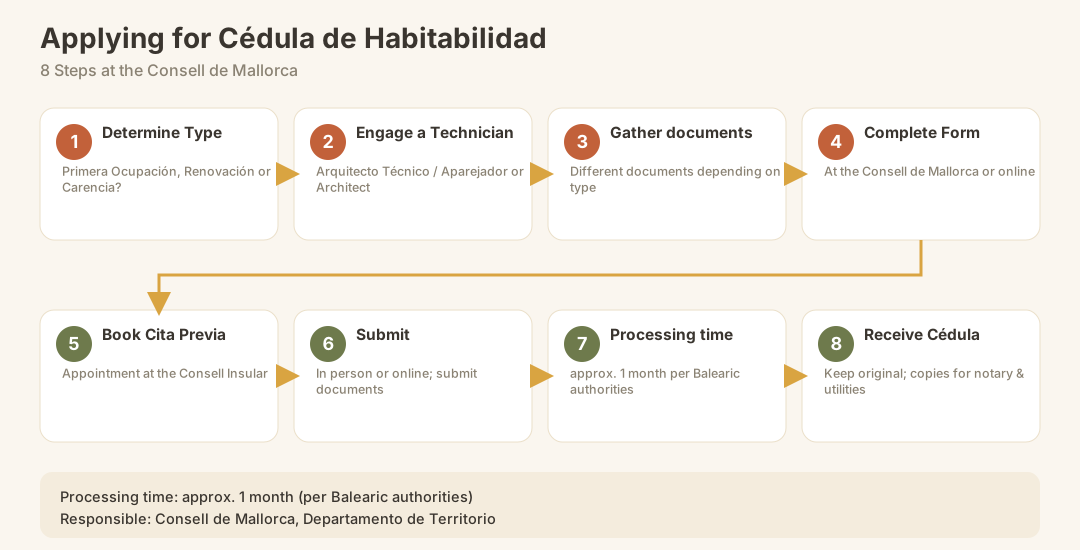
- Determine the type — Cédula de Primera Ocupación, Renovación or Carencia? (Establish the year of construction and any history of alterations)
- Hire a technician or architect – For Primera Ocupación and Renovación, a qualified signatory professional (Arquitecto Técnico/Aparejador or Arquitecto) is required
- Compile the documentation – (see the table in the next section)
- Complete the application form – Form available from the Consell de Mallorca or online
- Book a Cita Previa – Schedule an appointment with the Consell Insular
- Submission – in person or, where possible, online; submit the documents and form
- Await processing – typically around 1 month
- Collect the Cédula – Keep the original; have a copy ready for the notary and utility providers
Documentation in detail: what do you actually need?
| Document | Primera Ocupación | Renovación | Carencia |
|---|---|---|---|
| Application form | ✔ | ✔ | ✔ |
| Proof of ownership (Nota Simple or equivalent) | ✔ | ✔ | ✔ |
| Current photographs (dated and signed by the technician) | ✔ | ✔ | ✔ |
| Building plans (signed by the architect) | ✔ | – | – |
| Building permit (Licencia de Obras) | ✔ | – | – |
| Certificado Final de Obra (architect + local authority) | ✔ | – | – |
| Catastro evidence / proof of year of construction | – | – | ✔ |
| Proof of cadastral data | ✔ | ✔ | ✔ |
Please note: The exact composition of the required documents may vary slightly depending on the municipal delegation and the specific individual case. Have the list checked in advance by a local architect or gestor.
Costs: What does the Cédula de Habitabilidad cost in Mallorca?
We do not have any officially established figures for the administrative fees (tasas) of the Consell de Mallorca for 2025/2026. The following cost items arise in practice:
| Cost item | Note |
|---|---|
| Administrative fee (tasas) Consell | Depends on type; generally a moderate official fee |
| Fee for Arquitecto Técnico / Aparejador | Depends on the scope of work and size of the property; negotiated individually |
| Gestor fee (if engaged) | Variable depending on the scope of services |
As no specific figures are available, we recommend obtaining quotes from at least two local professionals. The administrative fees of the Consell are, in our experience, modest; the main cost element lies with the appointed technical specialist.
Validity, expiry and renewal
A Cédula de Habitabilidad is valid in the Balearic Islands for 10 years – regardless of whether it concerns a Primera Ocupación or a Renovación. Once it expires, a new Cédula de Renovación must be applied for before:
- the property is re-let
- a purchase contract is signed before a notary
- utility contracts are transferred to new owners
Please note: Anyone buying a property with an expired Cédula should resolve the renewal before the notary appointment – or stipulate in the contract who is responsible for obtaining it. If the Cédula is missing entirely, this may indicate planning or building regulation issues.
Cédula and Property Purchase: What Buyers Need to Know
When buying property on Mallorca, the Cédula is a key due-diligence document. Here are the most important points for prospective buyers:
- The notary will not proceed without a valid Cédula. This is not a discretionary rule, but a legal requirement.
- A missing Cédula ≠ an automatically illegal building, but it may indicate unresolved planning or building regulation issues.
- For new purchases, the Cédula (or at least a pending, documented application) should be in place before the escritura appointment.
- Request a copy from the seller – a reputable seller will provide it at the viewing or at the latest upon signing the preliminary contract.
- For older fincas or rural properties, the Carencia variant is common; the year of construction can be evidenced via the Catastro or historical photographs.
For a full overview of the purchase process, see our guide Legal Process for Buying Property on Mallorca.
Cédula and Letting: Short-Term and Long-Term Rentals
The Cédula is essential for both types of letting:
Long-term rental
A valid Cédula is a mandatory requirement for any tenancy agreement. Landlords without a valid certificate may expose themselves to legal liability. Find out more in the guide Long-Term Rental on Mallorca.
Holiday rental (ETV licence)
Anyone wishing to apply for an ETV tourism licence must have a valid Cédula. Without it, the licence application will not be processed. Our guide explains everything else you need to knowETV licence Mallorca.
Most common mistakes relating to the Cédula de Habitabilidad
These are mistakes we encounter time and again – and all of them are entirely avoidable:
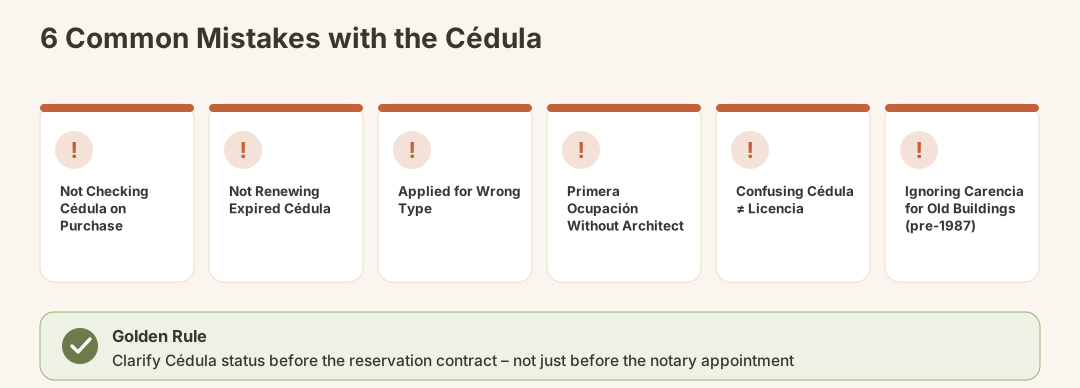
| Mistake | Consequence | Solution |
|---|---|---|
| Cédula not checked at the time of purchase | Notary refuses to certify the deed, delays | Clarify before signing the reservation contract |
| Expired Cédula not renewed in time | No new utility contract, no notary appointment | Submit the application well in advance of the appointment |
| Wrong type applied for | Rejection, loss of time | Discuss in advance with an architect or gestor |
| Primera Ocupación submitted without an architect | Formal error, rejection | Involve a professional from the outset |
| Assumption that the Cédula and the Licencia de Primera Ocupación are the same thing | Missing documents at the notary appointment | Obtain both documents separately |
| Cédula de Carencia not checked for older properties (built before 1987) | Unnecessarily complicated Primera Ocupación procedure | Check the year of construction in the Catastro |
What comes next? Utilities, notary, insurance
Once you have the Cédula in your hands, these are the next steps:
- Setting up utility contracts – electricity, water, gas, telephone/internet
- Notary appointment (escritura) – Bring the original or a certified copy of the Cédula
- Land Registry entry – After the Escritura, the property is entered into the Registro de la Propiedad; our guide is recommended for this: Checking the Spanish Land Registry
- Energy certificate – Also mandatory for purchase and rental; often commissioned at the same time from the same technician → Energy certificate Spain
- Home contents insurance – Many insurers require the Cédula as proof of residential use → Home contents insurance Spain
- Register for IBI – The property tax transfers to the new owner from the date of purchase → IBI tax Spain
Checklist: Cédula de Habitabilidad Mallorca
Use this list as a reminder when buying, selling or before letting:
- Type of Cédula determined (Primera Ocupación / Renovación / Carencia)
- Validity period of the existing Cédula checked (still within 10 years?)
- Year of construction of the property clarified (relevant for Carencia: before 1 March 1987)
- Architect or Arquitecto Técnico engaged (if required)
- All documents fully compiled
- Application form completed
- Cita Previa booked with the Consell de Mallorca
- Processing time of approx. 1 month factored in
- Original Cédula stored safely, copies made for notary & utility providers
- Energy certificate applied for (if applicable, at the same time)
- Utility contracts registered upon receipt of the Cédula
Conclusion
The Cédula de Habitabilidad is no mere bureaucratic footnote on Mallorca — it is a genuine key document: without it, neither the notary appointment nor connection to the utility network can proceed. The good news is that the process is clearly regulated, the three types cover virtually every property situation, and with an experienced local technician (Arquitecto Técnico or Aparejador) the Cédula can generally be obtained within a month. The crucial thing is to act early — ideally before the reservation contract, not just shortly before the notary appointment.
Official sources
- Ley 5/2018, de 19 de junio, de la vivienda de les Illes Balears (Art. 16.1 – Obligation to obtain a Cédula de Habitabilidad): https://www.caib.es/sites/lleihabitatge/de/pagina_principal-34840/
- Consell de Mallorca – Departamento de Territorio (Competent authority, application documents): https://www.conselldemallorca.cat
- COAATMCA – Col·legi Oficial d'Aparelladors, Arquitectes Tècnics i Enginyers d'Edificació de Mallorca, Menorca, Eivissa i Formentera: https://www.coaatmca.com
- Fundació AEDIFICAT (Training & professional support for the Cédula application process): https://www.fundacionaedificat.org
- Govern de les Illes Balears – Habitatge (general housing policy for the Balearic Islands): https://www.caib.es