
Buying Property in Mallorca: A Step-by-Step Guide
Buying property in Mallorca follows a different rhythm from buying in Germany: the notary here does not carry out checks on your behalf, the preliminary contract (Contrato de Arras) typically commits you to a deposit of 10 percent, and without a NIE number you cannot sign anything at all. Those who understand the process buy with confidence — those who underestimate it risk five-figure losses in the worst case. This guide takes you step by step through the entire process: from the NIE through to reservation, the Arras contract, due diligence and the notary appointment, right through to registration in the land registry and your post-purchase obligations.

Check your arras contract
Explanation
The purchase price is the property price agreed in the contract. The preset is an example; enter your agreed price.
Explanation
The type determines what happens if either party pulls out. Check your contract; the word arras alone is not enough to select a type here.
- Balance payable at the notary
- €585,000.00
- Total purchase price
- €650,000.00
- Deposit (arras)
- €65,000.00
If you pull out
Select the type stated in your contract above so the consequences of pulling out can be explained.
Legal status: 16 August 1889
This calculation is provided for guidance only and is not a substitute for tax or legal advice in specific cases.
The timeline: 60 to 90 days at a glance
Between signing the Arras contract and the notary appointment there are typically 30 to 90 days — this is the window you have for financing and due diligence. Before that come the search and reservation phases. The overview below shows the typical sequence for a straightforward purchase.
| Phase | Step | Typical duration |
|---|---|---|
| Preparation | Apply for NIE, calculate budget, open bank account | 1–4 weeks (in parallel) |
| Search | Property selection, viewings, negotiation | variable |
| Commitment | Reservation + Contrato de Arras (10 %) | 1–2 weeks |
| Review | Due diligence: Nota Simple, encumbrances, Cédula | within the Arras deadline |
| Financing | Apply for mortgage (if required) | 4–8 weeks |
| Completion | Notary appointment, escritura, balance payment, keys | 1 day |
| Follow-up | Pay taxes, land registry entry | 3–6 weeks |
Important: The NIE and — if you are financing — the mortgage are the most common bottlenecks. Both require lead time. Start on them as soon as a purchase becomes a serious possibility, not only after signing the Arras contract.
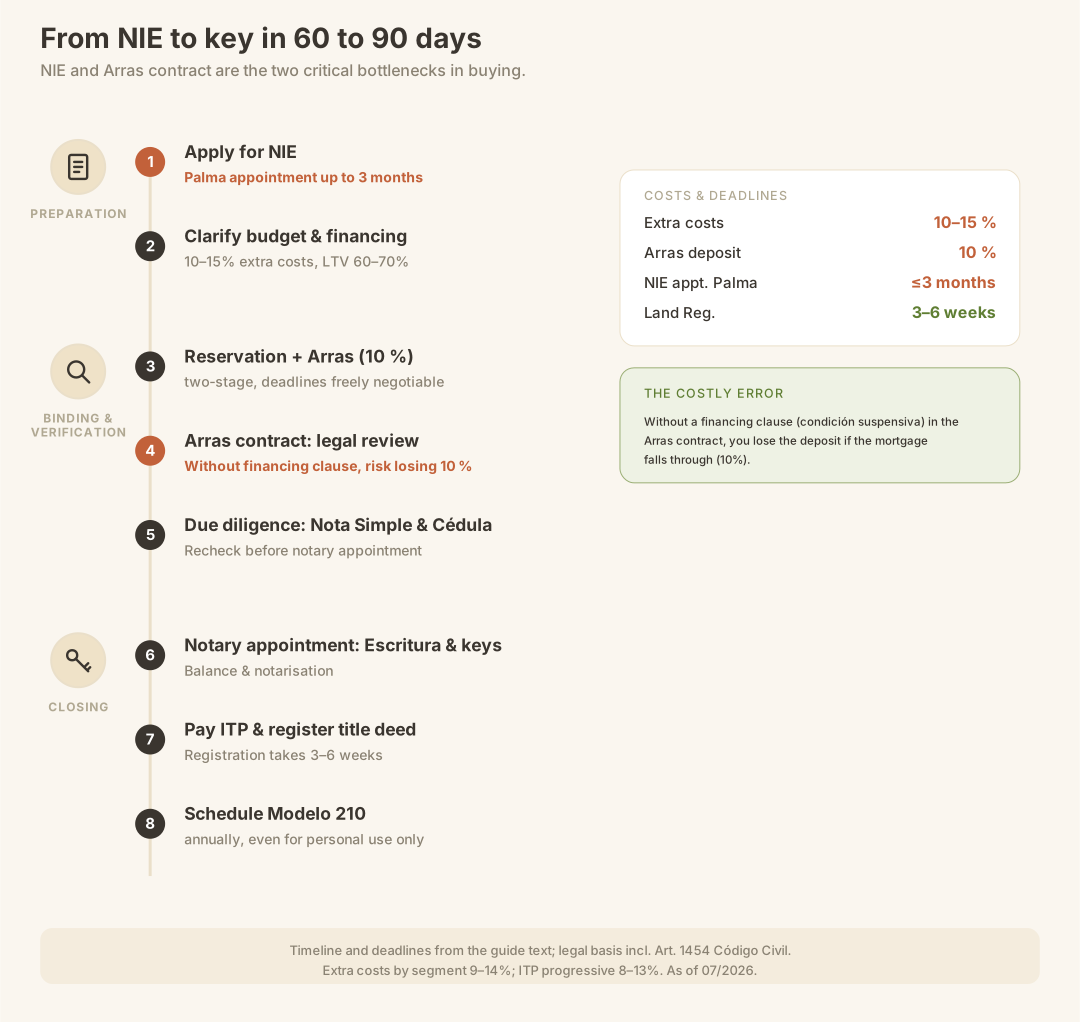
Step 1: The NIE number — nothing happens without it
The NIE (Número de Identidad de Extranjero) is the Spanish identification number for foreign nationals. It is not a residence permit but purely an administrative number — yet without it you cannot sign a notarised purchase contract, open a bank account, or register utilities. The number is issued once and remains valid for life.
To apply you will need:
- The completed Formular EX-15 (in Spanish).
- The paid Tasa 790, Modelo 012 — the administrative fee in 2026 is around 9,84 €.
- A valid passport or national identity card plus copies.
- Written proof of the reason for the application (e.g. the reservation or Arras contract).
There are three ways to apply: in person on Mallorca at the foreigners' registration office in Palma, through the Spanish consulate in your home country, or by notarised power of attorney via a local lawyer. According to several law firms, waiting times for an appointment in Palma can currently be up to three months — the power-of-attorney route often takes just two to three weeks. Plan your NIE well in advance: if you are applying through a consulate, you should start at least two months before your planned notary appointment.
You can find more details in our guide to the NIE number on Mallorca.
Step 2: Estate agents, searching and preparation
Unlike in Germany, on Mallorca it is generally the seller who pays the estate agent's commission — the standard rate is 5 to 6 per cent of the purchase price plus IVA. Commission is not regulated by law and in practice ranges from around 3 to 7 per cent; for very high-value properties it is often lower. As a buyer, you will not normally incur any direct commission from the agent, unless something different has been expressly agreed.
Before you make an offer, the following groundwork is worthwhile:
- Calculate your budget realistically. On top of the purchase price, expect 10 to 15 per cent in additional costs, plus reserves for renovation and furnishing.
- Sort out financing early. Banks frequently only lend non-residents up to 60-70 per cent of the property value (LTV) and require a full credit assessment.
- Factor in your own lawyer. The Spanish notary does not act in your interest in the same way as a German notary. Independent legal support is strongly recommended on Mallorca.
You should familiarise yourself with regional market conditions before you negotiate. Our Mallorca market report.
Step 3: Reservation and Contrato de Arras — this is where the deposit risk lies
Once you have decided on a property, the process usually follows a two-stage binding structure: first a small reservation fee (typically 3.000 to 10.000 €), which takes the property off the market for a few days, then the Contrato de Arras — the Spanish preliminary contract with a deposit of generally 10 per cent of the purchase price. These 10 per cent, the two-stage structure and the 30- to 90-day timeframe are standard market benchmarks, not legally fixed requirements — the amount and timescales are freely negotiable.
What matters is which type of Arras contract you sign. Spanish civil law recognises three types with very different consequences:
| Type | Right of withdrawal | Buyer withdraws | Seller withdraws |
|---|---|---|---|
| Arras penitenciales (most common type) | yes, with penalty | loses the deposit | pays back double the deposit |
| Arras confirmatorias | no | legal action for performance/damages possible | legal action for performance/damages possible |
| Arras penales | no | loses deposit + any further claims | penalty + any further claims |
By far the most common type for residential properties on Mallorca is Arras penitenciales, governed by Article 1454 of the Spanish Código Civil. The principle: both parties may withdraw from the deal — but at a cost. If you withdraw as the buyer, you forfeit your entire deposit. If the seller withdraws, they must pay you double.
A worked example: You agree on a villa in Santa Ponsa for 1.200.000 € and sign Arras penitenciales with a deposit of 120.000 € (10 %). If you pull out, the 120.000 € are gone. If the seller pulls out, you receive 240.000 € back. These consequences apply to pure Arras penitenciales — provided no deviating contractual clause limits the penalty.
This is precisely where the risk lies: anyone who transfers 10 per cent without having the contract reviewed is buying blind. Two protective clauses are particularly important:
- Finance contingency (condición suspensiva): If your mortgage is declined by the bank, you get the deposit back. Without this express finance clause, you bear the financing risk, and a failed loan could cost you the 10 per cent.
- Clear conditions regarding freedom from encumbrances and Cédula, so that any breach of contract by the seller can be clearly established.
The amount, deadlines and withdrawal consequences are freely negotiable. Always have the contract reviewed by your solicitor before making the transfer.
Step 4: Due Diligence — Nota Simple, encumbrances and Cédula
The Arras period is your due-diligence phase. In Spain the principle of caveat emptor applies — the buyer bears responsibility for carrying out checks. Three documents take centre stage.
The Nota Simple (land registry extract)
The Nota Simple is the extract from the Spanish land registry (Registro de la Propiedad). It costs 9,02 € zzgl. IVA from the official provider (Colegio de Registradores) and is usually available online in under two hours. You can order it yourself via registradores.org — or your solicitor/a gestoría can obtain it on your behalf.9,02 € plus IVA and is usually available online in under two hours. You can order it yourself via registradores.org — or your solicitor/a gestoría can obtain it on your behalf.
It contains everything you need to know:
- Ownership details — who is the legal owner?
- Charges and encumbrances — registered mortgages, enforcement orders (embargos), easements, tax liabilities.
- Property description with floor-area details and cadastral reference.
- Indications of a Owners' community and, if applicable, a note regarding tourist rental.
Watch out for red flags: existing embargoes, multiple mortgages, notes marked "fuera de ordenación", discrepancies in the owner's name, and floor areas that don't match what you see on site. An entry can change right up until the notary appointment — which is why the Nota Simple is checked again immediately before the deed is signed.
Catastro vs. Land Registry
The Catastro (sedecatastro.gob.es) is a separate system, independent of the Land Registry: it records the physical characteristics of a property for tax purposes (Hacienda), whilst the Land Registry (under the justice system) holds the legal record of ownership and encumbrances. With older properties, the two frequently diverge — a house listed as 200 m² in the Nota Simple but recorded as 140 m² in the Catastro is a typical example. Such discrepancies can stem from undeclared extensions, but equally from outdated or inaccurate historic surveys, the Catastro's aerial-imagery-based recording method, or a lack of coordination between the two registers. In any case, they need to be clarified.
The Cédula de Habitabilidad (Habitation Certificate)
The Cédula de Habitabilidad certifies that the property meets the minimum requirements for residential use. On Mallorca it is governed by Decreto 145/1997 and is issued by the Consell de Mallorca. It is central to the purchase:
- Since the Balearic Ley de Vivienda 2018, a valid Cédula must be presented on purchase and sale. If it is missing, notaries will routinely require it in practice — or the buyer must explicitly waive this requirement.
- Without it, utility providers (water, electricity, gas, telephone) will not enter into definitive contracts.
- It is valid for 10 years and must be renewed thereafter.
- It is also a prerequisite for a tourist rental licence (ETV).
Processing an application at the Consell de Mallorca takes around one month, and by law up to two months from the date of application. If the document is missing, it can be reissued or renewed via the Consell — an experienced estate agent or solicitor can assist with this. Factor in this timeframe early during the arras phase and always check the issue date, so you are not left with an expired Cédula after completion. Also request the valid Energy Performance Certificate (Certificado Energético).
Step 5: Financing
If you are financing through a Spanish bank, apply for the mortgage as early as possible — the assessment process often takes four to eight weeks and can easily clash with the arras deadline. Non-residents are generally subject to more conservative loan-to-value ratios (typically 60-70 percent LTV) and a full credit check including proof of income and assets.
The most important safeguard in conjunction with Step 3: ensure that a financing condition is included in the arras contract. If the mortgage is declined and this clause is absent, you risk losing the 10 percent deposit. Also bear in mind that the bank will determine the property value via its own valuation (tasación) — if this comes in below the purchase price, the bank will only lend against the lower figure.
Step 6: The Notary Appointment and the Escritura
Comunidad costs
Explanation
The annual budget (presupuesto ordinario) is the spending plan the owners' meeting (Junta de Propietarios) approves once a year; you will find it in the minutes of the last ordinary meeting. The preset is a round worked example, not a benchmark — no authority publishes figures on how much communities budget.
Explanation
The cuota de participación is your share of the building, expressed in hundredths; it is written in your deed of purchase (escritura) and in the land register. It governs both your charge and your voting weight. If your garage or storeroom (trastero) carries a quota of its own, add it or calculate separately.
- Your annual charge
Why this figure?
The community's annual budget times your quota of 2.5% (art. 9.1.e LPH). - €1,500.00
- Amount per payment (monthly)
Why this figure?
The annual charge divided by 12 payments a year. - €125.00
- Total for this year
- €1,500.00
Legal status: 6 March 2019
This calculation is provided for guidance only and is not a substitute for tax or legal advice in specific cases.
The big day: at the notary, the public deed of sale — the Escritura Pública de Compraventa — is signed. Buyer and seller (or their authorised representatives) appear in person. The notary reads out the contract, verifies the identities of the parties and confirms the legality of the transaction.
In Spain — unlike in Germany — there is no legal requirement to use a notary. A private purchase contract is valid between the parties (Art. 1450 Código Civil), but it does not enable no entry in the Land Registry. That is why the rule is: always complete every purchase via a notarial deed.
What happens at the notary appointment:
- Final payment of the purchase price (usually by bank-certified cheque or bank transfer).
- Where the seller is a non-resident: the buyer withholds 3 per cent of the purchase price (Retención, Modelo 211) as an advance tax payment against the seller's IRNR liability; this must be remitted within one month of the deed being signed.
- Handover of keys.
- The notary draws up the escritura and notifies the Land Registry of the change of ownership electronically.
You will need the following documents for the appointment:
| Document | Who brings it |
|---|---|
| NIE number (buyer) | Buyer |
| Passport/national identity card (valid for at least 3 months) | Both parties |
| Nota Simple (current) | Seller |
| Cédula de Habitabilidad | Seller |
| Energy Performance Certificate (Certificado Energético) | Seller |
| Most recent IBI receipt (property tax) | Seller |
| Inventory list (if furniture is included in the purchase) | Seller |
Step 7: Land Registry and taxes
Calculate closing costs
Explanation
The purchase price stated in the deed. If it is below the cadastral reference value, ATIB taxes the higher value.
Explanation
Existing property is subject to property transfer tax (ITP), while a new build is subject to value added tax (IVA) plus stamp duty (AJD). The two tax treatments are mutually exclusive.
- Total
- €62,765.00
Legal status: 1 January 2023
This calculation is provided for guidance only and is not a substitute for tax or legal advice in specific cases.
After the deed is signed, the purchase is taxed and registered in the Land Registry. The property transfer tax ITP (Impuesto de Transmisiones Patrimoniales) is levied in the Balearen on a progressive banded basis (tramos): each portion of the price is taxed at its own rate — it is therefore not a flat rate applied to the total price. The tax base is also important: tax is assessed on the higher of the purchase price and the valor de referencia (the official cadastral reference value).
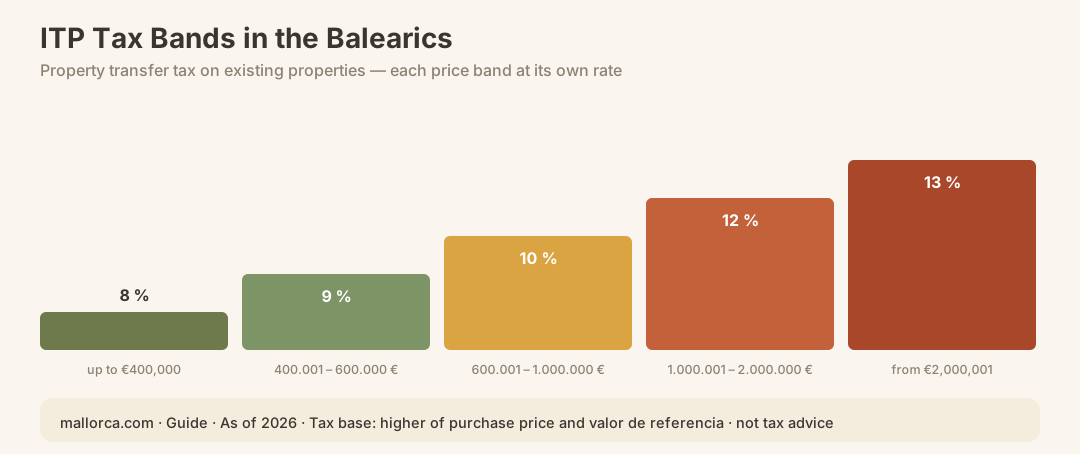
| Share of purchase price | ITP rate (Balearen) |
|---|---|
| up to 400.000 € | 8 % |
| 400.001 € to 600.000 € | 9 % |
| 600.001 € to 1.000.000 € | 10 % |
| 1.000.001 € to 2.000.000 € | 12 % |
| from 2.000.001 € | 13 % |
So, on a purchase price of e.g. 700.000 €, you do not pay a flat 10 per cent; instead, you pay 8 per cent on the first 400.000 €, 9 per cent on the next 200.000 €, and 10 per cent only on the final 100.000 €.
ITP applies to resale properties. For new builds (first transfer), 10 per cent IVA (VAT) plus AJD (stamp duty) applies instead; the standard AJD rate is 1,5 per cent. For a primary residence below 270.151,20 €, a reduced AJD rate of 1,2 per cent applies; from 1 million € upwards, an increased rate of 2,0 per cent applies. The deadline for paying ITP is generally 30 working days from the date of notarisation.
Additional ancillary costs apply. Notary and land registry fees follow a statutory fee schedule (Real Decreto 1426/1989 and 1427/1989 respectively) and are degressive — the percentage rate decreases as the purchase price rises, which means the effective proportion can exceed the figures quoted for very low-priced properties:
| Item | Approximate amount |
|---|---|
| Notary | approx. 0,1–0,3 % of the purchase price (statutory fee schedule) |
| Land Registry (Registro) | approx. 0,1–0,2 % of the purchase price |
| Gestoría (administration) | 200–1.000 €, depending on complexity |
| Lawyer (optional, recommended) | approx. 1 % |
After the notary appointment, the gestoría remits the taxes and arranges registration in the property register. Full entry in the land registry typically takes three to six weeks. Budget a total of 10 to 15 per cent of the purchase price for ancillary costs — for standard resale properties they tend to be closer to 9 to 10 per cent, while in the upper and luxury segments they reach 11 to 14 per cent due to the higher ITP tranches. You can find a detailed breakdown in our guide to purchase costs. Please note: under statute, the municipal capital gains tax (plusvalía municipal) is borne by the seller.
Step 8: After the purchase — utilities and ongoing taxes
Once the property is entered in the land registry, the purchase is complete — but as an owner you have ongoing obligations.
Transfer utilities and administration: Transfer electricity, water, and gas (if applicable) into your name, notify the residents' association (comunidad), and take over the annual property tax IBI (Impuesto sobre Bienes Inmuebles). IBI ranges from 0.4 to 1.1 per cent of the cadastral value and is levied by the local authority, which sets the rate.
Modelo 210 — the tax for non-residents: If you are not tax-resident in Spain and you use the property yourself or leave it vacant, you must pay tax annually on a deemed income (renta imputada). The basis of assessment:
- 1,1 per cent of the cadastral value, if it has been updated within the last ten years — otherwise 2 per cent.
- Tax rate: 19 per cent for EU/EEA residents (incl. Iceland, Norway, Liechtenstein), 24 percent for third countries (e.g. UK after Brexit).
- Deadline: by 31 December of the following year (tax year 2025 therefore by 31.12.2026).
Example from the official completion guide: For a flat in Calvià with an updated cadastral value of 75.500 €, the assessment base is 1.1 % = 830,50 €; applying 19 % to this gives approximately 158 € tax per year.
If you let the property, different deadlines apply and you declare the actual rental income — usually quarterly or as an annual summary. How this works and what you need to bear in mind for a long-term rental is explained in our guide to long-term rentals on Mallorca.
The most common mistakes when buying property on Mallorca
- Not engaging your own solicitor. The Spanish notary does not protect you in the same way as in Germany. Without an independent review, you are buying blind.
- Applying for the NIE too late. Without an NIE there can be no notarisation. In popular areas, getting an appointment can take weeks to months.
- Signing the Arras contract without having it checked. Not every contract includes a right of withdrawal, and not every contract includes a financing contingency clause — losing the 10-percent deposit is a real risk.
- Not checking the Nota Simple, or checking it too early. Encumbrances can change right up to the notary appointment. Checking shortly beforehand is essential.
- Ignoring the Cédula and energy certificate. Without a Cédula there is no utility connection, and notaries routinely require it in practice.
- Overlooking discrepancies between the cadastre and the land registry. These can stem from undeclared extensions, but also from outdated historic surveys — and can prove costly later.
- Underestimating the additional costs. 10 to 15 percent comes on top. Anyone who budgets too tightly will run into difficulties.
- Forgetting the Modelo 210. The annual declaration for non-residents is very frequently overlooked — even when the property is used solely by the owner, it is mandatory.
Checklist: Your path to ownership
- NIE number applied for (with plenty of lead time)
- Budget calculated including 10-15 % additional costs
- Financing clarified in advance (LTV, tasación)
- Own solicitor instructed
- Property selected, price negotiated
- Arras contract reviewed by solicitor (type, financing contingency clause)
- Nota Simple checked (owner, encumbrances, embargos)
- Cadastre cross-checked against land registry and physical reality
- Cédula de Habitabilidad and energy certificate in place
- Nota Simple checked again shortly before notary appointment
- Notary appointment: escritura signed, balance payment made, keys handed over
- ITP/VAT and fees paid via gestoría
- Land Registry entry arranged
- Utilities, IBI and comunidad transferred to new owner
- Modelo 210 noted for the first year
Conclusion
Buying a property on Mallorca is entirely manageable if you know the right sequence: first the NIE and financing, then a carefully reviewed arras contract, thorough due diligence via Nota Simple and Cédula, followed by notarisation and the clean settlement of taxes and Land Registry. The greatest risks lie not in the purchase price but in the details — a missing financing clause, an overlooked encumbrance, or an expired Cédula. With independent legal support and realistic budget planning (10–15 per cent in ancillary costs), the dream of owning a property on Mallorca becomes a secure purchase.
Official Sources
- Colegio de Registradores — Request a Nota Simple and fees (official Land Registry platform, 9,02 € + IVA)
- Sede Electrónica del Catastro (cadastre, cadastral value, valor de referencia)
- Consell de Mallorca — Cédula de Habitabilidad (certificate of habitability, Decreto 145/1997)
- Agencia Tributaria — Modelo 210 (income tax for non-residents)
- Real Decreto de 24 de julio de 1889 — Código Civil, Art. 1454 (statutory basis for arras penitenciales)
This guide is intended for general information purposes only and does not replace individual legal or tax advice. Laws, tax rates and deadlines are subject to change and depend on the specific circumstances — in particular the ITP banding, Modelo 210 calculation and Cédula requirements. For your specific transaction, please seek advice from a lawyer specialising in Spanish property law (abogado) and a tax adviser (asesor fiscal/gestor).
NIE applications for multiple buyers
If two people buy a property together, each foreign national named as a buyer in the deed must apply for their own NIE. To apply at the Spanish Consulate General in Düsseldorf, each applicant needs a separate appointment. Arrange appointments for both people; buying together does not remove the need for either application.
This is general information, not legal or tax advice.