
Water Supply for a Finca in Mallorca: Cisterns, Wells and Water Scarcity
Anyone who buys or lives in a finca on Mallorca will sooner or later encounter one of the most practical yet complex questions on the island: where does the water come from — and is there enough of it all year round? The water supply of a finca on Mallorca is not merely a matter of comfort, but a fundamental question of law, technology, and ecology. Rural properties are frequently not connected to the public network and must therefore rely on cisterns, wells, or water deliveries. At the same time, prolonged summer dry spells, growing tourism pressure, and falling groundwater levels are structurally worsening the situation. This guide explains the different supply options available, what they cost, which permits you need, which regions are particularly affected — and what you should absolutely check before buying a finca.
Do you already know how your dream finca is supplied with water?
- 📩 Submit a personal enquiry — We will clarify the water-rights situation for your property
- Checklist: Planning Permission and Infrastructure on Mallorca
The Water Situation on Mallorca: What You Need to Know as a Finca Owner
Mallorca is hydrologically one of the most demanding islands in the western Mediterranean. Three factors shape the situation: the topography with three clearly distinct landscape zones, a pronounced summer drought, and the enormous demand for water driven by tourism and population growth.
Three Landscape Zones — Three Water Regimes
| Zone | Characteristics | Water Supply |
|---|---|---|
| Serra de Tramuntana (west/north-west) | Limestone and marl bedrock, heavily karstified cave systems, steeply sloping towards the coast | Natural springs, groundwater in karst aquifers; supply via the Tramuntana pipeline network |
| Central Plain (Palma–Inca–Sa Pobla) | Flat basin, intensively used for agriculture | Predominantly public network; groundwater often under stress |
| Serres de Llevant (east) | Isolated ridges, scattered rural settlements | Frequently autonomous supply via wells and cisterns; mains connection often unavailable |
The Serra de Tramuntana supplies a significant proportion of groundwater through its karst system. Rainwater percolates through the weathered limestone layers into deep aquifers, which have traditionally been the primary source for rural wells. However, this system only functions when sufficient rainfall occurs — which in summer is regularly not the case.
Please note: Fincas in the interior of the island, particularly in the central plain, are frequently not directly connected to the drinking-water network, according to local reports. During dry periods, water is sometimes delivered there by tanker lorry — a running cost you should factor into your calculations.
Desalination as a Third Pillar
For a number of years now, seawater desalination plants have been supplementing the traditional springs and groundwater. These facilities buffer shortfalls during the height of summer, but they depend on electricity and maintenance infrastructure. For finca owners outside the public network, they play only an indirect role — their significance lies more in relieving pressure on the groundwater supply.
Public network or autonomous supply?
When is a mains connection possible?
In areas with suelo urbano (land classified as urban) it is generally possible to connect to the municipality's public drinking water network. For classic fincas on suelo rústico – the rural land that makes up by far the largest part of the island – a mains connection is often simply unavailable or comes with disproportionately high development costs.
The main suppliers on Mallorca:
| Supplier | Area of responsibility |
|---|---|
| EMAYA | Palma de Mallorca |
| Aguas de Mallorca | The majority of the remaining municipalities |
| Individual municipal utilities | Some smaller municipios with their own operations |
Whether your finca is connected or can be connected can be found out at the relevant local authority office (Ajuntament) or directly from Aguas de Mallorca. Have this clarified before the purchase contract – not afterwards.
Autonomous supply: the norm in rural areas
Rural fincas are predominantly reliant on a combination of a cistern (rainwater collection) and a well (groundwater access). Both systems complement each other: the cistern bridges dry periods, whilst the well ideally provides water year-round. If neither functions reliably, a water tanker is the only remaining option.
Cisterns on Mallorca: function, types and building regulations
History and principle
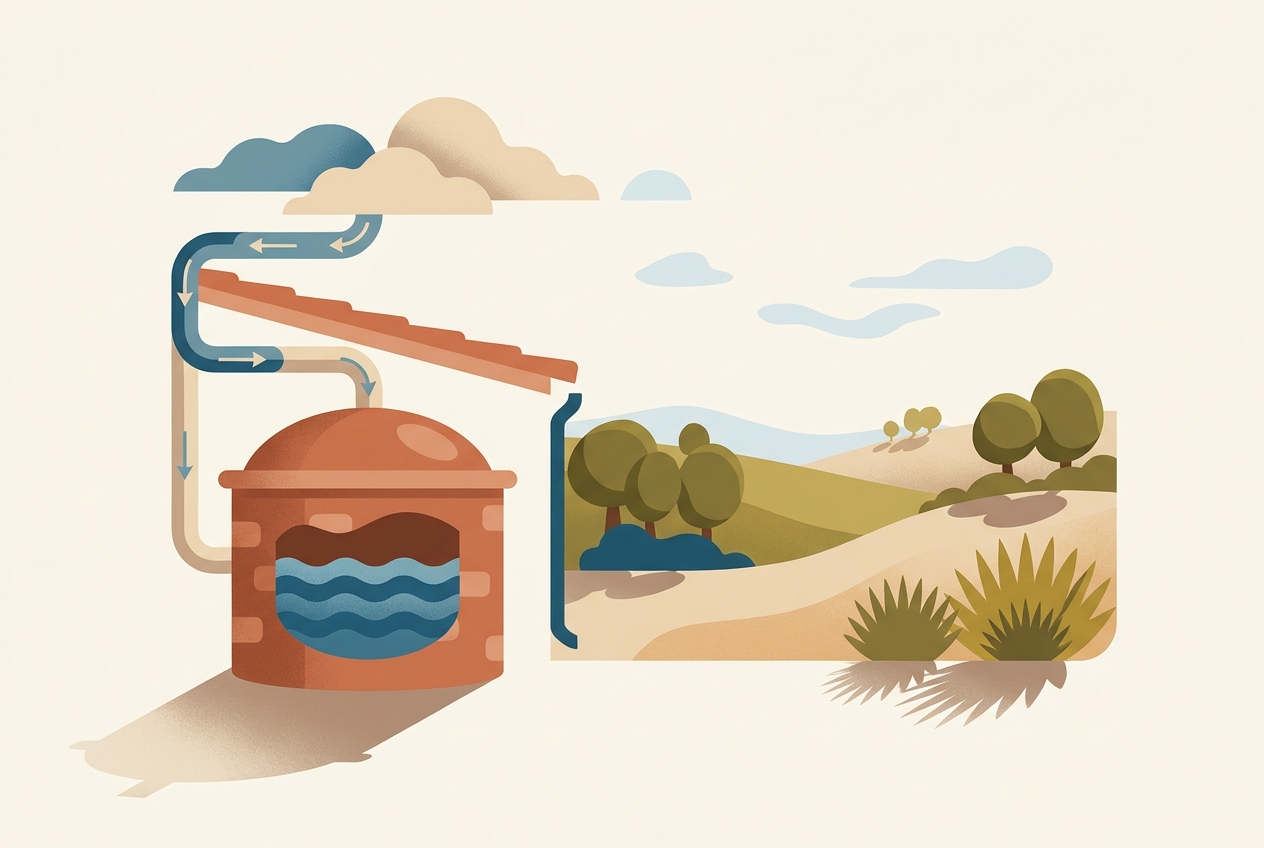
The cistern (aljibe in Spanish/Catalan) is no modern invention on Mallorca, but rather a solution that has been practised since Moorish times. The historic underground storage tanks were built from robust natural stone and lined with a waterproof lime mortar layer. In villages such as Llubí, historic cistern installations are still preserved to this day. The basic principle remains unchanged: rainwater is channelled from roof surfaces via downpipes and filtration systems into an underground or above-ground tank, where it can be used for the garden, household purposes, or – with appropriate treatment – as drinking water.
Types at a glance
| Cistern type | Advantages | Disadvantages |
|---|---|---|
| Underground (precast concrete or masonry) | Space-saving, well protected from heat and contamination, large capacities possible | More complex installation, crane required for removal |
| Above-ground tank (plastic/steel) | Easy to install, lower purchase cost | Visible, greater thermal stress, smaller |
| Historic stone cistern | Part of the charm of an old finca, often already in place | Renovation effort required, check sealing, quality control necessary |
What you need to consider when planning
Cisterns on Mallorca make sense because:
- The island has long rain-free summers and collected rainwater bridges these periods
- Mains water can become more expensive and scarcer during the summer months
- Every litre of rainwater that is used takes pressure off the already strained groundwater reserves
For the construction of a new cistern – or significant alterations to an existing one – you will need, depending on the municipality, either planning permission or at least a comunicación previa. Discuss this with your architect and the Ajuntament before commissioning any work. More on this in the guide Planning Permission on Mallorca.
Please note: An old cistern that you inherit when purchasing a finca should always be checked for watertightness and contamination before being put into service. Cracks in the lime render allow sediment and bacteria to penetrate.
Wells on Mallorca: Groundwater, Permits and Legalisation
Why the well is the critical variable
Whilst a cistern depends on rainfall, a well taps into groundwater – theoretically a year-round source. In practice, the water table on Mallorca drops considerably in dry years, which means wells that draw water without issue in winter can run dry in August.
Added to this, rural fincas often have historically grown well installations that are frequently not properly registered in legal terms – so-called legacy issues from an era when wells were simply dug without going through any official channels.
Permit requirement: Water law on Mallorca
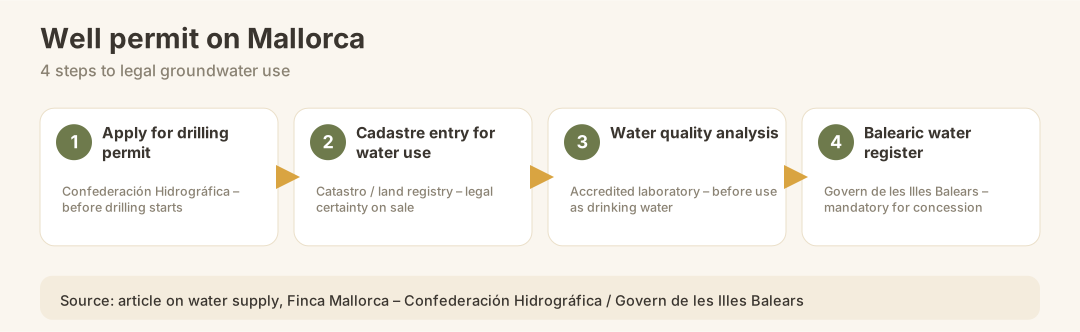
Water is regarded as public property in Spain. The use of groundwater is not unrestricted but subject to permit. The authority responsible for the Balearic Islands is the Confederación Hidrográfica in coordination with the Balearic environmental ministry (Govern de les Illes Balears). New wells require a concession; existing, unregistered wells should be legalised.
You can find the detailed steps for obtaining and legalising a well permit in the guide Legalising a well on Mallorca.
| Step | Responsible authority | Note |
|---|---|---|
| Drilling permit / concession application | Confederación Hidrográfica | Before drilling work begins |
| Cadastral registration of water use | Catastro / Land Registry | For legal certainty when selling |
| Water quality analysis | Accredited laboratory | Recommended before using as drinking water |
| Entry in the Balearic water register | Govern de les Illes Balears | Mandatory for licensed use |
Caution: If you buy a finca with an unregistered well, you take on the legalisation risk. Check this during your Land Registry and Catastro research – and have it clarified by a notary in the purchase contract.
Water quality: mains water, wells and cisterns compared
Mains water
Mains water on Mallorca meets European drinking water standards and is regularly tested. In practice, however, many locals and long-term residents still recommend filtering it – particularly in areas where the water flows through older pipework or has a higher mineral content. Quality can vary depending on the municipality.
Well water
Well water in rural areas is not automatically suitable for drinking. Even if the well is in perfect working order, residues from agriculture (fertilisers, pesticides), saltwater intrusion near the coast, or bacterial contamination can make the water unsuitable for direct consumption. A bacteriological and chemical analysis by an accredited laboratory is essential before drinking well water.
Cistern water
Collected rainwater is generally well suited for garden irrigation, toilet flushing, and filling a pool. For drinking purposes, a multi-stage filtration system is required.
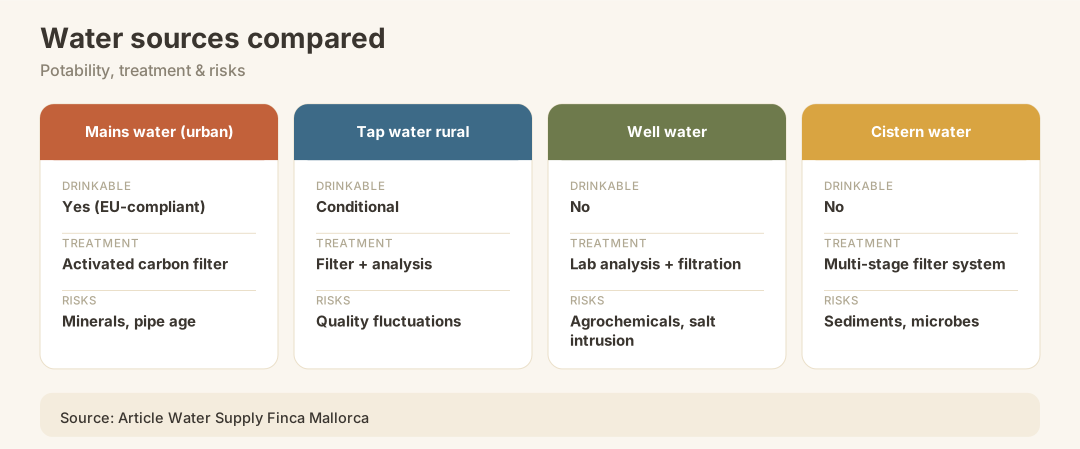
| Water source | Safe to drink without treatment? | Recommended treatment | Main risks |
|---|---|---|---|
| Tap water (municipal) | Yes (EU-compliant), filter recommended | Activated carbon filter | Minerals, pipe age |
| Tap water (rural) | Conditional | Filter + analysis | Quality fluctuations |
| Well water | No | Laboratory analysis + filtration | Agricultural chemicals, salt intrusion |
| Cistern water | No | Multi-stage filtration system | Sediment, pathogens |
Water scarcity in summer: regions, risks and precautions
Where shortages are most acute
Not all parts of Mallorca are equally affected. The problems tend to follow specific patterns:
- The interior and central plain: Many smaller villages are not connected to the Tramuntana network. During dry spells, these areas are sometimes supplied by tanker lorry, and the water supply can even be restricted to certain hours.
- The east coast and Serres de Llevant: Rural fincas with an independent supply suffer from falling water table levels during prolonged dry periods.
- Palma and coastal towns: Generally well supplied, as both the Tramuntana network and desalination capacity are utilised.
The cost of emergency tanker deliveries
Anyone who relies on water deliveries in summer pays noticeably more than through the mains supply. Actual prices vary depending on the supplier, region, and volume – as a finca buyer, ask neighbours or the previous owner how often tanker lorries were called and at what cost. This is a legitimate part of due diligence.
A Sustainable Counter-Strategy: Combined Systems
In practice, well-equipped fincas rely on a combination of:
- Large-capacity cistern for rainwater collection (rainfall on Mallorca is concentrated predominantly in the autumn and winter months)
- Deep well with reserves even during dry spells
- Water-saving irrigation system (drip irrigation for the garden and fruit trees)
- Greywater recycling where technically feasible
- Solar power for pump operation – synergies with photovoltaics can be utilised (→ Registering photovoltaics on Mallorca)
What You Absolutely Must Check Before Buying
A water supply problem on a finca is not a minor cosmetic flaw – it can directly affect the habitability of the property and give rise to substantial ongoing costs. Here are the most important points to check:
Water Supply Checklist Before Buying a Finca
- Is there a mains connection? Enquire with the Ajuntament and Aguas de Mallorca
- Is there a well? Is it registered in the land registry/cadastre? Is a concession in place?
- Is there a cistern? Check its condition – watertightness, capacity in litres, year of construction
- Water quality analysis request one for the well or cistern water (or commission one independently)
- Ask about summer supply: Have tanker lorry deliveries been made in recent years?
- Pumps and pressure system: Condition, year of manufacture, maintenance history
- No unauthorised installations: Unauthorised wells or unregistered water abstractions can become a problem when selling or renovating (→ Legalising an Unauthorised Building on Mallorca)
- Cédula de Habitabilidad check for proof of water supply (→ Cédula de Habitabilidad Mallorca)
Cost Overview: Cisterns, Wells and Water Delivery
The following figures are indicative estimates based on available market information – actual quotes may vary considerably depending on the supplier, region and technical requirements. Always obtain several quotes from local contractors.
| Measure | Indicative Range | Note |
|---|---|---|
| Underground concrete cistern (prefabricated, installed) | depending on volume and construction complexity | Crane costs are additional |
| Well drilling (new borehole) | depending on depth and geology | Depth is the main cost driver |
| Drinking-water-quality filtration system | depending on number of stages and capacity | Multiple stages recommended |
| Pressure pump with accumulator tank | Standard market configurations | Maintenance contract advisable |
| Water analysis (laboratory) | depending on parameters tested | Recommended before commissioning |
| Water tanker delivery | depending on quantity and supplier | Highly seasonal |
Please note: Because these costs depend heavily on the specific circumstances of your finca – geology, existing infrastructure, planning status – we recommend consulting a specialist Mallorcan architect or structural engineer before commissioning any work.
Most Common Mistakes with Water Supply on a Finca
Failing to check the well's legal status: Many buyers rely on the previous owner's verbal assurances without verifying the concession in the water register. Missing concessions must be retrospectively approved after purchase — with associated costs and uncertainty.
Underestimating cistern capacity: A cistern that is sufficient for one person over summer will quickly run dry for a family using a pool. Have the sizing calculated before purchase or before renovation.
Failing to have the water quality analysed: Well water is assumed as a matter of course to be fit for drinking — without any analysis. This is a health risk, particularly for children.
Taking a mains connection for granted: Property listings sometimes state "water connection present" — this can refer to a basic internal installation, not necessarily a mains connection. Always ask for clarification.
Failing to factor in renovation costs: Old cisterns and historic wells often require sealing, new pumps, and filtration systems. These costs are frequently missing from renovation budgets (→ Full Renovation in Mallorca: Costs).
No emergency reserve planned: Anyone relying exclusively on a well with no reserve tank will find themselves without water during a dry summer.
Ignoring legal encumbrances: Existing unregistered wells or cisterns can suddenly become a problem when applying for a renovation permit or at the point of resale.
What comes next? Operation and maintenance
Once the water supply has been established and legalised, the focus shifts to keeping it reliably operational over the long term. A few practical pointers:
- Annual servicing of the pump system by a local technician — pumps that stand on standby for months often fail at precisely the moment they are needed.
- Clean the cistern at least every two years: sediment deposits and organic material accumulate on the floor.
- Monitor the water table in summer: If the level drops noticeably, reduce consumption early and order water by tanker if necessary, before the well runs dry.
- Repeat water analysis: A one-off analysis at the time of purchase is the starting point, not the conclusion — groundwater quality can change over time.
- Monitor consumption: Simple water meters on the main outlets help to detect leaks early — a running tap or a leaking toilet on a finca with a cistern can empty the tank within days.
Official sources
- Aguas de Mallorca (public water supplier for most municipalities): https://www.aguasdemallorca.com
- EMAYA (water supply for Palma de Mallorca): https://www.emaya.es
- Govern de les Illes Balears – Medi Ambient i Territori (water law, concessions, groundwater Balearic Islands): https://www.caib.es
- Confederación Hidrográfica del Júcar (responsible for water concessions in the Balearic Islands): https://www.chj.es
- Catastro España (land and infrastructure data): https://www.sedecatastro.gob.es
- BOE – Boletín Oficial del Estado (Water Act Ley de Aguas and implementing regulations): https://www.boe.es