
Solar panels Mallorca registration: permits, autoconsumo & grants 2026
With over 300 days of sunshine per year, Mallorca is one of the sunniest regions in Europe – and therefore one of the most attractive locations for a photovoltaic system. Anyone wishing to install a PV system on the island and register photovoltaics in Mallorca will find themselves navigating a Spanish administrative system that differs markedly from the German one: Industria, Ayuntamiento, the grid operator, and the Balearic funding authority each play their own distinct role. This guide walks you through step by step which permits you need, how Autoconsumo (self-consumption) is correctly registered, when and how much feed-in compensation is paid – and how to secure the FOTOPAR-2026 subsidy of up to 600 €/kWp before the budget runs out.
Solar payback in Mallorca
Example values, not market data. Enter yours.
Explanation
Freely chosen illustrative value; no statement about market prices in Mallorca. Replace it with your figures.
Explanation
Solar power you use yourself is called autoconsumo. Your share refers to production; actual self-consumption is capped by your consumption. Freely chosen illustrative value; no statement about market prices in Mallorca. Replace it with your figures.
Explanation
Your paid, avoidable energy unit price, excluding fixed charges. The same price values grid consumption for the credit ceiling. Freely chosen illustrative value; no statement about market prices in Mallorca. Replace it with your figures.
Explanation
Your total paid amount including non-recoverable taxes and associated costs. The tax scenario assumes fully eligible payments by one taxpayer with an unused annual allowance. Freely chosen illustrative value; no statement about market prices in Mallorca. Replace it with your figures.
- First payback
- 8 years, 9 months
- Balance after 20 years
- €11,075.00
- Self-consumption savings
- €978.75
- Net investment
- €8,500.00
Only your self-consumption is counted: grants, surplus credit, running costs, IBI property tax relief and the IRPF income tax deduction are set to zero here.
Legal status: 1 January 2026
This calculation is provided for guidance only and is not a substitute for tax or legal advice in specific cases.
Why Mallorca is ideal for photovoltaics
Mallorca enjoys more than 300 days of sunshine per year. This high level of solar irradiation significantly reduces the payback period of a PV system compared with locations in central Europe. Added to this, the trajectory of electricity prices in Spain makes self-consumption particularly attractive from a financial perspective: anyone using self-generated electricity during the day saves directly on their bill.
The island also offers both grid-connected systems (with or without feed-in) and fully off-grid systems (sistemas aislados) for fincas without a grid connection. Both options are subject to different approval processes – more on that shortly.
Please note: Anyone who owns a historic finca or a listed building should check before planning whether any special requirements apply. More information can be found in the guide on Historic properties on Mallorca.
The key players: who is responsible for what?
Before going into the details, it helps to have an overview of the authorities involved. In Germany, much of this runs through a single channel (grid operator plus the Marktstammdatenregister); in Spain, responsibility is distributed across several authorities.
| Authority / Body | Responsibility |
|---|---|
| Industria (Conselleria de Transició Energètica) | Technical approval, Boletín eléctrico, registration of the system |
| Ayuntamiento (local council) | Planning permission (licencia de obras) depending on the system and municipality |
| Grid operator (typically Endesa/e-distribución) | Grid connection, meter replacement, feed-in |
| Balearic funding authority | Processing of FOTOPAR-2026 grant applications |
| Chamber of Architects | Mandatory involvement for systems above 10 kWp |
A specialist firm that is officially registered and approved with Industria may certify all electrical work itself and carry out the registrations with Industria, the Ayuntamiento, and the grid operator. This saves considerable time and effort.
Step by step: how to register a PV system in Mallorca
The order of the steps is not arbitrary – each subsequent step generally builds on the one before it.
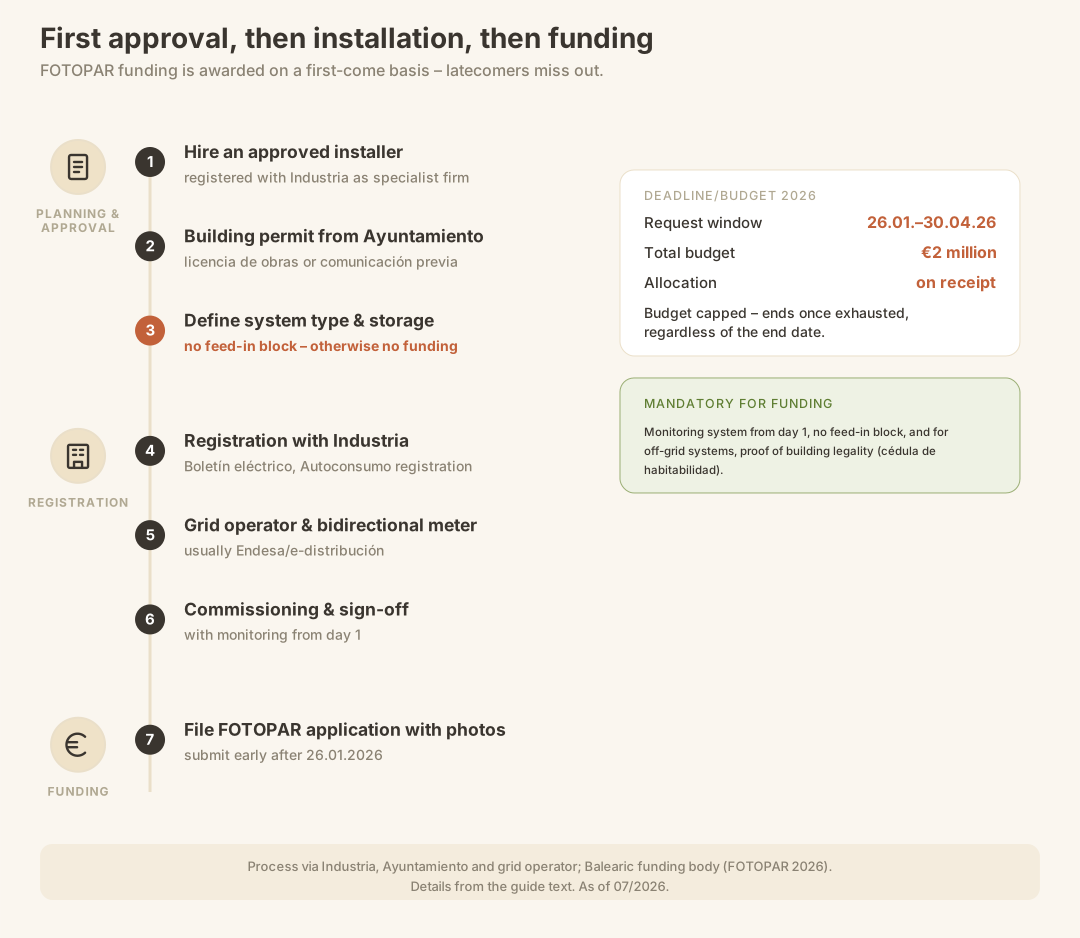
- Needs analysis and planning by a certified installer: location, roof orientation, grid connection point, desired output in kWp, storage requirements.
- Planning permission from the Ayuntamiento apply for (licencia de obras menor or comunicación previa, depending on the municipality and system). Many municipalities on Mallorca treat small rooftop installations as a simplified procedure.
- Technical project documentation to be prepared (mandatory for systems over 10 kWp, by an architect or engineer with official chamber stamp).
- Registration with the Industria (Conselleria de Transició Energètica i Sectors Productius): technical data sheet, Boletín eléctrico, registration as an Autoconsumo installation.
- Application to the grid operator (typically Endesa/e-distribución) for grid connection and – if desired – feed-in as well as meter replacement (bidirectional meter).
- Commissioning and sign-off by the installer, with final documentation.
- Submit the subsidy application (FOTOPAR 2026, see dedicated section), including photos of the fully installed system and the required documents.
Please note: Funding is allocated on a first-come, first-served basis (orden de entrada). Anyone who delays the installation and subsidy application risks the budget already being exhausted.
Grid-connected system vs. off-grid system: what applies where?
| Feature | Grid-connected system (con conexión a red) | Off-grid system (sistema aislado) |
|---|---|---|
| Registration with Industria | Yes, mandatory | No (not required) |
| Registration with grid operator | Yes | No |
| Feed-in possible | Yes (compensation) | No |
| FOTOPAR 2026 subsidy | Yes | Yes – but proof of the building's legal status required |
| Proof of building legitimacy | Not explicitly required | Mandatory (certificate of habitability, planning permission, or similar) |
| Monitoring obligation (for subsidy) | Yes | Yes |
For off-grid systems (sistemas aislados) the following applies: anyone wishing to apply for the FOTOPAR subsidy must demonstrate the lawfulness of the building – for example by means of a valid habitation certificate (cédula de habitabilidad) or a building permit. Systems on non-legalised buildings will not be subsidised.
Note: If your Finca has not yet been fully legalised, please read our guide on legalising unauthorised construction on Mallorca.
Autoconsumo: registering self-consumption correctly
"Autoconsumo" is the Spanish legal term for photovoltaic self-consumption. Since the reform introduced by Real Decreto 244/2019, the process has been significantly simplified: for many small installations below certain thresholds, a simplified notification suffices — no full authorisation procedure is required.
In practical terms, this means: the certified installer registers the system with the Industria as an Autoconsumo installation and clarifies the technical implementation with the grid operator. There are two main variants:
- Autoconsumo sin excedentes (without feed-in): the system is technically configured to prevent electricity from flowing into the grid (zero-export system). These installations are technically simpler, but forgo any remuneration for surplus electricity.
- Autoconsumo con excedentes (with feed-in): surplus electricity is fed into the grid and can be remunerated. This requires a bidirectional meter.
Please note: Systems that technically prevent feed-in are excluded from the FOTOPAR 2026 subsidy. Anyone wishing to apply for the subsidy may not install a feed-in block.
Feed-in and remuneration: what you can realistically expect
The feed-in of surplus solar electricity into the grid is governed in Spain by the so-called mecanismo de compensación simplificada. The grid operator offsets fed-in electricity against your electricity consumption — you therefore receive a credit on your bill rather than a direct payment.
Important to know: the market price for solar electricity in Spain has fallen sharply in recent years — from over 60 €/MWh in spring 2023 to around 16.8 €/MWh in 2025. In spring, prices even turn negative at midday, because Spain is expanding solar capacity faster than demand is growing. This means: the economic benefit of a PV system on Mallorca today lies clearly in self-consumption, not in feed-in.
A battery storage system therefore significantly increases the self-consumption share and improves overall economic viability. This is precisely why FOTOPAR 2026 also specifically subsidises storage at 420 €/kWh.
FOTOPAR 2026: the current subsidy in detail
The FOTOPAR 2026 programme forms part of the FEDER programme 2021–2027 and is the Balearic Islands' central subsidy measure for private PV installations. Here are all the key facts:
Application period and budget
| Parameter | Value |
|---|---|
| Opening of applications | 26. January 2026 |
| Closing of applications | 30. April 2026 |
| Total budget | 2.000.000 € |
| Award principle | First come, first served (no concurrencia competitiva) |
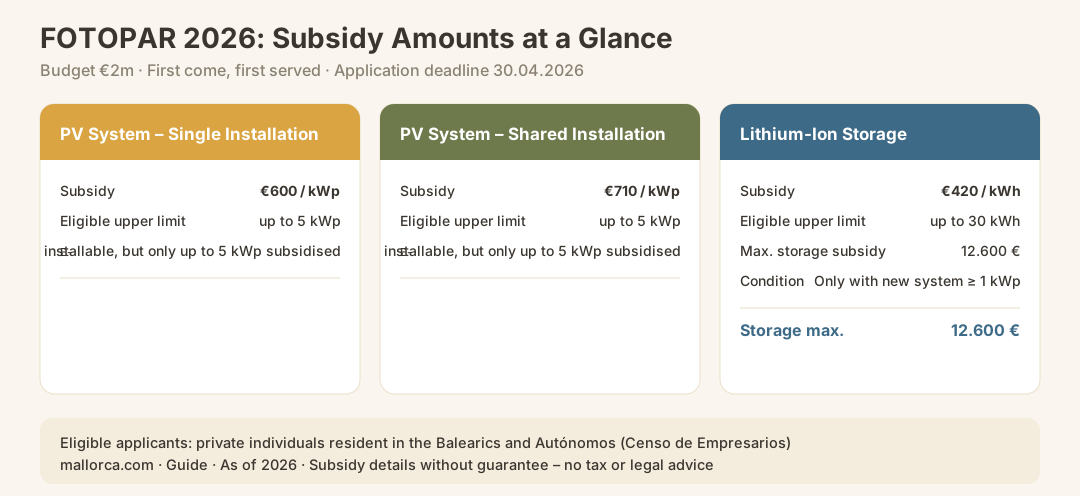
The budget is capped at 2 million euros and is allocated in order of receipt of applications – those who apply too late will miss out.
Who is eligible to apply?
- Private individuals resident in the Balearic Islands, for residential properties for owner-occupation
- Self-employed individuals (Autónomos) registered in the business register (Censo de Empresarios), for their place of work or a property they own
Eligible measures and amounts
| Measure | Subsidy | Cap |
|---|---|---|
| New PV system (individual installation) | 600 € / kWp | Up to 5 kWp of subsidised capacity |
| New PV system (shared installation) | 710 € / kWp | Up to 5 kWp of subsidised capacity |
| Lithium-ion battery storage | 420 € / kWh | Up to 30 kWh (max. 12.600 €) |
Capacities greater than 5 kWp may be installed, but funding is only granted up to the threshold of 5 kWp. The subsidy amount may under no circumstances exceed the actual costs of the measure.
Important regarding storage: Batteries are only eligible for funding if they are installed together with a new system of at least 1 kWp. Simply retrofitting a storage unit to an existing older system is not eligible for funding.
Mandatory technical requirements
- Monitoring system: Every subsidised installation must have a system that displays energy production and consumption on a daily, monthly, and annual basis – accessible via mobile devices.
- No feed-in restriction: Systems with a technical zero-feed-in configuration are excluded.
- Proof of building legitimacy (island installations only): certificate of habitability, building permit, or completion certificate.
- Public visibility requirement: Upon completion, an official plaque or sticker in at least A3 format must be affixed in a clearly visible location.
Systems over 10 kWp: Additional requirements
Anyone planning a system with more than 10 kWp should expect a considerably more involved process:
- Involvement of the architects' association is mandatory
- Further engineering services (technical project, endorsement) are required
- The approval period is extended accordingly
For typical single-family homes on Mallorca, the sensible system size is often below this threshold. Larger systems for multi-family properties, holiday rentals or commercial use require individual consultation.
If you operate a property as a holiday rental and want to reduce energy costs, the interplay between a PV system and an ETV licence is an interesting topic.
What documents do you need for the grant application?
The exact list of documents is determined by the Balearic funding authority. In practice, a complete application typically includes the following elements:
- Technical data sheet for the installed system (incl. inverter, modules, and battery storage if applicable)
- Photos of the fully installed system (roof, modules, inverter, meter)
- Proof of registration with the Industria (Boletín eléctrico)
- Proof of costs / installer invoice
- For off-grid systems: proof of the building's legitimacy
- Proof of monitoring capability (screenshot or system documentation)
- NIE / DNI of the applicant
Many certified installer companies on Mallorca handle the compilation and submission of documents as part of their service package.
Most common mistakes – and how to avoid them
| Mistake | Consequence | Solution |
|---|---|---|
| System installed before approval | Grant application rejected, possible regulatory offence | Obtain approval first, then install |
| Feed-in block installed | Eligibility for funding lost | Plan for a bidirectional meter |
| Battery storage retrofitted to an existing system | Not eligible for funding | Install together with a new system |
| Monitoring system missing | Grant application rejected | Integrate from day one |
| Non-approved installer | Boletín not recognised | Only engage companies registered with the Industria |
| Application submitted after budget is exhausted | No funding | Submit early, ideally shortly after 26.01.2026 |
| Island installation without proof of legalisation | Funding application rejected | Secure the habitation certificate first |
What comes next? Operation, maintenance and taxes
After successful registration and commissioning, there are a few points you should keep in mind:
Maintenance: A regular check of the modules, inverter and wiring is recommended. The monitoring system (a funding requirement in any case) will flag performance drops at an early stage.
Tax treatment in Spain: Income from feed-in can be tax-relevant depending on your personal situation. For private individuals using the compensation model, the tax impact is generally manageable, but should be clarified with a tax adviser. Our overview of Taxes & Law on Mallorca gives you the essential background.
IBI and the land registry: A PV system can marginally affect the cadastral value of a property and therefore the IBI tax. In practice, this effect is usually negligible for small installations.
Energy certificate: A PV system improves the energy rating of your property. Updating the certificate after installation can increase the resale value. More on this in the guide Energy Certificate Spain.
Checklist: registering a photovoltaic system on Mallorca
- Engage a certified installer approved by the Industria
- Obtain a building permit from the Ayuntamiento (depending on the municipality)
- Define the system type: grid-connected with feed-in or island installation
- For island installations: have the habitation certificate or building permit ready
- Do not plan for a feed-in block (funding requirement)
- Integrate the monitoring system from the outset
- For systems > 10 kWp: involve an architect/engineer
- Submit the FOTOPAR 2026 funding application as early as possible after 26.01.2026
- Document all photos and paperwork upon completion
- Commission the grid operator (usually Endesa/e-distribución) for the meter exchange
- Clarify tax treatment with a tax adviser
Conclusion
Installing and registering a photovoltaic system on Mallorca is well structured today – provided you have the right partner by your side. The sunshine hours speak for themselves, the FOTOPAR 2026 subsidy of up to 600 €/kWp and 420 €/kWh for storage is substantial, and the administrative process is manageable with an approved installer. What matters is the order of steps: first the permit, then installation, then the funding application. Anyone who also pays attention to the correct technical configuration – no feed-in block, monitoring from day one – will make no mistakes either in the process or with the funding. Given the limited budget of 2 million euros and the first-come-first-served principle, it is worth not waiting too long.
Official sources
- Conselleria de Transició Energètica i Sectors Productius (Govern Balear) – Responsible authority for Industria registration and funding applications: https://www.caib.es/govern/organigrama/area.do?lang=de&coduo=13702
- FOTOPAR 2026 (FEDER programme 2021–2027, Balearen) – Funding programme for PV systems and storage: via the Conselleria de Transició Energètica portal, gob.es
- Real Decreto 244/2019 – Regulatory framework for autoconsumo / photovoltaic self-consumption in Spain: https://www.boe.es/eli/es/rd/2019/04/05/244
- Ley 24/2013 del Sector Eléctrico – Legal framework for the electricity sector in Spain: https://www.boe.es/eli/es/l/2013/12/26/24/con
- CNMC (Comisión Nacional de Mercados y la Competencia) – Regulatory authority for network access and tariffs: https://www.cnmc.es
- Agencia Tributaria Balear (ATIB) – Tax aspects of Balearic subsidies: https://www.atib.es