
Feed-in tariff in Spain: how solar surplus offsets your bill
Anyone searching for the Einspeisevergütung Spanien (feed-in tariff Spain) is usually looking for something that hasn't existed in this form for years: a fixed, state-guaranteed cent amount per kilowatt-hour fed into the grid, as known in Germany through the EEG. Spain already suspended subsidies for new installations back in early 2012 and instead works with the so-called Compensación de Excedentes – an offsetting of surplus electricity against your own bill. At the same time, in 2026 the Balearics offer subsidies for photovoltaics and battery storage that are more attractive than they have been in a long time. In this guide you'll learn how the Spanish system works legally, which funding programmes are currently running, what deadlines you need to reckon with, and how a system with storage actually pays off on Mallorca.
Solar payback in Mallorca
Example values, not market data. Enter yours.
Explanation
Freely chosen illustrative value; no statement about market prices in Mallorca. Replace it with your figures.
Explanation
Solar power you use yourself is called autoconsumo. Your share refers to production; actual self-consumption is capped by your consumption. Freely chosen illustrative value; no statement about market prices in Mallorca. Replace it with your figures.
Explanation
Your paid, avoidable energy unit price, excluding fixed charges. The same price values grid consumption for the credit ceiling. Freely chosen illustrative value; no statement about market prices in Mallorca. Replace it with your figures.
Explanation
Your total paid amount including non-recoverable taxes and associated costs. The tax scenario assumes fully eligible payments by one taxpayer with an unused annual allowance. Freely chosen illustrative value; no statement about market prices in Mallorca. Replace it with your figures.
- First payback
- 8 years, 9 months
- Balance after 20 years
- €11,075.00
- Self-consumption savings
- €978.75
- Net investment
- €8,500.00
Only your self-consumption is counted: grants, surplus credit, running costs, IBI property tax relief and the IRPF income tax deduction are set to zero here.
Legal status: 1 January 2026
This calculation is provided for guidance only and is not a substitute for tax or legal advice in specific cases.
Why "feed-in tariff" is a misunderstanding in Spain
The term Einspeisevergütung (feed-in tariff) comes from the German EEG system: there, operators of new PV systems receive a fixed remuneration rate per kilowatt-hour fed into the grid for 20 full calendar years, tiered according to output and type of feed-in. Currently, according to the Bundesnetzagentur, this rate stands at around 7.78 ct/kWh for partial feed-in up to 10 kWp, and around 12.34 ct/kWh for full feed-in up to 10 kWp, with a biannual degression of about one percent.
Spain used to have a comparable system – but it's history now. Anyone building a system in Spain today no longer receives a comparable fixed tariff. Instead, an offsetting mechanism for surplus electricity applies, the amount of which is set individually by the energy provider and generally oriented to the market price. This is the key difference that many German owners on Mallorca initially misjudge when transitioning to the Spanish system.
Note: There is currently no nationwide fixed tariff per kWh in Spain as there is in Germany. The actual financial support in 2026 comes through direct investment subsidies for PV modules and battery storage, not through an ongoing feed-in tariff.
The legal basis: Real Decreto 244/2019 and the Compensación de Excedentes
Today's Spanish regulation on the remuneration of surplus electricity is anchored in Real Decreto 244/2019. The aim of the decree is to promote self-consumption (Autoconsumo) of solar power while simultaneously creating a simple way to feed unconsumed electricity into the public grid. Unlike the German EEG, this is not a legally fixed cent amount, but rather an offsetting mechanism agreed contractually with the respective electricity provider (Spanish: vertido de excedentes).
In practice, this means: the surplus electricity that your system produces and doesn't use itself is offset by your energy provider against your electricity consumption. The exact amount of the credit depends on the chosen tariff and provider and is generally settled monthly with the electricity bill, not paid out separately.
| Feature | Germany (EEG) | Spain (RD 244/2019) |
|---|---|---|
| Type of remuneration | Fixed rate per kWh, set by law | Offsetting against electricity bill, provider-dependent |
| Fixed term | 20 years guaranteed | No statutory fixed period |
| Support for new systems | Ongoing, with half-yearly degression | Suspended since early 2012 |
| Legal basis | EEG 2023, § 48 para. 2 | Real Decreto 244/2019 |
| Focus of support in 2026 | Ongoing feed-in tariff | One-off investment grants (FOTOPAR2026, among others) |
History: Why Spain scrapped the classic feed-in tariff
Spain did indeed have an ambitious support scheme – at times even more generous than the German one. Real Decreto 661/2007 provided for photovoltaic systems under 100 kW a remuneration of around 44 cents per kilowatt-hour for 25 years, followed by 80 percent of that rate for the remaining term. Larger systems up to 10 megawatts received around 42 cents/kWh. Real Decreto 1578/2008 for the first time differentiated between roof-mounted and ground-mounted systems and introduced a pre-registration system (Registro de Preasignación de Retribución) with entry tariffs of 34 cents (roof systems under 20 kWp) and 32 cents (larger roof and ground-mounted systems) respectively.
These high remuneration rates led to a boom – and to growing costs for the Spanish state. As a result, support for new projects was already suspended in early 2012. In addition, inflation adjustments for existing systems were scrapped and an additional tax of seven percent per kilowatt-hour was introduced, regardless of the form of energy. Later reform proposals envisaged granting operators, instead of a fixed tariff, a top-up payment to the electricity market price plus an investment allowance, based on a "reasonable profitability" that was to lie three percentage points above the yield of ten-year Spanish government bonds – at the time totalling around 7.5 percent. For small private systems on residential properties, this model has no practical relevance today – here, almost exclusively the Compensación de Excedentes under RD 244/2019 applies, in combination with investment grants.
| Decree | Year | Core provision |
|---|---|---|
| RD 436/2004 | 2004 | First Spanish remuneration scheme for solar power |
| RD 661/2007 | 2007 | Approx. 44 ct/kWh for systems < 100 kW, 25-year term |
| RD 1578/2008 | 2008 | Differentiation of roof/ground-mounted installations, pre-registration |
| Suspension of new installations | since 2012 | No more funding for new projects |
| RD 244/2019 | 2019 | Autoconsumo & Compensación de Excedentes (currently in force) |
FOTOPAR2026 funding programme for private individuals in the Balearics
Even though there is no longer an ongoing feed-in tariff, the Balearics are promoting the entry into photovoltaics and battery storage in 2026 directly through investment grants. The FOTOPAR2026 programme is financed from the FEDER programme 2021–2027 and is aimed at natural persons resident in the Balearics as well as at self-employed individuals (Autónomos) registered in the business register.
The budget is strictly capped at 2 million euros and is allocated on a first-come, first-served basis – without a competitive procedure, simply according to the date of receipt until the funds are exhausted.
| Concept | Funding rate | Upper limit |
|---|---|---|
| Photovoltaics (individual) | 600 €/kWp | up to 5 kWp |
| Photovoltaics (community) | 710 €/kWp | up to 5 kWp |
| Battery storage | 420 €/kWh | up to 30 kWh (max. 12,600 €) |
Note: The application window for FOTOPAR2026 ran from 26 January to 30 April 2026. Battery storage systems are only funded if a new PV system with at least 1 kWp is installed at the same time. The funding may under no circumstances exceed the actual costs of the measure.
Important technical requirements for the application:
- A monitoring system for visualising production and consumption via a mobile app is mandatory.
- For detached houses, the legality of the property must be proven, for example via a Cédula de Habitabilidad, a building permit or a completion certificate.
- An official A3 sign or a corresponding sticker must be visibly attached to the property.
New funding for owners' associations (July 2026)
According to press reports, a separate funding programme from the Balearic government has been launched for multi-family buildings since 10 July 2026. It is intended specifically for Owners' Associations (Comunidad de Propietarios) that want to use shared roof or open spaces for solar panels in order to reduce ongoing communal electricity costs – for example for lifts, corridor lighting or pool pumps. Since only a single, non-official source is currently available for this programme, the exact conditions should definitely be verified directly with the relevant Balearic authority before submitting an application.
| Measure | Funding rate (according to reports) |
|---|---|
| Photovoltaic system (community) | up to 70% of total costs |
| Battery storage (community) | up to 45% of costs |
Here too, the following is said to apply: the budget is capped and allocated on a first-come, first-served basis. In addition, the programme reportedly requires a tight schedule for the construction work and proof of the completed installation, in order not to lose the funding entitlement retroactively. Anyone who is an owner living in a community should raise the topic early on at the owners' meeting – you can find more on resolutions and voting majorities in the guide on Owners' Association in Spain.
Note: Decisions on installing communal PV systems generally have to be formally passed at the owners' meeting before a funding application can be submitted. Allow sufficient lead time for this and check the current, official funding conditions directly with the Balearic administration before making any decisions.
Battery storage: national and regional funding
Battery storage systems are being funded at two levels in 2026: regionally via FOTOPAR2026 and the (according to reports, existing) Comunidad programme in the Balearics, as well as nationally via a large storage programme run by the Spanish state. This national programme, endowed with 700 million euros, aims to increase battery storage capacity in Spain by 2.5 to 3.5 gigawatts, with a total energy volume of over 9 GWh. It supports more than 100 projects and covers up to 85 percent of project costs – however, primarily on a commercial and grid-serving scale, not for individual residential homes.
The programme is a direct response to recent power outages and is intended to strengthen grid stability. With this, Spain is pursuing the goal of reaching around 22.5 GW of energy storage capacity by 2030 and accelerating the integration of renewable energies.
| Programme | Level | Funding amount | Focus |
|---|---|---|---|
| FOTOPAR2026 | Balearics, private | up to €420/kWh, max. €12,600 | Residential homes, autónomos |
| Comunidad funding July 2026 (unconfirmed) | Balearics, communities | up to 45% of costs | Multi-family buildings |
| National storage programme | Spain as a whole | up to 85% of project costs | Over 100 larger projects |
For private use on Mallorca, the regional programme FOTOPAR2026 is by far the most relevant; owners' associations should confirm their eligibility for funding in advance with the Govern de les Illes Balears. Anyone wanting to build or renovate ecologically will find further information in the guide Ecological Living on Mallorca.
Cost-effectiveness: What does a PV system with storage really bring?
Spain, and the Balearic Islands in particular, offer excellent conditions for photovoltaics: around 3,000 hours of sunshine per year and one of the highest levels of solar radiation in Europe. According to the specialist literature, one and the same solar module achieves up to around 1,550 kWh/year in Spain, compared with around 1,000 kWh/year at good sites in southern Germany – a yield advantage of roughly 50 percent.
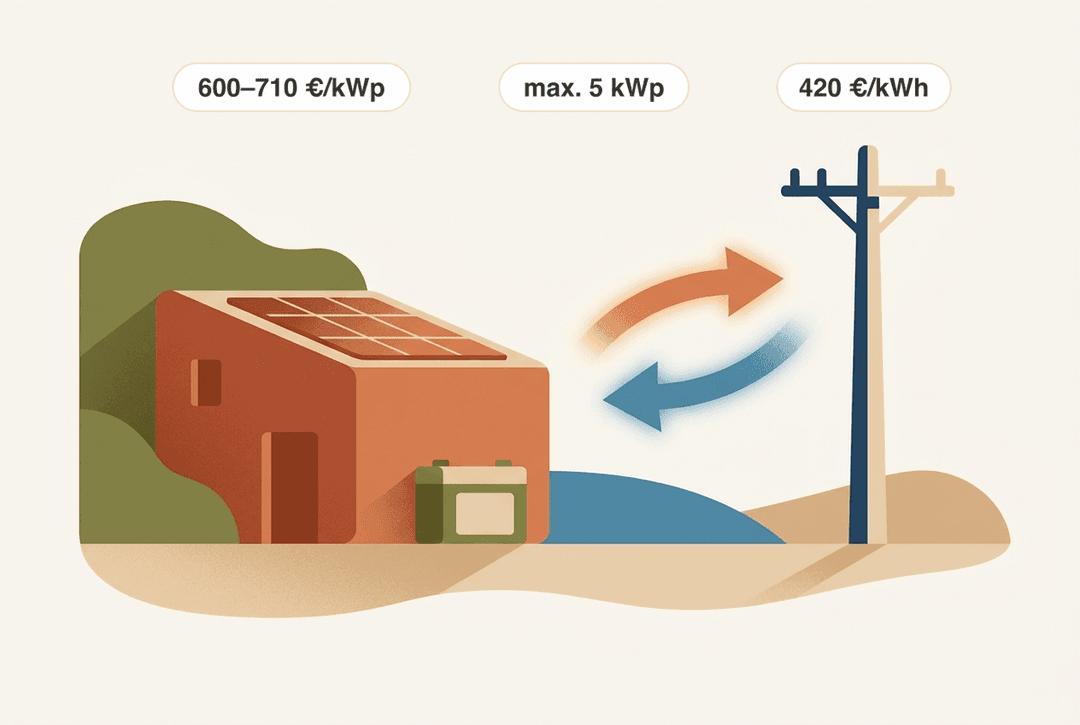
Since there is no ongoing feed-in tariff, the return on a system on Mallorca is generated primarily through three levers:
- Savings on electricity costs through self-consumption (the economically most important factor)
- The offsetting of surplus electricity via the Compensación de Excedentes
- The one-off investment grants from FOTOPAR2026 or the Comunidad programme, which directly reduce the initial investment
A battery storage system additionally increases the share of self-consumption, since solar power generated during the day can also be used in the evening and at night – a relevant factor especially on Mallorca, given the high cooling demand throughout the year in summer.
Requirements and application process
The path to a subsidised PV system with storage generally follows these steps:
- Needs assessment: Clarify electricity consumption, roof area and, where applicable, shared use.
- Proof of legality: Check or obtain the Cédula de Habitabilidad, building permit or completion certificate.
- Obtain a quote: Commission an installer experienced with the Balearic funding system, including a monitoring system.
- Submit the funding application: Observe the deadlines of the respective programme – the budget is capped and allocated according to date of receipt.
- Installation and proof: Document timely completion and attach the official identification plate.
- Contract with the energy provider: Contractually agree the Compensación de Excedentes in order to have surplus electricity offset.
Note: For flats and multi-family buildings, a formal resolution by the owners' association generally must be in place before the application is submitted. Clarify this at an early stage, as meeting dates often require several weeks' notice.
Most common mistakes
Many owners initially confuse the German EEG principle with the Spanish system and calculate on the basis of an ongoing feed-in tariff, which does not exist in this form in Spain – this leads to incorrect return expectations. Another common mistake is hesitating with the application: since FOTOPAR2026 is awarded strictly on a first-come, first-served basis, the funds are often exhausted before the official deadline expires. Missing proof of legality for detached houses – such as a missing Cédula de Habitabilidad – also regularly leads to funding applications being rejected. Finally, for communal systems the necessary lead time for the formal meeting resolution is often underestimated.
What comes next?
After installation and commissioning, the next step is agreeing the Compensación de Excedentes contract with the energy supplier as well as – depending on the programme – providing evidence to the funding body within the specified deadlines. After that, the system generally runs without any further application requirements; ongoing remuneration for surplus electricity is credited automatically via the monthly electricity bill. Anyone planning to rent out the property later should check whether the PV system and battery storage have a positive effect on the utility cost statement and thus on its appeal to tenants – you'll find relevant background information in the guide Renting out property in Mallorca.
Checklist for owners in Mallorca
- Electricity consumption and roof area/communal area checked
- Proof of legality (Cédula de Habitabilidad, building permit) available
- Suitable funding programme identified (FOTOPAR2026 vs. Comunidad programme)
- Quote obtained including a monitoring system
- Application deadlines and budget status of the respective programme checked
- For communal systems: assembly resolution obtained
- Compensación de Excedentes contract with the energy supplier prepared
- Official identification plate accounted for
Conclusion
Feed-in tariffs in the German sense no longer exist in Spain – since 2012 there has been no new funding with a fixed cent rate per kilowatt-hour. In its place is the Compensación de Excedentes under Real Decreto 244/2019, supplemented by attractive but time- and budget-limited investment grants such as FOTOPAR2026 and – according to press reports – a new funding programme for owners' associations, whose conditions should be officially verified before submitting an application. Anyone looking to invest in photovoltaics and battery storage in Mallorca in 2026 benefits above all from self-consumption, high numbers of sunshine hours and the current grants – but must act quickly, as funds are allocated on a first-come, first-served basis.
Official sources
- Real Decreto 244/2019 (Autoconsumo and Compensación de Excedentes) – Boletín Oficial del Estado: https://www.boe.es
- Govern de les Illes Balears – FOTOPAR2026 funding programme (FEDER 2021-2027): https://www.caib.es
- Bundesnetzagentur – German feed-in tariff rates (EEG 2023, § 48 Abs. 2), for system comparison: https://www.bundesnetzagentur.de
- Energy-Storage.News – National Spanish funding programme for battery storage: https://www.energy-storage.news