
Illegal building work in Mallorca: the eight-year limit and exceptions
The Statute of limitations for illegal buildings on Mallorca is, for many finca owners, the decisive question of all: Can the administration still order the demolition of a pool, extension or guest house built without a permit – or has the time for that run out? The answer depends on a deadline that, in the Balearics, is generally eight years, but which can also run longer depending on the time of construction and the protection status of the plot. And there are zones where this deadline practically never comes into play. In this guide you'll learn how the deadline is calculated, which buildings remain permanently open to challenge, what the Decreto-Ley 3/2024 changes about this – and why "time-barred" doesn't mean the same as "legal".

Why the statute-of-limitations question has suddenly become pressing again
For decades, Mallorca tended to turn a fairly generous blind eye when a shepherd's hut became a guest room or a terrace became a conservatory. Fines were occasionally issued, but demolition orders were rarely enforced. That has changed: the Balearic regional government now pursues building violations more consistently, and several demolitions in recent years have underlined this. At the same time, the property market has reacted – prices for properties that can be retroactively legalised have risen noticeably. Anyone buying, selling, renovating or insuring a finca can no longer avoid the statute-of-limitations question.
Note: A statute of limitations only means that the administration may no longer impose fines or order demolition. It does not mean that the building is legal. Very few owners understand this distinction correctly – with costly consequences when selling.
The three categories: legal, protected by prescription, illegal building
Before classifying your case, it helps to look at the three states that coexist on Mallorca:
| Category | Feature | Practical consequence |
|---|---|---|
| Legal building | Built with a building permit and approval | Full marketability, habitability certificate possible |
| Protected by prescription | Built without a permit, but the building violation is time-barred | Demolition no longer possible, but no cédula, no renovation permit, difficult to sell |
| Genuine illegal building | Without a permit, statute of limitations not yet reached or proceedings ongoing | Fines and demolition orders still possible |
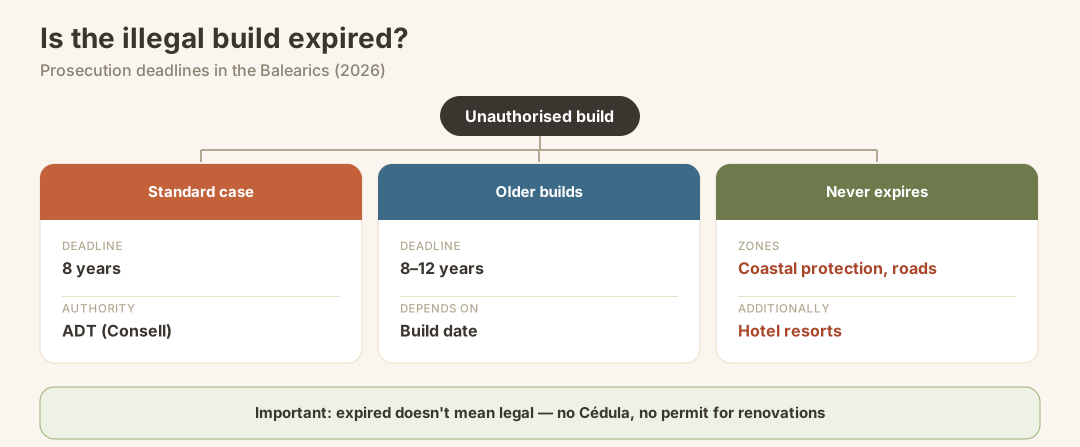
The fallacy many owners fall into: they consider a building protected by prescription to be "somehow legal" because no one can intervene anymore. In fact, it remains in legal limbo – as long as no legalisation takes place under the current Decreto-Ley, it will not receive a cédula de habitabilidad and no permit for renovations.
The 8-year rule: how the deadline is calculated
The basis is the Ley de Disciplina Urbanística of the Balearics, supplemented by the Balearic land law (LUIB), which has been in force since 1 January 2018. The starting point of every assessment is always the same: the date on which the construction work was actually completed – not the date of the land registry entry, not the purchase date.
- Determine the date of completion of the construction work (not the start of construction).
- Check whether an official procedure (fine, report, sanction file) was opened within the following eight years.
- If nothing was done, the violation is generally considered time-barred – the building has grandfathered status (bestandsgeschützt).
- If a procedure was initiated within the deadline, this interrupts the limitation period; the clock starts again or the procedure remains open.
Note: The burden of proving the completion date lies with the owner. Without solid evidence – aerial photographs, cadastral data, invoices, witness statements – it is often not possible to enforce a claim of limitation before the authorities.
When the deadline runs longer: 8 to 12 years
Eight years is the standard case, but not the only figure in circulation. Depending on the construction date and the protection status of the plot, the actually applicable deadline can range between eight and twelve years. This depends, among other things, on which law was in force at the time the construction was carried out and whether the plot is located in a specially protected zone.
| Factor | Effect on the deadline |
|---|---|
| Construction before the LUIB came into force (before 01.01.2018) | Earlier regulations may provide for different deadlines |
| Construction after 01.01.2018 | LUIB regulations and the eight-year deadline of the Ley de Disciplina Urbanística apply |
| Plot in a specially protected area | Tends towards a longer or even no limitation period (see below) |
| Ongoing administrative procedure | Limitation period is interrupted or does not occur |
Note: Because the exact calculation of the deadline strongly depends on the individual case, it is worth having an individual review carried out by a lawyer or architect on site specialising in urban planning law before any decision – purchase, sale, legalisation application.
The Agency for the Defence of the Territory
Responsible for pursuing building violations on the island is the Agencia de Defensa del Territorio, which is attached to the Consell de Mallorca. It examines reports, evaluates aerial photographs, and initiates sanction proceedings. It is precisely this authority that, through increased controls in recent years, has ensured that "no one ever said anything" is no longer a reliable strategy for many owners. Anyone who owns or wants to buy a finca with an unresolved building status should assume that an active procedure can interrupt the limitation period at any time – even after years of calm.
When an illegal building practically never becomes time-barred
This is exactly where the core of the question in the title of this guide lies. The current Decreto-Ley 3/2024, which regulates subsequent legalisation, categorically excludes certain cases regardless of the time elapsed. This means: even if the pure fine period had technically expired, these buildings remain permanently without any prospect of legalisation and thus remain vulnerable in practice:
| Zone / Situation | Status |
|---|---|
| Coastal protection zones | Excluded from legalisation |
| Proximity to certain roads | Excluded from legalisation |
| Hotel complexes | Excluded |
| Buildings with a tourist rental licence (ETV) | Consequences currently unclear, exception considered unlikely |
| Suelo urbano (urban land) | Generally not covered by Decreto-Ley 3/2024 – only suelo rústico is covered |
Note: If your finca is located in a coastal protection zone, you should expect legal uncertainty regardless of any calculation of the limitation period. You can read more about this in our guide on Ley de Costas.
Grandfathering is not legalisation – the consequences
A time-barred building violation protects against demolition, but it doesn't solve any of the practical problems that really affect owners:
- No cédula de habitabilidad: Without a habitability certificate, it becomes difficult to change water and electricity connections or to rent out the property on a regular basis.
- No renovation permit: Even urgently needed repairs – for example to a dilapidated roof – can fail at the town hall if the original construction was never approved.
- Difficult to sell: Buyers and banks are wary of an unclear building status, which is reflected in the price.
- No holiday rentals: Subsequently legalised properties remain permanently excluded from tourist rentals.
This chain of restrictions is the real reason why Decreto-Ley 3/2024 is in demand at all: it transforms a grandfathered but paralysed building into a building with a habitability certificate and the right to renovate.
Decreto-Ley 3/2024: Legalisation despite the statute of limitations
On 24 May 2024, the Balearic government's decree-law came into force, enabling the subsequent legalisation of time-barred illegal constructions in the countryside. It affects an estimated around 30,000 unauthorised buildings in Mallorca and builds on a similar regulation introduced in 2014 under the "Ley Company", which was later abolished, and under which around 1,500 buildings were legalised at the time.
| Requirement | Detail |
|---|---|
| Location | Only suelo rústico (rural land), regardless of the municipality |
| Age | The building violation must be legally time-barred, generally at least eight years |
| Ongoing proceedings | Must not exist |
| Application window | 3 years from entry into force (24.05.2024) – applications submitted afterwards will no longer be accepted |
| Partial legalisation | Not possible – the building must be legalised as a whole |
Note: The application window runs for three years from 24 May 2024, meaning it is expected to close in May 2027. Anyone who lets this deadline pass will have to wait for a possible follow-up regulation or risk having to demolish the building.
You can find more on the specific procedure, the required application documents and the role of the municipality in our in-depth guide Legalising an illegal build in Mallorca as well as in the guide on the standard building permit in Mallorca.
Costs and requirements of legalisation
Anyone submitting the application pays, in addition to the regular back-dated fees, a time-staggered penalty fee that depends on the value of the building work:
| Time of application | Penalty fee (% of the building value) |
|---|---|
| In the 1st year of the window | 10 % |
| In the 2nd year of the window | 12,5 % |
| In the 3rd year of the window | 15 % |
In addition, the decree requires environmental measures as a condition. According to the available information, low-income earners can receive reductions of up to 50% on these fees – the exact income thresholds should be clarified in each individual case with a specialised advisor.
Attention: The earlier the application is submitted, the lower the penalty fee. Anyone who waits until shortly before the deadline will pay noticeably more – for larger building volumes, this can amount to a difference of several tens of thousands of euros.
Most common mistakes when dealing with time-bar questions
- Confusing time-barring with legality: A building protected by time-barring is not automatically fit for sale or extension.
- Not documenting the completion date: Without aerial photos, invoices or other evidence, a statute of limitations can hardly be proven in a dispute.
- Ignoring the location in a protected area: Anyone building in a coastal protection zone should not rely on the statute of limitations – these buildings remain excluded from legalisation.
- Letting the application window lapse: The three-year deadline of Decreto-Ley 3/2024 keeps running regardless of individual circumstances.
- Hoping for a partial legalisation: As things currently stand, it is not possible to legalise only individual parts of a building – the property as a whole is what counts.
- Confusing ETV licence and legalisation: Legalised buildings remain excluded from tourist rental, regardless of an existing licence.
What comes after 2027?
The application window of Decreto-Ley 3/2024 is limited to three years from the outset. Once it expires – based on the information currently available – no new applications will be accepted, and buildings that still stand without a permit and without completed legalisation would in principle have to be removed. The previous, similar regulation from 2014 was abolished after a change of government; whether there will be a follow-up regulation after 2027 is currently unclear. Anyone who owns a property that could potentially be legalised should factor this uncertainty into their planning.
Checklist: Is my building statute-barred or legalisable?
- Document the completion date of the construction work (aerial photos, invoices, land registry history).
- Check whether eight to twelve years have passed since then – depending on the construction date and protection status.
- Clarify whether any official proceedings have ever been opened against the building.
- Check the location of the plot: suelo rústico or suelo urbano, coastal protection zone, proximity to roads.
- Take into account any existing tourist rental licence and the intended use.
- If legalisation is fundamentally possible: submit the application in good time within the three-year window.
- Consult a specialist lawyer or architect on site for the specific deadline calculation and application process.
Conclusion
The statute of limitations for an illegal building on Mallorca is not a fixed figure but the result of a case-by-case assessment: eight years as the general rule, with variations of up to twelve years depending on the construction date and protection status – and in coastal protection zones or with hotel complexes practically never, because Decreto-Ley 3/2024 categorically excludes these cases from legalisation. It remains important to understand: the statute of limitations protects against demolition, but it does not make a building legal. Anyone who really wants legal certainty – for a sale, renovation or rental – cannot avoid an individual assessment and, if possible, a legalisation application within the current window.
Official sources
- Ley 12/2017, de 29 de diciembre, de urbanismo de las Illes Balears (LUIB) — Boletín Oficial del Estado: https://www.boe.es
- Decreto-Ley 3/2024, of 23 May, on urgent measures regarding housing and urban planning — Govern de les Illes Balears: https://www.caib.es
- Consell de Mallorca – Agencia de Defensa del Territorio: https://www.conselldemallorca.cat
- Butlletí Oficial de les Illes Balears (BOIB): https://www.caib.es