
Installing Air Conditioning in Mallorca: Permits, Façade Rules & Costs
Anyone looking to install an air-conditioning unit in Mallorca often underestimates the bureaucratic side: before a technician drills so much as a single hole in the wall, the Comunidad de Propietarios, the local council, and — in the case of historic buildings — even the heritage protection authority may all have a say. At the same time, a well-planned system on the island is no luxury — when summer temperatures in top-floor flats routinely reach 35°C and above, it is simply a necessity. In this guide you will find out which permits you genuinely need, what rules apply to shared façades, how professional planning works in practice, what an installation in Mallorca costs, and which mistakes you should avoid at all costs.

Do you already know whether your Comunidad and your local council will give the green light?
- 📩 Submit a personal enquiry — We can help you clarify the right questions in advance
- More on the topic of building & renovation in Mallorca
Why planning ahead of installation is crucial
An air-conditioning system in Mallorca is not a plug-and-play solution. Professional contractors on the island — from German-trained master tradespeople to specialist climate-technology firms — consistently emphasise: planning is at least as important as the installation itself. Anyone who skips this step risks ending up with a system that either cools insufficiently, runs too loudly, or is mounted in the wrong location.
The following factors must be clarified before installation:
- Calculate the cooling load — As a rough guideline: top-floor flats or poorly insulated buildings require around 100 to 140 watts of cooling capacity per square metre. In well-insulated new builds or ground-floor flats, 60 to 80 W/m² is often sufficient.
- Determine the positions of the indoor and outdoor units — Pipe runs, height differences, and condensate drainage must all be suitable.
- Check the electrical wiring — Existing wiring in Mallorca is often not designed for modern air-conditioning systems.
- Clarify the permit situation — Only then should you proceed with commissioning.
- Commissioning and handover — After installation, a test run and a full walkthrough of the system's functions are part of the professional standard.
Please note: Competent planning ensures efficient, cost-effective, and long-term trouble-free operation — this is not marketing speak, but the very essence of a quality climate-system installation.
Which types of air-conditioning system are suitable for Mallorca?
The choice of system depends on the building type, the number of rooms, and the available space for the outdoor unit. Three systems are particularly widespread in Mallorca:
| System type | Description | Typical application |
|---|---|---|
| Split air-conditioning unit | 1 outdoor unit + 1 indoor unit | Single room, apartment |
| Multi-split air-conditioning unit | 1 outdoor unit + multiple indoor units | Multiple rooms, villa |
| Ducted unit | Concealed in the ceiling void, air distributed via ducts | New builds, renovations, commercial premises |
Ducted units are very popular in Mallorca for villas and high-end renovations, as the indoor unit remains completely hidden from view. Midea, for example, offers ducted units with cooling capacity levels ranging from around 3,5 kW to over 15 kW — with energy efficiency classes from A+ to A++ (SEER/SCOP). Two identical indoor units can be operated from a single shared outdoor unit (twin combination).
Split systems are the most common solution for existing flats — they are less expensive, quicker to install, and generally easier to handle in terms of permits with most local councils.
Please note: In cooling mode, the indoor temperature should ideally be kept between 24 and 28°C. The temperature difference between indoors and outdoors should not exceed 6°C — this is kinder to the system and makes good sense from a health perspective.
Permits: What You Actually Need in Mallorca
This is the point where many property owners and tenants in Mallorca come unstuck. The permit requirement depends on several factors:
Detached house (freestanding, no listed-building status)
For a detached single-family home with no listed-building restrictions, installation is generally most straightforward. That said, as soon as external units are visibly mounted on the façade or structural alterations are made, acomunicación previa(prior notification) or even alicencia de obra menor(permit for minor building works) may be required, depending on the municipality. This varies from one municipality to another across Mallorca – clarify the position in advance with the relevant Ayuntamiento.
Owner-occupied flat in a multi-unit building
Here, the law on horizontal property ownership (Ley de Propiedad Horizontal) applies without exception. For any measures affecting common property – and the external façade almost always falls into that category – a resolution of theComunidad de Propietariosis required.
| Situation | Consent required |
|---|---|
| External unit on the communal façade | Resolution of the Comunidad (owners' meeting) |
| Routing of pipes/cables through communal areas | Resolution of the Comunidad |
| Indoor unit within the private area | Comunidad consent generally not required |
| Listed building | Additional approval from the relevant authority |
| Historic old town / protected zone | Additional requirements depending on the municipality |
Warning:Never act without a Comunidad resolution when the façade is affected. Having to remove everything at your own expense – plus potential fines – is the likely outcome.
Listed buildings and historic old towns
For properties in historic town centres – such as Palma de Mallorca or other municipalities with protected zones – considerably stricter requirements may apply. In such cases, a separate approval from the relevant authority is often necessary before the Comunidad can even be consulted. Anyone who owns a historic property should approach this matter with particular care – for more information, see the guideHistoric Properties in Mallorca.
The communal façade: rights, obligations and the vote
In Spain, the external façade is generally common property – regardless of whether the external unit is to be positioned directly outside your own window. This means you may not attach anything there without a majority resolution from the owners' meeting.
How does the voting process work?
- Submit a request– You apply in writing to have the matter placed on the agenda for the next owners' meeting (Junta de Propietarios).
- Wait for the meeting– Extraordinary meetings are possible, but require advance notice.
- Vote– For structural alterations to common property, a qualified majority is generally required; the precise quorums are governed by the Ley de Propiedad Horizontal.
- Minutes– The resolution must be recorded in writing – you will need the minutes if the municipality requires a prior notification or permit.
Noise and Aesthetic Rules
Many Comunidades include regulations in their house rules (Estatutos de la Comunidad) regarding external units: placement, permitted noise levels, and cladding. Check these rules before booking an installation appointment.
Step by Step: How a Professional Installation Works
A professional air-conditioning company on Mallorca typically follows this process:
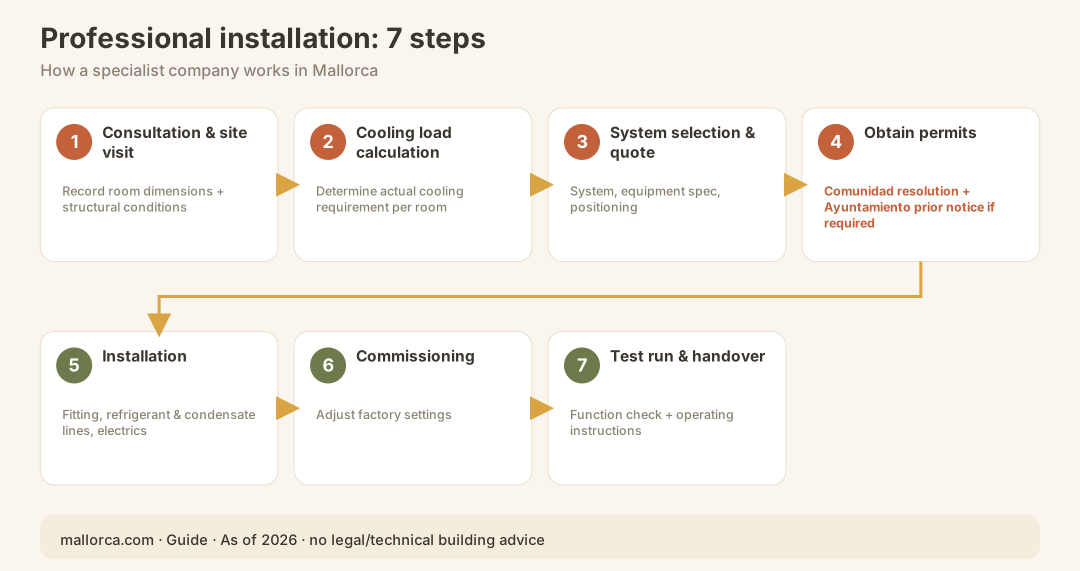
- Consultation and Site Visit – Inspection of the premises, recording of room dimensions and structural conditions.
- Cooling Load Calculation – Determining the actual cooling requirement per room and for the entire building.
- System Selection and Quote – Recommendation of the appropriate system, including equipment specification and positioning.
- Obtaining Permits – Comunidad resolution and, if applicable, prior notification/approval from the Ayuntamiento.
- Installation – Fitting of indoor and outdoor units, routing of refrigerant and condensate lines, electrical work.
- Commissioning – Factory settings are adjusted to suit the specific on-site conditions.
- Test Run and Handover – Functional check and explanation of operation.
Note: There are specialist companies on Mallorca that communicate in German, Spanish, and English – a considerable advantage for German-speaking owners who wish to discuss the finer points of planning in their native language.
Costs: What You Should Budget for in Mallorca
There are no reliable fixed figures available for Mallorca-specific installation prices. General indicative values can serve as a rough guide – actual costs in Mallorca can vary considerably depending on the provider, system type, building structure, and pipe run length.
| Cost Factor | Description |
|---|---|
| Unit (split system, basic) | Varies depending on performance class and brand |
| Assembly / Installation | Depends on complexity, pipe run length, and floor level |
| Electrical Work | Additional cost if existing wiring is absent or insufficient |
| Comunidad Process | Usually free of charge; management fees may apply |
| Ayuntamiento Permit | Varies depending on municipality and complexity |
| Annual Maintenance | Recommended at least 1× per year; to be arranged separately |
Important: Always obtain at least two to three detailed quotes from local specialist companies. Flat-rate prices found "online" without a site visit carry little weight on Mallorca – the structural characteristics of older Mallorcan buildings can significantly affect costs.
For rough preliminary planning: ducted systems involve greater outlay in terms of purchase and installation than standard split systems, but offer greater comfort and a visually unobtrusive solution.
Maintenance: What Is Often Overlooked
An air-conditioning unit on Mallorca is subject to considerable strain: long operating hours in summer, salt air near the coast, and dust ingress. Regular maintenance is therefore not an optional extra.
Minimum recommendation: Have the unit serviced by a qualified specialist at least once a year. This covers cleaning or replacing the air filters, checking the refrigerant pressure, inspecting the condensate drain, and clearing the outdoor unit of any deposits.
What you can do yourself: Check the indoor unit's air filters regularly for dirt and clean them as needed. Clogged filters noticeably reduce performance and increase energy consumption.
A well-maintained unit can achieve a service life of 15 to 20 years – a neglected one considerably less.
The most common mistakes when buying and installing air conditioning on Mallorca
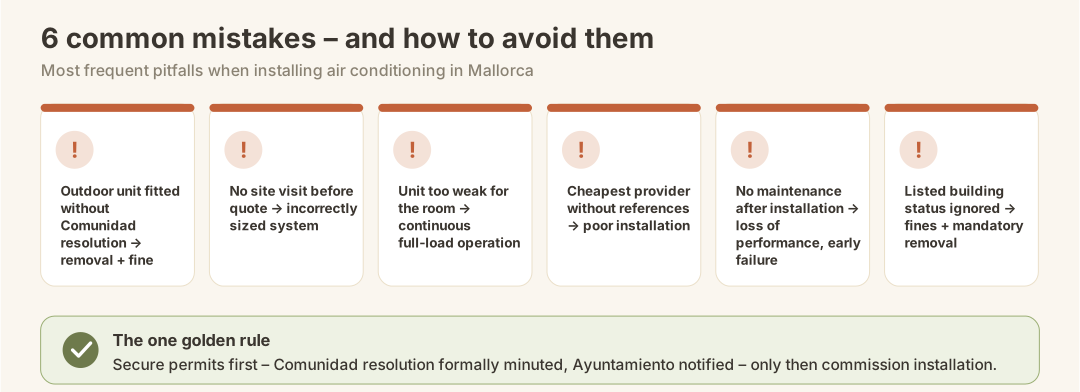
| Mistake | Consequence | Better approach |
|---|---|---|
| No site visit before the quote | Incorrectly sized system | Always insist on a site inspection and cooling load calculation |
| Outdoor unit installed without a Comunidad resolution | Removal at your own expense, possible fine | Resolution first, installation second |
| Cheapest provider with no references | Poor installation, no after-sales service | Choose a qualified specialist with verifiable credentials |
| No maintenance after installation | Loss of performance, premature failure | Take out a maintenance contract at the point of purchase |
| Unit too underpowered for the room size | System runs continuously at full load | Have the cooling load calculated correctly |
| Listed building protection not observed | Fines, obligation to restore original state | Contact the relevant authority in advance |
What comes next? Air conditioning and the energy certificate
If you want to let or sell your property after the air-conditioning installation, the new system may change the building's energy status – generally for the better. This is relevant for the energy certificate in Spain, which is a legal requirement for both letting and selling. An efficient air-conditioning unit with a high energy efficiency rating (SEER A++, SCOP A+) can have a positive impact on the assessment.
Are you planning to let your property after the upgrade? Then it is worth taking a look at our guides on long-term rentals on Mallorca or on the subject of letting in general.
Checklist: installing air conditioning on Mallorca
Before placing an installation order, you should be able to tick off every point on this list:
- Cooling load calculated for each room to be air-conditioned (or calculation commissioned)
- System type (split / multi-split / ducted unit) determined
- Position of indoor and outdoor unit discussed and agreed
- Comunidad de Propietarios informed and resolution obtained (for blocks of flats)
- Relevant Ayuntamiento contacted (prior notification or permit checked)
- Listed-building or protected-zone status of the property checked
- At least two quotes obtained from approved specialist contractors
- Electrical installation checked and electrician engaged if necessary
- Maintenance intervals and service contract clarified
- After installation: test run and handover briefing confirmed
Conclusion
Installing an air-conditioning system in Mallorca is technically very achievable – provided the planning is sound and the necessary permits are secured. The most common mistake is underestimating the bureaucratic side: in blocks of flats in particular, the approval of the Comunidad de Propietarios is non-negotiable, and in historic areas or protected zones there are further hurdles to clear. Have the cooling load calculated professionally, obtain at least two quotes from locally based specialist contractors, and don't forget the annual service. Do all that and you'll get many years of use from your air-conditioning system – on an island where you'll genuinely need it.
Official Sources
- Ley de Propiedad Horizontal (Spain) – Regulations governing owners' associations and common property: https://www.boe.es/buscar/act.php?id=BOE-A-1960-10906
- Ajuntament de Palma – Urbanisme (planning permissions and prior notifications): https://www.palma.es/es/sede-electronica
- Consell de Mallorca – Ordenació del Territori (spatial planning and protected areas): https://www.conselldemallorca.cat
- Govern de les Illes Balears – Medi Ambient (environmental and building regulations for the Balearic Islands): https://www.caib.es