
Buying historic properties in Mallorca: costs and BIC heritage rules
Anyone looking to buy a historic property on Mallorca – whether a centuries-old finca in the island’s interior, a town palace in Palma’s old town or a listed manor house in the Tramuntana – is entering a market unlike any ordinary property purchase. These buildings tell a story: thick natural-stone walls, vaulted ceilings, spacious courtyards and olive groves are all part of their appeal. At the same time, they come with particular legal, tax and structural pitfalls that can catch unprepared buyers off guard. This guide explains the types of property available, where to look, what a purchase really costs, which permits you need and how to avoid common mistakes – with specific figures, deadlines and guidance on the relevant authorities.
Why historic properties on Mallorca are so special
Mallorca has an exceptionally rich architectural heritage for a medium-sized Mediterranean island: Moorish wells, Gothic town palaces, manor houses dating from the heyday of the olive trade and farmsteads worked since the Middle Ages. Modern developments cannot replicate these buildings. That helps explain why demand remains strong despite the often substantial need for renovation – both from European buyers seeking authenticity and from investors who see the limited supply as a driver of value.
Even so, this is no straightforward purchase: heritage restrictions, building regulations on suelo rústico, energy requirements and complex land registry records make thorough due diligence essential. Buyers who understand this and bring in the right specialists can acquire a property unlike anything else in the world.
The main property types at a glance
Not every old building on Mallorca is the same. The term “historic property” covers very different types of building, with different legal statuses, price ranges and renovation requirements.
| Type | Spanish term | Typical features | Common location |
|---|---|---|---|
| Country estate / farmhouse | Finca rústica | Natural stone, terracotta roof, olive groves, extensive land | Island interior, Tramuntana, south-east |
| Manor house / country estate | Possessió | Imposing façade, chapel, large estate, historic farm buildings | Central Mallorca, north-east |
| Town palace / townhouse | Casal / Palau urbà | Courtyard (pati), vaulted ceilings, aristocratic architecture | Palma old town, Alcúdia, Pollença |
| Historic village house | Casa de poble | Part of a historic village centre, often with stone arches | Sineu, Petra, Artà, Felanitx |
| Mill | Molí | Tower-like building, often requiring special permission | Throughout the island |
Note: The classification in the Spanish cadastre and Land Registry is what matters – not the estate agent’s marketing term. A property advertised as a “finca” may be registered as a townhouse, which means different building regulations apply.
The best locations for historic properties
The island’s interior
The geographical centre of the island – including municipalities such as Sineu, Santa Margalida, Petra, Porreres and Montuïri – has a large number of unrenovated and partly renovated fincas and possessions. The region offers historic villages, castles and monasteries, as well as a tranquillity that coastal areas have long since lost. The choice of properties here is still relatively broad.
Tramuntana
The UNESCO World Heritage mountain range in the north-west – home to Valldemossa, Deià, Sóller, Fornalutx and Banyalbufar – is the most prestigious area in which to search for historic properties. Planning rules and heritage restrictions are particularly strict here. Those restrictions also help properties hold their value.
Palma Old Town
Palma’s historic centre has urban palaces with Gothic or Baroque façades, often with elaborate patis (courtyards). Demand is high and supply is limited; according to market reports, the number of properties available on online portals in Palma has recently fallen noticeably.
Alcúdia & the north-east
The medieval town of Alcúdia is surrounded by well-preserved 14th-century walls. Narrow cobbled streets lead to historic churches and small squares. The north-east also has numerous fincas in municipalities such as Artà and Sant Llorenç.
Prices: what historic properties cost in Mallorca
The Mallorca market reached historically high prices in 2025/2026. According to market reports, asking prices in areas popular with tourists averaged around €6,700 per square metre in 2025 – and are still rising, albeit more moderately than in the boom years. Coastal hotspots remain the most expensive locations, while selected inland villages are emerging as new luxury destinations.
| Location / type | Guide price (unrenovated / in need of renovation) | Guide price (fully renovated) |
|---|---|---|
| Central Mallorca – medium-sized finca | from approx. €800,000 | from approx. €1.5 million |
| Tramuntana – finca / possessió | from approx. €2 million | from approx. €4–6 million |
| Palma Old Town – Casal | from approx. €1.5 million | from approx. €3 million |
| North-east – finca with land | from approx. €600,000 | from approx. €1.2 million |
| Luxury finca in the Tramuntana / on the coast | €10 million and more | up to €40 million and beyond |
Please note: These guide prices are based on market reports from 2025/2026. Individual properties can vary considerably. Always obtain an independent valuation before making an offer.
Limited supply meets strong demand – and that continues to push up prices, including in the historic property market. As a rule, waiting means paying more.
Additional purchase costs: what you’ll actually pay
Transfer tax (ITP)
Explanation
The taxable base (base imponible) is the value used to calculate the tax: the price stated in the deed or the higher cadastral reference value. Enter the higher value.
Explanation
A main home (vivienda habitual) is the home you normally occupy under Spanish income tax rules. Select a profile only if you meet all its conditions; the calculator checks the value threshold and transaction date.
The general tariff applies without personal tax relief, for example when buying a second home.
- Property transfer tax (ITP) payable
- €25,600.00
Legal status: 14 June 2026
This calculation is provided for guidance only and is not a substitute for tax or legal advice in specific cases.
The most reliable rule of thumb is to budget an extra 10 to 14 per cent of the purchase price. For existing properties (such as a typical historic finca or manor house bought from a private seller), the figure is closer to 12 to 14 per cent because of the Balearic Islands’ progressive property transfer tax (ITP).
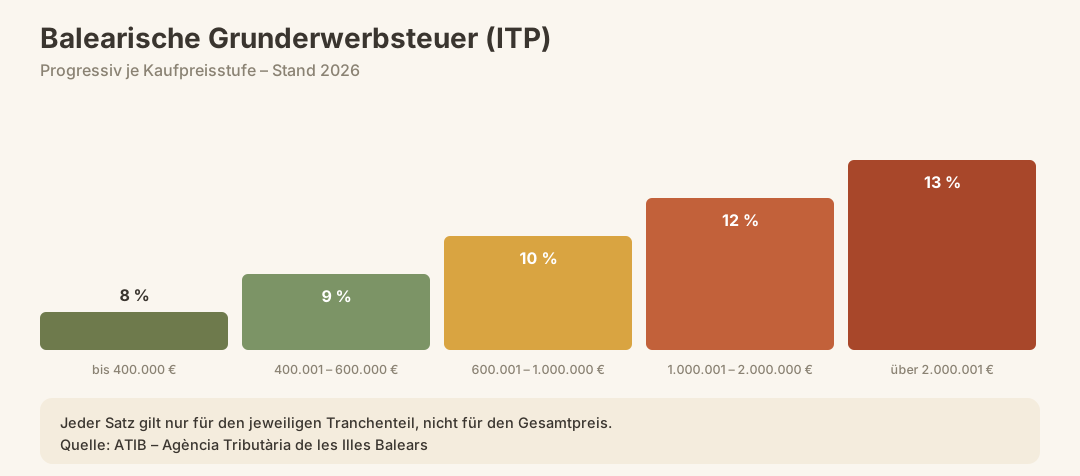
Balearic ITP bands (resale properties, as at 2026)
| Purchase price band | ITP rate |
|---|---|
| Up to €400,000 | 8% |
| €400,001–€600,000 | 9% |
| €600,001–€1,000,000 | 10% |
| €1,000,001–€2,000,000 | 12 % |
| Over €2,000,001 | 13 % |
ITP is progressive: each rate applies only to the relevant portion of the price, not to the total purchase price. Other additional costs include notary fees, Land Registry fees, legal fees and, where applicable, estate agent fees. You can find more details on all these costs in the guide Additional costs of buying property in Mallorca.
Heritage protection & BIC: what it means for you
Spain has different levels of protection for historically significant properties. The highest category is Bien de Interés Cultural (BIC) status – alterations to the building’s structure, façade or overall ensemble are subject to strict approval requirements. Municipalities also have local protection registers (catálogos de protección), which are less well known but just as legally binding.
What BIC protection means in practice:
- Any alteration to the building – including maintenance, replacing windows or changing the façade colour – requires prior approval from the relevant cultural heritage authority (Consell de Mallorca or Govern de les Illes Balears, depending on the level of protection).
- The approval process generally takes significantly longer than for properties without heritage protection.
- When a BIC property is sold, the public authorities have a right of first refusal (derecho de tanteo y retracto) – this must be taken into account in the notarial deed.
- In return, funding for heritage-sensitive restoration is available in certain cases.
You can find a full overview of protection levels, requirements and funding options in the guide BIC heritage protection in Mallorca.
Building regulations on suelo rústico: the key rules
Most historic fincas and estates stand on suelo rústico (rural land), which is subject to its own building regulations and must not be confused with urban planning rules.
| Topic | Rule |
|---|---|
| General ban on new builds | New residential buildings are generally not permitted on suelo rústico |
| Extensions to existing buildings | Only possible within strict limits and with permission |
| Rebuilding ruins | Depends on documentation of the original building |
| Outbuildings | Restricted – pools, garages and the like cannot simply be built without permission |
| ANEI protected area | Particularly strict requirements; see ANEI & Nature Conservation |
| Tramuntana UNESCO zone | Additional restrictions; see Tramuntana Building Regulations |
Important: Over the decades, many historic fincas have had extensions or alterations made without permission. These must be identified before purchase and – where possible – legalised. Read Legalising Unauthorised Building Work and How to Spot Illegal Extensions.
For fincas on rural land, the guide Finca on Suelo Rústico in Mallorca is also recommended.
Due diligence: What to check before buying
For historic properties, a specialist property lawyer is essential, not optional. Due diligence involves considerably more checks than a standard flat purchase:
- Land Registry extract (Nota Simple) – Check the owner, charges, property description and registered rights of residence or use → Check the Spanish Land Registry
- Cadastral record – Does the registered area (building + plot) match the actual area?
- Building permits – Were all phases of construction approved? What documents are available?
- Heritage register – Is the property listed on a local or national heritage register?
- Local development plan (PGOU) – Current land classification and permitted uses
- Cédula de Habitabilidad – Is there a valid certificate of habitability? → Cédula de Habitabilidad Mallorca
- Energy performance certificate (Certificado Energético) – Required when selling → Energy certificate Spain
- IBI and outstanding taxes – Arrears of annual property tax (IBI) pass to the new owner → IBI tax Spain
- Water supply – Well, cistern or mains connection? → Water supply for a finca
- Right of first refusal – Public authorities have a statutory right of first refusal for BIC properties
Note: Ask the seller to give you the originals of all building permits – not just copies. Missing permits for extensions, pools or outbuildings can lead to costly demolition orders after you buy.
Restoration & renovation: costs, requirements and grants
Renovating a historic property on Mallorca is a project that can take years and tie up substantial financial resources. Plan for this realistically and you can avoid unpleasant surprises later.
Typical cost drivers for historic properties
- Structure and foundations – Old stone buildings often lack reliable structural documentation; a preliminary assessment is essential
- Building services – Electrical, water, drainage, heating and air-conditioning systems must all be replaced in a complete renovation
- Roof structure and terracotta – Original roof tiles are labour-intensive to restore; replacement materials can be hard to source
- Materials appropriate for listed buildings – For protected properties, the authorities often specify particular materials (lime plaster, natural stone, traditional window construction)
- Building permit procedures – Can take several months or more than a year
You can find a detailed cost breakdown for complete renovations in the guide Complete renovation costs on Mallorca.
Restoration grants
In certain cases, the Balearic Islands offer grants for restoring historic and listed buildings. The terms change regularly; you can find the latest information in the guide Restoration grants on Mallorca.
Building permits: what you need and when
Even for an existing historic building, you need a permit for almost any work – often more so than for a new build. The local council (Ajuntament) is usually your first point of contact; for listed properties, the cultural heritage authority is also involved.
| Work | Permit required |
|---|---|
| Minor repairs, interior painting | Generally none / comunicación previa |
| Façade work, window replacement | Licencia menor or comunicación previa, for BIC properties: cultural heritage authority |
| Structural alterations, remodelling | Licencia mayor (major building permit) |
| Change of use (e.g. to a hotel) | Special permit + possibly Declaración de Interés General |
| Construction of new outbuildings on suelo rústico | Severely restricted, often not eligible for approval |
Read more in the guides Building permits in Mallorca and Comunicación Previa building permits.
Holiday lets in historic properties: the current rules
Many buyers of historic fincas and manor houses consider using them for tourism. Caution is needed: since Decreto-ley 4/2025, apartments in multi-unit buildings in the Balearic Islands can no longer be newly registered as holiday lets. For detached houses, the Consell de Mallorca allocates places only through a ballot for limited quotas; in Palma, it no longer allocates any. Decreto-ley sets out separate rules on places for buildings of heritage or cultural value – a lawyer must check whether your property qualifies.
This means that if you buy a historic property intending to let it to holidaymakers, you must either:
- buy a property that already has a valid ETV licence (an existing licence), or
- opt for long-term letting instead
Transferring an existing ETV licence to a new owner is subject to strict conditions; find out more in the guide Transferring an ETV licence.
Important: Don’t buy a historic property primarily for holiday rentals without first having a lawyer check the property’s exact licence status.
Financing: what’s different for historic properties
Spanish banks can find historic properties – particularly unrenovated fincas or properties with an unclear planning status – harder to assess as security. This affects the mortgage terms.
What you should know:
- The mortgage valuation (valor de tasación) can be significantly lower than the purchase price if substantial renovation is needed or the property’s heritage protection status is unclear
- Many buyers in this segment therefore need a larger deposit than they would for a newly built villa
- Specialist banks with experience in Mallorca understand this market better than general lenders
For a detailed overview of mortgages in Mallorca, see the guide Financing a property in Mallorca. The reporting obligation under AWV for transferring money to Spain is explained in this guide.
Taxes for owners: ongoing costs
Your tax obligations don’t end with the purchase. As the owner of a historic property in Mallorca, you’ll have ongoing payments to make:
| Tax / charge | Basis | Note |
|---|---|---|
| IBI (property tax) | Cadastral value | Annual; amount varies by municipality |
| Wealth tax (Impuesto sobre el Patrimonio) | Market value less allowances | Not suspended in the Balearic Islands |
| Non-resident income tax | Deemed rental value or actual rental income | If you are not resident in Spain |
| Plusvalía (on sale) | Increase in the value of the land | Usually paid by the seller; check in the case of inheritance |
More on wealth tax: Wealth tax in Spain. On inheritance and gifts involving historic family homes: Inheritance and gifts in the Balearic Islands.
Most common mistakes when buying historic properties
- Not hiring a specialist lawyer – A general property lawyer without experience in historic properties may overlook heritage listings, suelo-rústico restrictions and planning breaches. → Lawyer for a property purchase
- Underestimating renovation costs – The purchase price is often the smallest expense. Get a detailed cost estimate before signing binding contracts.
- Ignoring unauthorised buildings – Many fincas have extensions built decades ago without permission. After purchase, these may lead to demolition orders or fines.
- Forgetting the right of first refusal – Public authorities have a right of first refusal over BIC properties. A notary without Mallorca-specific expertise sometimes misses this step.
- Not checking the ETV licence status – If you buy a finca intending to let it and only discover afterwards that no licence can be transferred, you have an expensive problem.
- Cadastral measurements not verified – Older buildings often have outdated cadastral records; the actual living area may differ significantly.
- Energy performance certificate missing – Without a valid energy performance certificate, a legally binding purchase contract cannot be concluded.
- Water rights unclear – For fincas with their own well, the water rights must be recorded in the water register. → Legalising a well
What happens next? From signing to a move-in-ready property
Once you have signed the notarial deed of sale (escritura pública), the next steps begin:
- Pay ITP – Deadline: one month from signing the deed, payable to the Balearic tax authority ATIB (Agència Tributària de les Illes Balears)
- Land Registry registration – The notary forwards the documents; registration usually takes several weeks
- Transfer utility contracts – Have electricity, water and, if applicable, gas transferred into your name
- Take out contents insurance – For historic buildings with a declaration of special value → Contents insurance in Spain
- Start planning renovations – Hire an architect with heritage conservation experience and begin discussions with the authorities
- Apply for grants – Check deadlines and submit applications early
Checklist: Buying a historic property in Mallorca
- Specialist property lawyer (with knowledge of suelo rústico + heritage conservation) appointed
- Land Registry extract (Nota Simple) checked for charges and accuracy of the property description
- Cadastral record compared with the actual area
- Originals of all existing building permits reviewed
- Heritage protection registers (local + national) checked
- Cédula de Habitabilidad available and valid
- Energy performance certificate (Certificado Energético) available
- Outstanding IBI and other unpaid taxes and charges checked
- Water supply and water rights clarified
- ETV licence status checked (if holiday rentals are planned)
- Public authorities’ right of first refusal taken into account (for BIC properties)
- Renovation cost estimate obtained from a specialist contractor
- Financing budget confirmed, including 12–14 % in additional purchase costs
- Reservation agreement signed only with a withdrawal clause → Reservation agreement in Spain
Conclusion
Buying a historic property on Mallorca means exceptional architectural character and an incomparable lifestyle – but also a greater need for due diligence. Take the time to investigate thoroughly, understand heritage protection requirements early and budget realistically for renovation, and you can acquire a property that cannot be replicated. Additional purchase costs of 10 to 14 per cent, the progressive Balearic ITP rate of up to 13 per cent for high-value properties, and the moratorium on ETV licences are specific factors that should shape your financial planning from the outset. With the right specialists by your side, this is one of Europe’s most appealing property markets.
Official sources
- ATIB – Agència Tributària de les Illes Balears (ITP, Balearic Islands tax authority): https://www.atib.es
- Govern de les Illes Balears – Conselleria de Cultura (BIC register, heritage protection): https://www.caib.es/govern/organigrama/area.do?coduo=9
- Consell de Mallorca – Departament de Territori (suelo rústico planning law, PTM): https://www.conselldemallorca.net
- Catastro España (cadastral information): https://www.sedecatastro.gob.es
- Registro de la Propiedad (land registry search via Nota Simple): https://www.registradores.org
- BOE – Boletín Oficial del Estado (Ley 16/1985 Patrimonio Histórico Español): https://www.boe.es/buscar/act.php?id=BOE-A-1985-12534
- BOIB – Butlletí Oficial de les Illes Balears (Balearic regulations, Decreto-ley 4/2025): https://www.caib.es/boib