
Long-Term Renting in Mallorca: The Complete Tenant Guide 2026
Anyone who wants to live on Mallorca permanently will find it hard to avoid a long-term rental (in Spanish alquiler de larga duración or vivienda habitual). It is your legally strongest residential status on the island — and at the same time the most fiercely contested market. This guide shows you, from a tenant's perspective, what rights Spanish tenancy law guarantees you, what distinguishes a long-term rental from a seasonal or holiday let, what costs you should budget for, and how to avoid the typical Mallorca pitfalls.
On Mallorca, the long-term rental is the key to a vivienda habitual — your primary residence. A long-term tenancy agreement is generally the only way to obtain empadronamiento (registration with the local authority in the padrón), which you need for follow-on NIE processes, your health card, a school place, and much more. Unlike holiday lets, long-term rentals enjoy the full protection of Spanish tenancy law: a guaranteed minimum term, capped rent increases, and — since 2023 — estate-agent fees charged to the landlord.
Are you planning your move to Mallorca and looking for the right strategy between renting and buying?
- 📩 Submit a personal enquiry — we will connect you with vetted local contacts for your area.
- Guide to emigrating to Mallorca — from NIE and padrón to tax residency.

Long-term rental vs. seasonal and holiday lets — what's the difference?
Spanish law recognises three very different forms of tenancy that are constantly confused in practice. The distinction is not merely academic: it determines whether you have five years of housing security or have to move out again in October.
| Type of rental | Spanish term | Legal basis | Tenant protection | Typical Mallorca scenario |
|---|---|---|---|---|
| Long-term rental (primary residence) | arrendamiento de vivienda habitual | LAU Art. 9–10 (full protection) | very high: minimum term of 5/7 years | You live on the island permanently |
| Seasonal rental | arrendamiento de temporada (LAU Art. 3) | LAU for "uso distinto", freely negotiable | low: only the contract applies | Overwintering, project lasting 6–11 months |
| Holiday let | alquiler turístico / vacacional | Balearic Tourism Act + ETV licence | virtually none (similar to a hotel) | Holiday, short stays |
The most important trap: A seasonal tenancy is not a dwelling in the legal sense. It falls under "alternative use" (uso distinto de vivienda) and grants you neither the minimum term nor the capped rent increase. Some landlords on Mallorca deliberately offer "temporada" contracts to circumvent tenant protection — even though you are in fact living there permanently. This is risky for both parties and has increasingly been in the legislator's sights since 2026, with efforts to curb the abuse of seasonal contracts (a corresponding Real Decreto-Ley was announced in mid-2026 but had not yet been confirmed in the BOE — see the note further below).
Bear in mind the rule of thumb: if you want to make Mallorca your permanent home, you need a contrato de vivienda habitual — not temporada, not vacacional.
The legal framework: LAU + Ley de Vivienda 2023
Two pieces of legislation govern your long-term tenancy. The Ley de Arrendamientos Urbanos (LAU, Ley 29/1994) is the fundamental tenancy law. The Ley 12/2023 por el derecho a la vivienda fundamentally reformed it in 2023 — in favour of tenants.
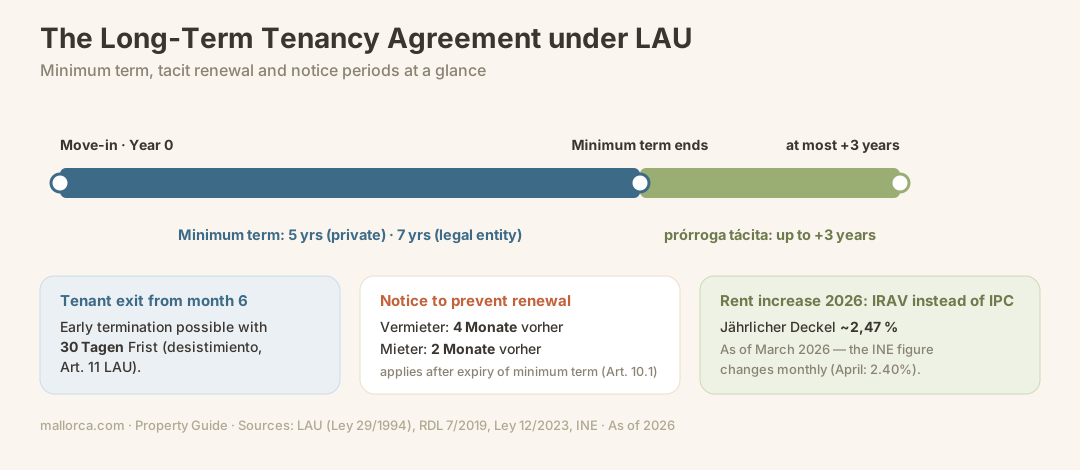
Minimum term: 5 years (private landlord) or 7 years (company)
This is your strongest right. Regardless of what duration is stated in the contract: if the landlord is a private individual, you may stay for up to five years. If the landlord is a legal entity (a limited company, a fund, a gran tenedor), the period is seven years (LAU Art. 9). If the contract specifies a shorter term, it is automatically extended year by year up to this minimum — for as long as you wish. The landlord cannot extricate themselves early.
Tacit extension (prórroga tácita): up to 3 additional years
Once the 5 or 7 years have elapsed and neither party gives notice in time, the contract is automatically extended by one year at a time, for up to three further years (LAU Art. 10). The notice periods that must be observed in order to prevent precisely this automatic renewal once the minimum term has expired are important: the landlord must give at least four months give notice, the tenant at least two months in advance (LAU Art. 10.1).
Don't confuse the two: These 4-/2-month notice periods only apply to the threshold for tacit renewal after the 5 or 7 years respectively. If, on the other hand, you want to exit during the tenancy term, a different, shorter rule applies: the desistimiento with 30 days' notice (LAU Art. 11, see below). Don't mistakenly use the 2-month period for an early termination — 30 days is sufficient for that.
Agency fees: paid by the landlord since 2023
Perhaps the most important practical change for you: since the Ley 12/2023, LAU Art. 20.1 stipulates that "the costs of property management and contract formalisation shall be borne by the landlord" (serán a cargo del arrendador). This obligation had already applied since RDL 7/2019, but only where the landlord was a legal entity — the Ley 12/2023 extended it to all landlords, including private individuals.
The notorious "mes de agencia" — typically around one month's rent plus 21 % IVA in agency fees, previously paid by the tenant — is therefore illegal in long-term residential lettings. Spain's consumer affairs ministry (Consumo) explicitly warned in an official communication (February 2024) that charging the tenant this fee is unlawful. The specific figure of "one month's rent + IVA" is the industry-documented practice, not the official wording. If you are asked to pay it regardless, you are entitled to refuse or to reclaim it later.
Watch out for a loophole: For temporada-, luxury and commercial contracts, the fee may still be freely agreed. This is another reason why some landlords prefer seasonal contracts.
Rent controls & zonas tensionadas — not active in Mallorca
The Ley 12/2023 allows "zonas de mercado residencial tensionado" (stressed residential markets) to be declared, with rents capped accordingly. What matters for you: Such a declaration is a matter for the Autonomous Community. As of 2026, Catalonia accounts by far for the greatest number of stressed zones (around 271 municipalities, approximately 89 % of all declared zones). The Basque Country (including Bilbao) has also designated zones, Navarra (Pamplona) and Galicia (A Coruña) declared zonas tensionadas; over 300 municipalities in total. Madrid and the Comunitat Valenciana have issued no such declaration.
What matters for you: The Balearic Islands have not yet declared any zona tensionada — the Govern under Marga Prohens is instead banking on planned tax incentives for moderate landlords (an announced regional IRPF discount that had not yet entered into force as binding legislation by the end of 2025) rather than price caps. What this means for you: in Mallorca in 2026 there is no statutory rent control for new tenancy agreements. The initial rent is negotiated freely. Only the annual adjustment is subject to the statutory IRAV cap.
What documents do you need as a tenant?
In a market as pressured as Mallorca, it is often the person who has their paperwork ready fastest and most completely who wins. Prepare your file digitally before you even go to a viewing.
| Proof | Spanish term | Purpose | Required / standard |
|---|---|---|---|
| Passport / national ID card | pasaporte / DNI | Identity | Required |
| Foreign tax identification number | NIE | every contract, utility provider, bank | effectively required |
| Employment contract or proof of self-employment | contrato laboral / alta de autónomo | Creditworthiness | standard |
| Last 3 payslips | últimas 3 nóminas | Income | standard |
| Spanish bank statement | extracto bancario | Financial solvency | standard |
| Most recent tax return | declaración de la renta | for self-employed individuals | depending on the landlord |
| Guarantor / Guarantee | aval / garante | Security with a thin credit profile | optional |
The standard affordability rule of thumb used by estate agents on Mallorca: rent should account for no more than one third of your monthly net income . If you earn a combined net income of 3.600 € as a couple, a rent of around 1.200 € is considered safely affordable. If you fall below that threshold, a bank guarantee (aval bancario) or a solvent guarantor can make a considerable difference.
Practical tip: Without a NIE things get complicated. Whilst the law does not strictly require an NIE for the tenancy agreement itself, without one you will be unable to open a Spanish bank account or register utility contracts in your name — and that is precisely what landlords want to see. Apply for your NIE early.
Costs & deposit: what you actually pay on move-in
Do not budget for just the first month's rent when moving in. Here is a realistic breakdown for a long-term tenancy vivienda habitual:
| Item | Amount | Legal basis / Note |
|---|---|---|
| First month's rent (in advance) | 1 × rent | Standard |
| Statutory deposit (fianza) | exactly 1 month's rent | LAU Art. 36 — no more, no less |
| Additional guarantee (garantía adicional) | max. 2 further months' rent | RDL 7/2019, optional |
| Maximum on move-in (security) | max. 3 months' rent in total | anything above this is void |
| Agent's commission | 0 € for the tenant | LAU Art. 20.1 — payable by the landlord |
| Utility transfer (electricity/water) | approx. 50–150 € | Electricity Endesa, water municipal |
The fianza for residential tenancies is set by law at exactly one month's rent (LAU Art. 36). If a landlord asks for 'two months' deposit' for a long-term tenancy, strictly speaking this is no longer a fianza but an additional guarantee — and the total of the fianza plus any additional guarantees must not exceed three months' rent (this overall cap derives from RDL 7/2019). Anything above this is nulo de pleno derecho (null and void), even if you have signed the agreement.
Important regarding repayment: the landlord must return your deposit within one month of the keys being handed back (LAU Art. 36.4). If they repay later without a legitimate reason, they owe you statutory interest. Also: the deposit may not be 'used up' as the final month's rent — this is a common source of disputes.
Realistic rental levels in Mallorca (end of 2025 / 2026)
The Balearic Islands are among the most expensive rental regions in Spain. According to idealista, the average rent across the Balearics at the end of 2025 was around 19.1 €/m² per month — the second highest of all Spanish regions, behind only Madrid (20.8 €/m²). Other portals (e.g. fotocasa) quote slightly different averages; the figures given here are based on the idealista index. In Palma the figure was around 18.3 €/m², making the island's capital the third most expensive provincial capital in Spain (after Barcelona and Madrid).
| Location | Indicative €/m²/month | Example 70 m² flat |
|---|---|---|
| Palma (city, average) | approx. 18.3 €/m² | approx. €1,280/month |
| Premium south-west (Andratx, Portals) | in some cases > 22 €/m² | from approx. €1,540/month |
| Tramuntana villages (Sóller, Valldemossa) | upmarket, limited supply | highly variable |
| East of the island / Manacor | more affordable, but rising sharply (+13 % 2025) | depending on the property |
These figures are market averages drawn from idealista reports and vary considerably depending on condition, furnishings, and location. They are not a substitute for a concrete property valuation. You can find current market trends in our Mallorca Market Report.
The tenancy agreement: duration, notice, IPC vs. IRAV
What the contract (contrato de arrendamiento) must be included
- Identity of both parties incl. NIE/DNI
- Precise description of the property (address, cadastral reference)
- Rent amount and payment method
- Duration and explicit classification as vivienda habitual
- Amount of the fianza and any additional guarantees
- Index for the annual rent adjustment
Rent adjustment: IRAV replaces the IPC
The Ley 12/2023 has fundamentally restructured this area. Previously, the annual rent was linked to the IPC (consumer price index). Since January 2025, a new, lower index applies to all tenancy agreements concluded on or after 26 May 2023: the IRAV (Índice de Referencia de Arrendamientos de Vivienda), published monthly by the national statistics office INE.
| Contract concluded … | Adjustment index 2026 | Example value |
|---|---|---|
| before 25 May 2023 | IPC (or agreed formula) | IPC approx. 3.2 % (April 2026) |
| on or after 26 May 2023 | IRAV (cap) | approx. 2.47 % (as of March 2026) |
The IRAV is deliberately set below the IPC: it is defined as the minimum of the IPC, core inflation, and a smoothed average, and is designed to cushion sharp rent increases. In practical terms: with a rent of €1,200 and an IRAV of 2.4 %, the landlord may increase the rent by no more than €28.80, bringing it to €1,228.80 — once a year on the contract anniversary date. An increase mid-year or without written notice is not permitted.
Important — check the current index: The IRAV changes monthly. The figure quoted here of approximately 2.47 % is the value as of March 2026 (published by the INE in April 2026); by April 2026 it had already fallen to 2.40 %. For your specific increase, the value that always applies is the current figure at the time of adjustment, taken from the INE monthly dataset. Note on the legal position: during 2026 an extraordinary cap of 2 % was temporarily in force (RDL 8/2026), however this was not confirmed by Congress and was repealed (derogated) at the end of April 2026. Since then, the regular IRAV has once again been the applicable index.
Early termination by you (desistimiento)
You are not 'locked in' for five years. Under LAU Art. 11 you may, after at least six months Cancel at any time during the term with 30 days' notice — this is the relevant period for early tenant exit during the term (not the 2-month period from Art. 10, which only concerns renewal after expiry). You only owe compensation if the contract expressly provides for it — and even then, at most one month's rent per remaining full contract year (pro-rated for partial years). If the contract says nothing about this, you are free to leave after the 6 months. Always give notice in writing with proof of receipt — the safest method is by burofax.
What is different about Mallorca?
The law is the same throughout Spain, but the Mallorcan market has its own pitfalls.
1. Extreme housing scarcity. The Balearen are an island with limited housing stock and high demand. In 2026, approximately 24,000 rental contracts on the Balearen alone are due to expire (exactly 24,456 according to data from the Ministerio de Consumo, reported by EL PAÍS in December 2025, among others) — competition for every listing is fierce. Good long-term properties are often gone within hours.
2. Summer season clash. Many landlords prefer the more lucrative holiday rental market in summer. You will therefore occasionally come across 'long-term' listings that are in reality 'only until May' — in other words, disguised seasonal contracts. Read the contract type carefully.
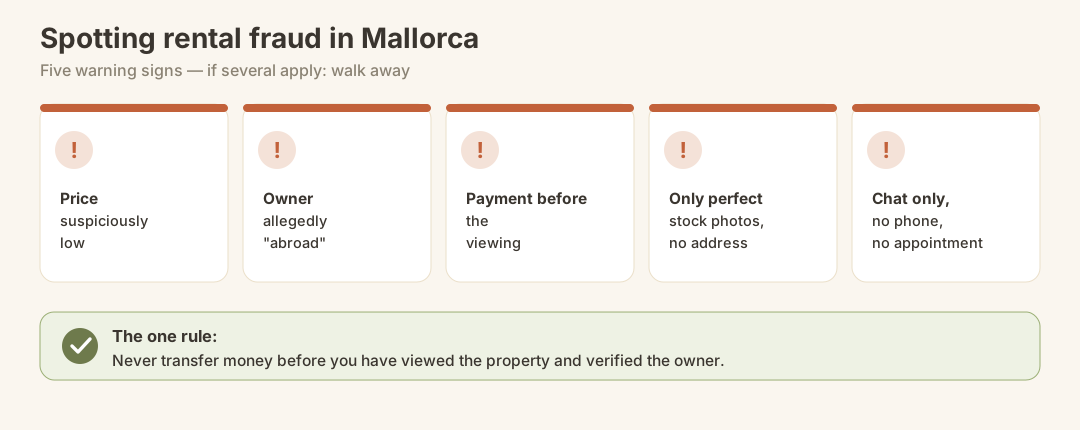
3. Advance-payment scams. Fake listings circulate on Idealista, Fotocasa and in Facebook groups. The pattern: flawless photos, a suspiciously low price, the 'landlord' is allegedly abroad ('I'm a doctor/architect and travel a lot'), and viewings are only possible after a 'reservation payment'. Never transfer money before you have seen the property and verified the landlord's identity. The Spanish police (Policía Nacional) and the national cybersecurity institute INCIBE explicitly warn against landlords who cannot show the property, and against any payment prior to verification.
4. temporada vs. habitual. As described above — the most common legal stumbling block. Anyone living somewhere permanently belongs in a habitual contract.
Where to search?
These sources provide the broadest coverage of the Mallorcan long-term market — listed neutrally, without any affiliate arrangements:
| Source | Strength | Note |
|---|---|---|
| idealista.com | largest portal, best market data | many listings, but fake ones too — scrutinise carefully |
| fotocasa.es | second-largest portal | good filters, comparable reach |
| Local estate agents (inmobiliarias) | access to off-market properties | Commission is paid by the landlord (Art. 20.1) |
| Facebook groups (e.g. 'Palma de Mallorca pisos en alquiler') | direct contact, fast | highest risk of fraud — exercise extreme caution |
| local noticeboards & word of mouth | best prices in the island's interior | only realistic with a knowledge of Spanish |
Anyone looking at the premium or purchase segment rather than renting only will find the basics on buying costs, taxes and the process in the Property Guide.
Most common mistakes
- Signing a seasonal contract even though you are living there permanently — you forfeit the 5-year protection and the IRAV rent cap.
- Paying the agent's commission — for vivienda habitual lettings, the landlord has been liable for it since 2023. Don't let it be pushed onto you.
- Accepting more than 3 months' rent as a security deposit — anything beyond fianza (1) + additional guarantee (2) is void.
- Transferring money before viewing the property — the classic Mallorca scam.
- Verbal assurances — without a written contract there is no proof. Check every word of the content before signing, ideally with a gestoría or solicitor.
- Applying for your NIE too late — without it, no bank account, no utility contracts, and poorer chances with landlords.
- Using the deposit as the final month's rent — this is prohibited and leads to disputes and debt collection.
- Applying the wrong notice period — if you want to leave after the minimum term expires, give at least 2 months' notice as the tenant; if you want to exit early during the term, the 30-day notice period applies (after 6 months).
Checklist: 30 – 7 – 1 days before moving in
30 days before
- NIE applied for / already held
- Spanish bank account opened
- Document folder complete in digital form (passport, NIE, nóminas, bank statements)
- Budget calculated: first month's rent + max. 3 months' security deposit + utilities
- Type of contract clarified: vivienda habitual, not temporada
7 days beforehand
- Owner / agent verified (proof of ownership, no upfront payment)
- Contract read in full, IRAV index and term checked
- fianza amount = confirmed at exactly 1 month's rent
- Condition report (inventario / acta de estado) prepared with photos
- Utility transfers (electricity, water, internet) initiated
1 day before / on moving-in day
- Meter readings (electricity, water) photographed
- Key handover documented
- Contract and proof of payment secured
- empadronamiento (padrón) appointment booked at the town hall
Conclusion
Three things to take away:
- The type of contract determines everything. Only a contrato de vivienda habitual gives you 5 years (private landlord) or 7 years (company) of security of tenure, the IRAV cap, and full LAU protection. Do not accept seasonal contracts if you intend to stay permanently.
- You pay less than many people think. Since Ley 12/2023, the landlord bears the agent's commission; the deposit is capped at one month's rent and total security payments at three months (RDL 7/2019). Do not let anyone demand anything unlawful from you.
- Mallorca is a seller's market with a real risk of fraud. Complete documentation, an early NIE, and zero upfront payments are your best tools — no zona tensionada here puts a brake on the initial rent.
Official sources
- BOE — Ley 29/1994 (LAU), consolidated version — Minimum term (Art. 9–10), desistimiento (Art. 11), fianza (Art. 36).
- BOE — Ley 12/2023, de 24 de mayo, por el derecho a la vivienda — Agent's commission (Art. 20.1), zonas tensionadas, IRAV.
- Ministerio de Vivienda y Agenda Urbana — Changes to the rental market — Landlord bears administrative costs.
- Ministerio de Vivienda — Consultation on zonas tensionadas — Official list of declared tension zones.
- Ministerio de Consumo — Press release on agent's commission (Feb. 2024) — Charging commission to tenants is unlawful.
- INCIBE — Estafas en alquileres — Warning about upfront payments and landlords based abroad.
- idealista — Rent adjustment reference index (IRAV) — Monthly IRAV figures.
Current as of June 2026. This guide is for general information only and does not constitute legal or tax advice. Tenancy law and index values change regularly — the IRAV is published afresh each month, and the legal position on renting was still evolving in 2026 (for example, the exceptional 2% cap introduced by RDL 8/2026 was lifted again at the end of April 2026, and a planned Real Decreto-Ley targeting the misuse of seasonal contracts had not yet been confirmed in the BOE by mid-2026). Individual contracts may contain special clauses, and the designation of a zona tensionada in the Balearic Islands can change at any time. If in doubt, have your situation reviewed by a gestoría or a solicitor specialising in arrendamientos.