
Selling property in Spain: Plusvalía and capital gains tax
Anyone selling a property in Mallorca faces two entirely different taxes at the same time: the municipal tax on increases in land value Plusvalía Municipal and the national capital gains tax on the sale proceeds. Together, they can account for a substantial share of the net proceeds – and each has its own rules, deadlines and calculation methods. Whether you sell as a tax resident or a non-resident makes a fundamental difference: non-residents pay a flat rate of 19 %, while residents are taxed on a progressive scale. There is also an automatic withholding tax that the buyer deducts at the notary’s office. This guide explains how both taxes are calculated, which costs you can deduct, what deadlines apply – and which mistakes regularly prove costly even for experienced sellers.

Calculate sale profit
Explanation
This is about tax residence, not nationality: anyone living in Spain for more than 183 days a year, or whose economic base is there, is a resident and is taxed on the savings scale instead of a flat rate.
Explanation
The price actually agreed in the deed. If it is below market value, the tax office uses the market value instead.
Explanation
The amount in your purchase deed. For an inherited or gifted property, the value used for inheritance or gift tax applies instead.
- Capital gains tax
- €60,040
- Gain (ganancia patrimonial)
- €316,000
- Left after costs and tax
- €832,960
Legal status: 1 January 2025
This calculation is provided for guidance only and is not a substitute for tax or legal advice in specific cases.
When selling a property in Mallorca, there are two separate taxes to consider:
| Tax | Full name | Who levies it? | Basis |
|---|---|---|---|
| Plusvalía Municipal | Impuesto sobre el Incremento de Valor de los Terrenos de Naturaleza Urbana (IIVTNU) | Local council (Ayuntamiento) | Cadastral value of the land + length of ownership |
| Capital gains tax | Impuesto sobre la Renta (IRPF) or IRNR for non-residents | Spanish state (AEAT) | Actual gain on the sale |
Both taxes are payable solely by the seller – not the buyer. The buyer instead pays property transfer tax (ITP) or VAT; find out more in the guide to the additional costs of buying property in Mallorca.
Note: Plusvalía and capital gains tax cannot be offset against each other. They arise independently, although the Plusvalía paid can be claimed as a deductible expense when calculating capital gains tax.
Plusvalía Municipal: calculation, rates and payment deadline
Municipal plusvalía
Explanation
The Ayuntamiento is the municipal authority and its ordenanza fiscal is the local tax bylaw. It sets the rate, coefficients and possible reliefs.
Explanation
Use the date of the last taxable transaction. A non-taxable transfer, such as one under a divorce judgment, does not restart the holding period (Art. 107.4).
Explanation
The transfer date is the accrual date (devengo) under Art. 109.1(a) and selects the applicable legal version.
Explanation
Valor catastral del suelo is the cadastral value of the land alone on the transfer date. If none is fixed, Art. 110.4 prohibits autoliquidación (self-assessment).
- Tax after reliefs (cuota líquida)
- €2,592.00
- Taxable base, objective method
- €14,400.00
- Generation period
- 10 complete years (10 actually elapsed)
Filing deadline: 30 días hábiles (business days), not calendar days (Art. 110.2(a)).
Legal status: 1 January 2026
This calculation is provided for guidance only and is not a substitute for tax or legal advice in specific cases.
Plusvalía Municipal taxes the calculated increase in the value of the urban land (not the building) during your period of ownership. The calculation is based not on the actual market price, but on the official cadastral value (valor catastral) of the land portion.
Two calculation methods
Following a ruling by the Spanish Constitutional Court (2021), you can choose between two methods and use whichever is more favourable to you:
Method 1 – Objective method (valor catastral × municipal coefficient × tax rate)
| Period of ownership | Maximum national coefficient |
|---|---|
| Up to 1 year | 0.14 |
| 1–2 years | 0.13 |
| 2–3 years | 0.15 |
| 3–4 years | 0.17 |
| 4–5 years | 0.17 |
| 5–6 years | 0.17 |
| 6–7 years | 0.12 |
| 7–8 years | 0.10 |
| 8–9 years | 0.09 |
| 9–10 years | 0.08 |
| 10–11 years | 0.08 |
| 11–12 years | 0.08 |
| 12–13 years | 0.08 |
| 13–14 years | 0.08 |
| 14–15 years | 0.08 |
| 15–20 years | 0.06 |
| Over 20 years | 0.045 |
Method 2 – Actual gain method
If the actual gain on the sale (sale price minus purchase price, in each case for the land portion only) is lower than the amount calculated under Method 1, you can use that actual gain as the basis for the calculation.
Important: If the property is sold at a loss (the actual sale price is lower than the original purchase price), no Plusvalía is payable. However, you must provide evidence of the loss and apply for the exemption.
Tax rate and municipality
Each municipality sets its own applicable tax rate; the statutory maximum rate is 30 % of the calculated increase in value. Cities such as Palma de Mallorca have their own regulations. You can find out the actual rate from the relevant local council.
Deadline
| Situation | Deadline |
|---|---|
| Sale during the owner's lifetime | 30 working days (días hábiles) from signing before the notary |
| Inheritance | 6 months from the date of death (extendable to 12 months) |
Capital gains tax for non-residents: 19 % flat rate
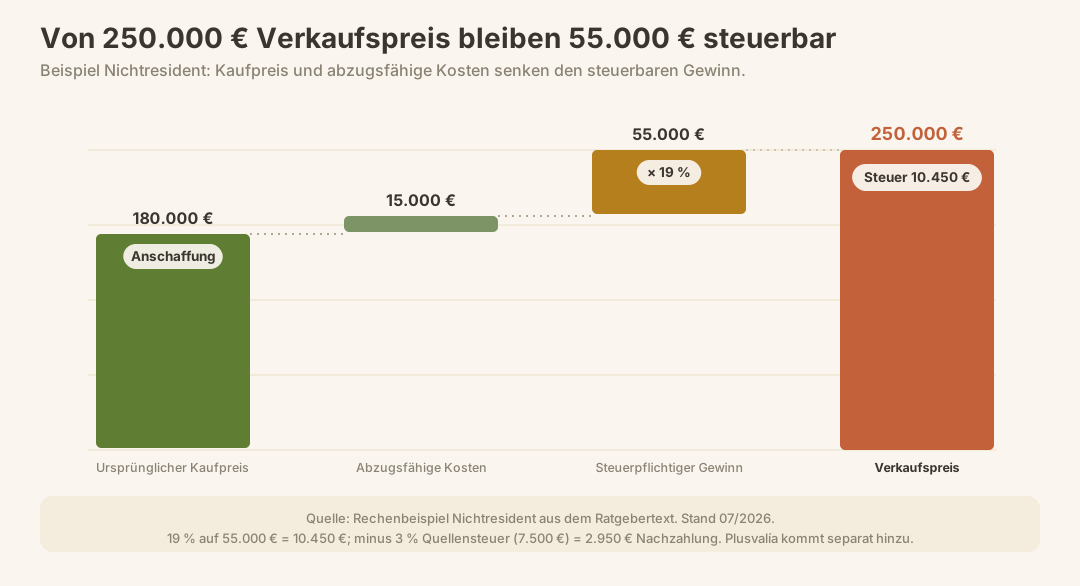
If your main tax residence is not in Spain and are therefore not a Spanish tax resident, the profit from selling the property is taxed at a flat rate of 19 %. This rate applies whether you are an EU or non-EU citizen.
Calculation formula
Taxable gain = sale price – purchase price – deductible costs
Tax = taxable gain × 19 %
Deductible costs when selling
The following costs can reduce the taxable gain:
| Type of cost | Deductible? | Note |
|---|---|---|
| Notary and legal fees for the original purchase | ✅ Yes | Keep the receipts |
| Property transfer tax (ITP) or VAT (IVA) paid on purchase | ✅ Yes | Incurred during the purchase |
| Estate agent’s commission on the sale | ✅ Yes | Must be supported by an invoice |
| Legal costs of the sale | ✅ Yes | Lawyer, administrative services |
| Structural improvements | ✅ Yes | Structural work only |
| Cosmetic renovations (kitchen, paint, flooring) | ❌ No | Not considered improvements that add value |
| Ongoing maintenance costs | ❌ No | No capital improvements |
| Plusvalía paid | ✅ Yes | Reduces the taxable gain |
Worked example for a non-resident
| Item | Amount |
|---|---|
| Sale price | €250,000 |
| Original purchase price | €180,000 |
| Deductible costs (notary, ITP, estate agent on purchase, estate agent on sale) | €15,000 |
| Taxable gain | €55,000 |
| Capital gains tax (19%) | €10,450 |
| Tax already withheld (3% × €250,000) | €7,500 |
| Additional payment / refund | €2,950 additional payment |
The 3% withholding tax: how it works
3% withholding on a sale
Explanation
The consideration agreed in the deed (contraprestación acordada) is what the withholding is measured against — not the cadastral value and not the reference value (valor de referencia).
Explanation
The capital gain (ganancia patrimonial) is the sale price less your selling costs and less the acquisition value including the costs and taxes of buying, reduced by any depreciation already claimed (amortizaciones) if the property was let. If you sold at a loss, enter the loss with a minus sign: no tax arises and the withholding credited to you can be refunded.
- Buyer's withholding (retención)
- €19,500.00
- Tax on the gain
- €22,800.00
- Additional payment
- €3,300.00
Your tax exceeds the withholding. You pay the difference with your return.
Legal status: 1 January 2016
This calculation is provided for guidance only and is not a substitute for tax or legal advice in specific cases.
When a property is sold by a non-resident, the buyer is legally required to withhold 3% of the sale price and pay it directly to the Spanish tax authority, AEAT. This is not the final tax, but an advance payment towards capital gains tax.
How it works:
- The notary notarises the sale contract
- The buyer pays 3% of the sale price not to the seller, but remits this amount via Modelo 211 to the AEAT – within one month of notarisation
- Within three months of the end of this one-month period – roughly four months after notarisation – the seller files a tax return using Modelo 210.
- If the actual tax is less than the 3% withheld: refund
If the actual tax is more: additional payment
Important: If the buyer fails to remit the withholding tax, the property itself serves as security for the debt. Buyers purchasing from a non-resident should never forget this – or fail to remit the tax.
Capital gains tax for residents: progressive rates
Anyone who is tax-resident in Spain (more than 183 days per calendar year in the country, or with their centre of economic interests in Spain – as set out in Article 9 of Law 35/2006) pays tax on gains from property sales under IRPF at progressive rates:
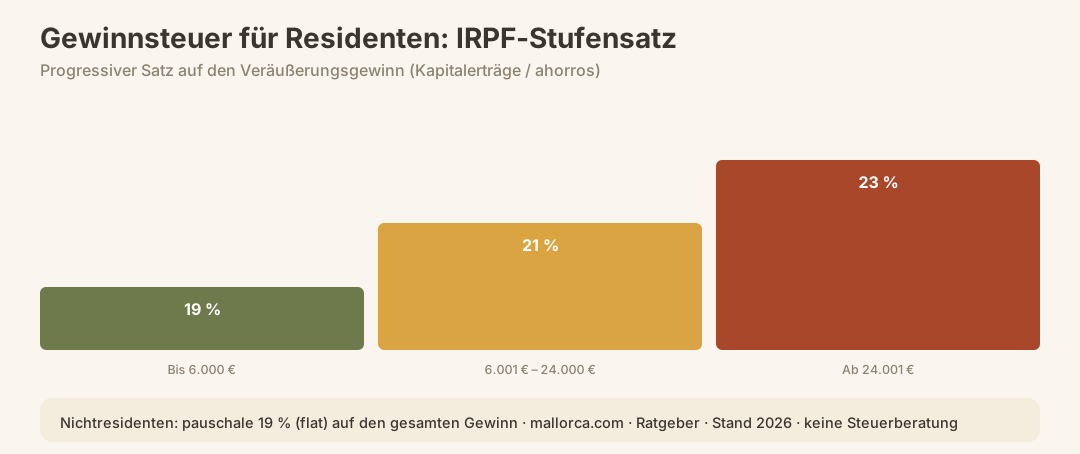
| Portion of the gain | Tax rate |
|---|---|
| Up to €6,000 | 19% |
| €6,000 to €50,000 | 21% |
| €50,000 to €200,000 | 23% |
| €200,000 to €300,000 | 27% |
| Over €300,000 | 30% |
Note: The rates apply progressively: each portion is taxed at the rate for its band, rather than the entire gain at the highest rate. This is the savings income tax scale (base liquidable del ahorro) under Article 66 of Law 35/2006; Ley 7/2024 introduced the top rate of 30% with effect from 1 January 2025. The property gain is combined with your other investment income from the same year.
The tax on the gain is declared in the annual Spanish income tax return (IRPF, Modelo 100), which is generally due by the end of June the following year.
Note: Residents are not subject to automatic withholding tax on a sale. The 3% withholding applies only if the seller is a non-resident.
Tax exemptions and special rules
Exemption for reinvestment in a main residence (residents)
Residents may, subject to certain conditions, be exempt from tax on the gain if they reinvest the entire sale proceeds in the purchase of a new main residence in Spain. The reinvestment must take place within 2 years before or after the sale. A separate, broadly similar rule applies to non-residents from the EU and EEA – see the note at the end of this section.
Exemption for people over 65 (residents)
Residents who have reached the age of 65 and have lived in the property as their main residence for at least 3 years are exempt from tax on the gain from their main residence, whether or not they reinvest the proceeds.
No Plusvalía if the property has fallen in value
As mentioned above, Plusvalía is not payable if you can prove that the actual sale price is lower than the original purchase price. The purchase deed and sale deed provide the evidence.
Important: The exemption for those aged 65 or over applies only to tax residents. The reinvestment exemption is also available to non-residents who live in an EU country or an EEA country with effective information exchange, provided they previously used the property being sold as their own main residence in Spain. The entire proceeds must be invested in a new main residence; if only part is reinvested, the exemption applies proportionately. The 3% withholding tax and filing via Modelo 210 are still required. The legal basis is the Disposición adicional séptima of Real Decreto Legislativo 5/2004.
Residents vs non-residents: a direct comparison
| Criterion | Non-resident | Resident (IRPF) |
|---|---|---|
| Tax rate | 19 % (flat) | 19 % to 30 % (progressive, banded) |
| Form | Modelo 210 | Modelo 100 (annual IRPF return) |
| Filing deadline | 4 months after the sale | Generally by 30 June of the following year |
| 3 % withholding tax | Yes, the buyer withholds it | No |
| Reinvestment exemption | Yes, if resident in the EU or EEA (former main home) | Yes (subject to conditions) |
| Exemption for those aged 65+ | No | Yes (main residence, min. 3 years) |
| Plusvalía | Yes, for both | Yes, for both |
Deductible costs: the items often overlooked
Many sellers underestimate how much they can deduct from their taxable gain. These costs are often overlooked:
On the original purchase:
- Notary and Land Registry fees
- Property transfer tax (ITP) or VAT (IVA) paid
- Lawyer’s or gestor’s fees for the purchase
On the sale:
- Estate agent’s commission (including the Spanish VAT charged on it)
- Legal and notary fees for the sale
- Cost of the energy performance certificate (required by law)
- Costs of any regularisation (e.g. for unauthorised buildings)
- Plusvalía Municipal paid
Tip: Keep all invoices and receipts from the purchase indefinitely – even if you bought the property many years ago. Without proof of payment, you cannot claim these costs for tax purposes.
Deadlines at a glance
| Tax / form | Who files it? | Deadline |
|---|---|---|
| Modelo 211 (payment of withholding tax) | Buyer | 1 month after signing the deed before a notary |
| Modelo 210 (non-resident capital gains tax) | Seller | 3 months after the Modelo 211 deadline (around 4 months) |
| Plusvalía Municipal | Seller | 30 working days after signing the deed before a notary |
| IRPF / Modelo 100 (resident) | Seller | Usually by 30 June of the following year |
Important: Missing the deadlines for Plusvalía and Modelo 210 can result in surcharges and interest. The deadlines run from the date the deed is signed before a notary, not from the date payment is received.
The most common mistakes when selling property in Mallorca
Experienced tax advisers and lawyers see these mistakes time and again:
Purchase documents not kept: If you no longer have the purchase deed, ITP assessments and notary invoices from the original purchase, you cannot deduct those costs – significantly increasing the taxable gain.
Withholding tax refund not claimed: Many non-residents do not realise that, after filing Modelo 210, they can receive a refund if the tax actually due is less than the 3% withheld. You must actively apply for this refund.
Plusvalía filed late: The 30-day deadline set by the Ayuntamiento passes quickly, especially when the sale is being coordinated from abroad.
Renovations incorrectly claimed: Kitchen and bathroom renovations, painting and new flooring are not tax-deductible. Only structural improvements that increase the property's value count.
Tax residency assessed incorrectly: Anyone who spends more than 183 days a year in Spain is a tax resident – even if they do not realise it. This affects the applicable tax rate and exemptions.
No withholding tax arranged for non-residents: Buyers who forget to withhold the tax are personally liable to the AEAT.
Plusvalía not checked when selling at a loss: If you sell at a loss but still pay Plusvalía, you are throwing money away.
What comes next? Reporting obligations and subsequent taxes
There are still a few things to take care of after the sale:
- Land Registry (Registro de la Propiedad): The buyer registers the change of ownership with the Land Registry. As the seller, you do not need to do anything further, but you should make sure any mortgage is discharged.
- Cadastral Office (Catastro): The buyer is responsible for updating the registration, but as the seller, it is worth confirming the change to avoid future IBI bills (property tax).
- Income tax return in Germany: Anyone liable for tax in Germany must also declare the gain from the sale there. The double taxation agreement (DBA) between Germany and Spain provides that gains from property are generally taxed in the country where the property is located (Spain) – in Germany, they are subject to the progression clause. You should also seek advice from a German tax adviser.
- Wealth tax return: A return is no longer required for the sold property after the sale, but make sure you accurately reflect your position on the assessment date (31 December of the year of sale). Read more in our guide to wealth tax in Spain.
Checklist: Selling on Mallorca with your taxes in order
Use this list as a starting point when preparing your sale:
- Purchase deed (Escritura de Compraventa) from your acquisition available
- ITP assessment or IVA invoice from the purchase available
- All notary, solicitor and gestoría invoices from the purchase collected
- Invoices for structural improvements (with building permits) available
- Energy performance certificate commissioned (required before sale)
- Property’s cadastral value known (for estimating Plusvalía)
- Tax residency status checked (resident or non-resident?)
- Estate agent’s commission and contract terms agreed in writing
- Tax adviser with expertise in Spain appointed
- Plusvalía deadline (30 working days) entered in the calendar
- Modelo 210 deadline (3 months after the Modelo 211 deadline expires) noted
- Withholding tax refund (if applicable) planned
Conclusion: Good preparation saves real money
The tax burden when selling a property in Mallorca is manageable – provided you understand it. The 19 % capital gains tax for non-residents is clearly regulated, and the 3 % withholding tax is an effective advance-payment system. Problems almost always arise when supporting documents are missing, deadlines are missed or tax residency is assessed incorrectly. Plusvalía Municipal is a municipal tax with its own rules: after long periods of ownership and increases in cadastral value, it can be substantial, but it may not apply at all if the property is sold at a loss. Start planning the tax aspects of your sale at least six months in advance, consult a specialist local tax adviser early on, and keep all the paperwork from your purchase – it is the best investment you can make in your net proceeds.
Official sources
- Agencia Tributaria (AEAT) – Modelo 210 (IRNR), Modelo 211, Modelo 100: https://www.agenciatributaria.es
- Agencia Tributaria Illes Balears (ATIB) – Balearic taxes and regional regulations: https://www.atib.es
- Ley 35/2006, de 28 de noviembre – Impuesto sobre la Renta de las Personas Físicas (IRPF law, Article 9 on tax residency): https://www.boe.es/buscar/act.php?id=BOE-A-2006-20764
- Real Decreto Legislativo 5/2004 – Texto Refundido de la Ley del Impuesto sobre la Renta de no Residentes (Article 25 on tax rates, Disposición adicional séptima on the reinvestment exemption): https://www.boe.es/buscar/act.php?id=BOE-A-2004-4527
- Real Decreto Legislativo 2/2004 – Texto Refundido de la Ley Reguladora de las Haciendas Locales (Plusvalía Municipal / IIVTNU): https://www.boe.es/buscar/act.php?id=BOE-A-2004-4214
- Real Decreto-ley 26/2021 – Reform of Plusvalía following the Constitutional Court ruling: https://www.boe.es/diario_boe/txt.php?id=BOE-A-2021-17910
- Ajuntament de Palma – Plusvalía Municipal Palma: https://www.palma.cat
- Consell de Mallorca – Balearic tax authority: https://www.conselldemallorca.net
Claiming back Plusvalía Municipal you have paid: what to do
If you paid Plusvalía Municipal when selling a property despite there being no increase in the land’s value, or if the tax was calculated too high, submit your application to the responsible municipality. The key question is how the tax was assessed:
- Your own self-assessment (autoliquidación): Apply for it to be corrected and for a refund of the amount overpaid.
- Municipal tax assessment (liquidación): Check the appeal instructions and challenge the assessment within the deadline. If it has already become final, you will need to establish whether a special review procedure is available; a refund is not then automatic.
- Include supporting documents: In particular, provide the purchase and sale deeds, the self-assessment or tax assessment, and proof of payment. Your application should explain why you consider the tax unjustified or too high.
The Plusvalía Municipal procedure is separate from capital gains tax on a property sale: applying to the municipality does not replace filing a return with the Spanish state tax authority. The municipal tax and appeals against municipal tax assessments are governed by Spain’s local tax law (Real Decreto Legislativo 2/2004). Refunds of taxes paid in error are governed by the general tax law (Ley 58/2003 General Tributaria, Art. 221) and Real Decreto 520/2005.
Note: This is not legal or tax advice. Particularly for older assessments or those that have become final, the deadlines and available remedies should be checked for the individual case.