
Mallorca wealth tax: who pays and the €3m resident allowance
- Request the Q1 2026 market report — including tax context for Mallorca buyers
Spanish wealth tax (Impuesto sobre el Patrimonio) — the basics
Since its reintroduction in 2011, Spain has levied a wealth tax on individuals’ worldwide assets. The 2021 tax reform removed its originally temporary status, making the tax permanent. The relevant date each year is 31 December: what matters is the wealth you own on that date.
Calculate wealth tax
Explanation
The value of your taxable assets and rights before deducting debts. Property is valued at the highest of the cadastral value, the purchase price and any value assessed by the authorities.
Explanation
Documented debts and charges attributable to the assets above, such as the outstanding balance of a mortgage on the property.
Explanation
Non-residents may apply the rules of the autonomous community holding the greater part of their Spanish assets (disposición adicional cuarta of Ley 19/1991). This decides both the allowance and the scale.
- Annual tax burden
- €14,571.42
- Wealth tax (Impuesto sobre el Patrimonio)
- €14,571.42
- Solidarity tax after credit
- €0.00
- Allowance (mínimo exento)
- €3,000,000.00
Legal status: 1 January 2024
This calculation is provided for guidance only and is not a substitute for tax or legal advice in specific cases.
Companies and corporations are not subject to wealth tax. It applies only to individuals — both Spanish tax residents (on their worldwide assets) and non-residents (only on assets located in Spain, typically their Mallorca property).
€3 million Balearic Islands allowance since 2024 — the key change
The most important update for Mallorca property owners and buyers: Under the Balearic Islands Budget Law No. 12/2023, the personal allowance for people who are tax-resident in the Balearic Islands rose from €700,000 to €3,000,000 per person on 1 January 2024.
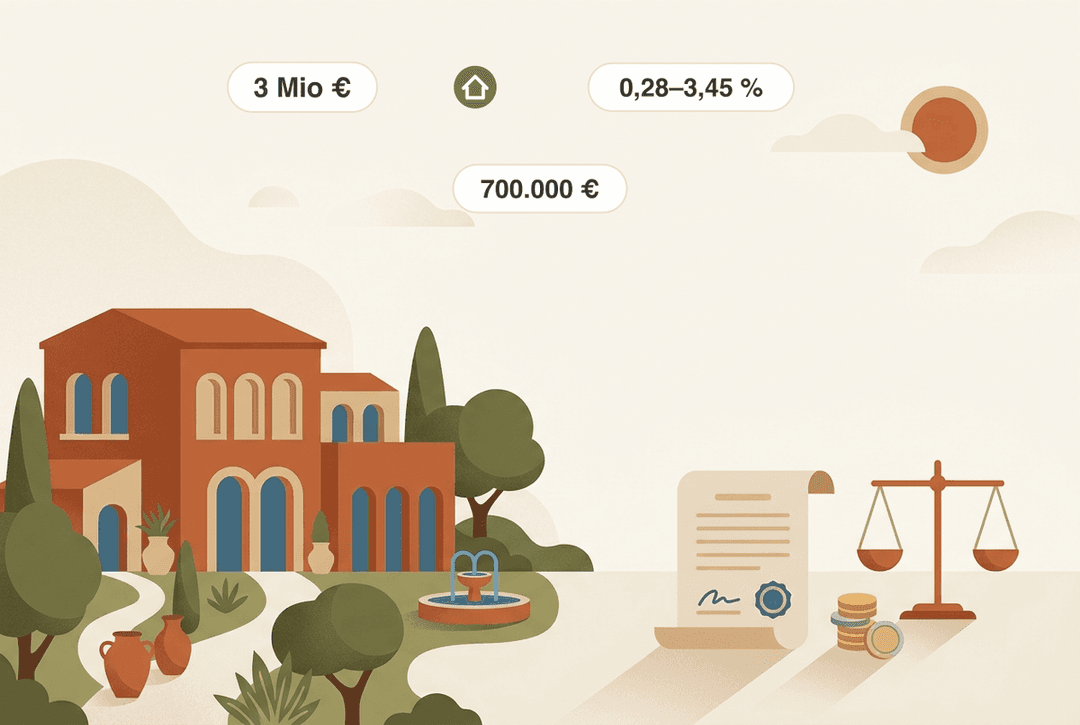
As a result, anyone whose main residence is in Mallorca and whose wealth is below €3 million (plus a €300,000 main-home allowance) pays no wealth tax. For married couples with jointly owned assets, the threshold can effectively rise to around €6.6 million — because each person has their own allowance.
This increase matches the threshold at which the national solidarity tax (Impuesto Temporal de Solidaridad de las Grandes Fortunas) applies. The solidarity tax was extended by Real Decreto-ley 8/2023 of 27 December 2023 and applies throughout Spain to net wealth above €3 million; any wealth tax paid is credited against it. In effect, the Balearic Islands increase eliminates the regional tax up to this threshold — above it, the national solidarity tax also applies.
Non-residents — national allowance and choice of tax rules
For buyers who are not tax-resident (typically from Germany, Austria, Switzerland or other EU countries), the national allowance of €700,000 traditionally applied — without the €300,000 main-home allowance, as their Spanish property is not their main residence.
Important since 2015: Non-residents can choose whether to be taxed under the national rates or those of the autonomous community where most of their Spanish assets are located. For Mallorca buyers, this means you can choose the €3 million Balearic allowance choose if most of your Spanish assets are in the Balearic Islands. You must make this choice explicitly on your tax return, and it is usually considerably more favourable than the standard national rules.
Tax bands and liability — how much tax is actually due?
Wealth tax is charged at progressive rates. In the Balearic Islands, the highest rate is 3.45% per year on wealth above approximately €10.7 million. The lower bands start at 0.28% for the first few hundred thousand euros above the allowance and rise gradually.
Worked example: non-resident with a €5 million Mallorca property (using the Balearic tax bands)
- Gross assets: €5,000,000
- Less Balearic allowance: −€3,000,000
- Taxable base: €2,000,000
- Wealth tax (Balearic tax bands, lower brackets): approximately €8,000–€12,000 per year
Without the Balearic allowance (that is, under the national tax bands, with a €700,000 allowance), considerably more would be due on the same €5 million — roughly €25,000–€40,000 per year.
Filing requirement — even if no tax is payable
A wealth tax return must be filed if tax is payable or gross assets exceed €2 million — even if no payment is due after deducting liabilities or allowances. This threshold has remained unchanged for years and was not adjusted when the allowance was increased.
In practice, anyone who owns a Mallorca property worth over €2 million must file a return, even if they pay no wealth tax thanks to the €3 million allowance.
Beckham Law for new residents
Skilled professionals or self-employed people moving to Spain may, in certain circumstances, qualify for the Beckham regime (Régimen Especial Trabajadores Desplazados, RETD). Under this special regime, as for non-residents, only assets located in Spain are subject to wealth tax, and the top income tax rate on Spanish-source income is 24% for the first €600,000.
For wealth tax purposes, the national tax bands with a €700,000 allowance apply under the Beckham Law (or the Balearic tax bands, depending on the choice of residence). The precise rules governing this choice should be checked with a tax adviser specialising in Mallorca, as the Beckham Law interacts with regional wealth tax in complex ways.
Planning options — how to reduce wealth tax
Several approaches matter in practice:
- Year-end planning: Buy at the end of December and you pay for the whole year; sell before 31 December and you avoid a year’s tax.
- Multiple owners: High-value properties can be purchased jointly, with each person owning a share. Individual allowances and progressive tax rates can significantly reduce the overall tax bill.
- Loans: Mortgage interest can offer useful leverage, provided it costs less than the wealth tax saved.
- Property companies: Ownership through a holding structure is possible, but it has complex tax implications in Spain and the country of origin (withholding tax, CFC rules). It only makes sense with tax advice covering both countries.
- Changing tax residence: Anyone who registers their main residence in Mallorca benefits from the Balearic tax rates and €3 million allowance — but also incurs further tax obligations (income tax on worldwide assets).
Regional differences across Spain — a comparison
Wealth tax rules vary considerably between the autonomous communities:
- Balearic Islands (Mallorca, Ibiza): €3 million allowance since 2024 (Law 12/2023)
- Madrid: 100% tax credit — wealth tax effectively abolished
- Andalusia: 100% tax credit since 2023 — also effectively abolished
- Valencia (Comunitat Valenciana): Allowance increased to €1 million from the 2025 tax year
- Catalonia: €500,000 allowance (regional), €700,000 for non-residents
- Canary Islands: Still €700,000 — holiday letting may qualify for an exemption
With its €3 million allowance, Mallorca is among the most attractive Spanish regions that still levy wealth tax.
Double taxation agreements — who has the right to tax?
Before Spain can levy tax at all, the double taxation agreement (DBA) between Spain and the country of residence must permit it. The Germany–Spain DBA (Articles 9 and 25 of the Spanish Wealth Tax Act) provides that assets located in Spain, particularly property, are taxed where they are situated — in Spain. For German non-residents, a Mallorca property is therefore subject to Spanish wealth tax even if their centre of life remains in Germany.
Frequently asked questions about wealth tax in Mallorca
This guide provides a general overview of the legal position and does not replace legal or tax advice on your individual circumstances. Laws and deadlines may change; the linked official sources are authoritative.
As a German buyer in Mallorca, do I really have to pay wealth tax?
When is it worth choosing the Balearic tax schedule as a non-resident?
What happens if my assets exceed €3 million?
Does the €300,000 main-home allowance apply to me too?
How is a property's value determined for wealth tax?
Is it worth buying property through a company to avoid wealth tax?
Is a 100% property tax levied in Spain?
Related topics
- The legal process of buying property — notary, NIE, preliminary contract, completion
- Tax burden on luxury properties — IBI, ITP, AJD in detail
- Sustainable Tourism Tax — Sustainable Tourism Tax on rental properties
- Tips for buying property in Mallorca — A step-by-step guide
Note: This article provides a general overview of wealth tax in the Balearic Islands (as of 2026) and is not a substitute for personalised tax advice. For advice on your circumstances, we recommend consulting a tax adviser who specialises in Mallorca tax law.