
Annual property taxes in Mallorca: IBI, second homes and relief
Buying the property does not close the tax chapter: ongoing property taxes in Mallorca belong in your annual budget even if you only use the house occasionally. The main bill is usually the municipal property tax, IBI. If it is a second home, your obligations also depend on whether you are tax resident in Spain and whether you use the property yourself or rent it out. Calling these obligations a general ‘second-home tax’ that you can avoid by rarely using the property is misleading.
Here you’ll learn how IBI is generally calculated from the cadastral value and the municipality’s tax rate, why payment deadlines vary from place to place, and which other taxes you should check. We also explain potential reliefs: not every reduction available for a main home applies to a holiday property. For your annual planning, the bill for your property and the rules of the relevant municipality therefore matter more than a blanket Mallorca average.

What ongoing taxes might apply to a property?
Not every recurring cost associated with a house is a tax. For tax planning, it helps to distinguish between the following:
| Item | What it covers | What to check |
|---|---|---|
| IBI – Impuesto sobre Bienes Inmuebles | Annual municipal property tax | The municipality’s cadastral value, tax rate and payment period |
| Taxation of non-resident owners | Potential income tax on a property you use yourself or rent out | Your tax residency status and how the property is used |
| Wealth tax | May apply if your wealth reaches the relevant threshold | Your personal circumstances and the applicable rules |
| Other municipal charges | For example, waste collection charges or charges for access to a property | Municipal bills and payment calendar |
Electricity, water, insurance and homeowners’ association fees are also part of the ongoing budget for a holiday property, but they are not the same as IBI. Likewise, the one-off tax paid when buying an existing property is not an ongoing property tax.
How is IBI property tax calculated in Mallorca?
IBI is based on the property’s cadastral value and the tax rate set by the relevant municipality. Put simply, the calculation is: applicable taxable base × municipal tax rate. You then need to check separately whether any reliefs apply.
The cadastral value is not necessarily the purchase price or a current asking price. You can find it on your IBI bill; for more background, see our guide to Valor Catastral. To work out what you will actually owe, you also need the tax rate and bill from your municipality. A rate from another municipality will not give you a reliable figure for your property.
Note: Residents and non-residents alike may be liable for IBI. Using a property as a holiday home does not exempt it from municipal property tax.
You can find out more about the tax itself in our guide to IBI in Spain.
When is IBI due?
There is no single payment deadline across Mallorca. The following voluntary payment periods for 2026 show how much the dates vary:
| Municipality | Published payment period for 2026 | Taxes and charges listed in the calendar |
|---|---|---|
| Ses Salines | 1 August to 1 October | Municipal taxes and charges; the payment period starts as early as August |
| Alcúdia | 1 September to 2 November | Municipal autumn taxes and charges |
| Palma | 15 September to 1 December | IBI, IAE and Vado |
| Manacor, Marratxí and Artà | 15 September to 1 December | IBI and IAE |
| Inca | 1 September to 1 December | IBI and waste collection, among others |
What matters is the calendar for your Municipality and charge. ATIB publishes relevant information for many municipalities. For recurring municipal charges administered by ATIB, you should not rely on receiving a payment notice by post.
Please note: A published payment period for IBI, IAE and Vado does not mean that all these charges apply to you. Check the specific notice and its payment deadline.
Is there an exemption from the “second-home tax”?
People often mean different things by “second-home tax”. There is no exemption from all recurring taxes simply because a property is used as a second home. IBI also applies to holiday homes.
For owners who are not tax resident in Spain, the tax treatment of the property must also be considered – even if they use it themselves and do not rent it out. If the property is rented out, its tax treatment is different. Anyone who is tax resident in Spain must assess their situation under the rules for residents; their status does not depend solely on how often they visit their home in Mallorca.
The practical question, then, is not “Who is automatically exempt?” but: Which tax do you mean, where are you tax resident, and how is the property used? See also our guidance on the taxation of properties used by non-resident owners themselves and on tax residence in Spain.
What changes if you rent out the property or become resident in Spain?
IBI remains a separate matter as a municipal tax. For income tax, it also matters whether you use the property exclusively yourself or earn income from it. Non-resident owners should consider the rules on the taxation of rental income separately from the taxation of their own use of the property.
“Property owner in Mallorca” and “tax resident in Spain” are not interchangeable terms either. If your centre of life changes, reassess your tax status rather than simply continuing the previous tax treatment of your holiday home. Our guide to taxes for non-residents in Spain is a starting point for this transition.
When does wealth tax become relevant?
Depending on your assets, Spanish wealth tax may also be relevant. The questions of which assets must be included and which reliefs are available differ depending on whether you are tax resident in Spain. You therefore cannot reliably determine your personal tax liability from the value of a single property.
Especially if you own property jointly or have other assets, you should not base your plans on an oversimplified claim such as “wealth tax never applies below a certain property value”. Wealth tax in Spain needs to be assessed separately.
What tax relief might be available?
Tax benefits when buying a main home are different from reductions in annual taxes. For your ongoing costs, the key question is whether an IBI reduction applies to the property in question. Any such relief depends on the relevant rules and eligibility criteria – not simply on your intention to use the property more often in future.
| Potential relief or distinction | What matters |
|---|---|
| IBI reduction | Check the specific eligibility criteria and application process with the relevant municipality |
| Relief for social housing | Cannot be assumed to apply to an ordinary holiday property without checking |
| Tax relief when buying a main home | Applies to the purchase, not automatically to subsequent annual IBI bills |
| Wealth tax relief | Consider your personal tax circumstances, not just the purchase price |
If you think you may qualify for a reduction, start with your IBI bill and ask which specific provision applies. Our guide to IBI reductions in Mallorca covers this in more detail.
Most common mistakes
- Confusing purchase tax with IBI: The tax paid when buying a property is not an annual IBI bill.
- Using the purchase price as the cadastral value: The relevant cadastral value is the starting point for calculating IBI.
- Assuming infrequent use means a tax exemption: Even an occasionally used second home can give rise to several tax obligations.
- Put a single island-wide date in your diary: Municipal payment periods vary.
- Wait for a letter: Check for outstanding amounts yourself, especially if ATIB administers the charge.
- Assume a main-residence tax relief applies: Whether it applies to your property depends on whether you meet its conditions.
Checklist for your tax year as a property owner
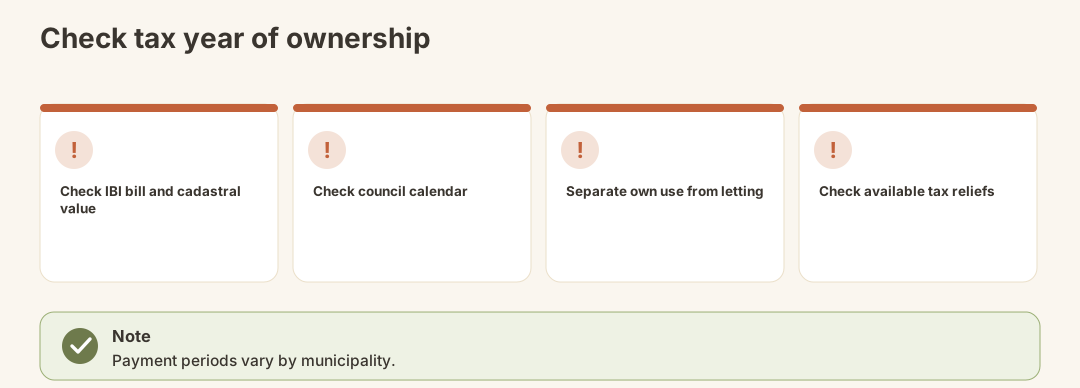
- Have your IBI notice ready: Check the property details and cadastral value.
- Identify the responsible authority: Check whether you deal with the charge through the municipality or ATIB.
- Check the payment calendar: Find the payment period for your municipality and the charge in question.
- Keep a record of how the property is used: Distinguish between personal use and letting for income tax purposes.
- Clarify your tax residency: Do not assess your obligations based solely on where the property is located.
- Check each relief separately: Follow the conditions of the relevant rules.
What comes next?
Once you know your annual IBI bill, you can complete the rest of your budget: other possible municipal charges, tax on personal use or letting, and non-tax expenses. If you have a parking space with a special vehicle access to the property, for example, you should also check whether a Vado charge applies; for flats, contributions to the owners’ association are often part of the budget.
If how you use the property or your tax residency changes, review your position. An unchanged IBI notice does not automatically mean that all your other tax obligations remain unchanged.
Conclusion
IBI is the main recurring property tax on Mallorca – and it does not apply only to main residences. Its amount can only be estimated meaningfully using the property’s details and the rules of the relevant municipality. For a second home, your personal tax position is another consideration: personal use, letting and tax residency can give rise to different obligations. Tax reliefs may be available, but there is no blanket benefit for holiday properties.
Not legal or tax advice. For a specific tax return or a tax relief claim, your documents and the applicable rules matter.
Official sources
- ATIB – Balearic tax authority and access to municipal tax information
- Spanish Cadastre – information on cadastral value