
A temporary rental agreement in Mallorca: what matters
A temporary tenancy agreement in Mallorca can be suitable if you genuinely need a property only for a specific, limited purpose – for example, for a temporary stay while your usual home remains elsewhere. But the agreed term alone does not determine the type of tenancy. Even an agreement labelled “seasonal rental” may legally count as an ordinary residential tenancy if the property in fact meets your long-term housing needs. This matters for tenants and landlords alike: the classification affects important legal protections and the options for ending the tenancy. This guide explains how to distinguish a temporary tenancy from a residential tenancy and a holiday let, what details help establish the temporary purpose, and why an eleven-month agreement is not a legal shortcut. You will also learn what questions to resolve before signing or extending an agreement.

What makes a tenancy agreement in Mallorca temporary?
Spain’s tenancy law, the Ley de Arrendamientos Urbanos (LAU), distinguishes between renting a home to meet long-term housing needs and renting a property for another purpose. Seasonal or temporary rentals may fall into the second category.

What matters is not how short the agreement is, but why the property is rented and how it is actually used. A specified period helps with the classification; it does not, on its own, establish a temporary need.
| Classification under the LAU | Nature of the housing need | Relevant provision |
|---|---|---|
| Ordinary residential tenancy | The property meets long-term housing needs | Art. 2 |
| Rental for another purpose, including seasonal rental | The property is used for a genuinely temporary purpose | Art. 2 |
| Certain holiday lets | Subject to separate rules from rentals under the LAU | Art. 5 |
Note: A temporary tenancy does not fall outside Spanish tenancy law simply because it is called a “seasonal rental”. Holiday lets are a separate category; you can find more information in our guide to holiday lets in Mallorca.
What purpose justifies a temporary rental?
There must be a clear reason for the temporary stay in the particular tenancy. When drawing up the agreement, one question is therefore more useful than any number of months: Why do you need this particular property only for this period?
Before signing, establish whether you will keep another usual home and what limits the duration of your stay. Both should reflect your actual circumstances. A blanket statement such as “seasonal use only” says little if you then use the property as your permanent home.
That does not mean every temporary rental must have the same purpose. Rather, the parties to the agreement should set out the actual reason rather than adopting a boilerplate purpose that has nothing to do with how the property is used.
Why is eleven months not a reliable cut-off?
In Mallorca, properties are explicitly advertised as fixed-term lets for eleven months or for other periods. This does not create a rule that a contract shorter than a certain number of months automatically qualifies as a seasonal let.
Two decisions by the Provincial Court of the Balearic Islands illustrate the distinction:
| Decision of the Provincial Court of the Balearic Islands | Date | Significance for the classification |
|---|---|---|
| SAP Baleares 83/2024 | 22 February 2024 | The name and duration of the contract are not decisive on their own; what matters is how the property is actually used. |
| SAP Baleares 601/2024 | 6 November 2024 | A nine-month fixed-term tenancy was upheld where a temporary need and a separate habitual residence had been demonstrated. |
The fact that a nine-month contract can be valid no more makes nine months a statutory cut-off than the common contract length of eleven months does.
Please note: Repeated short contracts do not solve the underlying problem if the property continuously meets the tenant’s long-term housing needs. How it is actually used remains decisive.
How does a fixed-term let differ from an ordinary residential tenancy?
With an ordinary residential tenancy, the LAU protects the continuation of the tenancy even if the contract initially specifies a shorter term. With a genuine seasonal let, by contrast, its defining feature is the temporary purpose for which the property is used. You should therefore establish which type of contract you have before drawing conclusions about when you can move in or out from an agreed end date.
| Point | Ordinary residential tenancy |
|---|---|
| Statutory right to remain with an individual landlord | Up to five years |
| Statutory right to remain with a landlord that is a legal entity | Up to seven years |
| Statutory deposit | One month’s rent |
In the Balearic Islands, the deposit for contracts governed by the LAU must be lodged with the relevant IBAVI to be lodged. You should check which deposit and security requirements apply to your particular contract based on its correct legal classification, not its title. You can find more about the differences in the guide to residential tenancy agreements in Mallorca and rental deposits in Spain.
How do you draw up a clear seasonal tenancy agreement?
A useful agreement does more than describe the property, the rent and the parties. It also makes clear why the stay is temporary. Work through the following steps in order:
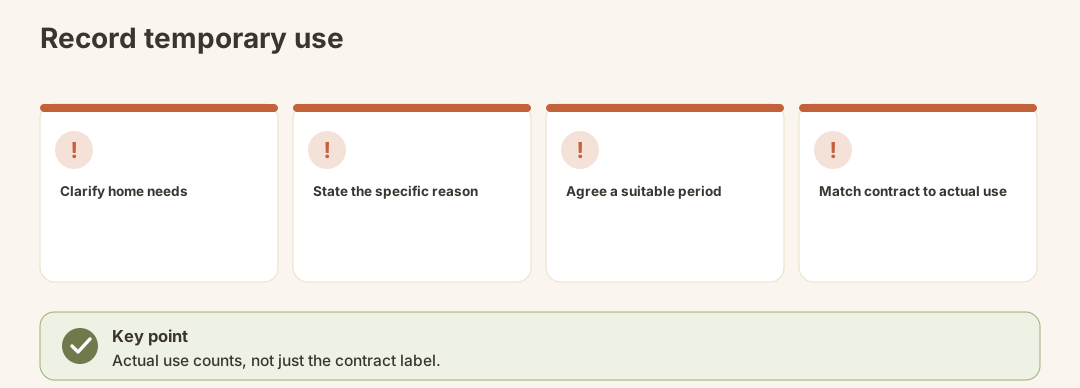
- Clarify your housing needs: Will the property be your permanent home, or do you need it for a limited stay?
- State the specific reason: Record the actual reason for renting the property temporarily.
- Agree on an appropriate period: The start and end dates should match the stated reason.
- Record your other usual residence, if you have one: This information must be accurate and verifiable.
- Set out payments and permitted use: Clearly agree on the rent, deposit, utilities and other charges, and how the property will be used.
- Check the agreement against reality: Do not plan to live there permanently under an agreement labelled seasonal in name only.
For furnished properties in particular, it is worth checking the agreed charges carefully. The label “fixed-term tenancy” alone does not tell you whether water, electricity or other services are included in the rent. The guide to utilities and other charges for a rented property in Spain can also help with this practical check.
What applies to extensions and termination?
With a genuine seasonal tenancy agreement, you should not simply assume that the same rules on continuation and termination apply as for an ordinary residential tenancy. Check what has been agreed about the end of the contract and early termination – and whether the temporary purpose would still apply if you plan to extend it.
Conversely, an end date in the agreement cannot, by itself, override the statutory protections for ordinary residential tenancies simply because the document is headed “fixed-term tenancy agreement”. If your stay develops differently from what you planned, clarify how the tenancy is classified before agreeing to an extension. The guide to terminating a tenancy agreement in Spain covers general questions about the process.
What about supposedly new rules since 2025?
If you come across claims of a “new eleven-month rule” or a blanket ban on seasonal lets, ask for the specific legal provision. For the distinction discussed here, the key question remains: does the property meet a permanent housing need, or is there a genuine temporary purpose? A fixed number of months does not answer that question.
Do not confuse changes to tourist letting with a general change to the rules for all seasonal rental agreements. Whether a listing is for tourist accommodation, a genuine fixed-term let or an ordinary residential tenancy must first be determined from the intended and actual use.
Most common mistakes
- Treating the contract length as proof: Eleven months in the contract do not establish a temporary housing need.
- Stating an arbitrary reason for a seasonal let: Wording in the contract will not help if it has nothing to do with your circumstances.
- Stating your usual residence without checking: It should genuinely exist if the contract relies on it.
- Treating fixed-term letting and holiday letting as the same: They are legally distinct types of use.
- Looking only at the heading: How you actually use the property also matters when determining its legal status.
- Signing an extension without checking: Ask again whether the temporary need originally described still exists.
What happens next?
Before moving in, keep a signed copy of the contract and check that the agreed payments and services are clearly set out. If, contrary to the original plan, the property becomes your permanent home, do not treat that as a mere formality: its legal status may then become decisive.
If you want to live permanently on Mallorca from the outset, look specifically for long-term rentals on Mallorca. If, on the other hand, your stay is genuinely limited, you can find further practical guidance on temporary living on Mallorca.
Checklist before signing
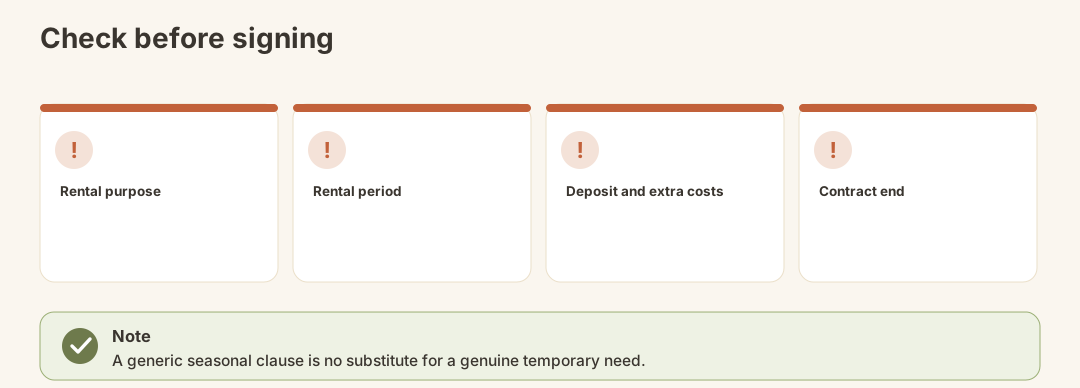
- Is the reason for the temporary stay described accurately and specifically?
- Do the contract start and end dates fit that reason?
- Do you actually have another usual residence, if one is stated?
- Are the rent, deposit and additional charges clearly agreed?
- Have the rules on the end of the tenancy and early termination been clarified?
- Does the intended use match what the agreement says?
- Has it been established whether this is a residential tenancy, a genuine seasonal tenancy or a tourist rental?
Conclusion
A fixed-term rental agreement in Mallorca is not simply a residential tenancy agreement with a shorter title. It is appropriate where there is a genuine temporary need for accommodation and the agreement clearly reflects that need. The key question is therefore not ‘How many months can I sign for?’ but ‘Why am I living here only temporarily – and does that match how I will actually use the property?’
Not legal or tax advice. If there is a dispute about how the tenancy is classified, or before drafting a specific agreement, it is worth seeking individual legal advice.
Official sources
- Boletín Oficial del Estado (BOE) – Ley de Arrendamientos Urbanos (LAU), particularly Art. 2 and 5.
- Govern de les Illes Balears – information on lodging rental deposits with IBAVI.
- Consejo General del Poder Judicial – case law, including SAP Baleares 83/2024 and SAP Baleares 601/2024.