
Integrating in Mallorca as an Expat: What Nobody Tells You Beforehand
You've made the move or are planning to: Mallorca, permanently. The images in your head ring true – the light, the quiet after peak season, the terrace in January. What most expat blogs leave out, however, is that integration on Mallorca takes real work, that loneliness on the island is far from a fringe phenomenon, and that the difference between 'living somewhere nice' and 'truly settling in' often hinges on precisely the topics nobody talks about openly. This guide shows you what lies beneath the holiday feeling – social realities, concrete strategies, honest figures, and the mistakes others have already made before you. You'll learn how to approach the first few months in a structured way, which networks actually work, where the integration risks lie, and what you can do to not just live on Mallorca, but truly arrive.
Would you like to know what a structured integration on Mallorca could look like for you?
- 📩 Submit a personal enquiry — we'll discuss your individual situation free of charge
- Relocation Service Mallorca — professional support from the very start
The first illusion: 'I already know the island'
Many people don't arrive on Mallorca as strangers. They know the island from holidays – perhaps ten or fifteen summers' worth. That creates a sense of familiarity – and at the same time a dangerously skewed perception. As a tourist, you see the island at its best, with anticipation in your heart and the knowledge that you'll be flying home again soon.
As a resident, it's different. Everyday life begins. That means: dealing with authorities in Spanish or Catalan, tradespeople who don't show up, empty streets in Alcúdia in February, favourite restaurants closed from October to April. What feels vibrant in summer can become very quiet in winter – quieter, in fact, than many people anticipated.
Solicitor Dr Reichmann, who has been advising German expats on Mallorca for years, puts it plainly: emotional enthusiasm frequently overshadows strategic and financial considerations. Those who only know Mallorca from holidays systematically underestimate what living there permanently actually means.
Please note: The 'I-already-know-the-island' heuristic is one of the most common reasons why expats find the first few months harder than expected. Consciously plan for an adjustment phase – ideally at least one full year, including a complete winter.
Where you live matters more than you think
The choice of where to live on Mallorca is not a purely lifestyle or budget question. It plays a decisive role in how quickly you find your social footing.
| Region | Expat infrastructure | German-language offerings | Winter life | Notable feature |
|---|---|---|---|---|
| Palma (districts Bonanova, Son Armadams) | very high | high | active | urban living, year-round |
| South-west (Portals Nous, Santa Ponsa, Calvià) | very high | very high | moderate | largest international residential community |
| Puerto Andratx / Andratx | high | high | quiet | exclusive, rather small community |
| North-west (Sóller, Valldemossa) | medium | medium | very quiet | romantic, but isolated in winter |
| North (Alcúdia, Pollença) | medium | medium | very quiet | strong seasonal effect |
| East (Artà, Manacor) | low | low | quiet | authentically Mallorcan, language skills more important |
Families with children and people seeking international schools, English- or German-speaking doctors and a dense expat network are best placed in the south-west of the island. Those who genuinely want to immerse themselves in Mallorcan society, on the other hand, are better off inland or in the east – but will need to invest considerably more effort in learning the language.
The loneliness trap: what nobody says out loud
This section is the most uncomfortable – and probably the most important.
Loneliness on Mallorca is not a marginal phenomenon among expats. It is a documented problem recognised by counselling services and social organisations on the island. The German-speaking Protestant congregation in the Balearic Islands has witnessed over decades how Mallorca can gradually transform for some people from a dream destination into social isolation.
Pastor Heike Stijohann, who has accompanied many such cases, describes the pattern: many couples arrive on the island at retirement age, live well and enjoy their time together – but in doing so fail to learn Spanish and truly integrate into society. People tend to stay within German-speaking circles of a similar age. When a partner then dies or requires care and has to return to Germany, the social network collapses overnight. And the home country they left behind years ago often no longer exists in the form they remember.
The Herztat project, which grew out of an initiative by Roland Werner and the Protestant congregation of Mallorca, was originally founded to connect lonely senior citizens with social contacts. The initiative now faces a broader range of problems: isolation, precarious housing situations and the absence of a social safety net increasingly overlap for those affected.
Loneliness doesn't only affect older people. It is also widespread among younger emigrants — particularly among:
- Remote workers, who spend their days alone at a laptop and have barely any social contact in the evenings
- Partners, who relocated without having their own professional or social footing
- People who deliberately wanted 'distance' from Germany and underestimated how much social energy they would need to build a new life from scratch
The language question: Spanish? Catalan? Or just German?
Mallorca is bilingual: Spanish and Catalan (spoken on the island as Mallorquí) are both official languages of the Balearen. In everyday life, Spanish will get you by almost everywhere. In more rural communities and among older locals, however, Mallorquí is very much present.
| Language | Where important | Minimum level for integration | Resources on Mallorca |
|---|---|---|---|
| Spanish | Authorities, doctor, everyday life, work | B1–B2 recommended | Language schools, UIB, adult education courses |
| Mallorquí / Catalan | Local community, administration, school | A2–B1 as a bonus | Consell de Mallorca, UIB |
| English | Expat networks, tourism, international school | – | widely spoken |
| German | German community, certain service providers | – | very good infrastructure available |
The biggest integration problem that comes up time and again in practice: people live on Mallorca for years without building any meaningful Spanish language skills. They shop at the German supermarket, visit the German-speaking doctor, and socialise exclusively with other Germans. This works on a surface level — but it means remaining permanently disconnected from the island's society.
Anyone who genuinely wants to settle in invests in language. Not perfectly — but functionally. A B1 level in Spanish is realistically achievable within 12–18 months with a regular course and everyday practice.
➡️ More on this: Learning Spanish in Mallorca
Community and Networks: What Actually Works
A strong community is the single most important accelerator during the first few months. It not only saves time when dealing with official matters — it prevents isolation.
German-speaking structures in Mallorca:
- Evangelische Gemeinde Balearen — one of the oldest German-speaking social institutions on the island, with a community centre at the Playa de Palma
- Deutsche Schule Mallorca — an important social hub for families with children
- Facebook groups — several active groups for German residents (membership numbers vary, as of 2026)
- Stammtische — regular informal get-togethers, particularly in Palma and the south-west
- Online communities — for example the Mallorca Expats Skool Community, a structured digital starting point with checklists and the sharing of experiences
Please note: A good community is no substitute for local integration. It is a starting point — not the destination. Those who remain permanently within the German bubble deny themselves the opportunity to truly experience the island.
International networks:
- Palma and the south-west have English-speaking expat groups, international clubs and sports communities (tennis, golf, sailing, triathlon)
- Sports clubs and local clubs (football, cycling, hiking) are often an underestimated path to integration into local society
The First 90 Days: Starting in a Structured Way
The first three months after arrival are crucial — for administrative matters, but also for settling in socially. Those who tackle both simultaneously in a structured manner avoid the most common pitfall: administrative overwhelm combined with social isolation.
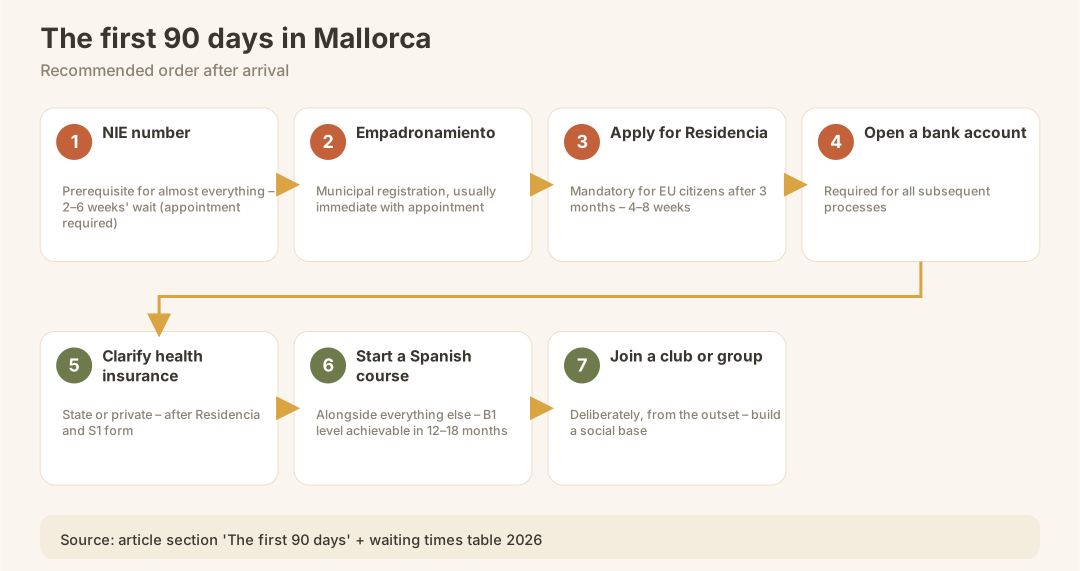
Recommended order of priorities in the first 90 days:
- NIE number — apply for this first (a prerequisite for almost everything)
- Empadronamiento — municipal registration, which unlocks access to many services
- Residencia — apply for this (mandatory for EU citizens after 3 months)
- Bank account — open one
- Health insurance – sort out whether public or private
- Finalise your place of residence and secure your tenancy agreement
- Start a Spanish course – alongside everything else
- Join a club or group – deliberately, from the very beginning
| Step | Responsible authority | Typical waiting time 2026 |
|---|---|---|
| NIE number | Immigration Office (Oficina de Extranjería) / Police | 2–6 weeks (appointment required) |
| Empadronamiento | Ayuntamiento (local council) | usually immediately with an appointment |
| Residencia (EU) | Oficina de Extranjería | 4–8 weeks |
| Health card (Tarjeta Sanitaria) | IBSALUT + INSS | after Residencia and S1 |
➡️ Details on registration: Empadronamiento Mallorca | Residencia Spain
Integration in retirement: particular risks
Those who move to Mallorca in retirement face a specific integration profile. No office, no colleagues, no structure provided by work. This significantly increases the risk of social isolation – particularly if there is no partner, or if a partner is later lost.
The cost of living on Mallorca is, according to various sources, generally lower than in major German cities – which makes the move financially attractive. But money does not solve social problems.
What is particularly important in retirement:
- Before the move Start Spanish classes – not after
- Fixed weekly structure build from the outset: sport, courses, volunteering, community
- Reduce dependencies: Don't rely solely on your partner as the only social contact
- Healthcare sort out before the need becomes urgent
- Consider a fallback plan: What if one of you can no longer live on the island?
The S1 form from the German health insurance fund is the key to accessing state healthcare on Mallorca – it must be applied for before departure and then submitted to the INSS.
➡️ More on this: S1-Formular Spanien | Pflegeversicherung Spanien
Families with children: The fastest route to integration
For families with children, integration is easier in many respects – provided the choice of school is right. Children learn languages quickly, make friends, and naturally draw parents into social structures.
The international schools on Mallorca are concentrated in the south-west of the island (Palma, Portals Nous, Calvià region). Those living in the north or east need to factor in longer school commutes.
Important distinction:
| School type | Language of instruction | Integration into local society | Costs (tendency) |
|---|---|---|---|
| Deutsche Schule Mallorca | German | mostly within the German community | moderate |
| International school (English-language) | English | international environment | high |
| Spanish state school | Spanish/Mallorquí | fastest local integration | free |
| Spanish private school | Spanish | good local networking | medium |
Children in state schools not only pick up Spanish quickly, but also build friendships with Mallorcan families – which naturally introduces parents to local networks. This is the most direct route to genuine integration.
➡️ Further reading: Schule Mallorca Kinder
Work and remote working: who has it easier?
The way you earn your living has a significant impact on your integration.
Employees in local companies have the most natural path to integration: daily contact with colleagues, Spanish as the working language, and local networks. However, getting started is demanding – the Mallorcan job market is tight, salaries are often below German levels, and without a good command of Spanish, opportunities are limited.
Remote workers enjoy maximum freedom – but also maximum risk of isolation. Anyone who sits alone at a laptop all day with no workplace context needs to actively create social structure from outside. This does not happen by itself.
Self-employed people with a local offering require, in the assessment of lawyer Dr. Reichmann, at least: sufficient reserves to cover one year without profit, a good command of Spanish, and a business model that is not aimed exclusively at the German community.
Note: Anyone working in Mallorca or operating as an Autónomo must take their tax obligations seriously. Remote Work Mallorca gives you an overview of the options.
The most common integration mistakes
The same patterns keep emerging in consultations and personal accounts:
| Mistake | Why it happens | Consequence |
|---|---|---|
| Not learning Spanish | German infrastructure is sufficient at first | Permanent dependency, social isolation |
| Staying only within the German bubble | Comfort, fear of the unfamiliar | No contact with island society |
| Choosing a location without infrastructure | Romantic setting trumps everyday practicality | Isolation, especially in winter |
| Not planning realistically for winter | Only experienced the island in summer | Shock from deserted villages, bad weather, depression |
| Not building your own social network | A partner is enough social contact | Total collapse in the event of separation or loss |
| Not thinking through the option of returning | Too painful to contemplate failure | Inability to act in a crisis |
| Underestimating bureaucracy | Preparations are put off until 'after the move' | Delays, fines, stress |
| Starting out naively without capital | Enthusiasm overshadows the numbers | Insolvency, returning under pressure |
What comes next? Integration as an ongoing process
Integration is not a state you can tick off after six months. It is an ongoing process – and it shifts as your circumstances in life change.
After the first year most people have a basic structure in place: established routines, some contacts, a functioning day-to-day organisation. But the deeper layers – friendships with locals, genuine bilingualism, the feeling of truly belonging – often only develop after several years.
What you can actively do in the second and third year:
- Build up your Spanish systematically (aim for level B2)
- Take on a voluntary role or get involved in the local community
- Actively nurture Mallorcan acquaintances and friendships
- Get involved in clubs and associations that are not primarily aimed at expats
- Plan ahead for your own healthcare needs in old age
Anyone planning to stay long-term should also have their legal and tax affairs properly structured – from the Residencia to tax obligations and through to Spanish citizenship after ten years of residency.
Checklist: Taking an active approach to integration
Before the move:
- Start a Spanish course (aim for at least A2 level)
- Choose your location based on everyday practicality, not just holiday atmosphere
- Spend at least one winter on the island deliberately (trial month November–February)
- Consciously maintain your social network back home – even from a distance
- Think through a return option and contingency plan
In the first 90 days:
- Apply for NIE, Empadronamiento and Residencia in the correct order
- Open a bank account and sort out health insurance
- Join a course, club or group
- Enrol in at least one Spanish course
- Find a tax adviser for your first tax return
In the first year:
- Spend a full winter on the island
- Build at least three local (non-German) acquaintances
- Fully resolve your administrative situation (all registrations, tax)
- Establish your own daily routine with a consistent social element
Conclusion
Integration on Mallorca is possible – and can be deeply rewarding. But it doesn't happen automatically. The island offers excellent conditions: a large, active expat community, German-speaking infrastructure, a mild climate and genuine Mediterranean everyday life. What it doesn't offer is a safety net for people who put off the social side of emigrating until later.
The honest message is this: those who learn Spanish, think carefully about where they live and where their children go to school, get involved in local structures from the outset, and develop a realistic outlook on winter, old age and the risk of loneliness – they truly settle in. Those who don't end up living on Mallorca inside a golden bubble that sooner or later bursts.
The best time to address this is before the move. The second best time is now.
Official Sources
- Evangelical Community of the Balearic Islands – German-speaking church congregation with social work services: evangelisch-baleares.de
- Consell de Mallorca – Language Services (Mallorquí/Catalan): conselldemallorca.net
- IBSALUT (Illes Balears Salut) – Healthcare: ibsalut.es
- Oficina de Extranjería Balearen – Residencia and NIE: extranjeria.gob.es
- INSS (Instituto Nacional de Seguridad Social) – S1 form and pension insurance: seg-social.es
- Ministerio de Inclusión, Seguridad Social y Migraciones: inclusion.gob.es